Daily insights for city builders, delivered every morning at 6 AM ET. I’m Brandon Donnelly — a Toronto-based real estate developer and founder of Globizen. I’ve been writing here since 2013.
I am not convinced that autonomous vehicles will make “location” irrelevant.
But I do agree with the following line from this recent Bloomberg article called, A Driverless Future Threatens the Laws of Real Estate.
“The link between property and transport has been perhaps the most durable in human history.”
So this remark by David Silver could very well be correct:
“Real estate might be the industry that is most transformed by autonomous vehicles.”
Technological advances in mobility have historically brought about decentralization because each advance – from streetcars to the automobile – made it reasonable to travel further distances.
Of course, autonomous vehicles are also expected to free up our time and focus while in transit – although trains do that for us today albeit with that pesky last mile problem.
But just like the internet in the late 90′s didn’t make location irrelevant (the opposite appears to have happened), I am similarly unconvinced when it comes to autonomous vehicles. What we consider a desirable location may simply shift.
So this is not to say that the won’t see profound change in our cities. We will. Which is why we’re all trying to get ahead of it.
What Kolko did was take recent population estimates from the US Census Bureau and group them into 6 categories based on the size of the metro and its population density.
By doing this he discovered something that runs counter to the narrative that we are living through an urban renaissance: lower-density suburbs grew faster than urban counties. The former grew at ~1.3% in 2016. And in the south and west, the lower-density suburbs of large metro areas topped over 2% growth.
What gives?
Well, this urban renaissance is lopsided. Here’s an excerpt from the article:
That revival is real, but it has mostly been for rich, educated people in particular hyperurban neighborhoods rather than a broad-based return to city living. To be sure, college-educated millennials — at least those without school-age kids — took to the city, and better-paying jobs have shifted there, too. But other groups — older adults, families with kids in school, and people of all ages with lower incomes — either can’t afford or don’t want an urban address.
Back in 2015, I was interviewed for a documentary called The Millennial Dream. I then completely forgot about it until somebody tweeted it at me yesterday. So the documentary is out – it was released last year – and you can rent it or buy it on iTunes.
The documentary calls into question the [North] American Dream. This idea that you just have to work hard, save up, buy a house in the suburbs, pay off your debt, and then everything will be just fine. For many, that dream is quickly disappearing, if it hasn’t already.
Enter the Millennial Dream. Our economy is changing. Our jobs are changing. Our cities are changing. And by 2020, the Millennial generation is expected to form 50% of the global workforce. What is this generation dreaming about? That is what this documentary is about.
But I should probably stop here because I haven’t actually seen the film. I could be overselling it. I’ll watch it this weekend and then report back. If you can’t see the trailer embedded below, click here.
Here’s what you’ll learn (taken verbatim from edx.org):
The principles of ecodesign and why it is important as a response to the current disorganized urban growth model
Ways to adapt to a changing climate, and ways to mitigate climate change locally
Policies to balance auto and airplane transportation with walking, cycling, transit and high-speed rail
Ways of designing urban and suburban regulations to make cities more livable and environmentally compatible
Strategies for designing and managing the public realm, plus innovative arrangements and processes for implementing ecodesign
The course is geared toward urbanists from all over the world and so the case studies will be global in nature. You can also participate as actively or passively as you’d like. Though, if you’d like to get a certificate, then you need to fully participate.
What immediately stood out for me was the focus on both cities and suburbs. In many ways the suburbs are a more challenging problem to solve. So I hope there’s a good amount of focus on that context.
Beasley was formerly co-director of planning at the City of Vancouver and Barnett is a professor of city and regional planning at the University of Pennsylvania (my alma mater). It should be an interesting course.
As a follow-up to yesterday’s post about fluid labor markets and urban density, I thought I would present an opposing view.
Joel Kotkin is a well known geographer and author. He has published a number of books, the most recent of which is called, The Human City: Urbanism for the Rest of Us. He is also well known as a supporter of the suburbs, which is a somewhat contrarian view in today’s urban-centric world.
Here is a recent interview he did with Aaron M. Renn (click here if you can’t see it below):
One of his messages is that the urban core is great for young people without kids, but that we shouldn’t expect it to serve everyone’s needs and wants – particularly those of families. Families need space and affordability, and urban cores are simply not engineered for that.
Groceries have relatively low online penetration, which makes them great for brick-and-mortar retailers. I’ve written about this topic before in the context of big box stores and online shopping. But I clearly didn’t realize that it had become such a big segment for Walmart.
What’s also noteworthy about grocery shopping though, is that customers appear to be less likely to travel far distances for it, even for lower prices. This means that the radial impact of Walmart the supermarket is less significant and far tighter (~2 miles) than Walmart the discount store. Click here for that study.
This is important because a big catchment area has been central to the Walmart model. They consume cheap land on the outskirts of cities and then offload the transportation costs (indirect costs) to consumers in exchange for everyday low prices (direct costs). Studies show that we, consumers, typically undervalue indirect costs.
Charlie argues in his post that this does not mean that we should write off big box retailing. And I would agree. The Walmart Express concept may have failed, but they are clearly looking for ways to rethink their model. Urban stores will need to form part of that.
That’s the second largest inventory of apartment towers in North America – many or most of which are in car-oriented suburban neighborhoods.
Of course, Toronto continues to build a lot of towers. But this second and current wave of towers is quite different than the last. Virtually all of them are now condo (as opposed to rental) and most are concentrated in central neighborhoods that are generally well-serviced by transit.
This has created a lot of positives for the city. It brought more people into the core to live, which in turn brought more retailers and employers into the city. It has created what I believe is a more vibrant and exciting 24/7 city.
But this return to city centers (as well as the economic spikiness it has created) is now well established both in Toronto, as well as in other cities all around the world. Every real estate conference or panel you go to now talks about Millennials and their desire to be in walkable communities. We got it.
And relatively speaking, those kinds of communities aren’t that difficult to create when you’re infilling city centers. Certainly not at this point. The street grid and bones are usually all in place. And the urban form is often conducive to transit.
The real challenge – and thus opportunity – for Toronto and lots of other cities is how to urbanize the (inner) suburbs and in particular these “towers in a park”. If you follow this space, you’ll know that there’s a lot more that we could be doing.
How do we rethink their relationship to the rest of the city? How do we better connect them through transit? How do we plug them in economically? In my opinion, these are far more difficult tasks. But they’re important ones for the long-term success of our cities.
Last Friday the Financial Post published an interesting article talking about Mattamy Homes and the new office that its founder, Peter Gilgan, is in the process of opening up downtown in the Toronto-Dominion Centre (which just so happens to be my favorite office complex in the city).
At 64 years old, Peter recognizes that his company has changed and the world has changed. He he himself recently moved downtown and now he’s bringing his company with him.
“Our Oakville office [a western suburb of Toronto] is a reflection of what our business was 25 years ago,” he says. “We were a local, west-end Toronto builder. Now we’re the largest home builder in Canada and we’re the largest private home builder in all of North America.”
Come September he will move his finance, legal, IT, human resources and strategic marketing team — about 100 of Mattamy’s 1,100 staff — into the new downtown digs. He wants to attract “the absolute best talent.”
“The young people seem to really want to work down here. So that’s one reason. The other thing is to make sure the business has the capital to move forward and expand. Well, where’s the capital? It ain’t in Oakville.”
This of course isn’t a new thing for suburban homebuilders. Many in Toronto have made the switch – or at least expanded – from suburban houses to downtown/urban condos. And I’m assuming that’s what is going to happen here.
Still, it’s fascinating to see this trend continue. Young people really do want to live and work “down here.”
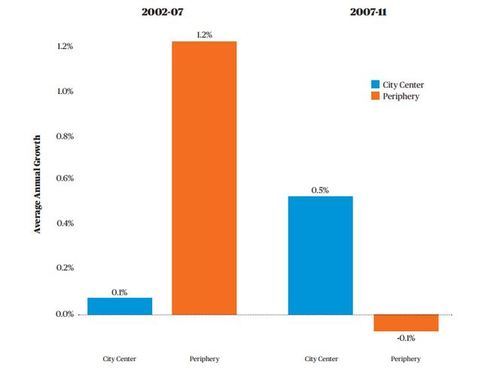
We know that urban living has been seeing a renaissance over the last decade or so, but as recently as 2002 – 2007 (pre-Great Recession), the suburbs and peripheral areas were still seeing significantly higher job growth: 1.2% per year in the periphery versus 0.1% in the city center. The “city center” is defined as a 3 mile radius around the center of the city in this study.
The strength of city centers appears to be driven by a combination of the growing attractiveness of urban living, and the relatively stronger performance of urban-centered industries (business and professional services, software) relative to decentralized industries (construction, manufacturing) in this economic cycle. While it remains to be seen whether these same patterns continue to hold as the recovery progresses, (the latest LEHD data on city center job growth are for calendar year 2011), there are structural forces that suggest the trend of center-led growth will continue.
In some ways, it just makes intuitive sense. People started returning to cities and so the jobs followed (although there were also structural changes to the economy).
The big question, however, is whether this trend will continue? My bet is on yes. What do you think?
The Economist recently published an essay called, A Planet of Suburbs – The world is becoming ever more suburban, and the better for it. The argument is basically that the “great urbanization” that everyone loves to talk about these days is actually a misnomer. From Chicago to Chennai, it’s not the urban core that’s growing. It’s the suburbs. And so what we’re seeing should actually be called the great suburbanization.
The basis for this argument is that wealth fuels sprawl. As people become richer, they naturally consume more of everything – including space. It’s a natural market outcome.
Take for example, the path of many of Toronto’s ethnic groups. In the first half of the 20th century, College Street was the Little Italy. Then it shifted north and St. Clair Avenue West became the more authentic Little Italy. Today, many Italians now live north of the city in Woodbridge. In fact, last weekend I was on St. Clair West and was disappointed to learn that one of my favorite butchers had closed up shop and “moved to Woodbridge.”
However, there are also many supporters of the exact opposite outcome. From Edward Glaeser to Alan Ehrenhalt, many have argued that we’re in the midst of a “great inversion.” The suburbs are no longer a threat to urban centers. It’s the urban centers who are threatening the suburbs. The suburbs are dead. Long live the city.
So which is it?
Well, The Economist does cite two examples where true urbanization is actually taking place. It’s happening in Tokyo and London. In both cases, it’s the city center that is growing the fastest – not the suburbs. The explanation for Tokyo is its aging population. And the explanation for London is its restrictive greenbelt, which effectively stops the possibility of any further sprawl.
Here in Toronto – where there is also a greenbelt in place – we know that the population of the downtown core is growing at an incredible pace. A recent report by the city – called Comprehensive to the Core – revealed that the downtown core is growing at 4 times the rate of the rest of the city.
But what about the suburbs?
If we look at the province of Ontario’s growth projections, it is indeed the suburbs which are expected to grow the fastest up until 2036. Here is a diagram showing percentage growth rates:
In absolute numbers, the city of Toronto alone is expected to add about 0.66 million people between 2012 and 2036, and the suburbs are expected to add almost 1.9 million.
There are a number of potential explanations for this differential, but I think it’s largely because land is cheaper in the suburbs, it’s easier to add new housing supply, population densities are lower, and we’re talking about very different land areas.
The city of Toronto is 630 square kilometers. If you tack on the suburbs, the Greater Toronto Area is 7,124 square kilometers. That means Toronto makes up less than 9% of the total land area. And yet it is expected to contribute 25% of the region’s population growth.
Still, the suburbs are where the bulk of the population growth is expected to happen over the coming decades.
However, the “great inversion” that authors like Alan Ehrenhalt have been talking about should not really be interpreted as the death of the suburbs. What he’s instead talking about is a socioeconomic or demographic reversal: center cities used to be poor and now they’re becoming rich.
What we are seeing is a reversal in which the words “inner city,” which a generation ago connoted poverty and slums, [are going to mean] the home of wealthier people and people who have a choice about where they live, and the suburbs are going to be the home of immigrants and poorer people. And Census figures show that that’s taking place.
In this context, we are still living through the great urbanization. We’re seeing a shift in consumer preference and a shift in where wealth is choosing to locate. That’s a profound change.
And while we’re obviously still suburbanizing, I don’t agree that we’re better for it. In fact, left unchecked, this demographic inversion could actually prove to be quite damaging to our suburbs.