Daily insights for city builders, delivered every morning at 6 AM ET. I’m Brandon Donnelly — a Toronto-based real estate developer and founder of Globizen. I’ve been writing here since 2013.

Tag: suburbs

  • The war on the car

    image

    In today’s post I’d like to focus on the second tweet I embedded in yesterday’s piece about downtown Toronto. Specifically, the fact that almost 75% of downtown residents walk, cycle, or take transit to work, leaving drivers firmly in the minority.

    For me, this then makes me question whether or not we’re optimizing well enough for the majority. However, it’s often not that simple. And that’s because the downtown core is clearly regional in its draw, and the further you move out from the downtown core, the more the modal split flips. In the suburbs, driving is obviously the majority.

    And herein lies the tension and the reason for all this “war on the car” rhetoric: We have a downtown core with completely different mobility preferences than the rest of the region.

    But as Toronto continues to intensify and grow (the population of the Greater Toronto Area is projected to reach almost 9 million by 2036), I truthfully don’t know how we could reasonably expect to (efficiently) move that number of people in private cars. I’ve just never seen it done before.

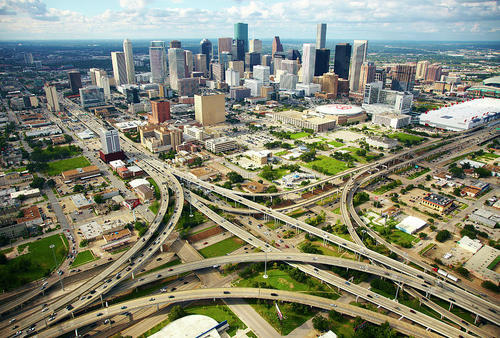
    Some people think that if we simply got rid of all those damn streetcars on our city streets, that we’d be doing a lot to eliminate traffic congestion. But it’s not that simple. The Highway 401 here in the city is already 18-lanes and one of the widest in the world. And yet it’s perpetually clogged. No streetcars there.

    So I look at this tension as a growing pain. Sooner or later I think we’re going to realize that this war should really be a war on inefficiency. How do we move lots of people around big cities while minimizing waste, maximizing economic output, and enhancing quality of life?

    Now that’s a war worth fighting.

    Image: Helibacon
  • Are the suburbs really cheaper?

    image

    Smart Growth America released a report this month called Measuring Sprawl 2014. It’s an update to a report they did back in 2002 and it’s worth a read if you’re into urban planning. You can download it here

    The report looks at 221 metro areas in the US and develops a “sprawl index ranking.” The higher the number, the more compact the metro area. Not surprisingly, New York tops the list with San Francisco coming in second. But more interesting are the correlations they discovered. As you go up their sprawl index ranking (that is, as the cities become more compact), they found the following:

    • People have greater economic opportunity in compact and connected metro areas.
    • People spend less of their household income on the combined cost of housing and transportation in these areas.
    • People have a greater number of transportation options available to them.
    • And people in compact, connected metro areas tend to be safer, healthier and live longer than their peers in more sprawling metro areas.

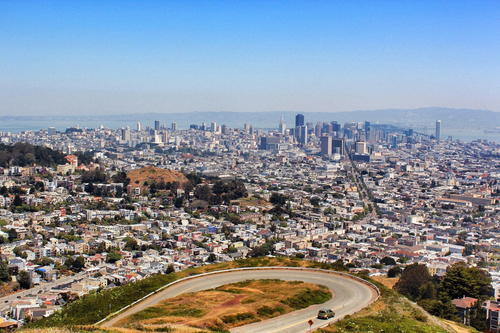
    If you’re a follower of smart growth, then some of these will sound familiar. But they’re worth repeating and I’d like to focus on the second one for a minute (not to undermine the importance of living longer). Conventional wisdom dictates that as you sprawl out from the center of a city, the cost of housing drops. And indeed, that’s what they found. There’s a correlation between density and housing costs, and more compact cities generally have more expensive housing.

    However, they also found that the percentage of income spent on transportation is much less in compact metros:

    Each 10 percent increase in an index score was associated with a 3.5 percent decrease in transportation costs relative to income. For instance, households in the San Francisco, CA area (index score: 194.3) spend an average of 12.4 percent of their income on transportation. Households in the Tampa, FL metro area (index score: 98.5) spend an average of 21.5 percent of their income on transportation.

    But here’s where it gets interesting: they found that transportation costs dropped faster than housing costs increased as metro areas became more compact. Meaning if you consider both housing costs and transportation costs in aggregate, it’s actually cheaper to live in more compact areas. From what I can tell, they’re also only considering direct transportation costs and not indirect costs such as the time people waste sitting in traffic. 

    Either way, it’s something to consider the next time you’re thinking about where to live and how much you should be willing to spend on housing. That cheaper suburban home may not be as cheap as it seems.

    Photo by Aythami Perez on 500px

  • Should we go backward to go forward?

    Robert A.M Stern–who is a fairly traditional architect (stylistically) and Dean of the Yale School of Architecture–recently coauthored a book called “Paradise Planned: The Garden Suburb and the Modern City.” It’s over 1,000 pages. I haven’t read it yet and I likely won’t, but I did just read this op-ed piece in the New York Times by Allison Arieff and I wanted to comment.

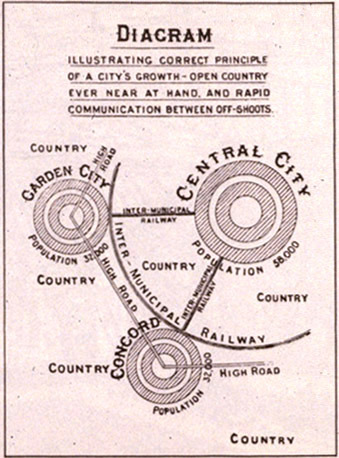
    In the book, the authors argue that the solution to our suburban problems is to return to a “tragically interrupted, 150-year-old tradition” known within urban planning and architectural circles as the Garden City movement. Here’s how Arieff describes it:

    The garden suburb is — because it still exists in many places — a planned, self-contained village located usually outside a major city. Ideally, it features a variety of housing types, though by variety, we’re talking single-family homes and a few low-rise multifamily buildings.

    In contrast to the suburbs we’ve come to be most familiar with, these featured homes are situated in a comfortably dense, highly walkable environment designed around a public center or square.

    But in addition to being more dense and walkable, the big difference for me is that the garden city (to use the original terminology) was initially intended to be self sufficient economically–rather than just serve as a bedroom community for the central city.

    It was all incredibly rational. As one garden city reached its population and employment projections, the next garden city node would be created and connected to the network via road and rail. And by using land relatively intensely, it meant that more of the countryside could be preserved as undeveloped land.

    But while I would agree that the suburbs aren’t going to go away (I’ve said this before) and that we should be making them more dense and walkable, the book (well, the article) got me wondering to what extent the Garden City model applies from an economic standpoint. Should we be trying to create poly-centric cities with tidy little self-sufficient pockets of employment? Or should everything primarily feed a central city?

    The irony of the decentralized information economy is that it appears to be encouraging centralization across and within cities. But even before the rise of the internet and other technologies, there have always been real economic benefits to firms clustering in cities. Known as agglomeration economies, it’s one of the reasons cities even exist in the first place.

    Certainly, there’s a lot we can learn from the way we used to build and plan our cities and towns (they were designed around people as opposed to cars). But something doesn’t sit right with me in terms of the way the Garden City movement thinks about cities, economically. It seems idealistic.

  • The suburbs, they are a changing

    Earlier today, a good friend of mine shared this New York Times article on my Facebook wall. It talks about how some suburbs are taking action to try and curb the exodus of young people to cities. They’re doing things like making themselves more walkable and building bike lanes. I thought it was an interesting article.

    Of course, it’s not just young people moving from the suburbs to the city. It’s also a case of young people living in the city and never leaving for the suburbs–which they have traditionally done. 

    I’ve talked about this topic a lot here on ATC, but I wanted to share this article because I think it’s one thing to talk about how city centers are on the rise and it’s another thing to talk about how suburbs are starting to take notice and take action to curb their (potential) decline.

    I say potential because some would argue that the suburbs aren’t necessarily on the decline–we just have a scenario where young people are delaying that period of their life, either for economic reasons or for personal/lifestyle reasons.

    I, however, would disagree. I think the growing preference for cities is a real societal shift. That doesn’t mean I think the suburbs are going to die though. There will likely always be a segment of the market that prefers that housing type (or some variation of). I just think the suburbs aren’t going to be what they once were to previous generations.

  • Car as prosthetic

    I spent a lot of time in the suburbs over the holidays and it got me thinking.

    For all the talk about intensification here in Toronto, adapting our car dependent suburbs to become, well, less car dependent is going to be an enormous challenge. Once you’ve built out an area around the car, it’s almost impossible to go back. 

    One of the biggest challenges is going to be figuring out how to turn the suburbs from inward to outward. If you think about it, the suburbs are an incredibly inward type of development pattern.

    Retail plazas typically have their entrances—not off main streets—but off internal parking lots. And residential areas often have backyards facing the main streets because nobody wants a house fronting on a major thoroughfare. These are the design principles we’ve used to create our suburbs.

    But the result is that we’ve created environments that are inhospitable to pedestrians. What enjoyment would you get out of walking along a street where everything has its back turned to you? This is the anthesis of animated street life. And in this case, Margaret Thatcher would probably be right: I would feel like a failure taking the bus.

    To compensate for this kind of environment, we’ve made it virtually mandatory to have a car. It’s the only reasonable way to get around. Writer Rebecca Solnit put it best when she said:

    “In a sense the car has become a prosthetic, and though prosthetics are usually for injured or missing limbs, the auto-prosthetic is for a conceptually impaired body or a body impaired by the creation of a world that is no longer human in scale.”

    And that’s precisely it. We built around the car and not around people. And in doing so, we made ourselves dependent. I don’t know about you, but there’s something liberating about being able to walk to all the things I commonly want—food, money, coffee and so on. But maybe that’s just me.

  • The suburbs aren’t dead; they’re just growing up

    At this point, it’s well established that more and more people are favouring downtown urban centres over suburbs. Eric Jaffe from Atlantic Cities, put it this way:

    “Population growth is on the rise in city centers (though total population still favors suburbs), Millennials seem less keen to drive than their parents were, urban home values are increasing faster than suburban ones. The list can and does go on.”

    As one Toronto columnist put it, generation Y is now keen to live in apartments the size of their childhood suburban bedrooms so that they can be closer to amenities.

    So what does this mean for the suburbs?

    Some believe that this means the suburbs are dead, or dying. But Leigh Gallagher, in her new book “The End of the Suburbs”, argues that it’s not the end of the suburbs. It’s simply the end of the suburbs, as we know them.

    That is, the suburbs, which functioned arguably quite while for a period of time, have now become a victim of their own success. They’ve become too big, to the point where they now isolate people away from their social networks and places of employment.

    Gallagher believes that the future will be “urban burbs.” Burbs that are more dense, walkable and transit friendly. And I would agree. But I would add that I don’t think all suburbs will make this transition successfully. Like with anything, there will be some that pull it off and some that fail.

    The car had a devastating impact on our cities and it’s not going to be easy to reverse what has been done. But we’ll need to figure it out.