Daily insights for city builders, delivered every morning at 6 AM ET. I’m Brandon Donnelly — a Toronto-based real estate developer and founder of Globizen. I’ve been writing here since 2013.

Tag: suburbs

  • Les banlieues of Paris

    One of the things that I notice about people from Paris is that they’re always very clear on whether they live in Paris or outside of Paris in the banlieues (the suburbs). They’ll say things like, “No I don’t live in Paris. It’s too expensive. I live in such and such a place in the banlieues.”

    I suppose this isn’t entirely different than saying you don’t live in New York, you live on Long Island, or you don’t live in Toronto, you live in Burlington. Except that there seems to be a greater sense of division when they say it here in Paris (although it’s entirely possible that it could be my rusty French that is leading me to believe this).

    There is a sense that you’re either inside the Boulevard Périphérique, or you’re really not. And this seems like a shame. Cities regions care less about administrative borders and more about the movement of people, ideas, and goods.

    And as much as I love Paris (the central part), it is, from what I can tell, far more static than some of its surrounding areas in terms of new people (immigration), new buildings, and probably new ideas.

    Paris can sometimes feel like a perfectly curated museum. It’s beautiful and precious and should not be touched — please stand behind the ropes mesdames et messieurs. But perhaps it’s time to equally celebrate les banlieues and recognize what they have to offer.

  • Economic update with Benjamin Tal — get ready for the second half of this year

    Benjamin Tal — CIBC’s Deputy Chief Economist — is seemingly everywhere. And earlier today, he was delivering an annual economic update at an online event hosted by Brattys LLP (our condo lawyers) in partnership with CIBC. Below are a handful of slides that I found interesting and that I tweeted out during the event.

    All of our personal risk curves changed during this pandemic. When the first wave hit, we all had no idea how bad this was going to be and what to expect. And so we all stayed home and washed our hands and our groceries. That changed with each subsequent wave. And now we’re all ready and anxious to be done with this.

    Tal referred to this as one of the most unequal recessions we’ve ever seen. If you had a high paying job, you probably kept it. And after you stopped spending money on eating out, entertainment, travel, and watching the Leafs lose in person, you likely had a meaningfully higher savings rate. That has created some $100 billion of “excess cash” sitting on the sidelines.

    This cash wants to be spent and I think we’re going to see it flying out the door in the second half of this year. Much of it will also flow into services, which should help to prop up the hardest hit segments of the economy. So while there has been some real pain, many are expecting the economy to snap back pretty quickly. Get ready for some euphoria in the second half of this year.

    This last slide is particularly relevant to the kind of things we often talk about on this blog. It is essentially showing the increased demand for housing outside of the city during this pandemic (as of Q4 2020).

    A flatter line (Vancouver, Calgary) indicates that year-over-year price growth was less affected by “distance from the city center.” On the other hand, a steeper line (Toronto, Ottawa) indicates that price growth was stronger the more you moved outward from the core. In the case of Toronto, it was nearly 20% YoY when you got about 60-70 kilometers out of the city.

    But it’s important to keep in mind that the core of Toronto still grew at about 5% year-over-year. About the same as in Vancouver. And in the case of Ottawa, the number looks to be about 17.5% in the city center. These are meaningful numbers and not the kind of symptoms you would expect to see from downtowns in the middle of a death spiral.

    I would argue, as I have many times before, that this last chart is the result of short-term phenomena. I bet we’ll see a number of these pitches reverse by the time Q4 2021 arrives.

  • Moving from the city to the suburbs and back

    This is an interesting story about a Toronto couple who got married about 20 years ago, initially lived in a small downtown condo, and then decided it was “time to adult” and move to the suburbs. They bought a 3,200 square foot home in Markham and lived there for a number of years. It had a lawn, a garage, and all sorts of other suburban comforts. But eventually they realized that they had made a mistake. They preferred the conveniences of city living over the amenities of the suburbs. Living in the city was simply better suited to their lifestyles. And so they sold their house, bought an epic 2,100 square foot penthouse in the Shangri-La Residences — which just so happens to be one of my favorite buildings in the city — and hired the design firm NIVEK REMAS to completely redo it. I think their new home turned out great and maybe you do too.

  • Raising kids in the city

    This week, Matthew Yglesias of Vox makes the case for raising kids in the city. Spoiler: Driving sucks. Cities have lots to do. And parks can be better than lawns. However, he also talks about why this proposition is becoming increasingly difficult for many families. Here are a couple of excerpts:

    Now the father of a 4-year-old son, I live in Washington, DC, a city that is, mercifully, marginally more affordable than New York, and I wouldn’t want to raise a family any place other than the city.

    But unfortunately, families are disappearing from American cities even as city living in general has become fashionable again for those who can afford it.

    Children cost money. And they take up space. And urban space has become much more expensive — repelling growing families. This suits the proclivities of smug suburbanites just fine, but as someone who grew up in a big city in the 1980s and 1990s when city living was both less fashionable and more affordable, it seems like a tragedy to me.

    I didn’t grow up in the city. Though, I spent time in apartments and other higher density housing. And I don’t have kids. But I find this topic interesting. It’s also an important one. I don’t believe that the childless city is a good thing.

    For the full article, click here.

  • Driving distance between two adjacent homes

    I came across this tweet by Sean Galbraith last night. You will probably need to click through to see the full extent of the photos. It is a series of images showing two back-to-back houses. The lands touch one another. But if you were to drive from one house to the other, it would take you about 18 minutes because of the area’s road network. Approximately 7.1 miles.

    This, of course, is far from urban. It would take over two hours to walk this same distance (assuming an average walking speed of 1 mile every 18 minutes). If you’re an urbanist, this is surely galling to you. But I think it’s also important to remember that this is, at least partially, a result of a consumer preference for dead end streets that limit through traffic.

  • From urban to suburban

    The US Census Bureau just released its population estimates for 2018. As has been the case in previous years, the counties that added the most people (largest numeric growth) are all located in the south and west. Texas holds 4 out of the top 10 spots.

    Here is a Tweetstorm by Jed Kolko, the chief economist of Indeed, with a couple of graphs summarizing the findings (click through to see the full thread):

    Despite the narrative that people are returning to cities and urban centers, the data is pretty clear: the flow of domestic migration within the US is largely from dense urban counties to more suburban — and affordable — ones. Big cities are expensive.

  • Current state of autonomous vehicles

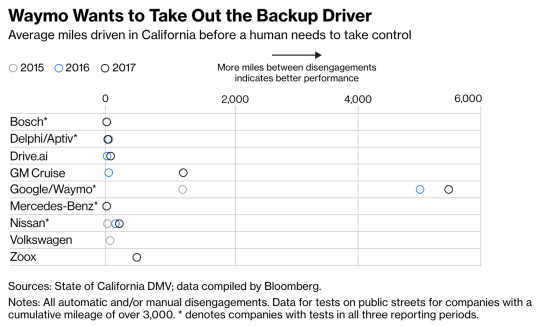
    This is an interesting piece by Bloomberg summarizing the current state of autonomous vehicles and in particular the (supposed) dominance of Waymo (Alphabet’s self-driving vehicle arm). Many believe they will be the first real entrant into the market.

    The company is currently running an “Early Rider” program in 25 cities. But its Phoenix trials are the furthest along, which isn’t at all surprising given the city’s car orientation and suburban fabric. Already Waymo has started offering passenger rides without a backup driver in the car.

    Overall, the company has come forward with four main business priorities:

    • Ride hailing
    • Trucking
    • Personal vehicles
    • Public transit

    But I still think that we’ll see a blurring of these priorities, if not outright cannibalization, as the cost per mile plummets. I mean, why own a personal vehicle if it is flat out easier and cheaper to just hail a robotaxi? 

    Here is an excerpt from the article talking about pricing:

    Tasha Keeney, an analyst at ARK Invest, says that Waymo could choose to offer an autonomous ride-hailing service today at around 70 cents a mile—a quarter of the cost for Uber passengers in San Francisco. Over time, she says, robotaxis should get even cheaper—down to 35 cents a mile by 2020, especially if Waymo’s technology proves sturdy enough to need few human safety monitors overseeing the autonomous vehicles remotely. “You could see software-like margins,” Keeney says.

    I can’t wait to be driven around for cents on the dollar. Click here to read the full article.

  • Urban metabolism

    I spent this morning in the suburbs bouncing around to a few different meetings. I then came back downtown so that I could get some actual work done in the office. And then after that, I was around downtown getting a bunch of different things done.

    I am mentioning this to you all because today I was reminded of how different the metabolic rate can feel in the city compared to the suburbs. There are even studies suggesting that people walk faster in larger cities.

    Some businesses, of course, require a lot of space and the economics simply do not work in the core of the city. We all get that. But if you’re competitive advantage is human capital, then this is something to think about.

    I feel like I spent most of my morning driving around, which I’m not complaining about, except that I could have probably had 3x as many meetings in the city during that same period of time. If you multiply that out over time, then we’re talking about a material spread in overall productivity.

    And we haven’t even touched on those fortuitous urban encounters, which do happen and do provide all sorts of benefits. As much as we’re all connected like never before – through things like, well, this blog – there’s nothing like shaking somebody’s hand and looking them in the eyes.

  • The real reason we want entertaining spaces

    According to a recent study out of UCLA, which I discovered via this Curbed article, American families tend to spend most of their time at home in informal, rather than formal, spaces. That means more time in the kitchen and family room, as opposed to in the living room and formal dining room. 

    I’m sure this comes as no surprise to all of you. Was a study necessary? Maybe you even have plastic on the furniture in your formal rooms because, you know, they’re reserved for “entertaining.” The reason I mention this is because I thought it was funny how Kate Wagner describes this phenomenon in her Curbed article:

    The ironic inefficiency of hyper-exaggerated high-end entertaining spaces belies a truth: These spaces aren’t really designed for entertaining. They’re designed for impressing others. And not just impressing others: After all, it’s general politeness to compliment a host on their home no matter how impressive it is. The real goal, deeply embedded in these oversized, over-elaborate houses, is not for guests to say, “Oh wow, this is nice,” but to make them think, “Oh wow, this is nicer than what I have and now I feel jealous and insecure.” In true American irony, these giant “social” spaces (and McMansions in general) are birthed from a deeply antisocial sentiment: making others feel small. Considering that so often our guests are members of our own family adds another layer of darkness to the equation.

    For those of you who aren’t familiar with Kate Wagner, she is the founder of McMansion Hell, which is a hilarious website dedicated to blasting McMansions. A pejorative term for houses that privilege raw size and the appearance of wealth over quality. Now that you know that, I am sure the above blurb makes a lot of sense.

  • Shift toward the center

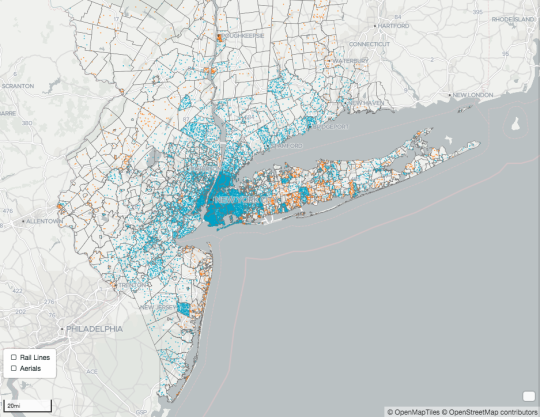
    The New York City Department of City Planning has a very cool “metro region explorer” online that allows you to explore population, housing, and employment trends in the tri-state NYC Metropolitan Region. Start here and then click on “Learn More” to cycle through the slides and data.

    One interesting takeaway is that population growth continues to centralize in the region’s core. Since 2010, 60% of the region’s population growth has taken place in the five boroughs of New York City, and in particular it has occurred in neighborhoods with strong rail transit.

    There has also been a slowing in terms of the number of residents leaving New York City. Historically, people moved to the city in their 20′s and left in their 30′s. That trend is slowing.

    I suspect this has to do with a combination of factors, including the shift toward a city-centered knowledge economy; the desire for walkability and urban amenities; the phenomenon of people getting married later in life (if at all); and so on.

    The people who do leave the city are also more likely to leave for other parts of the U.S. than other parts of the region. This has led to a decline in the number of prime age (25-54 years old) workers in the suburbs.

    Check out the Metro Region Explorer, here. There’s a lot of good stuff in there.