Daily insights for city builders, delivered every morning at 6 AM ET. I’m Brandon Donnelly — a Toronto-based real estate developer and founder of Globizen. I’ve been writing here since 2013.

Tag: startups

  • The new decentralized workforce

    A few weeks ago the WSJ published an article about Toronto’s growing tech talent pool, arguing that its base now rivals the top US cities, but that it may not be an entirely good thing for the city’s ecosystem. I wrote about it here.

    This morning venture capitalist Fred Wilson published a post on his blog talking about the necessity of scaling tech companies in lower cost locations. It’s a good follow-up to the above article/post.

    Here’s an excerpt from Fred:

    Last week I heard some shocking numbers about salary levels for certain kinds of engineers in the bay area. I checked them out with a few of our bay area portfolio companies and they were more or less corroborated.

    The tight technical labor markets in the bay area, NYC, and a number of other regions in the US are making it hard to scale software businesses without burning massive amounts of cash.

    He goes on to argue that (startup) companies now need to think about scaling in other/remote locations sooner than they ever have before — basically as soon as the company hits about 50 engineers (or 100-200 employees).

    Many companies are now working with a distributed workforce. Supposedly 2/3 of the global workforce now spends at least one day of the week working remotely. I almost never work from home, but I do get how this is possible.

    So what is happening is that engineering talent is spilling over into secondary markets out of necessity. There’s an economic imperative to colonize. But I would imagine that, at least initially, most of the economic benefits accrue to the colonizer.

    Photo by NASA on Unsplash

  • Is Toronto’s tech ecosystem too US-centric?

    The Wall Street Journal’s recent piece about “Silicon Valley invading Toronto” is, in my view, describing a generally positive outcome.

    We are one of the largest cities in North America (the exact ranking depends on where you draw the urban boundaries).

    We have more enlightened views around foreign and high-skilled workers (I was given a short window in which to leave the US after I finished my first graduate degree there).

    And we have a large and highly educated pool of tech talent (the salary differential discussed in the article looks to be, at least partially, a result of the weaker Canadian dollar).

    US companies are gobbling up office space in Toronto. And presumably, this is one of the reasons why 139 new flights were added between Toronto and Francisco over the last two years. (Source: WSJ)

    However, I do agree with the remarks from people like Jim Balsillie (Blackberry) and Harley Finkelstein (Shopify) that a better outcome would be the creation of more massively successful Canadian tech companies.

    As Finkelstein points out, there’s a big difference between 100,000 square feet of space for the HQ of a new and growing Canadian tech company and 100,000 square feet for a new branch or satellite office.

    The stats we read in the papers about the number of tech jobs being created in Toronto generally don’t speak to composition. Where in the value chain do these people sit? Where is the value accruing?

    The intellectual capital is here. And we should be doing everything we can to foster and finance new homegrown ideas and businesses.

    Image: WSJ

  • WordPress buys Tumblr for (only) $3 million

    Last week it was announced that brandondonnelly.com/ (which is what I use for this blog) had purchased Tumblr for around $3 million. This is, of course, after Yahoo had purchased it for $1.1 billion in 2013 and later wrote it down, having never figured out how to monetize it. Yahoo lost its shirt on the investment. I am sure you’ve probably seen some of the headlines and searing commentary online:

    I used Tumblr every day for more than 5 years. I started this daily blog on it because I had already been using it to share and collect photos. At one point Tumblr had more active users than Instagram and Pinterest combined. But eventually it lost its way. Yahoo (and later Verizon by way of its acquisition of Yahoo in 2017) didn’t know what to do with it.

    And so at the beginning of this year I said goodbye to Tumblr and switched this daily blog over to WordPress. A big part of that decision had to do with the fact that Tumblr was never really designed for long-form blogs like this one and its mobile support was even more appalling for this use case. It was impossible to write on an iPad. Switching was the right decision. I should have done it sooner.

    But now Tumblr is owned by brandondonnelly.com/. At $3 million, it feels like they're almost starting again from scratch. Maybe they'll figure Tumblr out. Or maybe they won't.

  • Shoppable videos

    Sometimes I think that writing a blog has become a bit old fashioned. I should probably be making videos. But the reality is that I like writing. Getting up in the morning, reading, having a coffee, and writing my thoughts down is a ritual that I really enjoy. Making videos is also a bigger time commitment, and I would rather focus my energy elsewhere.

    But there’s no question that user-generated videos have and will continue to change ecommerce and many other aspects of society. This recent blog post by Connie Chan and Avery Segal called, “Ecommerce as video’s killer app,” is a perfect example of that. In it, they talk about a handful of Chinese companies that are pioneering “shoppable videos.”

    What these platforms are doing is allowing consumers to buy things natively within their app and through a “video-centric checkout flow.” In other words: watch a story being told (from an individual, as opposed to a company); become interested in a particular product or service; and then immediately purchase it with only a few taps.

    Another use case, which I think many of you will find interesting, is the creation of “crowdsourced video city guides.” Instead of checking for hotel reviews on TripAdvisor, simply find someone who has already vlogged a stay and book it that way. The individual who uploaded the video will then earn a commission.

    This behavior already exists. Discovery and buying decisions — for many products and services — have moved to social platforms. Just today a friend reached out asking me about a bar that she saw on my Instagram stories a few weeks. She’s planning to go next week. Now where’s my commission?

    Shoppable videos are a natural extension. They may also lower the barriers to participation. And so maybe I will end up making videos, after all.

  • Software developers are half of the homebuyers in San Francisco

    A couple of months ago I wrote about the relationship between IPOs and home prices. It was in response to the current wave of tech companies — most of which are headquartered in San Francisco — that have gone public or are expected to go public this year (2019). What impact will this have on the city’s housing market?

    I cited this academic study on the topic, which already discovered a “positive and significant association between local house price changes and firms going public.” But today I stumbled upon another interesting study by a San Francisco real estate agent, name Deniz Kahramaner, who happens to also be a Stanford-trained data scientist.

    What Kahramaner wanted to figure out was, who tends to buy residential real estate in San Francisco?

    So he started with title data and then scraped the internet to try and match up individual buyer names with specific companies and industries. Since not everyone has some sort of public profile and because real estate is sometimes held within a company, he was only able to traceback about 55% of home purchases in San Francisco last year.

    Still, the data looks pretty clear. About half of the homes bought in 2018 were by individuals whose employment has roots in “software.” The next biggest buyer segment was “finance.”

    The other interesting thing about this data set is that it shows where people have been buying (at least last year). Historically, the north end of the city has been the wealthiest, but the above data shows things moving in a southeasterly direction. Though, it remains to be seen what all of this will look like when the dust settles after this current crop of tech IPOs.

    Chart: The Atlantic

  • One great big exit (not the Brexit kind)

    Wired’s oral history of how the London startup scene came to be is a good reminder that, typically, a city needs some great big exits (acquisition or IPO) to really kickstart an ecosystem. In the case of Silicon Valley, you could perhaps trace things back to Fairchild Semiconductor (1950s). But a more recent example of this phenomenon would be the PayPal Mafia, whose members have gone on to found Tesla, LinkedIn, YouTube, and other companies that you may have heard of.

    Put simply: success begets success. When a startup does really well and the founders and employees of that company get rich, it is likely that many will go on to found/fund other successful companies in that same city. In the case of London, that catalytic startup was arguably Skype (at least according to Wired). Microsoft acquired the company in 2011 for $8.5 billion, giving birth to the Skype Mafia. Of course, that wasn’t the only ingredient, but it sure helped (excerpt from Wired):

    Since 2008, according to data compiled by Dealroom.co, the UK has created 60 unicorns (tech companies valued at $1bn or more) – 35 per cent of the 169 created across Europe and Israel. In the past three years, the UK has created more unicorns (25) than France, Germany, the Netherlands and Sweden combined (19). And London has produced 23 unicorns with a combined value of $132bn, compared with Berlin’s eight, worth $32bn.

    The world has changed since Skype was founded. It’s now cool to be doing a startup. But given that every city seems to be trying to establish a thriving startup scene, I think it’s valuable to point out just how important a single big exit can be, not just for the people within the company, but for the broader city. Easier said than done, right?

    Photo by Benjamin Davies on Unsplash

  • Uber to go public in 2019

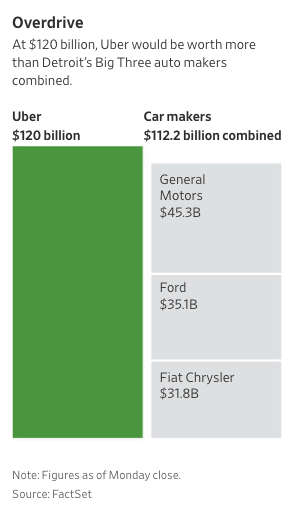
    Last week it was announced that Uber had confidentially filed for an IPO (right after Lyft did the same). It could go public as early as Q1 of next year. And supposedly, a valuation of $120 billion is being tossed around. The company last raised money in August of this year (from Toyota) at a $76 billion valuation.

    image

    Here are a few other interesting figures from a WSJ article published in the fall:

    – Uber has indicated that it doesn’t expect to be profitable for at least another 3 years. This year it is expected to hit between $10 and $11 billion in revenue, compared to $7.78 billion last year.

    – First Round Capital invested about $1.6 million in Uber’s first two fundraising rounds (2010 and 2011). If the company does in fact reach a valuation of $120 billion in the public markets, that early investment will be worth $5 billion. (First Round sold some of their shares to SoftBank in January and I’m not sure if the above figure accounts for that.)

    – Over 50 companies have invested in Uber since its founding, not including a slew of individual investments from people like Jeff Bezos of Amazon.

    On a related note, Fred Wilson, who is far more knowledgeable on this topic than I, recently published a post talking about the relationship between the private and public markets and what could happen to (tech) valuations in 2019. 

    It’s a good follow-on read to the above.

    Figure: WSJ

  • International Blockchain Real Estate Association

    I was at a Proptech dinner earlier this week (graciously hosted by Venturon) and I was introduced to the International Blockchain Real Estate Association (also known as IBREA). I feel like I should have known about this group. They have over 5,000 members and host an annual summit focused on blockchain + real estate.

    They have several videos from this year’s summit up on their website – everything from blockchain for titles to the tokenization of real estate assets. There are also a number of industry working groups that have been set up, which bring companies together around specific problems and ambitions (such as, creating a universal property identifier).

    To get you started, here is Blockchain Real Estate 101. If you can’t see the video below, click here.

    [youtube https://www.youtube.com/watch?v=1WcLOcWyfHk&w=560&h=315]

  • Create things people love

    I just finished listening to this podcast about venture capital and consumer products. One of the underlying questions is whether we are currently in a “consumer downturn.” Rebecca Kaden of Union Square Ventures (USV) talks about the importance of “platform shifts” for venture returns. These are moments where a new technology hits the marketplace and there’s a corresponding mass consumer adoption. When and where will that next shift occur? Maybe it’ll be in real estate.

    I like the discussions at 10:00 and 13:50. The first deals with the importance of non-paid customer acquisition strategies for consumer products. Rather than relying on bought attention, you really need organic growth strategies, which is often an indication that people are passionate about your product. This is arguably more important when you’re fundamentally reliant on massive growth/scale, but whether we’re talking about software or a home, I still believe it’s paramount. Create things people love.

    The second point is about commerce, Amazon, and how USV avoids investing in companies that are unlikely to ever win against Bezos. Kaden’s position is that Amazon’s advantage is and has been more executional than structural. They are simply really good at doing things better. But Amazon wins at logistics, speed, and value. They are not as focused on experience, entertainment, and discovery. And people still want that.

    I’ll stop there. If you can’t see the podcast below, click here.

    [soundcloud url=”https://api.soundcloud.com/tracks/507691569″ params=”color=#ff5500&auto_play=false&hide_related=false&show_comments=true&show_user=true&show_reposts=false&show_teaser=true&visual=true” width=”100%” height=”300″ iframe=”true” /]

  • What motivates us

    Earlier this week it was announced that Instagram founders Kevin Systrom and Mike Krieger have resigned from the company. Supposedly it had to do with weakening independence from the parent company, Facebook. But I’m not really in a position to comment on the specifics.

    Fred Wilson wrote a good post about the news this week. The point he makes is that it is extremely rare for founders to stay on, at least for extended periods of time, after their company has been acquired. So it is actually quite remarkable that Instagram’s two founders stayed on for 6 years.

    But what I really want to talk about today is this quote from Fred’s post

    “The truth is that many entrepreneurs don’t make for great corporate citizens. Entrepreneurs like to be in charge, to be able to move quickly without a lot of friction, and they like to feel a deep sense of ownership in what they are working on.”

    It stood out to me for two reasons. One, because I agree with it. And two, because it reminded me of Daniel Pink’s book, Drive: The Surprising Truth About What Motivates Us. His overarching argument is that motivation is intrinsic and that we are best driven by the following: autonomy, mastery, and purpose.

    That sounds pretty similar to the things that entrepreneurs also seem to like.