Daily insights for city builders, delivered every morning at 6 AM ET. I’m Brandon Donnelly — a Toronto-based real estate developer and founder of Globizen. I’ve been writing here since 2013.

Tag: startups

  • A more distributed startup geography

    The Economist recently argued that Silicon Valley’s innovation hegemony is waning and that it is a product of two factors: there appears to be more innovation happening elsewhere (good news), but that innovation in general also seems to be harder to achieve (bad news). Here is an excerpt from the article:

    Other cities are rising in relative importance as a result. The Kauffman Foundation, a non-profit group that tracks entrepreneurship, now ranks the Miami-Fort Lauderdale area first for startup activity in America, based on the density of startups and new entrepreneurs. Mr Thiel is moving to Los Angeles, which has a vibrant tech scene. Phoenix and Pittsburgh have become hubs for autonomous vehicles; New York for media startups; London for fintech; Shenzhen for hardware. None of these places can match the Valley on its own; between them, they point to a world in which innovation is more distributed.

    Part of the problem, of course, is rising costs in the Bay Area. Everything from the cost of living to the cost of operating a business. The article cites a recent survey where nearly half of all respondents said they are planning to leave the Bay Area in the next few years. This is up from 34% only two years ago.

    I don’t doubt that rising costs are causing some people to look to other cities, as well as other countries in the case of draconian visa policies. But I am suspect of the claim that we’ve heat peak “innovation” – however you want to define that.

  • Apple and the humanities

    image

    This morning I came across two news item that are interesting in their own right, but also have a noteworthy relationship.

    $AAPL now has a market cap that exceeds $1 trillion. And not surprisingly, everyone, from the New York Times to Bloomberg (photo essay), is talking about it.

    But the one thing that continues to stand out for me about this story is what Steve Jobs said back in 2011 when he unveiled iPad 2.

    He said that fundamental to Apple’s DNA is its ability to marry technology with the liberal arts and the humanities. Its secret sauce is not technology alone.

    Now let’s move on to the second piece of news that caught my attention.

    As of 2017, less than 5% of college and university students in the US were studying one of the big four humanities majors – a sharp cliff-like drop from 2011 according to this data.

    That’s almost certainly because business degrees and STEM degrees are thought to be more valuable and in demand in the labor market. And I’m sure they are right out of school.

    But perhaps we shouldn’t forget Apple’s trillion dollar lesson. And I think this goes for both the tech space and the real estate industry, as well as others.

  • Learning about O-zones

    I spent this evening reading about Opportunity Zones, or “O-zones”, in the United States. 

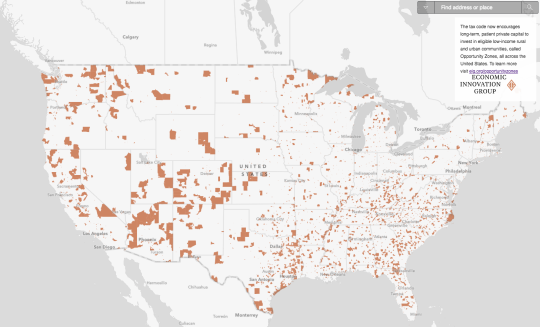
    For a census tract to become an O-zone, it has to have a poverty rate of 20% or higher, or the median household income has to be less than 80% of the surrounding area. Governors are also only able to designate 25% of their eligible census tracts.

    Here is a map of the areas that have been designated as Opportunity Zones.
    image

    Here is how these O-zones work. (All excerpts taken from this Forbes article.)

    The law’s engine is a new breed of financial product, the opportunity fund, that offers investors a trifecta of attractive tax breaks. Here’s how it works. Investors who sell assets have 180 days to plow their taxable capital gains into an approved opportunity fund, which must hold 90% of its assets in Opportunity Zone projects. To put money to work fast, the law requires that the funds invest all of their cash within some specified time frame. (The Treasury Department is still deciding on that and other crucial details.) Tax on the original reinvested gain isn’t due until 2026, and the taxable gain is cut by 15%. Meanwhile the new opportunity investment grows tax-free, like a Roth IRA, provided it’s held for at least ten years. (If it’s sold earlier, it can be rolled into another opportunity fund and remain tax-free.)

    Here is how it could get the real estate industry to take action.

    For real estate developers, O-zones offer cheap real estate and unlimited, untaxed upside if a neighborhood takes off. Developers must do more than stash cash in crumbling property. To qualify for tax perks, they must make swift and significant upgrades (at least equal to the cost of the initial purchase). With real estate projects come new office buildings, industrial districts, restaurants and affordable housing—all of which can lay the groundwork for an economic boom. “The real estate aspect is a great catalyst to attract new businesses,” says AOL founder Steve Case, an early supporter of the O-zone initiative, whose Rise of the Rest Fund invests in backwater areas. “But it’s the startups that will be the real job creators.”

    And here is how it could influence where new businesses decide to locate.

    “If Facebook could have chosen to locate itself in an Opportunity Zone, like the Tenderloin in San Francisco, the investors would’ve paid no capital gains on their equity,” says Parker, who presumably would have been one of the big winners. The promise of mega-returns could send VCs, investment banks and private equity firms scrambling to launch their own opportunity funds to create incubators, scour second cities for overlooked talent or move portfolio companies into O-zones. “It wouldn’t surprise me if a lot of Silicon Valley VCs started to tell founders, ‘We’d like you to go over the bridge to Oakland, or we’d like you to go to Stockton,’” Parker says.

    If you’d like to learn more about Opportunity Zones, check out the Forbes article.

  • The cost of failure

    Kevin Rose is an internet entrepreneur. He has built a number of consumer products, including Digg in 2004. Previously he was a venture capitalist with Google Ventures, but now he’s doing that with True Ventures. He also hosts a podcast.

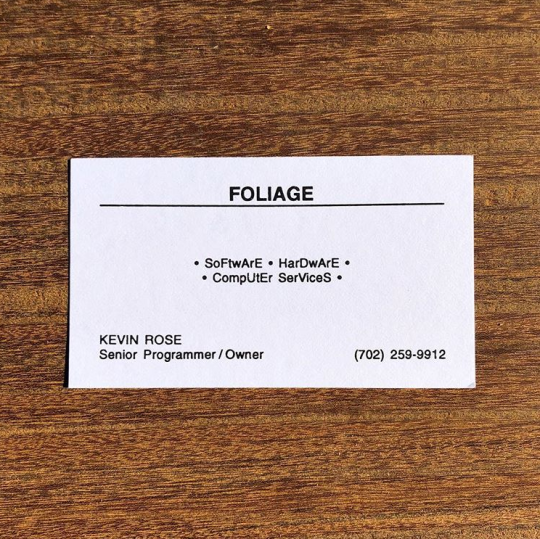
    This past weekend he posted the following photo to his Instagram:

    image

    Here’s the story. 

    After begging his mom to take him to the printers, he got this business card made when he was 13 years old. Foliage Software wasn’t a real company, of course. But it had business cards and he was not only a Programmer and the Owner, but a Senior Programmer and the Owner.

    I laughed as soon as I saw this post because it is exactly the sort of thing that the 13 year old version of me would have done and probably did. (The combination of upper and lower case letters on the card also helped with the humor.) I’m sure if I dug around my mother’s house I would find a trail of my failed business schemes and project ideas.

    But that’s entirely the point he is trying to make. Try. Fail. Learn. Refine. All of these actions will increase your odds of success at the next go around. Nobody will remember the failures anyways.

    Seth Godin perhaps said it best with: “The tiny cost of failure is dwarfed by the huge cost of not trying.”

  • IBI launches Smart City Sandbox

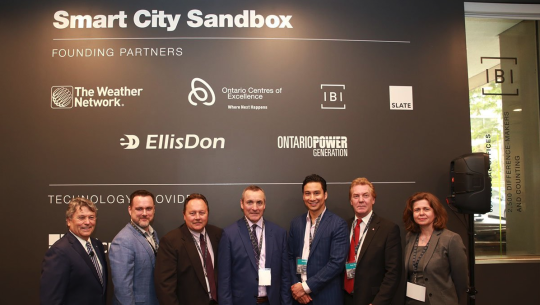
    This morning I was at 55 St. Clair Avenue West for IBI Group’s annual general meeting. And at this meeting their CEO, Scott Stewart, officially launched a new accelerator called the Smart City Sandbox

    Here is a description of what that is taken from a press release that was also published this morning:

    The Sandbox is a smart city-themed accelerator, focused on bringing innovative new products and systems to urban environments that improve the quality of life for residents. A technology hub that supports small-and medium-sized enterprises (SMEs), as well as entrepreneurs and start-ups, the Smart City Sandbox will operate out of a designated space at IBI Group’s Toronto headquarters, be open to global applications, and officially open doors with its first smart city-themed cohort in September 2018.

    And here is a photo from this morning:

    Slate Asset Management is proud to be a founding partner of the Smart City Sandbox and we’re thrilled that it will live at Yonge + St. Clair in midtown Toronto. 

    Our role is to provide our domain expertise as asset managers and developers, and to offer participants in the program access to real-world building systems and data from our holdings in the area.

    For more info, go here.

    And if you were at (or listening to) the meeting this morning, I’m sure you noticed something that we talk a lot about on this blog. To thrive today, virtually every company now has to think and act like a technology company. IBI Group is doing precisely that.

  • Meet Replica

    Sidewalk Labs is currently building out a platform called Replica that will support them in their development plans here in Toronto. Replica is

    “a user-friendly modeling tool that uses anonymized mobile location data to give planning agencies a comprehensive portrait of how, when, and why people travel in urban areas.”

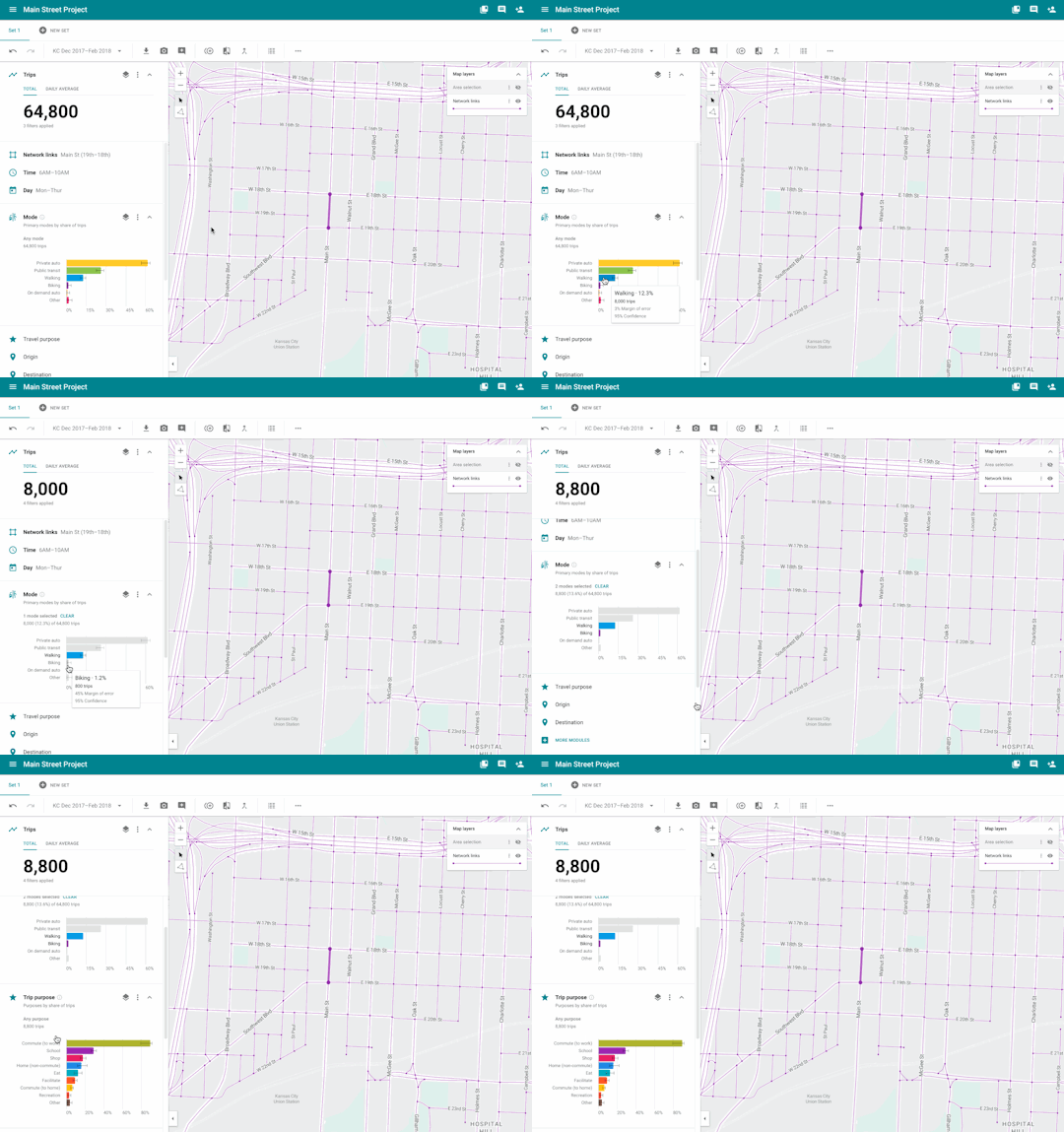
    Here is a preview of the Replica dashboard showing a section of Main Street in Kansas City. I hope the animated GIF shows up for you.

    The platform uses a combination of mobile location data (~5% of the population) and on-the-ground checks, typical stuff like manual traffic counts and transit boardings.

    The goal is to understand in real-time who is using a street, as well as how (driving? cycling?) and why (going to work?).

    Their introductory blog post obviously stresses the importance of personal privacy, but I am curious how they determine where people are going.

    I suppose if they pair journeys with destinations (and the durations at those destinations) they can make reasonable assumptions around the why.

    I think the benefits to all of this are clear. But does any or all of this worry you from a privacy standpoint?

  • Top US metro areas for VC investment

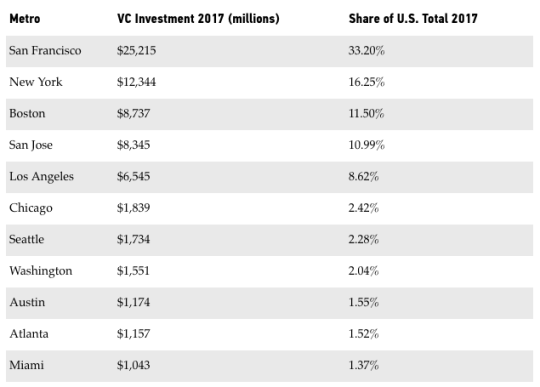
    Below is a list of the US metro areas that saw a billion dollars or more in venture capital investment last year (2017). It is taken from a recent CityLab article by Richard Florida where he talks about the “geographic inequality of high-tech venture capital.”

    image

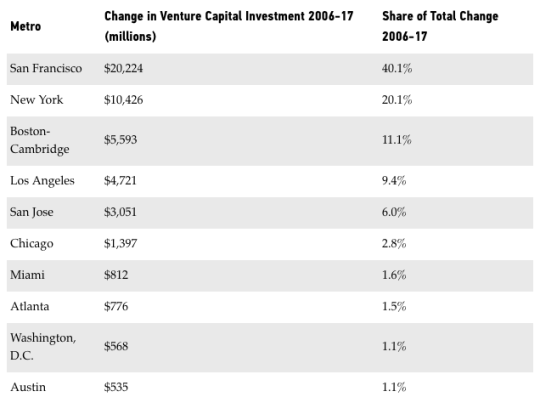
    It’s worth noting that San Francisco – not San Jose (Silicon Valley) – is at the top of the list with nearly 1/3 of the US total last year. It’s also interesting to note that when you look at each metro’s share of the total change from 2006-2017 (the chart below), you get Los Angeles now punching above San Jose. 

    image

    Florida also gets into which economic and demographic variables seem to be associated with higher levels of venture capital investment. For the rest of the article, click here

  • What’s the realtor jiu-jitsu move?

    Today’s post is a set of related questions for all of you.

    Fred Wilson has a post up on his blog today called, The Jiu-Jitsu Move. It’s about how people often dismiss new technologies, market entrants, and/or consumer behaviours as silly; whereas the real power move is to embrace and leverage them. That’s what he is calling the jiu-jitsu move.

    He gives a few examples, but for obvious reasons this one stood out to me:

    I spent the day yesterday at a real estate industry event and talked to a lot of agents about the fact that their clients are often more informed than they are these days. I encouraged them to embrace that fact and use it to their advantage and not fear it. It is hard when you have grown up in an industry when your advantage was information and you no longer have that working for you.

    For all the agents (and real estate consumers) who read this blog, I am curious if you agree with the above. Are consumers increasingly more informed than agents? I am sure that many of you will disagree. But if things are really changing, what should the jiu-jitsu move be?

  • InsurEye acquires the Dirt

    Back in 2013, my friend Mike Lerner and I designed, developed, and launched a condo review platform called the Dirt (thedirt.co). It’s hard to believe that it’s already been five years.

    Our mission was to empower real estate consumers through greater transparency in the marketplace. And we did this by crowdsourcing condo building reviews, as well as pricing comps.

    Today we are excited to announce that InsurEye Inc. has acquired the Dirt. InsurEye began as a moderated insurance review platform for home, auto, and life insurance, but it has since grown to include condo reviews.

    The team at InsurEye shares a very similar goal of creating greater transparency in the marketplace, and so we are thrilled that they will be picking up where we left off.

    Press release, here.

    P.S. The Dirt is the reason why I started the daily blog that you are reading right now. I started writing for the company and fell in love with it as a discipline and practice. Life is lived forwards, but understood backwards.

  • Are we entering a new era of tech-driven city building?

    Emily Badger of the New York Times published an interesting piece yesterday talking about the tech industry’s current obsession with trying to fix cities. And there are certainly many problems to fix.

    Staying true to tech and engineering parlance, there’s lots of talk of optimization. How do you technologically optimize a city, for things such as affordable housing?

    There’s no doubt that many of you will sympathize with this statement: 

    To planners and architects, all of this sounds like the naïveté of newcomers who are mistaking political problems for engineering puzzles.”

    But naïveté is not always a bad thing and with all of the money sloshing around in this industry, there’s also no doubt that this is likely a new era of city building.

    The article ends by quoting JD Ross, the 27-year old co-founder of Opendoor – a startup that we have discussed many times before on this blog and is now valued at over $1 billion.

    It is him saying that he wants to figure out how to put $100 million into this space as soon as he can figure out the right target to optimize for. “It’s better than buying a Bugatti.”

    Of course Sidewalk Toronto – which is mentioned a few times throughout the article – is already a perfect example of tech infiltration.

    But I think Dan Doctoroff gets it right when he posits that the real naïveté will come from disrespecting urbanist traditions.

    Photo by David Alacaraz on Unsplash