Daily insights for city builders, delivered every morning at 6 AM ET. I’m Brandon Donnelly — a Toronto-based real estate developer and founder of Globizen. I’ve been writing here since 2013.

Tag: social media

  • The importance of shareable experiences for retail

    image

    There is no shortage of articles talking about the disruption currently taking place in the retail space. Just this past weekend the New York Times wrote: Is American Retail at a Historic Tipping Point? With nine U.S. retailers filing for bankruptcy protection in the first three months of 2017 alone, one could certainly make this argument.

    The obvious explanation is the shift to online shopping. Mobile spending now also makes up > 20% of total digital dollars spent. But you already knew that. Nothing new here. Perhaps less trite is one of the explanations that Derek Thompson offers up in this Atlantic article: Americans are spending less on material possessions and more on meals and experiences with friends.

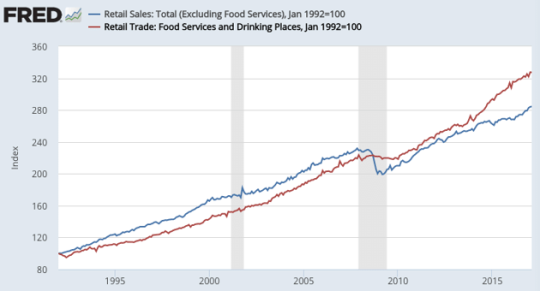
    Take a look at this FRED (Federal Reserve Economic Data) chart taken from the article:
    image

    According to Thompson, spending at “food services and drinking places” has grown twice as fast as all other retail spending since 2005. Americans now spend more money in bars and restaurants than they do in grocery stores. Last year was the first year that happened.

    But the possible reason behind all of this is arguably the most interesting: young people are looking for ways to create great social media content. And going out for gluten-free dinners with friends and traveling to Tulum “with bae” are clearly far better fodder for that than scouring the sale racks at J.C. Penney. 

    Social media is redirecting discretionary income. This is our new reality. Whether you’re a city builder or a retailer, you must now ask yourself: How shareable is the experience that I am trying to create? 
  • Turning data exhaust into gold

    Last year, social media company Foursquare predicted that Chipotle would see a ~30% drop in its Q1 2016 sales. It knew this because the geo-location data from people using its app (check-ins and passive visits) was also down. They had figured out the relationship between foot traffic and sales. I think I wrote about this in the first half of last of year.

    Not surprisingly, lots of companies – including those on Wall Street – are now starting to pay attention to data sets such as these. Matt Turck wrote a great blog post about it this morning, called: The New Gold Rush? Wall Street Wants your Data. Here’s an excerpt:

    That a social media company could be building a data asset of immense value to Wall Street is part of an accelerating trend known as “alternative data”. As just about everything in our lives is getting sensed and captured by technology, financial services firms have been turning their attention to startups, with the hope of mining their data to extract the type of gold nuggets that will enable them to beat the market.

    The opportunity is open to a wide range of startups.  Many tech companies these days generate an interesting “data exhaust” as a by-product of their core activity.  If your company offers a payment solution, you may have interesting data on what people buy. A mobile app may accumulate geo-location data on where people shop or how often they go to the movies.  A connected health device may know who gets sick when and where.  A commerce company may have data on trends and consumer preferences. A SaaS provider may know what corporations purchase, or how many employees they hire, in which region. And so on and so forth.

    We may be calling this alternative data right now, but it is almost certainly just a matter of time before it simply becomes: the data. 

    I like the term “data exhaust” that Matt uses, because it feels like it accurately captures what is going on right now. The new economy is producing a lot of byproduct. If you clean it up and package it in the right way, then you might be creating additional value. But if you don’t, then it’s probably just exhaust.

  • 365 project

    I love the idea behind a “365 project.” Two examples here and here. I learned about it from Bijan Sabet.

    The idea is simple. It’s a personal photography project where you post a single photo each day of the year with a short blog-style caption. In the above examples, it’s typically a description of what’s going on in their lives.

    Obviously there’s a major element of discipline to this project, but I also really like that the photos become a celebration of the mundane. The ordinary. The everyday.

    One photo I saw had the caption: “Today wasn’t a very good day.”

    Social media has evolved to become a high curated representation of our lives. We use it in an aspirational way to tell a story about who we hope to become or who we want people to believe we already are.

    I am not exempt. 

    But it’s refreshing to think about “an honest account of your life.” Unless you happen to have a life that consists entirely of Vegas trips and yacht parties, a daily photo means that it won’t always be epic and it will sometimes feel like a chore.

    I frankly don’t have the time for another daily commitment beyond this blog, but I would love to do a 365 photography project. Perhaps some of you have the time and the interest.

  • The social shift

    Those of you who know me or are regular readers of this blog, will know that I’m an avid social media user. 

    My favorites – judging by battery consumption on my phone – are Twitter, Instagram, and Snapchat (donnelly_b). I think it’s incredible what these platforms are doing to branding, marketing, personal connectivity, city building, and the list goes on.

    To that end, the March issue of Harvard Business Review has an interesting article by Douglas Holt called, Branding in the Age of Social Media. Whether you’re running a company, a city, or a real estate development project, I think you’ll find the information relevant.

    The article starts by describing a shift, brought about by social, whereby big brands are now struggling to capture the attention of consumers. Instead, consumers are listening to individuals and more grassroots movements.

    “Or consider Red Bull, the most lauded branded-content success story. It has become a new-media hub producing extreme – and alternative – sports content. While Red Bull spends much of its $2 billion annual marketing budget on branded content, its YouTube channel (rank #184, 4.9 million subscribers) is lapped by dozens of crowdculture start-ups with production budgets under $100,000. Indeed, Dude Perfect (#81, 8 million subscribers), the brainchild of five college jocks from Texas who make videos of trick shots and goofy improvised athletic feats, does far better.”

    So what should brands be doing? Holt argues that they need to tap into these developing subcultures and emergent ideologies:

    “These three brands broke through in social media because they used cultural branding—a strategy that works differently from the conventional branded-content model. Each engaged a cultural discourse about gender and sexuality in wide circulation in social media—a crowdculture—which espoused a distinctive ideology. Each acted as a proselytizer, promoting this ideology to a mass audience. Such opportunities come into view only if we use the prism of cultural branding—doing research to identify ideologies that are relevant to the category and gaining traction in crowdcultures. Companies that rely on traditional segmentation models and trend reports will always have trouble identifying those opportunities.”

    For me, this ties into one of my favorite lines from Simon Sinek: “People don’t buy what you do, they buy why you do it.” And now, thanks to social, it has become a lot easier to figure out what people and communities care about. It has become easier to figure out your why.

    Do you see this as being relevant to your work? I am certainly thinking about it in the context of mine.

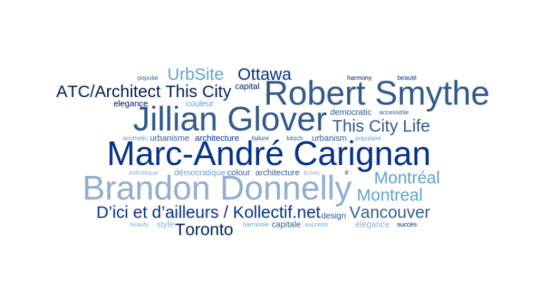
  • Urbanism Online: #capital

    image

    For those
    of you from Ottawa, I’m going to be in town this Thursday evening talking
    at an event put on by the National Capital Commission called Urbanism
    Online
    . It’s all about how blogging, social media, and online discussions can
    and are contributing to the betterment of cities.

    The other
    bloggers include:

    – Marc-André Carignan, Montreal, Kollectif.net

    – Jillian Glover, Vancouver, This City Life

    – Robert Smythe, Ottawa, UrbSite

    The event is
    now full, but email them or tweet me if you’d really like to come
    and I’ll certainly ask about space availability. I’m sure it’s going to be a great discussion.

    I have a bit of a soft spot for Ottawa. I used to spend a lot of time there when I was working on an office building at 150 Elgin Street. (Key tenants include The Canada Council for the Arts, KPMG, and Shopify.)

    I haven’t been back since the building was completed, so I’m excited to see how it turned out.

    Update: The event will also be streamed on Periscope, here.

  • A Spanish social media town

    I am a big fan of Twitter.

    I use it more than any other social network and any other app on my phone (according to my battery usage). In fact, I’m such a fan that I recently started buying shares. I don’t own a lot and the Canadian-US exchange is awful right now, but I do plan to continue buying (I like dollar cost averaging).

    Twitter isn’t the darling of Wall Street like Facebook is. And I think the biggest weakness of Twitter is that it’s difficult for new users to really “get it.” Facebook solved this problem early on by recognizing that new users had to connect with X number of friends right away so that they received value immediately and the next time they visited.

    But I digress. That’s not the focus of this post.

    This morning a friend shared a Medium article with me that was written by the Laboratory for Social Machines at MIT. The article is about a small town in Spain called Jun (pronounced “hoon”) that has transitioned to using Twitter as the dominant platform for communication between government and citizens.

    The initiative first launched in 2011 and since then the mayor, José Antonio Rodríguez Salas, has been trying to get every resident onto Twitter. All 3,500 residents are even encouraged to go into the town hall to have their Twitter accounts verified. This way government employees know for sure that they’re dealing with an actual resident of the town.

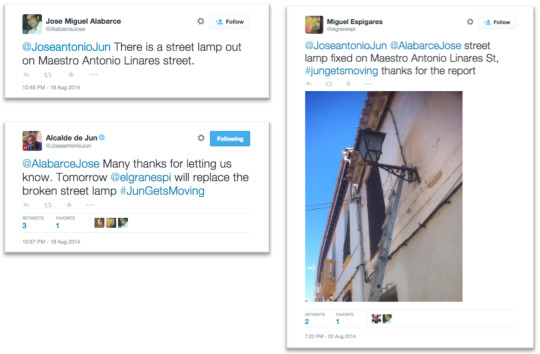
    Here’s a simple example of what this means for government-citizen relations (the folks at MIT translated everything to English):

    image

    In the above example, a citizen tweeted the mayor informing him that a street lamp was out. The mayor then responded, tagged an electrician, and said it would be fixed the following day. Sure enough the electrician went and fixed it the following day, and then tweeted out a photo of the lamp.

    This is great. And Twitter was made for these kinds of interactions. Facebook was not.

    Here in Toronto we have @311Toronto, which I have tweeted many times before with problems and they do respond quickly (far quicker than if you try and call them). But I still think there’s room for us to improve transparency and engagement across the board.

    All of this is a perfect example of how technology and cities are colliding in a big way. In today’s world I really think you need to be able to think across disciplines.

  • This is a personal blog

    The internet has created an interesting dialogue between personal identities and corporate brands.

    In the pre-internet and pre-blogging days, it was harder for individuals to establish a strong brand and public identity for themselves, unless of course they were somebody famous. The cost of doing so was simply prohibitive. To promote meant print, TV, radio, billboards, and so on.

    But now promoting can mean anything from tweets to writing a blog like this one. And that has opened up the opportunity for anyone to put themselves out there.

    The dialogue, or tension in some cases, is that it becomes a balancing act: what should I be putting out there? Myself, some faceless brand, or a mixture of the two? Brandon Donnelly or Architect This City?

    If you a run a company, you’re probably debating this. Do I create a personal social media account, one for my company, or both? And how do I go about managing both?

    To be clear, this blog is a personal blog. It’s not a business. 

    Some people have suggested I start to allow multiple authors and turn it into more of a platform. But I thought about that and that’s not what I want to do. Which is why I continue to write at brandondonnelly.com (i.e. myname.com). I like that I can send this URL to anyone and they’re able to quickly understand who I am and what I’m about.

    Because what I write about are things that I’m passionate about: cities, design, real estate, technology, and so on. But I also mix in personal things so that I feel as if I’m writing a public journal. There are many benefits to keeping a journal (my 4th grade English teacher Mr. Hoad-Reddick told me so). And that’s really how this whole blog phenomenon started – they were personal places.

    Over time though, blogs evolved to become less personal and more corporate. And I am sure that some of you would rather I keep things strictly business around here.

    But to be honest, my favorite people and brands to follow online are the ones that do make their content personal. Yes, I want to learn new things about interesting topics, but I also enjoy the connection that comes with reading somebody’s personal journal and engaging in discussion with them.

    In fact, I hate it when my Twitter feed becomes nothing but companies tweeting out polished articles and reports. That’s boring. I like seeing real people in my feed. People sharing what they’re doing and how they’re feeling. People being authentic, genuine, and even vulnerable.

    And ultimately I find it makes their non-personal content that much more engaging. You have context. You understand their thought process. You can read between the lines. Those connections are what social media and blogging are really all about.

    So I’m thinking that I’m going to try making this blog a bit more personal and a bit more playful. I hope you enjoy it. And if you don’t, I’m sure you’ll tell me about it in the comments below.

    On that note, I’m off to the gym to lift some weights. Besides blogging, that’s another one of my habits that I need to do on a regular basis in order to feel normal.

  • Value creation, transparency, and authenticity

    https://500px.com/embed.js

    I started writing this blog a year and 10 months ago. 

    At that time, I had no real title for it (it was just called “Cities”) and I had no idea where it was going to take me. All I knew was that I enjoyed the discipline of writing every day and that I wanted to talk about cities and city building. It was a way for me to neatly organize all of my passions – which span everything from architecture and real estate to technology and transportation.

    Since that time, this blog got a name (Architect This City). It was named by the Guardian (UK) as one of the best city blogs in the world. I’ve met an incredible array of different people (send me an email if you like coffee and are doing cool things). I get invited to comment on city building issues on a regular basis. And an incredible community of almost 10,000 daily readers has emerged (you can email subscribe here).

    A big thank you to everyone who reads and contributes to ATC.

    But over the course of writing this blog, something else unexpected happen. I started getting referred to as a “brander, marketer, and content creator.” Now, I’ll admit that I’ve become increasingly interested in these fields over the years, but it was certainly not something I thought of or could have predicted at the outset.

    What really happened though is that I simply started riding a wave that arguably took hold sometime around the mid-2000s and then focused my attention on an industry that has historically been slow to change (real estate). And that wave is the shift towards inbound marketing (as opposed to outbound or interruption marketing).

    If you’re a marketer, this is old news. You already know this. But I think there’s still lots of room for this to take hold in the real estate industry. So let’s talk about it a bit.

    To give you an example from outside real estate, take a look at Five O’ Clock magazine by Harry’s. Harry’s is a shaving company out of New York that offers moderately priced well-designed shaving supplies for men. It’s simple model that works very well.

    Their positioning has been around the idea of “Own Your AM”, which makes sense given that they are a shaving company. And so what they often do in their Five O’ Clock magazine is profile the mornings of interesting people, such as professional skier Jimmy Chin (who happens to live in one of the best places on earth).

    But if you do a search for the word “shave” in that Chin article, you won’t find it. Because it’s not about just creating content so that you can plug your business at every opportunity; it’s about creating value for your customers and building a relationship.

    And that’s really fundamental to the change I’m talking about. 

    Today, the marginal cost of reaching your customers has dropped to almost zero (even if you’re reaching out to them on a one-on-one basis over, say, social media). And so the opportunity exists for companies, brands, and individuals to do things that simply weren’t feasible before.

    Because of this, it is now possible for everyone to easily establish their own personal brand. I think we’re going to see more, not less, of that. And it has changed how we message and communicate – whether it be via blogs, social media, or online magazines.

    In my view it comes down to 3 considerations: value creation, transparency, and authenticity. If you can create value for your target audience and be transparent and authentic, you’re going to naturally draw people in. I try and do all of that on this blog and hopefully it comes through.

  • Towards more publicness

    Back when the commercial internet first started to take off it was uncommon to use your real name online. Instead people relied on usernames and other pseudynoms to represent themselves. I honestly can’t remember what I used in those days, but I’m sure it was something ridiculous.

    Over time though that started to change. 

    Blogging started to take off in the late 1990s. And we started to become more comfortable sharing personal information online. Perhaps the biggest shift though, came with the introduction of Facebook in 2004 (over 10 years ago!). All of a sudden people – young college students initially – started sharing lots of personal information online, including photos of themsleves and their friends.

    But this wasn’t an overnight change. When Facebook first launched, privacy was an important component. It still is, but I would argue that it has become less central given how public a lot of other social media platforms are today. Twitter, for instance, is what it is today largely because of its publicness. 

    For my own social media accounts, I have made every single one of them completely public. From Twitter to Facebook to Instagram to Snapchat, nothing I post to social media is restricted in any way. And I do that because I believe we are headed towards a world with more – not less – openness, transparency and publicness.

    Of course, I’m not just talking about social media and tech. I’m talking about open data in general.

    Earlier this year, the Toronto Real Estate Board clamped down on real estate brokers who were publishing historical sales data online. Citing privacy concerns, TREB ordered them to stop or lose their access to the MLS system. 

    For those of you not from familiar with the Toronto real estate market, historical sales data for homes is not open and published online. You generally need to go through a realtor to get access to this data. Some think this is the right approach. And others think it is antiquated.

    But as I explained above, our conception of what should be private can, and will, evolve over time.

    Here are the details on my home:

    I purchased it in September 2012 for exactly $400,000 (Canadian). It’s a 650 square foot condo in the St. Lawrence Market neighborhood of Toronto. It has one bedroom, a 400 square foot terrace, one parking spot, and 10′ ceilings.

    Sooner or later, I believe this information will be freely available online. But since that’s not the case today, I figured I would just tell you. Sharing this information is not a big deal for me.

  • Pushing and pulling

    image

    Venture capitalist Chris Dixon recently published an interesting post called, Two eras of the internet: pull and push. In it, he describes two patterns that have emerged within the internet over the past decade and a half.

    Pull (2000s):

    Pull is when you are seeking information, usually an answer to a question. You want to know the closing time of a restaurant, the description of a hotel where you are thinking about staying, the details of an historical event you heard about, etc. You go to your computer and pull the information. The killer app for pulling information was Google.

    Push (2010s):

    Push is when you are using the internet in a more passive way and content comes to you. The killer app for push is social networks, the most popular being Facebook. Information is pushed from user to user via likes, shares, tweets, etc. People tend to push things they find funny, interesting, moving, outrageous, etc.

    Now let’s think about this for a second, because it’s a pretty significant change.

    Google’s mission is to organize the world’s information. And they have certainly made it easier for us to get the information we want. Instead of physically searching for something, you just type in a few keywords and it pops up. But, it still involves us deciding we want something and then pulling the information.

    What’s fascinating to me about push is the idea that content and information comes to you. And it’s one of the reasons that I’ve always found Foursquare more interesting than Yelp – even though Yelp is far more popular as a tool to help you find somewhere to eat, drink and so on.

    When I walk into a restaurant or bar now, oftentimes I’ll see a Foursquare notification popup on my phone showing me a tip that somebody has left: “Try the meatballs – they’re to die for”. I didn’t search for that. I didn’t ask for a recommendation. But Foursquare knew where I was and presented me with that information.

    Now, there are obviously potential downsides to constant interruption, but let’s focus here on the opportunities. How could these same principles to be applied to other industries such as, say, real estate?

    I think there’s a pull and push parallel.

    Today MLS operates in a way like a search engine for homes. You decide you might be interested in buying a home and so you go online and start pulling listings.

    Of course, the vast majority of people also work with a real estate agent. And in a way they’re kind of like your push. They get to know you, they figure out what you’re looking for, and then they push relevant listings and information to you.

    And maybe that’s why nobody has killed off real estate agents – despite the numerous attempts. Everybody has been focusing on new pull platforms (listing platforms) as opposed to a new push platform.

    Who knows.

    But I think it would be naive to think that these emerging push platforms won’t reach far beyond social media.