Daily insights for city builders, delivered every morning at 6 AM ET. I’m Brandon Donnelly — a Toronto-based real estate developer and founder of Globizen. I’ve been writing here since 2013.
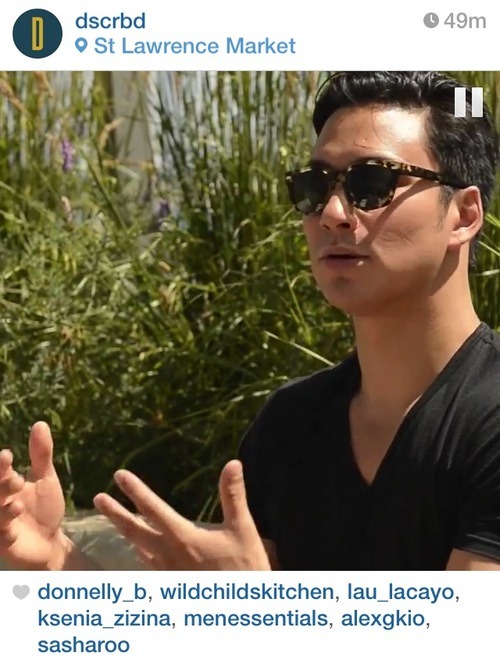
A good friend of mine recently launched a new project called DSCRBD (pronounced ‘described’). The goal is to “curate interesting minds” through short social video clips. Think Humans of New York but only creative types and only short videos.
I think it’s a great idea. And I was fortunate enough to be one of the first test subjects. It was conducted as an interview between he and I, and we spoke for probably about 45 minutes on the sun deck of my building.
He then took that entire interview and distilled it down to only a few seconds, extracting what he found most interesting. Perfect for social media consumption.
Click the image above for my video. What I’m talking about is my approach to architecture, and how I ended up not becoming an architect, but instead becoming a real estate developer.
I think he’s on to something here and I would love to see it develop further. He’s using the right mediums and format to get the message out in today’s noisy social world. But there’s also no reason that it couldn’t grow to include more content or simply feed to other content, such as what he did with Architect This City.
If you’re somebody that you think he should profile or know of someone that would be a good fit, drop him a line at hello@dscrbd.com.
Since I started blogging last year, I’ve been getting regular emails from both people I know and from readers I don’t know (but hope to one day meet) asking for advice on buying real estate. Usually somebody sends me the link to a place they’re thinking about buying, and they want to know what I think about the property and the neighborhood.
I’m more than happy to help when I can and I try to be brutally honest in terms of what I think. What’s interesting about this dynamic though, is that I don’t have a vested interest in any of the outcomes. Whether I tell that person I love the place or that it’s shit, I don’t stand to gain anything. And that means I can be brutally honest. It’s for this same reason that customer reviews on websites can work so well.
Because on the flip side, if I make money when you buy, then guess what, I’m going to want you to buy. That’s how it works for any industry–from financial services to real estate to retail. That’s why some stores will promote the fact that their sales people are not on commission. Although you could argue that those sales people are then less motivated to help you.
In any event, all of this got me wondering if there isn’t some way to take customer reviews to the next level. Could a decentralized sales model work?
Last year I had a conference call with one of the chief officers of one of the top 3 real estate websites in the US and I was told that they had actually tested a “social buying model.” It ultimately failed, but it strikes me as an interesting concept. Reviews are starting to feel a bit dated now on the social web, but I think the idea of crowdsourced input is here to stay.
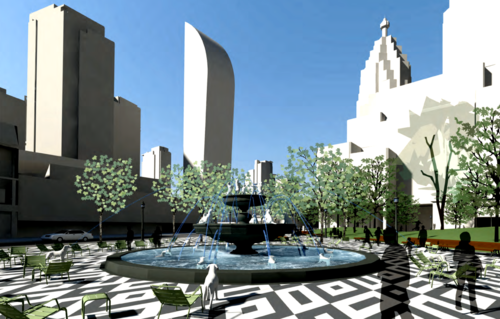
Earlier this week a friend of mine was live tweeting a public consultation meeting for the revitalization of Berczy Park in the St. Lawrence Market neighborhood of Toronto. And since I live in the neighborhood, it’s a project that I’ve been following particularly closely–although anything related to the built environmental generally fascinates me.
As soon as I saw the pictures he was tweeting out, I was immediately excited. And after reviewing the full design package (which you can download here), I must say that I think it’s going to be a brilliant change for the neighborhood.
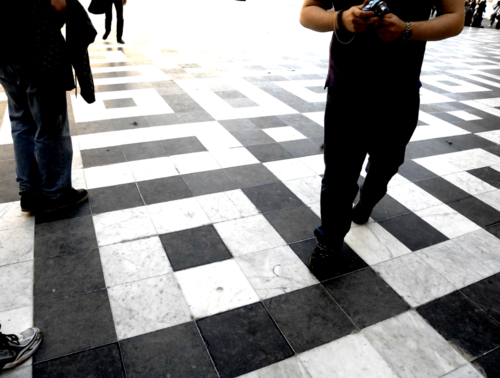
On an entirely superficial level, I like the paving motif they’ve chosen; even if it does appear to be be a copy from somewhere else (see above photo). I don’t think one should underestimate how small details, like paving, can have a huge impact on how one feels in a space, whether inside or out. It all counts.
But beyond just cosmetic changes, there are a couple of significant design changes being proposed.
First, a larger kid-friendly green space is being proposed on the west side of the park. And what was interesting to see was how the community overwhelmingly expressed a need for this play area. I’d like to believe that this speaks to the growing acceptance of raising kids downtown. There are certainly lots of families in the St. Lawrence.
Second, the south portion of the park is being “opened up” with a much larger hardscape area. The result will be a bigger promenade along Front Street, as well as, what I hope, will become an “urban stage” for people to hang out, breakdance, busk or try and sell me things I don’t need.
But equally exciting is the fact that along with the revitalization of Berczy Park will come a public art competition. It’s already in the works, but there aren’t any pretty images to share, just yet. Regardless, I think the topic of public art is an interesting discussion.
In a lot of cities around the world, there are mechanisms in place to encourage or mandate public art. Commonly, it comes in the form of a “Percent for Art” program, which means that, in the case of a new construction project, 1% of the construction costs would or should go to public art.
But the fact that we, at least in some cities, have programs to mandate it, should immediately signal to you that public art is not something universally believed in. And certainly it’s one of those things where it’s hard to measure the return-on-investment.
But that doesn’t mean it doesn’t or can’t exist.
In fact, I would argue that in today’s information and digital age it’s only going to become more important. We are living in a world of too much information and too little time. We’re living in a noisy world and, whether you’re a corporation or a city, the only way to stand out is to be remarkable. You need to bring delight to people.
Because when you do, you get noticed (and probably shared on Facebook, Twitter, Instagram, Tumblr, Snapchat, Vine, 500px, Flickr and maybe even Google+). As one example, how many of you recognize the public art piece below? It’s in Vancouver and I’ve seen it pop up a number of times in my social news feeds. It’s something that brings delight to people.
But at the same time, it’s something that speaks to and creates a sense of place. What could be more Vancouver than a giant blue raindrop along the waterfront? And that’s really one of the ironies of today’s digital world. Despite the fact that, no matter where we are, we’re all hyper connected through technology, more and more of us are gravitating back towards cities. We want to live close to other people and we want to feel a sense of place.
When done properly, public art can help cities achieve that. Whether it’s the famous LOVE sculpture or Richard Serra’s controversial Tilted Arc, public art can make you stop and take notice of your environment. It can give you that sense of familiarity or it can take you by surprise. Either way, it gives you a sense of place.
Two things happened yesterday. And since there’s a nice tie in, I’d like to talk about both of them.
First, here at TAS, we launched a new condominium project called Kingston&Co. We had already gone public with some information, but we now have an updated rendering and we’ve gone live with a public Q&A section on our website (kingstonandco.ca). The questions are all geared towards topics that we think are on a lot of people’s minds and anybody can respond. Instead of trying to cover up the elephant in the room, we wanted to do the opposite and get it out and into the open. It’s all about promoting greater transparency.
Second, I watched this 45-minute interview with author and entrepreneur Gary Vaynerchuk last night before going to bed. It’s a great video and I would encourage you to watch it if you have any interest in entrepreneurship, social media, marketing, capitalism and overall hustle. But if you don’t have the time, here are some of my key takeaways. Gary makes, on average, between $3-5 million a year selling the social media dream (but it could be more depending on things like his angel investments). Everybody is a media company first. He has clients putting 100% of their marketing dollars into social media and they’re seeing a ROI. It took him 1 ½ years to get anybody to care about his video blog Wine Library TV. And don’t just ask. Give as well.
That last point is a tie in to his latest book called Jab, Jab, Jab, Right Hook. And what he’s effectively saying is that, as a brand, you need to be mostly giving to your customers (that’s the jab). It could be valuable content you produce via social media or whatever. It’s you, delivering value to your customers in some way. Then, once you’ve done that, you can go in for the right hook, which is the ask: Buy my stuff. The idea is that you build up trust with your customers and develop a relationship so that you get the privilege of asking them to give you money.
The alternative, of course, is what we’re all already familiar with: brands constantly bombarding people with right hooks. It’s the let’s throw a bunch of shit up against the wall and see what sticks approach. And it’s related to the whole permission marketing vs. interruption marketing debate popularized by marketer Seth Godin.
But Gary’s argument–and I found this really interesting–is that constant right hooks is the approach we had to take before the internet and things like social media. Those right hooks were so expensive to deliver through billboards, print ads, TV commercials and so on, that companies simply couldn’t afford to be delivering any jabs. But all that has changed with social media and technology. Now, the best brands succeed by building trust and establishing relationships with their customers–often one-by-one.
And this is exactly what we’re trying to do with Kingston&Co. We know that there’s a lot of discussion happening in the marketplace around condos and we didn’t want to ignore it. We wanted to address it. And if you look at our messaging, you’ll notice that in most cases we’ve put “Join the conversation” ahead of the typical “Register now.” That’s because we truly do want to have a conversation.