Daily insights for city builders, delivered every morning at 6 AM ET. I’m Brandon Donnelly — a Toronto-based real estate developer and founder of Globizen. I’ve been writing here since 2013.

Tag: social media

  • The [Next] Pepsi Generation

    The product matters. How big is the screen on this smartphone? How many horses does this all-wheel drive car have? And how high are the ceilings in this condo? (Some architects get grumpy with me when I call buildings a “product.” It’s so much more than that, right?)

    But here is a good reminder from Zander Nethercutt via a post he did on Medium earlier this year: People Don’t Buy Products, They Buy Better Versions of Themselves.

    The example he gives is that of Pepsi. While damn near identical to Coke in terms of its chemical composition, Pepsi was struggling until it decided to try something new. They stopped focusing on the product itself and instead starting selling the type of person you would become, if you drank Pepsi.

    These people, and this campaign, became known as the Pepsi Generation.

    We have talked about this idea before on the blog and this approach to selling is now quite commonplace. But I like how Nethercutt distills it down: Desire translates into consumption. And I want to buy a better version of myself.

    I also buy his add-on argument that social media has amplified our awareness and desires around self, because today we are so often externalizing it to the world and being instantaneously judged on it. Like. No like.

    Am I the kind of person who eats here, stays there, and consumes this?

    Photo by Christina Boemio on Unsplash

  • Policies for the leisure state

    image

    Andrew Kortina and Namrata Patel recently published an intriguing essay called, Kinky Labor Supply and the Attention Tax.

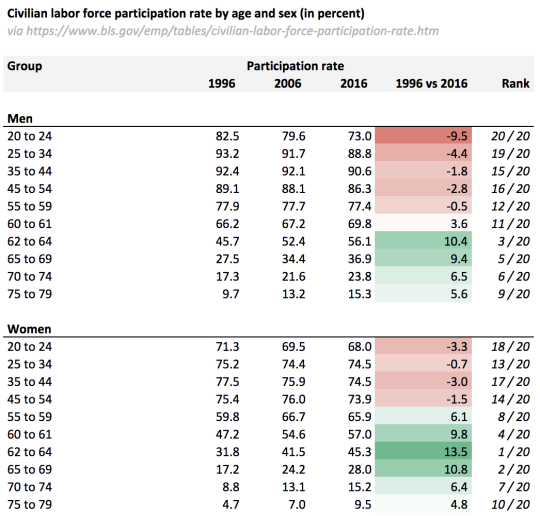
    They begin by talking about declining labor force participation rates, particularly among young men. Remember that the participation rate is distinct from the unemployment rate. Here is a chart from the essay:
    image

    Participation is down for young people, but up for older people. This is perhaps signaling that older demographics still need to work in order to maintain certain needs and/or a particular lifestyle.

    The possible explanations for this declining rate among young people are interesting. The authors argue that it is a combination of the declining cost of media entertainment content and the amplification of social status signaling, among other things.

    The declining cost of online content has meant that this form of leisure activity has become incredibly cheap, if not entirely free (beyond the mostly fixed cost of an internet connection). So there’s always something enjoyable to do.

    At the same time, the authors argue that once people make enough money to satisfy basic needs, there becomes a tradeoff between trying to make more money and simply spending more time on leisure.

    Historically, the motivator to make more money has been arguably associated with social status signalling through conspicuous consumption. But with the advent of social media, we are all now signaling globally, instead of just locally.

    Due to increased competition, the argument is that people are now feeling demotivated by all the conspicuous consumption that they see online. It is simply too difficult to compete. The Gini coefficient is too high.

    So why not just spent more time on leisure?

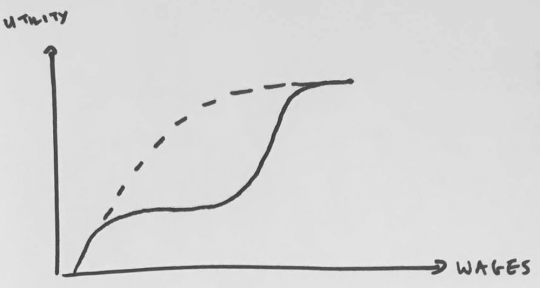
    One potential policy implication is that raising the minimum wage wouldn’t be enough to spur increased labor force participation. Labor isn’t responding in the same way to wage increases. There would need to be a much more significant increase in income for that to happen – hence the “kinky labor supply curve.”

    One view of the status quo is that media companies are aggregating human attention and selling it at a discount–far below minimum wage–to advertisers in a massive arbitrage on human capital. So, the state could set the price of an hour of human attention at the minimum wage rate, and charge media companies 12% (the federal income tax rate on minimum wage) of that wage rate for each hour of human attention they consume.

    One possible solution is an attention tax. But their takeaway is that this lost productivity will more than likely be made up for with technology, which could ultimately translate into something we are already seeing: increased inequality.

    Check out the essay here. It’s an interesting read.

  • #DeleteFacebook

    Earlier this week I deleted my Facebook account. If we were friends on the service and you can no longer find me, this is the reason why. 

    Part of why I did this certainly had to do with privacy. I read Brian Acton’s (WhatsApp cofounder) account in Forbes this week. And I have been following many of the discussions over the past year:

    Privacy legislation is perhaps the only thing that could pose an existential threat to a business that’s entirely powered by watching and recording what people do at vast scale. And relying on that scale (and its own dark pattern design) to manipulate consent flows to acquire the private data it needs to profit. –Natasha Lomas

    But at the same time, I’m still on and use Instagram and WhatsApp (both Facebook companies), and I use Twitter pretty much every day.

    So I am certainly not in a position to be smug about this decision. Hopefully this post does not come across that way.

    The simple truth is that I had more or less stopped using the service. I had long ago turned off mobile notifications and so it had become more of a hassle than anything else.

    Every now and then I would go on and find notifications and messages that I wasn’t responding to. 

    So it had finally reached a point where I thought to myself: Why keep my data here (by the way, you can download all of your data from the site) and why check it sporadically if I’m not really deriving any value out of it? Simplify.

    I enjoy Instagram because taking photos is one of my primary passions outside of real estate and design. And I enjoy Twitter as a source of news and mostly civil conversation. 

    I am easy to get ahold of. I don’t need Facebook for that. Any of the social links at the top of this page (if you’re reading this post on the web), will get you there.

  • Our social connectedness

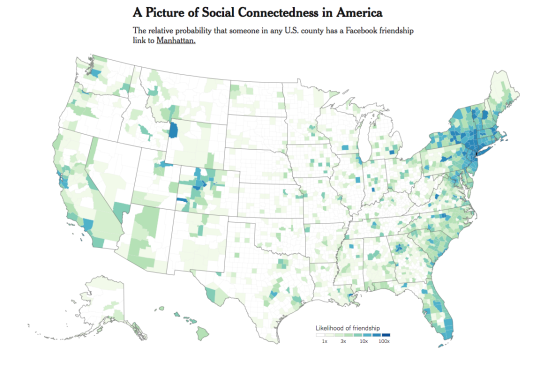
    Economists at Facebook, Harvard, Princeton and NYU recently analyzed anonymous Facebook data in order to study our social connectedness. The New York Times’ Upshot wrote about it here and it is a must read.

    There are a number of interesting takeaways from the study. One of them is that geography, distance, and political boundaries actually matter a great deal when it comes to our connectedness. 

    In other words, Americans are more like to be connected to someone nearby – within county or state boundaries – than they are to someone further away who may be infinitely more similar. This may seem somewhat intuitive.

    But at the same time, having a dispersed network also suggests certain things. Here’s the relationship that they discovered:

    These networks are important in part because of other patterns that are correlated with them. Counties with more dispersed networks — where a smaller share of Facebook friends are located nearby, or among the nearest 50 million people — are on average richer, more educated and have longer life expectancies. Places that are more closely connected to one another also have more migration, trade and patent citations between them.

    Counties that are more geographically isolated in the index are more likely to have lower labor force participation and economic mobility, and they have higher rates of teenage births. Some of the most economically distressed parts of the country appear to be the most disconnected: Among the 10 U.S. counties with the highest share of friends within 50 miles, six are in Kentucky.

    Again, it is worth checking out the full article. There’s also an interactive map to play around with.

  • Value of distribution and reach for consumer facing products

    image

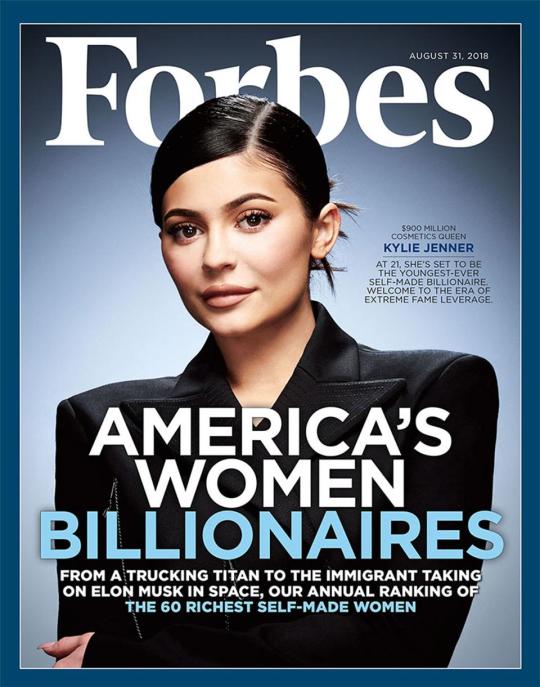
    Forbes recently pegged social media influencer Kylie Jenner’s net worth at somewhere around $900 million. That makes her the youngest (she’s 20) person on Forbes’ annual ranking of “America’s Richest Self-Made Women.” 

    And if the trend line continues, she’ll be the youngest self-made billionaire, ever. Mark Zuckerberg apparently holds that title right now. But he was a classic underachiever and only became a billionaire at age 23.

    Most of Kylie’s net worth is derived from Kylie Cosmetics, which launched less than 3 years ago, but did an estimated $330 million in revenue last year. Forbes values the company at almost $800 million. And Kylie owns every bit of it. 

    The reason I am mentioning this today is because I was fascinated by the above Forbes article. It’s such a powerful example of social media leverage. Forbes put it differently: “Social media has weaponized fame.” 

    Kylie has 111 million followers on Instagram (plus many more on her other social channels) and that’s really the most important part of this equation. She has the distribution and reach to acquire boat loads of customers. It doesn’t matter what you’re selling if nobody knows you’re selling it.

    The rest of her business is pretty much outsourced. Seed Beauty (out of Oxnard, California and Nanjing, China) handles the manufacturing, packaging, and shipping fulfillment. Shopify (headquartered in Ottawa) is her e-commerce platform.

    We could of course have a debate about whether a celebrity-fueled business is really all that sustainable. And perhaps there’s risk in relying so heavily on social for customer acquisition. But youngest billionaire is youngest billionaire.

    Image: Forbes

  • In defense of Instagrammable moments

    Surface Magazine – and more specifically the CEO of Surface Magazine – recently published this article criticizing the “trend” toward designing for Instagrammable moments.

    Here is an excerpt:

    We—and yes, this includes architects, too—have succumbed to the pressures of gaining followers, likes, and comments. High-priced, difficult-to-attain architecture degrees are now, incomprehensibly, being used to create “Instagrammable” installations for things like impromptu selfie fashion shoots and hotel lobby photo booths. The whole thing is, I must say, sad. It’s embarrassing enough that our team at Surface has received press releases from architects promoting their latest project with “Instagram-friendly interiors.” They can’t be serious.

    And here are his final words:

    If retail is dead, then its rebirth will depend on creating memorable atmospheres that don’t call for #✌💙👯🙋📷.

    I certainly appreciate the push for lasting and memorable spaces, but, at the same time, I can’t say I’m nearly as fussed about lobby selfies and the alleged timelessness of Instagram. 

    In fact, I think it would be an interesting exercise to study how social media may be impacting the way we design physical spaces.

    Maybe it is simply a fad being promulgated by “knucklehead junior marketers” or maybe 100 years from now nerdy architectural historians will look back on that quaint period of time when we designed spaces to service rudimentary 2D images shared amongst friends.

    Whatever the case may be, I think that architecture, like all art, should embody the milieu in which it was designed. 

    But often we have biases telling us that what is new is not as good as what’s existing and already accepted.

  • No is the second best answer

    image

    In addition to email, phone, and text, we live in a world where you can also easily and directly connect with people on LinkedIn, Facebook, Instagram, Twitter, Tumblr, Snapchat, Swarm, WhatsApp, Slack, as well as on many other platforms.

    As much as I love tech, I personally find this exhausting and far too distracting. So early last year I turned off all social media and messaging notifications – on both mobile and desktop – other than on the two platforms that I most commonly use. (Facebook and LinkedIn are not on this shortlist.)

    The result is that I am now missing (and consequently ignoring) a ton of direct messages. But as the saying goes, there’s no such thing as too much information, just poor filters. If you really want to reach me, I am not hard to find. You’re reading my public and daily journal right now.

    Zooming out from social media DMs, I am reminded of one of my all-time favorite Seth Godin posts where he talks about the value in saying no – which is, of course, just another kind of filter:

    No I can’t meet with you, no I can’t sell it to you at this price, no I can’t do this job justice, no I can’t come to your party, no I can’t help you. I’m sorry, but no, I can’t. Not if I want to do the very things that people value my work for.

    No is the foundation that we can build our yes on.

    And nobody should feel bad for saying no. A friend of mine likes to remind me that no is the second best answer. Yes is obviously the best, but a firm no is far better than an indecisive maybe that leaves everyone wondering what to do next.

    I should probably say no more often than I do. But I am working on it. Every now and then I remind myself that there’s huge value in saying no. Today’s post is that reminder and maybe it will be yours too.

    Photo by Kai Pilger on Unsplash

  • 4 years

    Today is the 4 year anniversary of this daily blog.

    Sure, I’ve missed a few days over the years (my estimate is 4-5 days), but for the most part I have shown up here every day and written something. 

    Sometimes that something is very short and/or bad. I’ve had a few people say to me: “I can tell when you’re super busy. Your posts are shorter.” I’m okay with that. Part of this exercise for me is simply about the discipline. 80% of success is showing up, right?

    In some ways, what I do here is an anachronism. Here is a good vintage article (2011) that talks about two different schools of thought when it comes to blogging.

    The reality is that it’s painfully slow and difficult to build an online audience via a personal blog using your own domain. It takes years, unless you’re a celebrity, which I am most certainly not. That’s why many people give up.

    Instead, many people/influencers choose to build their audience on top of an existing network, such as YouTube, Instagram, or Medium. Medium is pretty tempting and I’ve seen lots of bloggers port over their personal blogs.

    The idea here is that you simply bring your content to where your/an audience already lives, instead of trying to get them to come to you. 

    Of course, one of the risks of this approach is that you don’t own/control the platform. What if people one day decided to stop using MySpace? I like the idea of owning (at least part of) my online presence.

    So here’s to another year on the blog. Thanks for reading! I really do appreciate it. Regular scheduled programming will resume tomorrow.

  • The U.S. cities that gained the most workers over the last 12 months

    One of the great things about social media is that it gives us access to data that previously didn’t exist or was difficult to collect.

    Take, for example, LinkedIn’s monthly report on employment trends called the Workforce Report. They look at which industries are hiring, where people are moving for jobs, and so on. Click here for the June 2017 edition. 

    Note that architecture/engineering hiring appears to be up nationally, which is usually a positive leading indicator.

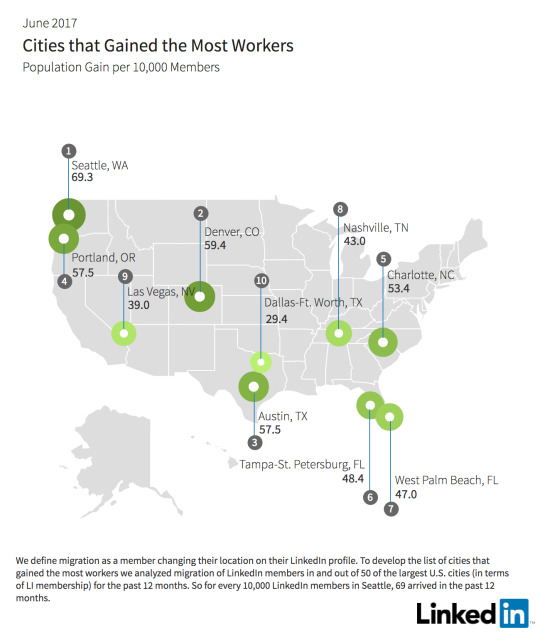
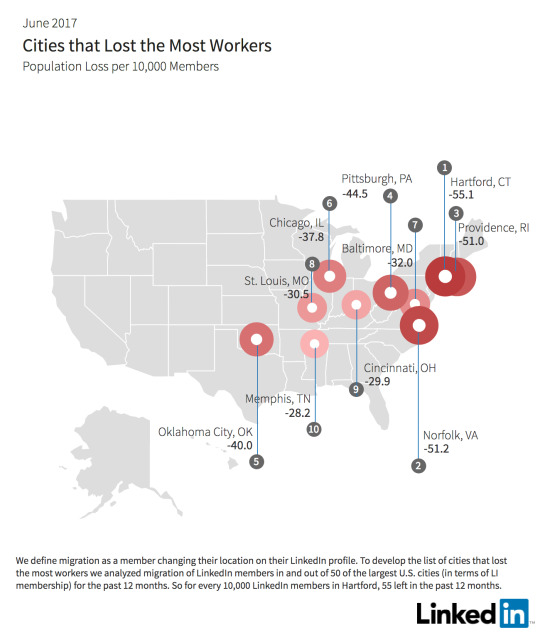
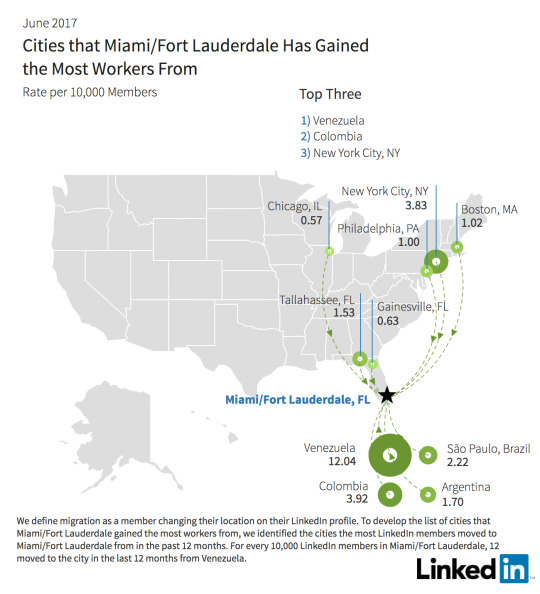
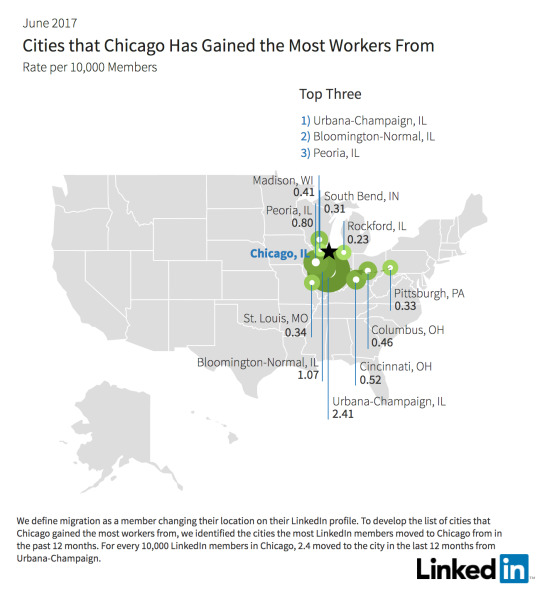
    I’ll leave you all to go through the report, but I did want to pull out a few of their maps and one of their takeaways. Below are maps of the cities that lost the most workers and gained the most workers over the last 12 months.

    The established trend of people moving from colder northern cities to warmer amenity-rich cities seem to play out here.

    That said, one of their “key insights” is that fewer workers today are moving to the San Francisco Bay Area. Since February 2017, there has been a 17% decline in the net number of workers.

    They blame housing affordability (ahem, lack of supply). People are simply turning to other great cities like Seattle, Portland, Denver, and Austin. They’re growing and cheaper.

    One of the other cool things about the report is that you can drill down into individual cities to see where people are moving from. I looked up Miami and Chicago just to do a quick comparison. 

    Not surprisingly, Miami is seeing a significant contingent from South America. What’s interesting about this random comparison is how international Miami is and how regional Chicago is in terms of their draws.

    I would love to see similar data for Canada. This is valuable stuff.

  • Instagram Stories has more active users than all of Snapchat

    Instagram has a company chart that shows: Days to Reach the Next 100 Million Users. It is only the chart where they want to see it decline. The first 100 million users took 28 months. And the last took only 4 months. Instagram now has 700 million active users.

    Instagram is also saying that they have 200 million people using their Stories feature – you know, the feature they blatantly stole from Snapchat. This would mean that more people are using Instagram Stories than Snapchat has daily users (~158 million).

    Anecdotally, I can tell you that I’ve almost completely stopped using Snapchat. (Snapchat battery usage over the last 7 days = <1%.) I still prefer Snapchat’s direct messaging functionality, but not enough to continue using the platform. Instagram now provides basically the same functionality – plus my photos – in a single app. 

    But more importantly, Instagram’s network and my network are bigger there. And network effects are clearly the most important thing. In fact, by directly copying Snapchat, Instagram (Facebook) made sure that this competition was only about network size and not about features. Monopoly power.

    In real estate, if you own a property in a great location, your position is pretty defensible. (Though you may not be completely immune.) But in tech, that is clearly not the case. Someone might copy everything you’ve done and beat you at your own game.

    As someone who used to be very bullish on Snapchat, I am now wondering if I need to remove my Snapchat handle from the header of my blog emails. I mean, I’m not there very often anymore. But maybe, just maybe, Snapchat will find a way to compete outside of network effects at a game that Instagram/Facebook can’t play.

    How would you or are you placing your bets?