Daily insights for city builders, delivered every morning at 6 AM ET. I’m Brandon Donnelly — a Toronto-based real estate developer and founder of Globizen. I’ve been writing here since 2013.

Tag: shopping

  • What e-commerce may do to our streetscapes

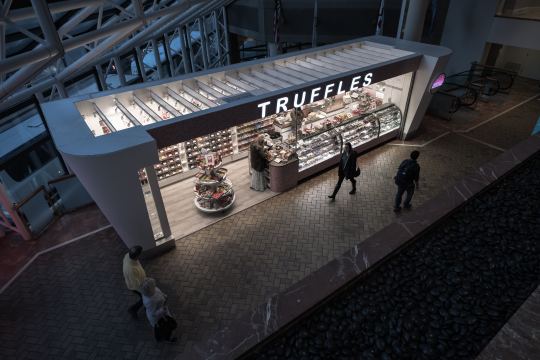
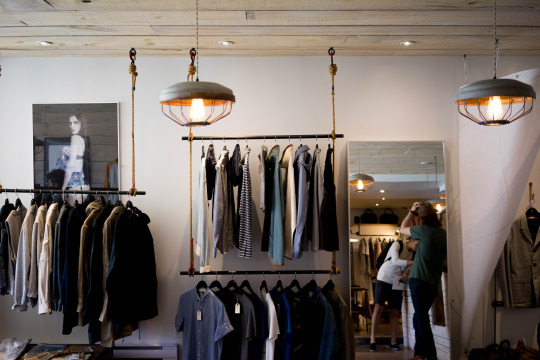
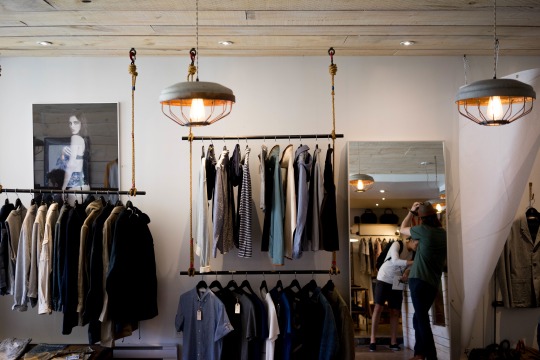
    Sidewalk Labs recently ran a thought experiment where they came up with 5 possible scenarios for the future of retail and, more specifically, what they may mean for our streetscapes. You can read all about them here, but my mind lumps them into 3 broad categories.

    First, there’s the temporary/pop-up/independent scenario. This one is all about flexibility and speed. It’s about web-first retailers who don’t have, need or want permanent stores and about empowering small scale business owners. This makes sense. The internet has decentralizing forces.

    The second one takes retail in the opposite direction. It’s about going all in on physical stores; upsizing them and making them even more over the top and Instagram-able. This one also seems intuitive given that we’re already seeing this trend with malls. Many/most are dying and the surviving ones are trying to go as high end as possible.

    The last scenario takes vacant and underutilized retail on the fringe and turns them into “digital dispensaries.” This one is entirely utilitarian and void of any streetscape/urban considerations. It’s about autonomous electric vehicles picking up your goods through drive-thrus and on-demand drones dispatching your toilet paper after you hit that Amazon Dash Button.

    This feels like a good list. I think you could argue that the writing is on the wall for all of these scenarios.

    Photo by Lance Anderson on Unsplash

  • So, what’s a town square?

    Earlier this week, Apple let us know that it is now calling its stores “town squares.” Not surprisingly, this elicited more than a few reactions. The Verge called it a “pretentious farce.” Others called it arrogant. Who is Apple to think that its stores could ever come close to a real town square?

    It also raised important questions around the actual “publicness” of the spaces within our cities. Traditionally, town squares have indeed been public. But our cities are now also filled with many privately owned public spaces (POPS). Most of the time you don’t know the difference. Though sometimes you do

    The reality is that there is a longstanding tradition of private retail-oriented spaces trying to simulate the experience of a town square, and certainly of a gathering space. The creator of the modern mall, Victor Gruen, always thought of his “garden courts” as a kind of substitute for traditional urban spaces. This was him trying to nobly urbanize the suburbs.

    What is perhaps unique about Apple’s town square nomenclature is that – beyond simply wanting to be a Starbucks-esque “third place” – they seem to be telling us that they want to usurp the public nucleus away from the proverbial “garden court” and place it in their individual stores. 

    And the reactions we have seen are because that feels far fetched.

    However this plays out, this is a very clear acknowledgement by Apple that in today’s world being a store simply isn’t enough. That’s no longer interesting. Consumers have far easier options at their disposable. You need to give us more of a reason to visit you in your store or, dare I say, your town square.

  • From retail to logistics

    Over the past few weeks we’ve been talking about the future of the mall on this blog. It’s a topic that I’m very interested in.

    Yesterday the Wall Street Journal published an article talking about the trend of converting retail/shopping facilities to logistic centers. 

    Here’s an excerpt:

    “In Mesquite, Texas, FedEx Corp. next month will open a 340,000 square-foot distribution facility on what once was the site of the former Big Town Mall. Located along U.S. Highway 80 in Texas, the mall declined after newer malls were built nearby. It was demolished in 2006 and the land was later rezoned for industrial use.”

    It turns – and we’ve talked about this – that good retail locations are also good distribution locations. They are usually located close to humans and infrastructure.

    Here’s another example from the article:

    In North Randall, Ohio, Amazon.com Inc. is considering the site of the former Randall Park Mall as a fulfillment center, according to Port of Cleveland, a local government agency focused on spurring job creation and economic growth in Cuyahoga County. Amazon didn’t immediately respond to requests for comment.

    For a short time when it opened in 1976, Randall Park Mall was the largest shopping center in the world and had been “a thriving heartbeat” for the local economy, according to Mr. Davis. But the mall closed in 2009 as stores struggled with fewer shoppers.

    Assuming this trend continues and people continue to buy things online, one has to wonder about the placemaking that should or needs to happen in these areas.

  • Online shopping and “last mile” real estate

    The Globe and Mail recently published an excellent article on “how e-commerce is driving a real estate revolution.” This is a topic that I’m very interested in: how online manifests itself offline.

    Not surprisingly, the article talks a lot about Amazon, including their 4th warehouse in the Greater Toronto Area, which is an 850,000 square foot facility in Brampton equipped with 350-pound robots (8050 Heritage Road).

    The first thing I did after reading the article was figure out the location of all of Amazon’s fulfillment centers in the GTA. Amazon doesn’t seem to publish this. But according to TaxJar, they are here (I mapped out the addresses):
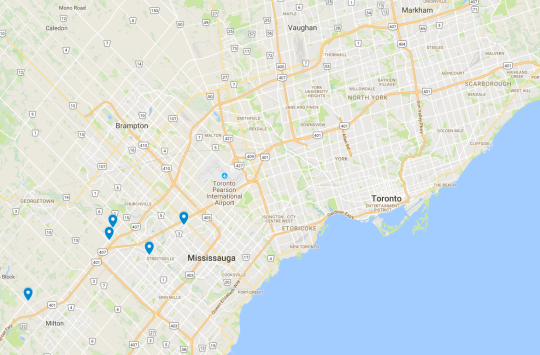
    There are two in Brampton at the precise location where Hwy 407 (toll route) and Hwy 401 meet. The other three are distributed along Hwy 401 in Milton and in Mississauga.

    Now let’s get back to that Globe and Mail article:

    – In 6 years, Amazon has leased over 2 million square feet of warehouse space in Canada.

    – Toronto is the third largest warehouse market in North America. It represents 43% of Canada’s total inventory.

    – Average net rents have increased 9.7% over the past year and vacancy rates have dropped to 2.7% (CBRE data). In Vancouver, those same numbers are 5.1% and 3%, respectively.

    – Online shopping is thought to account for about 6.5% of all retail sales in Canada. But in Toronto, 23% of all industrial space is already e-commerce-related (CBRE data, again).

    – CBRE believes that every $1 billion in new online sales per year requires an additional 1.25 million square feet of warehouse space. 

    – Based on online sales projections, Canada needs another 27.5 million square feet of industrial space over the next 5 years. We don’t have that much space in the pipeline.

    – Clear heights are increasing for stacking purposes. Amazon’s new Brampton facility is 45 feet tall / 4 floors. 10 years ago new warehouses were 26 feet tall.

    – Average sale price of warehouses in the GTA has gone from $119.35 psf to $142.19 psf over the last year.

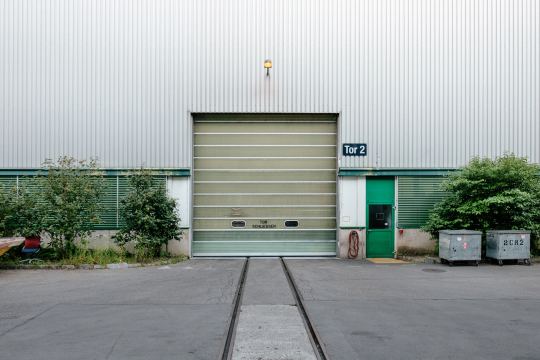
    Perhaps the most interesting takeaway from the article is the discussion around “last mile” distribution hubs. These are fulfillment centers located closer to the city, which are used to offer shorter delivery times: 

    “…instead of having inventory stored for days or months, these fulfilment centres will turn over their inventory in one day, sometimes twice a day.”

    This is something that I addressed in my recent presentation about the “mall of the future” at B+H’s retail design charrette. Where do these physical distribution centers want to be as online sales continue to grow and delivery times continue to compress? Where’s the future growth?

    According to this article, it’s going to be in “last mile” fulfillment real estate – relatively smaller spaces that are located very close or directly in the city center.

    Photo by Samuel Zeller on Unsplash

  • Gigantic shopping machines

    image

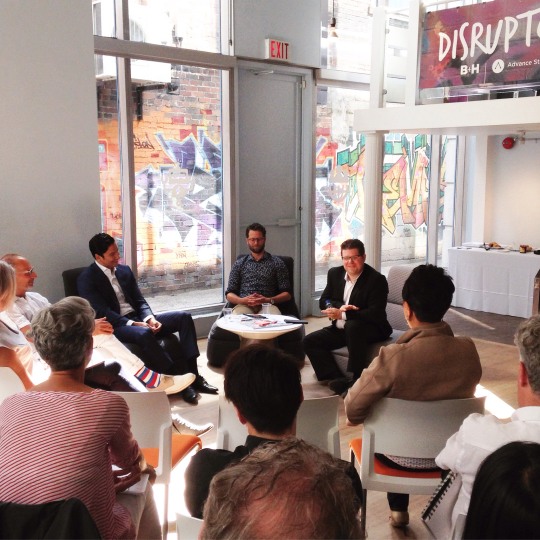
    This morning I gave a presentation and participated in a design charrette that was organized by B+H Advance Strategy about the “mall of the future.” (See photo above.) It’s a 2-day event and I was only able to stick around for a few hours in the morning, but I think it’s great that B+H Architects takes the time to research and get a deeper level of understanding in the areas in which they work. Great design demands that.

    The way the charrette was structured was around a handful of future scenarios. The idea being that it’s impossible to accurately predict the future, but it is possible to play out different possible futures to see what you get. I’m looking forward to seeing what the teams ultimately come up with at the end. I would also be really curious to hear your thoughts in the comment section below.

    But before we decide on what malls are going to become in the future, it’s perhaps useful to think about how they got their start. The man largely credited with inventing the fully enclosed mall typology is a man by the name of Victor Gruen. He was a Vienna-born architect who moved to the US in 1938. 

    In the words of Malcolm Gladwell:

    “Fifty years ago, Victor Gruen designed a fully enclosed, introverted, multitiered, double-anchor-tenant shopping complex with a garden court under a skylight—and today virtually every regional shopping center in America is a fully enclosed, introverted, multitiered, double-anchor-tenant complex with a garden court under a skylight. Victor Gruen didn’t design a building; he designed an archetype.”

    The most interesting thing about this story though is that Gruen’s initial hope was that the mall would urbanize America’s suburbs. The garden court was supposed to be a kind of town square. And his broader vision included a mix of higher density uses surrounding the perimeter. But in reality the opposite happened: The mall helped to further suburbanize America.

    However, as our malls begin to show their age (or die) and as we relearn to appreciate walkable urban environments, mall landlords are increasingly thinking mixed-use and higher density. And ironically, many of the plans probably don’t look all that dissimilar to Gruen’s original ideas. So maybe one possible future is simply the one that Gruen wanted to create all along.

    Image: Kinetic Commerce

  • E-commerce jobs are clustering in larger cities

    image

    The New York Times just ran an interesting piece on “how the growth of e-commerce is shifting retail jobs.”

    Here are some of the key takeaways (all US data).

    Online shopping accounts for about 8.4% of all retail sales.

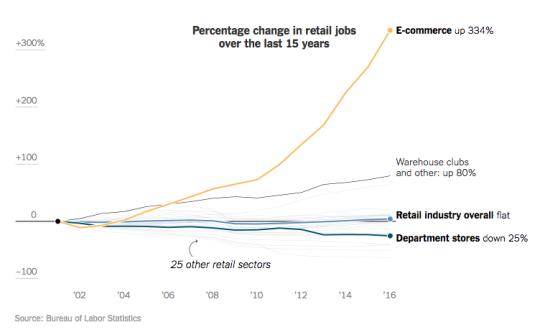
    But e-commerce related jobs are growing way faster than all other forms of retail employment. See above graph.

    That said, e-commerce jobs are still a small portion of overall retail employment. And the rise in e-commerce employment has not been enough to offset the losses in other areas, such as in departments stores.

    Over the last 15 years, e-commerce added 178,000 jobs and department stores lost 448,000 jobs. In this same time period, warehouse clubs added 841,000 jobs! I found it interesting to see department stores on the bottom and warehouse clubs on the top of the graph.

    image

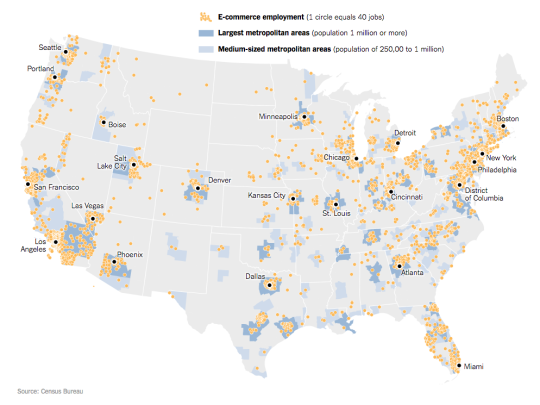
    Finally, e-commerce jobs appear to be concentrating in larger metros. See above map. Each mustard dot represents 40 e-commerce jobs. You’re selling more products with less human capital, and those people are clustering. This is a broader trend.

    According to the New York Times, counties and smaller cities (under 250,000 people) account for almost ¼ of overall retail employment. But when it comes to e-commerce firms the number drops to around 13%.

    Once again it would seem that technology and what we do online have an impact on our cities and towns. And that’s fascinating.

    All images from the New York Times

  • Retail tipping point

    Venture capitalist Benedict Evans recently published a post on his blog called, Ten Year Futures. If you haven’t already noticed, I really enjoy this sort of curiosity and line of thinking. Here is an excerpt where he talks about retail being at a tipping point:

    “First, ecommerce, having grown more or less in a straight line for the past twenty years, is starting to reach the point that broad classes of retailer have real trouble. It’s useful to compare physical retail with newspapers, which face many of the same problems: a fixed cost base with falling revenues, the near-disappearance of a physical distribution advantage, and above all, unbundling and disaggregation. Everything bad that the internet did to media is probably going to happen to retailers. The tipping point might now be approaching, particularly in the US, where the situation is worsened by the fact that there is far more retail square footage per capita than in any other developed market. And when the store closes and you turn to shopping online (or are simply forced to, if enough physical retail goes away), you don’t buy all the same things, any more than you read all the same things when you took your media consumption online. When we went from a corner store to a department store, and then from a department store to big box retail, we didn’t all buy exactly the same things but in different places – we bought different things. If you go from buying soap powder in Wal-Mart based on brand and eye-level placement to telling Alexa ‘I need more soap’, some of your buying will look different.”

    I’ve said this many times before, but the way the above excerpt ends is yet another remind that one has to look deeper beyond the obvious change(s). Yes, ecommerce is growing and impacting physical retail. But what other changes might ensue because of this shift?

  • Take it and go

    Given the option, I will buy online as opposed to offline. About the only thing I consistently buy in-person is groceries. Food shopping remains a persistently in-store activity for most of the market. Though some European countries seem to have much higher online food shopping rates.

    It is for reasons like this that Amazon opened a new small-format grocery store this past Monday called Amazon Go. The big game changer – which is currently making the rounds on the internet – is the fact that there are no check out counters. You simply check-in with their app when you walk into the store and then leave with whatever you want. Your phone will automatically charge you for whatever you picked up.

    Finally! Grocery store check outs suck. (The store is currently in beta and will not open to the general public until 2017.)

    But perhaps even more meaningful is all the data that Amazon will be collecting about our grocery shopping habits. This will scare some of you, I’m sure. But I can tell you that there are a slew of things that I buy regularly. And I bet that if you analyzed the data, the purchases would happen at fairly regular intervals: bananas every x days, orange juice every y days, etc.

    So once Amazon Go learns what I like to buy, I am sure that it will then start to try and sell it to me online, along with some sort of subscription. If it can assure me that the produce is fresh and the expiry dates are far out (if they’re not, I want to be able to take a picture and get a refund), then there’s probably a good chance that I, as well as others, could be converted to online food shoppers.

  • Below-grade urbanism

    I came across an interesting discussion on Twitter last night about tunnels, bridges, elevated walkways, and Toronto’s elaborate (mostly) underground shopping complex known as the PATH. It’s the largest of its kind in the world.

    Here’s the thing: the idea of pulling people off the street and into an underground shopping mall, runs counter to what many urbanists believe is the optimal outcome.

    Below is a footnote I found in a 2006 research paper by Pierre

    Bélanger called, Underground landscape: The urbanism and infrastructure of Toronto’s downtown pedestrian network.

    “The reluctance of urban designers and academics to engage the
    dynamics of the underground is stunning. For almost 50 years, urban
    designers, landscape architects and planners have longed for car-free
    pedestrian environments that are safe, secure and accessible. From a
    planning perspective, the Toronto underground may be the ultimate form
    of attrition of the automobile on the urban landscape: there are no parking
    lots, no asphalt, and no congestion. With its mass-transit accessibility, it is
    an ideal pedestrian network. This reluctance may in part be attributable to
    a prevailing attitude that privately-controlled underground shopping is
    undesirable, at best dismissible. As self-contained environments, they are
    perceived as lying outside the so-called public domain and that they kill off
    street life. As a more legitimate form of collective space, street-level
    activity located within municipal right-of-ways therefore receives much
    more advocacy.”

    Of course, there is truth to the notion that activity gets concentrated below grade. When people visit Toronto’s Financial District for the first time, they’ll often ask: Where is the retail? And then you have to explain that it’s all underground and that we live like mole people from 9-5.

    But despite this reluctance on the part of urbanists, people do seem to like it. When you’re marketing a building in the CBD, being PATH-connected is a feature, not a bug. I always joke that in the summer, I hate the PATH. But in the winter, I love it. 

    There’s also a feeling of hyper-connectivity during business hours in the PATH – particularly at lunch. You have everyone leaving their desks, descending from their towers, and mixing all about in a dense pedestrian-only network. It’s unusual not to run into someone you know.

    So love it or hate it, perhaps we should appreciate it for what it is: thriving city life.

  • Where do you shop?

    Matthew Townsend of Bloomberg recently published an interesting article talking about the dominance of Amazon.com (and online shopping in general); the shift towards experiences over stuff; and the languishing brick-and-mortar brands that keep saying it’s the macroeconomy, rather their product/approach, which is causing sales to slump.

    Here are a 3 excerpts that stood out for me:

    Lurking behind the cliché is a hard truth these executives are eager to avoid. “All this pleading that the consumer isn’t spending is an excuse, largely from management teams whose product is less relevant,” Kernan said. “The consumer is actually driving the U.S. economy, so it’s a little ridiculous when we hear the excuse of the macro environment is not good.”

    Another hurdle that isn’t going away is the shift to increased spending on experiences such as travel and classes, which make for much better posts on Instagram, Facebook, and Snapchat. “Social media has really fostered a have-done environment, which is not what retailers sell,” Perkins said.

    One characteristic of these struggling brick-and-mortar chains has been direct competition with Amazon. If they don’t go head-to-head with the online giant, they rely heavily on people visiting shopping centers anchored by retailers that do, such as ailing department-store chains Macy’s and Sears. One measure of store visits in the U.S. paints a dire picture, with only a dozen positive weeks over the past two years.

    According to Bloomberg, 55% of online product searches start at Amazon.com. And while online sales in 2016 have only accounted for 11% of all (U.S.) retail revenue, it has represented 54% of all growth! That’s a big number, especially when you think about what that will mean over time.

    Talking about the growth and threat of online shopping has become a boring truism. I know that. But are retail executives taking it seriously? The Bloomberg article gives you the sense that many are not – or at least they’re not publicly acknowledging it.

    When I look around my place right now and think about where I bought each item – everything from the shoes at my door to the protein powder in my cupboard – it’s pretty amazing to think about how much I now buy online. And I’m sure that many of you are the same.

    Groceries aside, I’m probably 85-90% online. What about you?