Daily insights for city builders, delivered every morning at 6 AM ET. I’m Brandon Donnelly — a Toronto-based real estate developer and founder of Globizen. I’ve been writing here since 2013.

Tag: shopping

  • How Muji is collaborating with Japan’s housing agency

    This is a familiar story that is, of course, not unique to Japan:

    “Danchi”, or apartment blocks built by Japan’s housing agency during the country’s high-growth period, may look grim and outdated in today’s Tokyo, where flashy glass and steel towers reign.

    However, I only just learned that, since 2013, the Japanese houseware brand Muji has been renovating apartments within these housing blocks in an attempt to reduce vacancies:

    But danchi are becoming hip again, thanks to modern renovations by lifestyle brand Muji, which is turning the poky, multi-room flats into open-plan studios.

    The above excerpts are from a 2015 article, but this partnership between Muji and Japan’s Urban Renaissance (UR) Agency continues to this day. Today, they’re also focused on creating a greater sense of community within these danchi neighborhoods.

    It’s a logical collaboration. Both want to bring good and affordable design to the masses. And obviously there are brand benefits for Muji. It’s a way to expose more people to their products.

    But what I find particularly interesting is that it, once again, shows the potential of a strong brand within the real estate industry.

    According to the same 2015 article, as soon as Muji completed its first round of apartment renovations, UR saw 2x the number rental applications from people in their 20s and 30s. Perhaps the number is even higher today.

    Clearly what happened is that you had young followers of the brand who said to themselves, “oh if Muji is involved, it must then be cool and nice, and so I’d like to live there.”

    I mention this because, as a gross generalization, real estate companies don’t seem to focus on their own brands in the same way other companies do. (Again, I’m making a gross generalization.)

    Instead, they often rely on 3rd party brands — hotel brands, fashion brands, and whatever else — to augment as needed. (See “Dubai is now the capital of branded residences.”)

    Maybe this is truly the optimal way to do it. Just partner as needed. Or maybe more real estate companies should invest in their own brand.

    Photo by taro ohtani on Unsplash

  • Automated checkouts

    I did something this week that I don’t often do: I shopped for (non-grocery) things in person. Like, in a physical store. So I recognize that this isn’t entirely bleeding edge. Still, I am thoroughly impressed by the self-checkout process at Uniqlo.

    All of their items now include RFID tags, which means you don’t need to scan anything. You just place your basket or items down, and then everything shows up automatically on the screen. Done. The most frictionless checkout that I have ever experienced.

    My understanding is that this was done more for supply chain management and that it is now possible because the cost of these tags have come down to something like a few cents per unit; but the added benefit is that they have greatly improved checkout throughput and the overall experience.

    This has been a part of the promise of RFID tags for many years. And this week I experienced it IRL for the first time. It was awesome. Now I hope this same experience comes to grocery stores in the near future.

  • Voi Cube — the first store in Switzerland without any employees

    Swiss supermarket chain, Migros, has just launched what is being called the first store in Switzerland to not have any employees. The concept, called the Voi Cube, is a small container-like outparcel space that is open 24/7 and offers about 500 or so everyday items. You enter using their app, you grab what you need, and then you check yourself out. (Presumably the doors don’t open back up until you’ve paid.)

    The concept is being positioned as a convenience add-on to its existing grocery store business. Swiss federal labor laws still prohibit retail staff from working on Sundays, and so this is a clever way for people to shop for essentials during that time. They just got rid of the labor component. It also begins to show just how flexible and adaptable grocery stores can be as the retail landscape continues to evolve.

  • Shoppable videos

    Sometimes I think that writing a blog has become a bit old fashioned. I should probably be making videos. But the reality is that I like writing. Getting up in the morning, reading, having a coffee, and writing my thoughts down is a ritual that I really enjoy. Making videos is also a bigger time commitment, and I would rather focus my energy elsewhere.

    But there’s no question that user-generated videos have and will continue to change ecommerce and many other aspects of society. This recent blog post by Connie Chan and Avery Segal called, “Ecommerce as video’s killer app,” is a perfect example of that. In it, they talk about a handful of Chinese companies that are pioneering “shoppable videos.”

    What these platforms are doing is allowing consumers to buy things natively within their app and through a “video-centric checkout flow.” In other words: watch a story being told (from an individual, as opposed to a company); become interested in a particular product or service; and then immediately purchase it with only a few taps.

    Another use case, which I think many of you will find interesting, is the creation of “crowdsourced video city guides.” Instead of checking for hotel reviews on TripAdvisor, simply find someone who has already vlogged a stay and book it that way. The individual who uploaded the video will then earn a commission.

    This behavior already exists. Discovery and buying decisions — for many products and services — have moved to social platforms. Just today a friend reached out asking me about a bar that she saw on my Instagram stories a few weeks. She’s planning to go next week. Now where’s my commission?

    Shoppable videos are a natural extension. They may also lower the barriers to participation. And so maybe I will end up making videos, after all.

  • Pleasure and product discovery

    Benedict Evan’s most recent blog post, called “Amazon as experiment,” draws some interesting parallels between what Amazon is doing today (and experimenting with) and the beginning of mass retail, namely the invention of the department store. He also talks about some of the shortcomings of Amazon’s model, which isn’t at all focused on (or good at) things such as “pleasure” and product discovery. Here are a couple of excerpts:

    On the other hand, it’s interesting that Amazon seems to be doing as much experimentation as possible around the logistics model—from stores to drones to warehouse robots of every kind—but much less around the buying experience, other than small-scale tests of the Four-Star stores. After all, historically, department stores were about pleasure as much as they were about convenience or price. They changed what it meant to “go shopping” and helped turn retail into a leisure activity.

    This has always been the gap in the Amazon model. It’s ever more efficient at finding what you already know you want and shipping it to you, but bad at suggesting things you don’t already know about, and terrible whenever a product needs something specific—just try finding children’s shoes by size.

    This is probably inherent in the model. For Amazon to scale indefinitely to unlimited kinds of products, it needs to have more or less the same commodity logistics model for all of them. That’s the line it’s never been willing to cross. Amazon doesn’t do “unscalable.” And yet, while we now know there is nothing that people won’t happily buy online, not everything will fit that commodity model. So maybe that’s the real test of Amazon’s pride: can it work out how to let us shop, rather than just buy?

  • Multi-storey retail

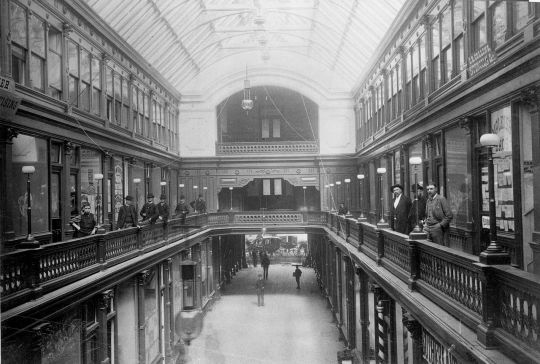
    I was at the St. Lawrence Market over the weekend and I saw a poster up for the original Yonge Street Arcade building, which was located at Yonge Street and Temperance Street here in Toronto. Initially constructed in 1884, the building was ultimately demolished in 1952 and replaced with today’s building by 1960.

    Here is a photo of the original arcade dated 1885:

    image

    The Yonge Street Arcade has been fairly well documented online (check out here and here). But what interested me when I saw the poster was the building’s retail characteristics.

    Modeled after the glass-roofed malls being constructed in Europe at the time – the Galleria Vittorio Emanuele II opened in Milan in 1867 – the Yonge Street Arcade is said to be Canada’s first enclosed shopping mall.

    The galleria was 267 feet in depth and 3 storeys high (pictured above). The ground floor contained 32 retail units, each 12 feet wide by 29 feet deep. 24 of the units were in the galleria and the other 8 faced outward toward each street frontage.

    On the 2nd floor were 20 more units. Some sources say they were intended to be offices, while others say they were retail units. The above photo makes me think they were retail. The 3rd floor then had offices and maybe some artist studios.

    Either way, the mix of uses is interesting (and maybe a first for Toronto). And if you know anything about retail, you’ll know how difficult it can be to successfully pull it off across multiple levels. The Yonge Street Arcade shows that we’ve been (possibly) trying it for well over a hundred years in this city.

  • Project Profile: Coal Drops Yard

    A new retail district called, Coal Drops Yard, opened this week in King’s Cross, London. The architecture is by Heatherwick Studio and the project is absolutely stunning. I love the idea of taking the roofs of the existing buildings and delaminating them to create the new spaces. It is a good example of old meets something new and cool. Here is a short video that I think many of you will enjoy. If you can’t see it below, click here.

    [youtube https://www.youtube.com/watch?v=iLUGxPP0iNw&w=560&h=315]

    Image: Heatherwick Studio

  • Experiences over fashion — or is that really the case?

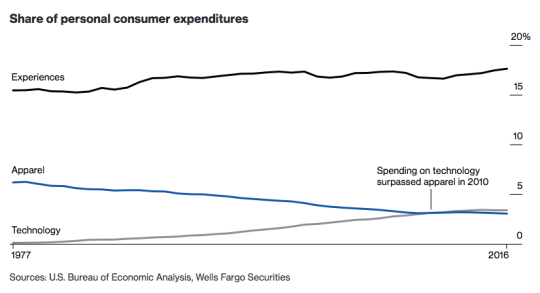
    Bloomberg recently published this interesting piece talking about the death of clothing. The reasons are as follows: we’re spending more on experiences, as well as technology (tech spending surpassed apparel spending in 2010); casual dress in the workplace has become more widely accepted; fast fashion companies like H&M and Zara are putting downward pressure on prices; and social media influencers – instead of big companies – are now the ones showing us what to buy and wear.

    Here is a graph from the article comparing experiences, apparel, and technology expenditures: 

    image

    The first thing I noticed is that experiences, while still increasing, haven’t really spiked since 1977, even though everybody seems to be talking about how social media-fueled Millennials are all about experiences. I was also surprised to see that the share of US employers that allow casual dress every day seems to be closing in on 50%. (Informal survey for the comments and for Twitter: Do you wear casual clothes to work? I’m a no.)

    But perhaps the biggest contributors to this decline are fast fashion and low-cost manufacturing. Stanley Pignal – South Asia business and finance correspondent for the Economist – pointed out on Twitter that since 1982 inflation in US apparel was only 123% compared to 248% for overall CPI. So maybe a lot of the above reasoning is just a distraction.

  • Amazon’s cashier-less grocery store finally opens

    This morning the first Amazon Go store opened to the public in downtown Seattle. It’s more convenience store than grocery store, but the big deal is that there are no cashiers and no lines.

    You enter the store through a gate and with your phone and Amazon’s app. As you walk around the store and pick up items they get automatically added to your online cart on Amazon.

    So everything goes right into the offline bag you’ll be leaving the store with. Place an item back on the shelf and it is instantly removed from your “cart.” Walk out of the store and you’re automatically charged.

    It’s not yet clear how exactly the technology works, but Amazon says that all of this is accomplished through sophisticated computer vision (cameras), machine learning, and lots of sensors. 

    What’s really remarkable is that it doesn’t rely on every product having a special chip or sensor attached to it. I would think that was one of the biggest hurdles to overcome in order to remove the pain point of grocery store lines.

    Now that this is up and running, I can only imagine the customer behavior data that they must be collecting. Heat maps of every shelf showing conversion rates for every imaginable customer segment. (Are tall people more likely to buy products displayed higher up?) Correlating people’s food purchases to their broader Amazon shopping habits. And the list, I’m sure, goes on. 

    There is even speculation that Amazon will begin licensing this technology to other retailers, similar to what it does with Amazon Web Services. That seems like a reasonable assumption given the data play we just talked about. Assuming the tech works, it’ll get copied. So they may as well embed themselves.

    In case you were wondering, the Bureau of Labor Statistics pegs the number of cashiers in the US at about 3,555,500 (2016 number).

    And this number is projected to remain more or less flat until 2026.

    That doesn’t feel right to me.

  • Waste and efficiency

    Here are a couple of cut-up snippets from a recent post by Seth Godin titled: “Waste and the new luxury.”

    Luxury goods are built on a foundation of waste.

    The front lawn is a luxury good, a sign that you don’t need to graze your cows on every square inch, and that you’re willing to waste the lawn.

    There’s a new luxury that’s occurring, though, one that’s based on efficiency.

    A luxury that’s based on investing in renewables, in resources that might be seen as endless, in smart design, in the satisfaction of knowing that others are benefitting, not paying, for the experience or the object you’re buying.

    Waste vs. efficiency.

    (Above is a photo I took this week in Dundas Square.)