Daily insights for city builders, delivered every morning at 6 AM ET. I’m Brandon Donnelly — a Toronto-based real estate developer and founder of Globizen. I’ve been writing here since 2013.

Tag: shopping

  • Amazon Dash — foolish joke or disruptive innovation?

    [youtube https://www.youtube.com/watch?v=NMacTuHPWFI?rel=0&w=560&h=315]

    Earlier this week on the day before April Fools’, Amazon launched two new services. The first was called Amazon Dash (see above video) and the second was called Amazon Home Services. The entire internet seemed to think that Dash was actually an April Fool’s joke, but it turns out it’s not. In fact, it’s actually an incredibly smart product.

    The way it works is simple. Each branded Dash Button is about the size of a pack of gum. You mount it in, on, and near things that you replace on a regular basis, such as laundry detergent, coffee refills, and so on. Then all you have to do is push the button and your order gets sent to Amazon. Shortly after the product arrives at your door. I say “shortly” because you can be certain that Amazon’s goal is to make that time frame as short as physically possible.

    I don’t know about you, but I could definitely see myself using this product. There are a number of essentials – such as laundry detergent and toilet paper – that I just hate shopping for. I have to create reminder appointments in my calendar just so I don’t forget. In fact, I did that today and I still forgot to pick everything up on my way home (my phone died).

    But what’s even more interesting about Dash, I think, is that it increases the threat to brick-and-mortar retailing and, more specifically, big box stores. Because if same day and same hour delivery is a big threat to big box stores, just imagine one button and same hour delivery. And, is it only a matter of time before something like this comes to Apple Watch? It seems like the right medium for it.

    Isn’t it interesting how something that most people believe is a silly joke could actually turn out to be a huge innovation? I try to always remain open minded. Sometimes it’s hard. But it’s good practice.
  • The value in small retail spaces

    image

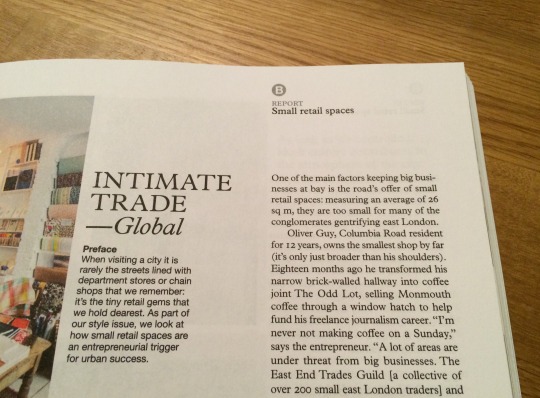
    This month’s issue of Monocle is centered around fashion, style, and retail. And one of the most interesting pieces is a report on small retail spaces. 

    The argument (which you can read in the preface shown above) is that micro retail spaces are incredibly important for entrepreneurship and urban vitality. Because if all a city has is large retail spaces, then you’re creating impossible barriers for new retail startups. The rents simply become too high.

    It’s on page 79 in case you have this month’s issue or want to go pick it up.

    After reading the article, I immediately thought of 2 posts that I recently wrote on related topics. The first is “Incubating new ideas in cities” and the second is “The hard things about retail.”

    In the first post, I questioned how cities might be able to encourage and incubate new ideas alongside new development and buck the Jane Jacobian truism that new ideas require old buildings. And in the second post, I expressed my concern for a micro retail condo complex here in Toronto that appears to be struggling.

    But maybe that micro retail complex is on to something (just with the wrong tenure: condo instead of rental). Maybe it’s as simple as starting with great urban design and small (affordable) retail spaces. 

    It seems to be working for Columbia Road in London, Knez Mihailova in Belgrade, and Tower Theater in Los Angeles (the 3 examples that Monocle gives).

  • The hard things about retail

    image

    Retail is one of the hardest – if not the hardest – real estate category to get right. If you don’t have the right setup, the right location, and the right tenant mix, you can fail pretty easily. It’s a bit of an art. And that obviously applies to both landlords and tenants. I mean, we all know what recently happened with Target Canada.

    This past weekend I had the opportunity to visit the Aura Condos in Toronto, which is supposedly the tallest and largest residential condominium in Canada. There’s about 1.1 million square feet of residential space across 79 floors and somewhere around 150,000 to 180,000 square feet of retail space (the estimates I found online varied). The main anchors include Bed Bath & Beyond, Marshalls, and Hard Candy Fitness (which also serves as the gym for the residences above).

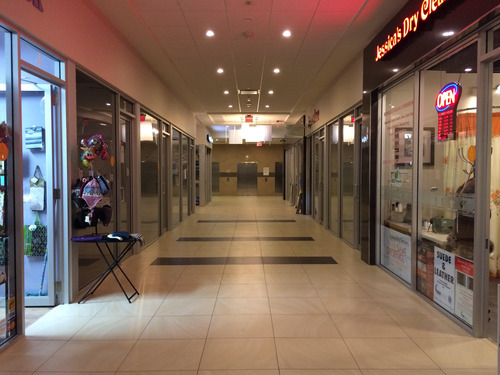
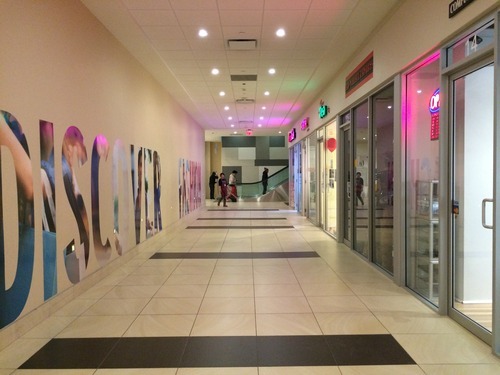
    But what’s probably most unique about the retail component of this building is the P1 level (the first underground level). It’s made up of small retail condos, some of which looked to be about 90 square feet. That means that each retail unit is individually owned, just like a residential condominium, and there’s no singular landlord focused on curating the tenant mix and ensuring the entire retail center does well.

    Now, I’m told that this approach works perfectly well in other parts of the world and I know that we’re trying it in other parts of the Greater Toronto Area, but I worry about the long term viability of this (P1) space in particular. When I was there on Saturday there was almost no foot traffic and probably half of the retail units were vacant.

    Maybe it’s because there isn’t enough employment density in the area. Maybe it’s because it’s not well connected to other P1 level retail. Or maybe it’s because the anchors all sit above this space, as opposed to around it (as they do in traditional malls). Whatever it is, I wasn’t feeling product/market fit.

    I hope I’m wrong.

    Images: P1 Retail at Aura Condos

  • Dead malls — what’s the future of offline retailing?

    image

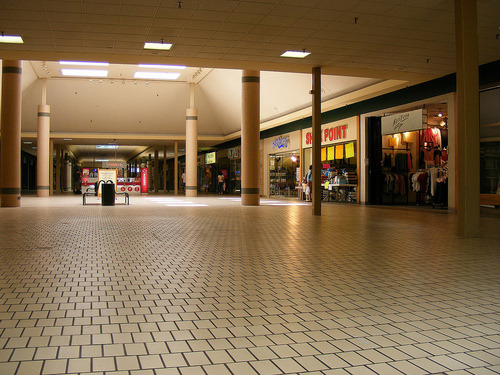
    A lot of shopping malls are dying. You’ve probably heard this before. But how bad is it and what exactly is happening?

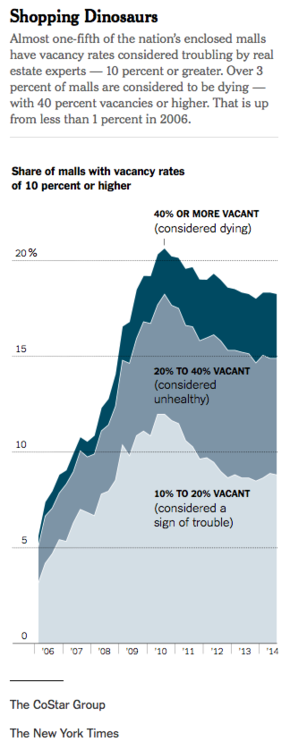
    Well, a new report by CoStar (heard through the New York Times) found that nearly 20% of the 1,200 malls in the US are presently in trouble. “Trouble” is defined as a mall with a vacancy rate of 10% or more.

    But what’s perhaps most disconcerting about this number is that, as recently as 2006, only about 5% of the malls in America would have been pegged as being “in trouble.” Here’s a chart from the New York Times (I’d love to see this same graph with a longer time horizon):

    image

    But not all malls are dying. The general sentiment seems to be that the high-end A malls are and will continue to thrive, and that it’s only the B and C malls that are dying:

    Tom Simmons, who oversees the mid-Atlantic shopping center division of Kimco, another real estate giant, is more blunt. “There are B and C malls in tertiary markets that are dinosaurs and will likely die,” he said, but “A malls are doing well.” (NY Times)

    So why is this happening? Some think it’s because the US is over-retailed. And some think it’s because of rising income inequality – which would explain why the high-end malls continue to thrive. But the experts seem to agree that it’s not the result of more people shopping online:

    One factor many shoppers blame for the decline of malls — online shopping — is having only a small effect, experts say. Less than 10 percent of retail sales take place online, and those sales tend to hit big-box stores harder, rather than the fashion chains and other specialty retailers in enclosed malls. (NY Times)

    I wrote a post 2 months ago where where I argued that big box stores will be the most impacted by online shopping (which is why so many of them now sell groceries). But I don’t believe that they are the only retailers that will be affected. Quite the opposite: Every retailer is or eventually will be impacted by the internet.

    This threat is real.

    Millennials have no hesitations about buying things online and, in many cases, they would prefer to do so. It has already been well documented that we (I’m a Millennial) don’t like driving as much as previous generations. So what makes you think we’d enjoy the process of driving to a mall?

    But the other factor at play, I think, is that malls are no longer the “public space” of young people. Their position as a kind of cultural institution is waning. At the same time, more and more people are craving uniqueness. They like independent shops, not malls that all look and feel the same. And as these young people become old people, we might find that even the A malls start becoming impacted.

    I don’t believe, for a second, that retail nodes within cities will ever disappear. But I think our attention would be better spent figuring out what the mall of the 21st century will be, as opposed to hiring PR firms to try and spin doctor our way out of this dead mall phenomenon.

    Image: Flickr

  • Shopping: offline vs. online

    According to Sequoia Capital, Americans spent $4 trillion on retail shopping last year – 95% of which was still done in traditional brick-and-mortar stores. I’m actually a bit surprised by how high this number is. I would have thought that a larger percentage of people would be shopping online.

    For me personally, I’d say that my split might be close to 50/50. From furniture to clothes, to even a new bicycle, I buy a lot online, come to think of it. Part of the reason is convenience, but the other reason is that I like having easy access to a broader selection.

    About the only thing I really prefer buying in person is groceries. However even there I’ve been exploring ways to regularize shipments of the items I typically buy. I can’t recall where I read it, but I remember seeing something about less than 1% of groceries in America being bought online.

    Intuitively, the percentage of online sales is only going to rise, particularly given the shift to mobile. Consumers can now shop anytime, anywhere. Real estate companies and retailers certainly need to pay attention.

    But just like the internet didn’t make cities irrelevant, I don’t think it’ll make shopping in person completely extinct. As Sequoia Capital points out in its article, mobile phones are creating new opportunities at the intersection of online and real world shopping.

    So while I don’t know what the future online/offline split might be, I suspect that the two worlds will continue to blur together. I might buy a bicycle online, but when it comes time to service it, I’d like to be able to bring it into a store.