Daily insights for city builders, delivered every morning at 6 AM ET. I’m Brandon Donnelly — a Toronto-based real estate developer and founder of Globizen. I’ve been writing here since 2013.

Tag: seattle

  • Seattle vs. Vancouver

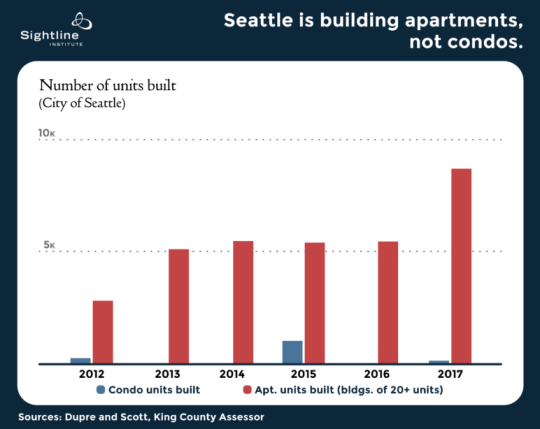
    A reader recently shared an article with me called: Why Seattle builds apartments, but Vancouver, BC, builds condos. Thanks for that.

    It’s a good summary of the differences between these two markets and why over the last five years less than 4% of all new residential units built in Seattle have been condos. The story is obviously very different in Vancouver.

    It’s also a good reminder that incentives matter. Capital has a funny way of flowing to where the returns are greatest.

    Chart: Sightline Institute

  • Crane capital of America

    When people like Richard Florida talk about today’s “superstar cities”, the usual suspects include London and New York for finance, the San Francisco Bay Area for tech, Milan for fashion and design, and so on.

    And you can certainly find the data to back up these claims. For instance, if you look at venture capital dollars invested, many of these same cities reappear near the top: San Francisco, San Jose, New York, etc.

    One city that doesn’t often appear on these sorts of lists, though, is Seattle. 

    However, clearly something special is taking place in the city. For the second year in a row, Seattle has been named the construction crane capital of America. No other American city comes close right now. (However, Toronto is still #1 in North America.)

    At the same time, if you think about all of the companies that have come out of Seattle over the years, you start to realize that maybe VC dollars invested isn’t enough to tell the entire entrepreneurial story.

    Venture capitalist Fred Wilson once said on his blog that if you look at dollars in and dollars out, Seattle outperforms – by a lot. And that’s very interesting to me. Is this simply the lasting legacy of Microsoft? Or are there other – transferable – lessons to be learned here?

  • Follow the sun and sprawl

    image

    The U.S. Census Bureau recently released it’s 2016 city and town population estimates. The press release can be found here.

    The headline isn’t a new one. Southern cities continue to grow quickly. This is not a new trend. Humans seem to like warm weather and the housing supply in southern cities tends to be more elastic. This keeps home prices relatively in check and allows the cities to more easily accommodate growth.

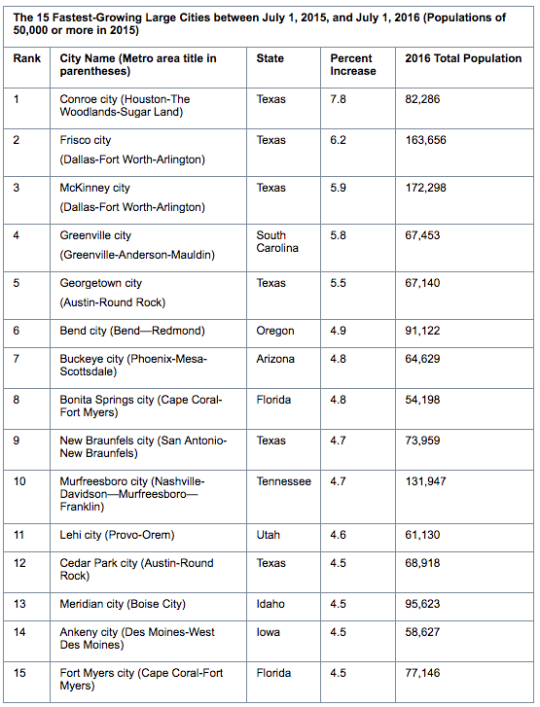
    From July 2015 to July 2016, 10 of the 15 fastest growing large U.S. cities were in the south (based on % growth). 4 of the top 5 were in Texas. 

    From 2010 to 2016, the population in large southern cities grew an average of 9.4%. Cities in the west clocked in at 7.3%. And cities in the northeast and midwest were at 1.8% and 3.0%, respectively.

    Two outliers near the top are Seattle and Denver. Since 2010, the population of these two cities grew 15.39% and 14.87%, respectively. I’m going to say it’s because of the skiing and snowboarding. Half-joking. For the top 25 large cities ranked by 2010-2016 growth rate, click here.

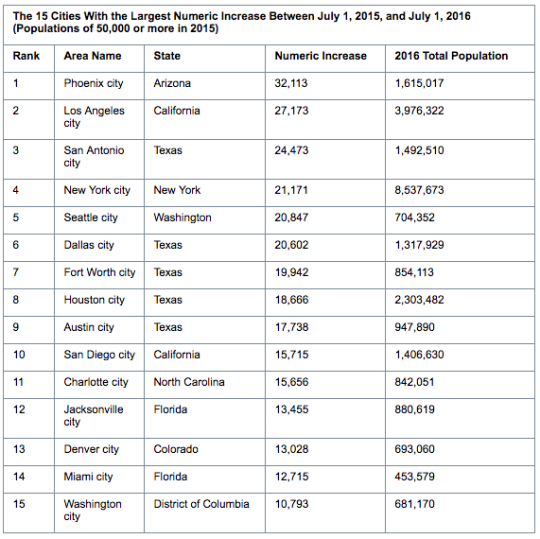
    In terms of absolute humans, Phoenix had the largest numeric increase between 2015 and 2016: 32,113 or about 88 people per day. After Phoenix it’s Los Angeles (27,173), San Antonio (24,473), New York (21,171), and Seattle (20,847). These are all city proper figures.

    It’s also worth noting which large cities aren’t growing. From 2015 to 2016, Chicago fell -0.32% and Detroit fell -0.52%. Philadelphia was only slightly positive at 0.19%. Going back to 2010, Chicago is still flat at 0.27% and Detroit is even more negative at -5.39%. Philadelphia is 2.5%.

    Follow the sun and the sprawl.

    The below charts are from the United States Census Bureau.

    imageimage

  • Is radical rezoning the solution to gentrification and displacement?

    image

    “If I meet one more anti-gentrification activist who moved to Seattle ten minutes ago, I shall scream.” –Dan Savage

    So it’s not just developers who are frustrated by the many paradoxical desires that we have of cities. We are concerned about housing affordability and we want to minimize displacement, but we do things that restrict new supply and put increasing pressure on our existing housing stock. 

    Below is another excerpt from Dan Savage. It’s from an article called: Doing Something Real About Gentrification and Displacement. Dan writes a sex-advice column, but clearly also feels passionate about urban issues. When he talks about “this city” he’s talking about Seattle.

    “Housing scarcity—exacerbated by the ridiculous amount of this city zoned for single-family housing—deserves as much blame for the displacement crisis as gentrification. More. And unlike gentrification (“a once in a lifetime tectonic shift in consumer preferences”), scarcity and single-family zoning are two things we can actually do something about. Rezone huge swaths of the city. Build more units of affordable housing, borrow the social housing model discussed in the Rick Jacobus’ piece I quote from above (“Why We Must Build”), do away with parking requirements, and—yes—let developers develop. (This is the point where someone jumps into comments to point out that I live in a big house on Capitol Hill. It’s true! And my house is worth a lot of money—a lot more than what we paid for it a dozen years ago. But the value of my house is tied to its scarcity. Want to cut the value of my property in half? Great! Join me in calling for a radical rezone of all of Capitol Hill—every single block—for multi-family housing, apartment blocks and towers. That’ll show me!)”

    His overarching point is that lots of highly-educated people with money are choosing, today, to live in urban centers. And whether we like it or not, that is going to cause gentrification. We can’t stop that. But what we can do is try and alleviate housing scarcity. 

    His other solution involves building lots of transit to address geographic isolation. I agree with him on this point and I’ve argued it before on the blog. If we can all agree that one of the issues is land/housing scarcity, then transit is certainly another way to “pull in” new supply. Though I think we need to be realistic about the level of service required to make areas desirable.

    If you have a few minutes, check out Dan Savage’s article. It’s a good and entertaining read.

  • Case Study: Chophouse Row, Seattle

    The Urban Land Institute recently published an interesting case study for a project in Seattle called Chophouse Row

    It is the last phase in a series of projects that the developer, Liz Dunn, has been involved with in the neighborhood over the last 16 years.

    This particular project has 25,317 sf of office, 6,379 sf of retail, and 4,795 sf of residential (3 penthouses). It also incorporates a heritage building. Good example of fine-grained urban infill.

    Here is the video (click here if you can’t see it below):

    [youtube https://www.youtube.com/watch?v=_PmAMsWEv98?rel=0&w=560&h=315]

    On a related note, ULI’s 2017 Toronto Symposium is coming up later this month (April 24 – 25, 2017). Here is the program. 80+ speakers. If you’d like to register, you can do that there.

  • Where the cranes are

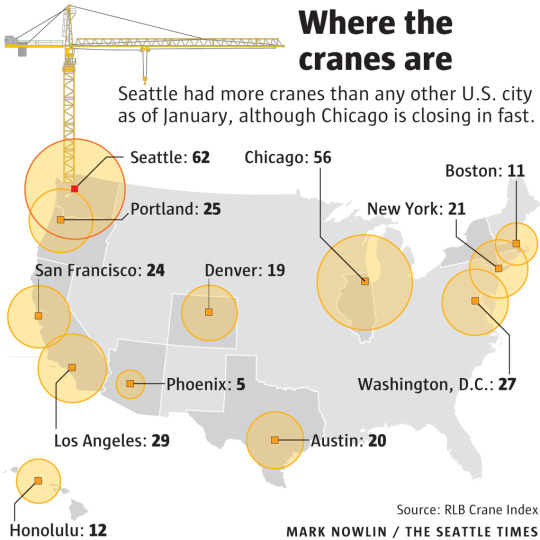
    Earlier this week the Seattle Times published the following graphic showing the US cities with the most (construction) cranes up in the air at the end of 2016:

    At the top of the list is Seattle with 62. And in second place is Chicago with 56. 

    You really need to see these numbers over time to get a better sense of activity. But supposedly, Seattle has been holding pretty steady. Also, these numbers only include cranes within each city proper. The suburbs don’t seem to be counted.

    To put these numbers into perspective, here’s a snippet from the article:

    “Seattle remains behind Toronto, which has 81 cranes, for the North American lead. In Australia, the Middle East, and elsewhere, there are cities where more than 100 cranes are at work.”

    I wonder which city has the global lead. Any guesses?

  • Ian Gillespie: It’s not about business

    The founder of Westbank, Ian Gillespie, recently sat down with Bloomberg TV to discuss the Toronto and Vancouver real estate markets; his Mirvish Village (Honest Ed’s) redevelopment project; affordable housing; and the markets he is and plans to be focused on (Vancouver, Toronto, Seattle, Tokyo, San Francisco).

    I like the part where he says that he’s really not that interested in business.

    If you can’t see the video below, click here.

    https://www.bloomberg.com/api/embed/iframe?id=6542ca85-017c-436e-aefc-25d8f4bb9b66

  • Vancouver-Seattle

    The New York Times has an interesting article up talking about how Vancouver and Seattle are trying to more closely align themselves and create a unified tech corridor. 

    BC premier Christy Clark and Washington governor Jay Inslee recently signed an agreement to that effect, which included more research collaboration between the University of British Columbia and the University of Washington.

    Seattle wants this because its companies need talent (read: foreign workers) and Vancouver’s borders are more open. Vancouver wants this because its tech industry is relatively small (go Hootsuite!) and it could benefit greatly from being more proximal to Seattle.

    On a side note, Seattle is an interesting case study. In terms of venture capital dollars invested, it is below top tier cities such as San Francisco, New York, Boston, and so on. But in terms of the companies it has birthed (Microsoft, Amazon, Zillow, Expedia…) it is certainly a heavy hitter.

    One of the key factors will be physical connectivity. There’s talk of high speed rail and/or a dedicated lane for autonomous vehicles. However it’s done, I think bringing this trip to < 1 hour would be the ideal scenario. There’s a psychological barrier beyond that.

    If any of you live/work in either of these cities today, I would be curious to hear your thoughts.

  • Thoughts on inclusionary zoning

    Ontario is looking to pass legislation that would allow municipalities in the province to implement something known as inclusionary zoning. If passed and should municipalities decide to use this tool (Toronto almost certainly would), developers would then be required and/or incentivized to include some percentage of affordable housing in their new market rate developments. 

    Politically, inclusionary zoning tends to be popular. It’s believed to be a way for governments to create new affordable housing using relatively small public subsidies. Not surprisingly though, the development industry generally hates IZ. It’s another cost that needs to be added to the development pro forma – though some municipalities rightly offset these additional costs with additional density, breaks on levies, and so on.

    What I always think about when this topic comes up is the broader economic impact of the land use policy. Because I’m suspect that it’s as simple as: mandate affordable housing; get more affordable housing for free. Generally there are always trade-offs.

    So here’s some reading material for you all this morning.

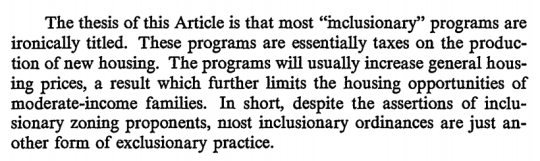
    In a classic paper (1981) by Yale Professor Robert C. Ellickson – called The Irony of Inclusionary Zoning – he argues that these practices can actually increase general house prices:
    image

    As a counterargument Owen Pickford over at The Urbanist argues that IZ simply reduces land prices as a result of the new tax. Land, after all, is the residual claimant. Therefore, he believes it’s an effective affordable housing policy. (I’m not so sure I believe that land prices would decrease in practice.)

    There’s also debate about the effectiveness of inclusionary zoning to actually deliver affordable housing at a meaningful scale. City Observatory wrote a post that looked at the total number of units produced (through IZ) across a number of American cities and the results were spotty. It should, however, be noted that not all inclusionary zoning policies are mandatory.

    Finally, the Furman Center for Real Estate & Urban Policy at New York University published a housing policy brief back in 2008 that looked at this exact topic. While they admit that the data is scarce, they come to the conclusion that IZ had no meaningful impact on the prices and production of single-family housing in San Francisco, but that IZ seems to have slightly decreased production and slightly increased pricing in the suburbs of Boston.

    What this last point suggests is that inclusionary zoning policies are not all created equal. So like all difficult questions, the answer to this one is likely: it depends. If anyone can point me to better data on inclusionary zoning, I would love to see it.

  • Rethinking the backyard from Seattle to Toronto

    RobCasey iphone lorens house by Rob Casey on 500px.com

    https://500px.com/embed.js

    The Urbanist recently published a guest post, called Let Us Build Backyard Cottages, that sounds a lot like a post I wrote a few years ago, called Why It’s Next to Impossible to Get a Laneway House Built in Toronto.

    It’s the same story: buy house; see opportunity to build low-cost well-designed backyard cottage (or laneway house); discover the countless obstacles in front of you; give up until the land use policies become more favorable.

    Here’s the Seattle version of the story (via The Urbanist):

    I bought my home in 2014 with the intent of building a backyard cottage on the property. The property is a mere 4,080 square feet, with a large flat backyard that is mostly wasted space. The plan was to buy a small, prefabricated, and super-insulated (to Passive House standards) house. We would install it and move into it while we brought the main house up to Passive House standards as well, adding insulation and ventilation. We would then move into the main house while my parents (who are currently living on the East Coast, and want to move closer to us) move into the backyard cottage.

    Unfortunately, Seattle’s backyard cottage requirements proved too onerous for us to move forward with building one. The requirement of an additional parking space was a bit irritating (especially considering that my family lives car-free near the future Roosevelt light rail station), despite the fact that we do technically have two parking spaces. But more frustrating than that, it was the owner-occupancy requirement that made us scrap our backyard cottage plans.

    What I find interesting about all of this is that the same narrative is happening in multiple cities, from Seattle to Toronto. That, again, suggests to me that change is likely inevitable. Especially since Seattle seems further ahead in this regard compared to Toronto. Change is happening.

    Of course, there are differences between accessory dwelling units (what The Urbanist wrote about) and independent laneway housing (what I wrote about). But I would classify them as being in the same family of urban change.

    Most North American cities are clinging to a specific kind of single family housing typology. I can appreciate why. But I believe that there will be a tipping point.

    I’m not sure that this year will be the year. Which is why I didn’t include laneway housing in my list of 10 city building predictions for 2016. But I think it will happen in the shorter term.