Daily insights for city builders, delivered every morning at 6 AM ET. I’m Brandon Donnelly — a Toronto-based real estate developer and founder of Globizen. I’ve been writing here since 2013.

Tag: scooters

  • Are shared e-scooters now dead?

    I first wrote about Bird, the electric scooter company, back in March 2018. At the time, they had just raised $115 million and their pitch was that they were going to solve the last-mile mobility problem. This is a real problem, and so lots of urbanist-type people, including myself, were excited. I then rode my first shared scooter in 2019 in Lisbon, and I had a ton of fun. I wrote: “Now I know what all the fuss is about.”

    But it wasn’t all puppy dogs and ice cream. People started getting annoyed by the clutter that dockless scooters were creating in our cities (see above photo). Safety also became a great concern, and so they started getting viewed as a nuisance. Toronto never allowed them (despite my insistent blog posts) and Paris — which had arguably become the scooter capital of the world — banned them in early 2023.

    Now there’s this: Bird announced this week that it has filed for bankruptcy. The once unicorn, which had its stock halted back in September because its market cap fell below $15 million for too long, needs cash. According to FT, they have about $3.25 million the bank, but they have an immediate need for $16.8 million to meet some “financial obligations” in January.

    This is maybe not unexpected. But I think the important question is: Is this an existential moment for micro-mobility and shared scooters (i.e. this is a fundamentally bad business), or is it more of a case that money used to be mostly kind of free, and now it’s not? Either way, I think there’s no question that the latter is going to cause further distress throughout 2024.

    But the question remains: Can shared scooters be a sustainable business?

    My day job is not to be a scooter analyst. But I do think that a number of things are true:

    These first and last points are important ones. I believe it’s always going to be easier to get people onto electric scooters and bikes than onto regular bikes; people will generally always choose what is easiest. At the same time, here is a company that has allegedly figured out how to offer this service profitably. Assuming these two things remain true, I think we’ll continue to find scooters in our cities.

    Photo by Gemma Evans on Unsplash

  • Should Paris ban electric scooters?

    This Sunday, Paris will be hosting an important referendum that has nothing to do with France’s retirement age. The question is whether shared electric scooters should be banned citywide. And while there are concerns about whether this single-question referendum will draw many people out to vote, the city has said that, whatever the outcome, the results will be binding.

    To be clear, this would only apply to the three micromobility rental companies that operate in the capital: Lime, Dott, and Tier. It would not apply to privately-owned scooters, of which there are many. In fact, France might just be one of the scooter capitals of the world. Over 900,000 scooters were purchased across France in 2021, and last year the number was about 759,000.

    Mayor Anne Hidalgo has publicly said that she thinks these scooters should be banned. But does that really solve things given the number of private scooters in circulation? And are the current problems truly ones we can’t solve? As I have said many times before, I like scooters. I like them a lot. They’re convenient and fun to ride, and I see their value in helping to solve the last-mile problem.

    I also can’t help but think back to the early 1900s when cars were just starting to infiltrate our cities and there were absolutely no traffic regulations to think of. It was chaos, it was dangerous, and I’m sure it was similarly divisive at the time. So should we have banned them and stuck with horses? Hmm. Maybe.

  • Micromobility ridership in the US from 2010 to 2021

    The National Association of City Transportation Officials (NACTO) has just published this report on shared micro mobility in the US from 2010 to 2021. And it’s a good look at how this space has evolved over the years. According to the report, the first modern North American bike share system was installed in Montréal in 2009 and the first in the US was in 2010. Though a quick Google search has Washington DC claiming this title in 2008.

    Whatever the case may be, bike share ridership started somewhere around 321k per year in the US and trip volume is now close to 50 million per year. Electric scooters also joined the mix in 2018, and 2019 was a banner year for this mode of transportation. The report suggests this was due to cheap VC money subsidizing these rides. Electric scooters have seen their average trip cost 2x between 2018 ($3.50) and 2021 ($7), despite the average trip distance remaining more or less flat (1.3 to 1.2 miles).

    Naturally, the pandemic was bad for shared mobility. But it is interesting to see how much this space has rebounded and how resilient it seems to be. Prior to the pandemic, bike share usage had clear morning and evening peaks, coinciding with people commuting to work. Since then, we have seen a shift to both a wider range of trips (i.e. to do things like get groceries) and more trips throughout the day.

    To download a full copy of the report, click here.

  • Bikes and property in Paris

    I have been reading Fred Wilson’s blog for over a decade now (and he has been blogging for almost two decades). A lot of the time it is about venture capital and tech, but similar to what I do here, it can be about almost anything. Today he wrote about the two weeks that he just spent in Paris with his wife (the Gotham Gal). And the post covers everything from real estate to relationship advice. But here are two points that will be particularly relevant to what we usually talk about around here:

    • Paris has done an excellent job of prioritizing cycling and building a ton of new lanes over the last number of years. We know this. But another good point that Fred makes is that Paris has allowed competition in their micro-mobility ecosystem. It started with Velib, but now you can also use Dott and Lime. The last time I was in Paris I used Lime bikes and scooters, mostly because I already had the app and because they were everywhere. Competition is good and Toronto should probably allow the same. Our bike share system — specifically the mobile app — is incredibly cumbersome to use, and the last time I checked most of the e-bikes were consistently out of service. Let’s see if someone else can do a better job. We should, of course, also add scooters to the mix while we’re at it.
    • Next, Fred describes Paris’ real estate market as being more “stable.” And by this he means that, for whatever reason, values and rents seem to be more moderated. This has some benefits. Restaurants and other retail businesses seem to stick around for decades, whereas according to Fred, “it’s hard to find a shopping street in Manhattan that doesn’t have multiple vacant stores”. I’m not exactly sure why this is the case in Paris (assuming it is). I don’t believe that they have any sort of vacant store tax. Though they do have a tax on unoccupied homes. Maybe this is just what happens when you’re a little less capitalistic. (This is me deliberately avoiding the term socialism.)

    If any of you have more insight into the real estate market in Paris, I would love to hear from you in the comment section below.

  • The new mobility landscape

    McKinsey published a report last month on the future of electric vehicles and what that will mean for the industry. Many countries, cities, and companies have set some sort of electrification target for 2030. The US is targeting 50% EVs by 2030. Several countries have announced a flat-out end to ICE sales by 2030. And a number of OEMs have committed to the same.

    But there are already cities, such as Oslo, which have reached EV majority. In July of this year, its passenger EV adoption figure was 66%, making Norway a global leader. What is clear is that the electrification of personal transport is well underway. Anecdotally, we are seeing that play out with the number of people now inquiring about electric charging infrastructure in our buildings (here in Toronto).

    This move to electric will have many repercussions, including a major shift in the entire supply chain (which McKinsey outlines in their report). While ICE vehicles and EVs still both have things like tires, EVs require a whole slew of new and now growing components:

    It is also going to force new public infrastructure:

    But in parallel to the electrification of personal vehicles, we are also seeing a number of other trends and shifts. The electrification of public transport (Shenzhen has already electrified its entire bus and taxi fleets). The rise of micro-mobility (things like e-scooters). The ongoing push to discourage driving in urban centers. And the continuing goal of autonomous vehicles.

    What all of this suggests to me is that the electrification of personal vehicles is only part of the story. The entire mobility landscape in our cities is changing and it will probably look a lot different by 2030.

  • The reversion of European cities

    This recent Economist article makes the argument that, despite the recent (and sometimes annoying) proliferation of electric scooters across Europe, we probably shouldn’t be that grouchy about them. And that’s, “because the rise of the electric scooter is part of a broader and welcome phenomenon: the gradual retreat of the car from the European city.” By way of one example, by next year, Paris will have grown its bike lane network by 50% in five years.

    The article ends with the point that, while this may seem like a “revolution,” it’s actually a “reversion.” European cities such as Paris and Antwerp (examples from the article) were both built before the advent of the car and were never really designed for it, although Haussmann’s wide avenues certainly helped. All of this gets back to a point I tried to make over the weekend with this post about driving and parking, and the relevance of urban form.

    Reversion is a lot easier than a revolution. And for most North American cities, a revolution is what’s needed if we are in fact serious about a post-car future.

    Photo by Z Klein on Unsplash

  • My first dockless scooter ride

    I now know what all the fuss is about. Yesterday I rode a dockless (Lime) scooter for the first time. I took in lieu of an Uber in order to get to the Museum of Art, Architecture, and Technology (MAAT) on Lisbon’s waterfront.

    Here’s another photo from my ride:

    We don’t have these scooters in Toronto, but I understand they are imminent. And now that I’ve used one — and learned how shockingly fun they are — I can see why they are proliferating across so many cities.

    They’re a solution to the last mile problem, but they’re also fast enough (20 km/h) that they can be a substitute for other forms of urban mobility, as was the case for me yesterday. I can also see myself using one to get to the office when I would rather not sweat through my suit.

    Of course, there is the much talked about problem of scooters as urban litter. It’s a real thing and I am seeing that firsthand here in Lisbon. Because they are dockless, people leave them anywhere and everywhere. At the same time, part of what makes them so convenient is that, well, you can leave them anywhere and everywhere.

    I’m confident there’s a tidier solution that doesn’t involve fixed docking stations. Geofencing, perhaps? Cars are “dockless” and we’ve sort of figured that out. Many cities are already working on and experimenting with different solutions. Here’s an example from Tel Aviv. I have also noticed a natural clustering effect.

    I’m not sure how good of a business they will prove to be. The barriers to entry seem fairly low right now. You just need some Chinese scooters and an app, which is why I am noticing so many competing companies. But as the market matures, increased regulation could change this.

    We are going through a period of growing pains and it’s not particularly elegant. However, I believe we’ll get there. So I am looking forward to riding these scooters when they do finally land in Toronto.

  • Lyft reveals plans for bikes and scooters

    On Monday, John Zimmer and Logan Green, the co-founders of Lyft, published this Medium post announcing their “approach to partnering with cities to introduce bike and scooter sharing” to their platform. 

    “Approach to partnering with cities” is undoubtedly a carefully chosen set of words given all the backlash going on right now around dockless scooters.

    Nevertheless, this is an exciting announcement. I could have used a scooter this afternoon to get to a meeting. And this is all part of their larger goal of transforming Lyft into a multi-modal platform – one that will also support conventional public transit.

    Here is an excerpt from the Medium post:

    Transit, bikes, small electric vehicles, and infrastructure such as safe pedestrian paths and bike lanes, all play a large role in decoupling people’s right to mobility from car ownership. We know we can’t accomplish this alone, and we’re committed to working with cities and residents to bring these elements together in the most cohesive way to maximize a reduction in vehicle miles traveled.

    The company has also set the goal that 50% of all trips on the Lyft platform will be shared rides by 2020. It is yet another example of the lines between public transit and ride sharing apps becoming blurrier. 

    Full post can be found, here.

  • Going dockless

    A couple of months ago I wrote about Bird, the electric scooter sharing company that is trying to solve the last-mile problem. They are expanding across the US and it is seemingly wildly popular.

    But its popularity is also leading some people to call them a public nuisance. Perhaps the biggest contributor to that is the fact that the system is dockless. That is, when you get to your destination you can park the Bird wherever you want.

    That’s obviously a great feature for users (who wants to look around for a docking station?), but it’s also causing a proliferation of “Bird litter” in the cities and neighborhoods where they are widely used. 

    I am sure this will eventually get resolved.

    The other thing about going dockless is that you now have a charging problem. Where and when do these scooters get charged and by whom? Bird solves this problem through decentralized contract workers called “Bird hunters.”

    You register to be one and then Bird pays you $5 to $20 for every scooter charged, depending on how difficult the Bird is to find. And as you can expect, these scooters are getting left all over the place.

    I thought this was a clever solution. And apparently it is popular with high school students looking to earn extra cash. Some are making several hundred dollars a day by spending their evenings picking up and dropping off Birds.

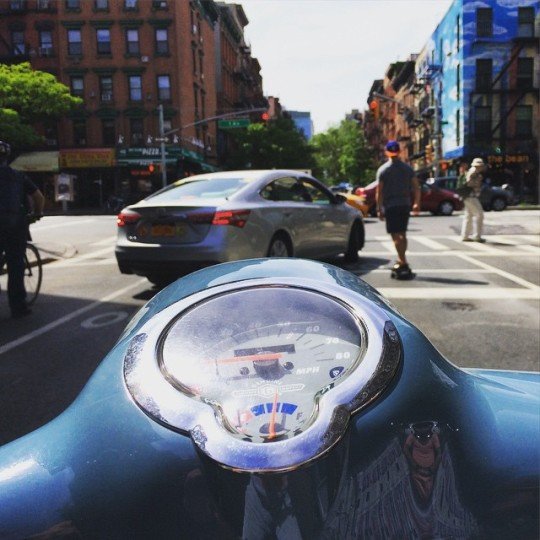
  • Scootering around New York City

    image

    I am writing this post on a Porter flight from New York back to Toronto.

    For my last day in New York, my close friend and I rented scooters and rode all around Manhattan and Brooklyn. It was a great way to cover a lot of ground, but also a great way to still absorb the city. It’s harder to do the latter in a car and I never have any desire to drive in New York.

    Because the great thing about New York is that as a pedestrian you feel like you control the streets. When you’re waiting at a crosswalk, you’re never actually waiting. You walk off the sidewalk and onto the street so that you can assert yourself in front of the cars and wait for an opening. This serves to narrow the portion of road that the cars can actually drive on and reminds the drivers who is boss.

    At the same time, there are many instances throughout the city where New York has purposefully reallocated the space dedicated to pedestrians (and cyclists) and the space dedicated to cars. They’ve created new public spaces, widened the areas where people can walk, and seemingly blanketed the city with bike lanes. And that makes a lot of sense given that in many (most?) areas of the city, pedestrians greatly outnumber cars.

    So does that mean New York is at war with the car? (I’d be curious to know – in the comment section below – if those kinds of discussions take place in the city.)

    I suppose you could spin it that way. But New York also does things for cars. While riding around on the scooter today, I was so impressed by how well timed the streetlights were along the avenues. It made it incredibly easy to go downtown or uptown. In Toronto, I often feel like we time our lights to make driving as slow as possible.

    But make no mistake; New York is not a driving city. 

    New York is about walking, biking, taking transit, and hailing cabs. There is a reason they have the highest transit ridership in the US. The city is built for it. And unless driverless cars and ride sharing completely changes the equation, I will continue to believe that transit is the most efficient backbone for any big city.