Daily insights for city builders, delivered every morning at 6 AM ET. I’m Brandon Donnelly — a Toronto-based real estate developer and founder of Globizen. I’ve been writing here since 2013.

Tag: san francisco

  • US cities with the most corporate HQs

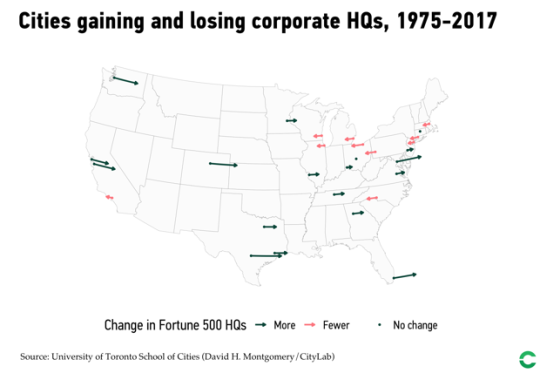
    The University of Toronto School of Cities recently looked at the changing economic geography of Fortune 500 companies across the US from 1975 to 2017. Here is a diagram of the results taken from CityLab:

    New York sits at the top with 70 corporate headquarters as of 2017. But the San Francisco Bay Area is now the second largest center with 35 headquarters – a testament to tech.

    The study does, however, omit service firms, as these weren’t tracked in Fortune’s list back in 1975.

    Also noteworthy is the specialization that has taken place across specific cities and regions. Here is another excerpt from CityLab:

    America’s headquarters geography reflects the substantial variation and specialization of the U.S. economy. New York leads in finance and business services, consumer services, and goods and materials. But Houston leads in energy, San Jose in tech, and Chicago in retail and wholesale. Chicago also ranks second in consumer services, and goods and materials, and Dallas takes third in energy. Other cities like Nashville and Minneapolis take third in consumer services, and goods and materials, respectively.

    The full article can be found, here.

  • San Francisco’s tax for the homeless

    Proposition C will be on San Francisco’s ballots this November 6th, 2018. 

    If approved by voters, the following additional taxes would be levied on businesses in order to create a dedicated fund to both support and prevent homelessness in the city:

    For businesses that pay a gross receipts tax, an additional tax of 0.175 percent to 0.690 percent on those gross revenues in San Francisco over $50 million;

    For businesses that pay the administrative office tax, an additional tax of 1.5 percent of their payroll expense in San Francisco.

    Marc Benioff – the founder of Salesforce (which happens to be the city’s largest employer) – has emerged as the lead supporter of Prop C. Between personal and corporate funds, he has contributed almost $8 million to getting this passed.

    But other billionaires in the Bay Area, such as Jack Dorsey of Twitter, have taken a different position, instead siding with Mayor London Breed, who does not support Prop C. 

    If you’re interested in this topic, the New Yorker has a piece called, The Battle of the Big-Tech Titans Over San Francisco’s Tax for the Homeless

  • Average age of a first-time mother

    image

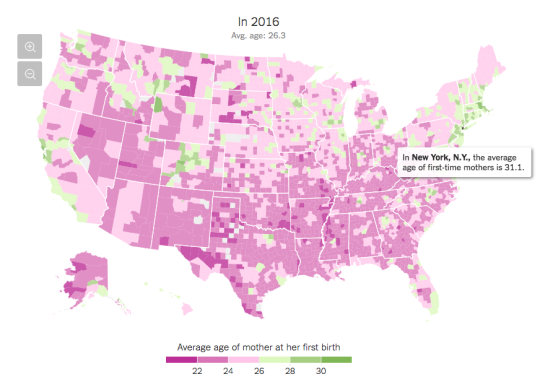
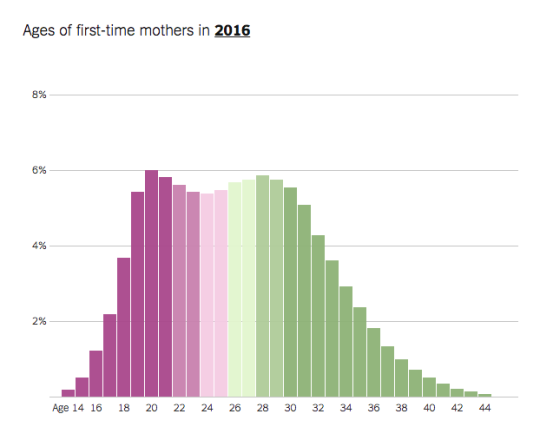
    According to a recent study in the New York Times, the average age of a first-time mother in Manhattan is 31.1 years old. In San Francisco County, the number is nearly 32. And in the US as a whole, it was 26.3 in 2016.

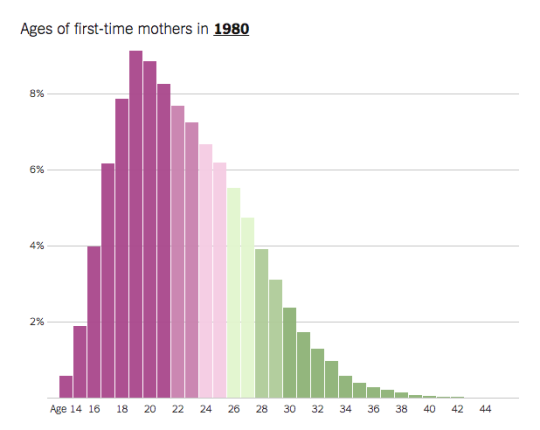
    This is what the national distribution looked like in 1980:

    image

    And this is what it looked like in 2016:

    image

    Perhaps not surprisingly, the biggest factor influencing the age of a first-time mother is education. Becoming educated and building a career takes time. First-time mothers tend to be older in big cities (particularly on the coasts) compared to rural areas.

    The concern that researchers have with all of this is that it is symptomatic of growing inequality. Scrolling over the NY Times’ map, it would appear that there’s nearly a 10 year gap between the coasts and many parts of the country.

    On the one hand you have people who are finishing high school and having kids fairly soon after. And on the other hand, you have people going to college, establishing their career, and waiting, in some cases a decade, to have kids.

    This is significant because it can create a virtuous circle (excerpt from article):

    “A college degree is increasingly essential to earning a middle-class wage, and older parents have more years to earn money to invest in violin lessons, math tutoring and college savings accounts — all of which can set children on very different paths.”

    Unequal childhoods can lead to unequal outcomes.

    Images: New York Times

  • Housing supply and displacement in San Francisco

    Joe Cortright recently wrote about a study by Kate Pennington (UC Berkeley), which looked at the impact of housing production on legal eviction in San Francisco. The goal was to figure out if new housing supply actually causes displacement.

    To do this, Pennington went block-by-block and looked at new housing projects, as well as over a decades’ worth of eviction notices. 

    The relationship between the two was found to be “statistically indistinguishable from zero.” In other words, the “monthly probability of an eviction notice” does not change when new housing supply is completed nearby.

    Some have been critical of her findings and some have questioned whether legal eviction notices are, in fact, the right proxy for displacement.

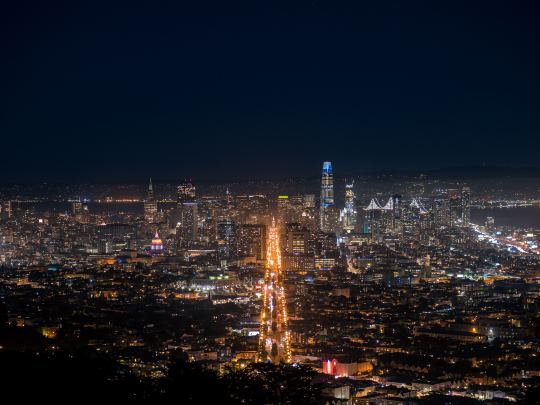
    But I agree with Joe Cortright in that this still feels like a meaningful relationship to understand, especially when we’re talking about a tight housing market like San Francisco’s.

    Photo by Matthew Cabret on Unsplash

  • Limits of housing affordability

    The San Francisco Chronicle recently published an article called, “SF residential projects languish as rising costs force developers to cash out.” It talks about the impact that rising costs (both construction and other) are having on new housing supply. Some developers aren’t building even though may have entitled sites. And that’s because the math doesn’t work, even though we’re in a market with a severe housing shortage.

    Here is an excerpt from the article that talks about the kind of pricing that is needed in order to make a project work:

    Chris Foley, a real estate investor and partner in brokerage firm Polaris Pacific, said that in the current construction environment a condominium developer needs to sell units for at least $1,400 a square foot for a wood-frame building and $1,800 a square for a taller, steel-frame midrise or high-rise. Even in a city where more than 80 percent of the population is priced out of the market, those numbers are a stretch, Foley said.

    San Francisco also has inclusionary zoning, which requires a certain percentage of units in any new development to be priced below market. According to the article, it is 18% for new rental projects and 20% for new condo projects. That’s a cost that needs to be absorbed by the remaining market rate units – so price accordingly. 

    The MIRA tower designed by Studio Gang is currently under construction and has 156 affordable units and 393 market rate units. The market rate pricing looks something like this:

    That’s the case with three buildings rising near the new Transbay Transit Center: Mira, the Avery at 400 Folsom St., and One Steuart Lane, which overlooks the Embarcadero at the foot of Howard Street. Unless there is a remarkable drop in the market, units in all three of those buildings will probably have an average sales price of more than $2,000 a square foot and penthouses could fetch $3,000 or even $4,000 a square foot. A 3,326-square-foot penthouse at 181 Fremont St., which opened last spring, recently sold for $15 million, or $4,500 a square foot.

    Projects being squeezed by rising costs is something that we are also seeing here in Toronto. And I don’t believe that the general public fully appreciates that there are limits to the costs that can be shouldered by new development. And the reason for that is because there are limits to what people can afford to pay for new housing.

    Photo by Jamie Street on Unsplash

  • A more distributed startup geography

    The Economist recently argued that Silicon Valley’s innovation hegemony is waning and that it is a product of two factors: there appears to be more innovation happening elsewhere (good news), but that innovation in general also seems to be harder to achieve (bad news). Here is an excerpt from the article:

    Other cities are rising in relative importance as a result. The Kauffman Foundation, a non-profit group that tracks entrepreneurship, now ranks the Miami-Fort Lauderdale area first for startup activity in America, based on the density of startups and new entrepreneurs. Mr Thiel is moving to Los Angeles, which has a vibrant tech scene. Phoenix and Pittsburgh have become hubs for autonomous vehicles; New York for media startups; London for fintech; Shenzhen for hardware. None of these places can match the Valley on its own; between them, they point to a world in which innovation is more distributed.

    Part of the problem, of course, is rising costs in the Bay Area. Everything from the cost of living to the cost of operating a business. The article cites a recent survey where nearly half of all respondents said they are planning to leave the Bay Area in the next few years. This is up from 34% only two years ago.

    I don’t doubt that rising costs are causing some people to look to other cities, as well as other countries in the case of draconian visa policies. But I am suspect of the claim that we’ve heat peak “innovation” – however you want to define that.

  • Public access at Martin’s Beach

    I just learned about the ongoing legal dispute on Martin’s Beach (south of San Francisco) through this New York Times article

    To briefly sum it up, tech billionaire Vinod Khosla bought a 53-acre beachside village known as Martin’s Beach in 2008. On the land is about 47 beach houses, a shop that sold ice cream at one point in its life, and a road that provides the only access to the beach. The road is private, but over the years and before Khosla purchased the property, it provided both parking for and access to the beach. 

    After acquiring the property, the county told Khosla that he had 2 options with respect to the road:

    (1) Keep it open (there’s a gate that controls access). And charge no more than $2 a car for parking, which was the rate charged in 1972.

    (2) Apply for a Coastal Development Permit to change how the access works.

    Khosla opted to do neither and in turn the residents of Martin’s Beach sued him. He’s been in a legal battle ever since. But according to the New York Times, he has about $3 billion sitting in his war chest. For him it is both a matter of principle and a matter of protecting property rights.

    Not surprisingly, tech billionaire fighting to keep people off a public beach makes for a sensational headline in the media. The NY Times argued that every generation has some sort of rich Californian fighting to privatize the waterfront. Khosla is this generation’s “beach villain”.

    But beneath the headlines lies a fascinating legal debate that you can read more about through a blog post that Khosla published earlier this year. For you property lawyers out there, I would be curious to hear your thoughts in the comment section below.

  • North American cities with the most construction cranes

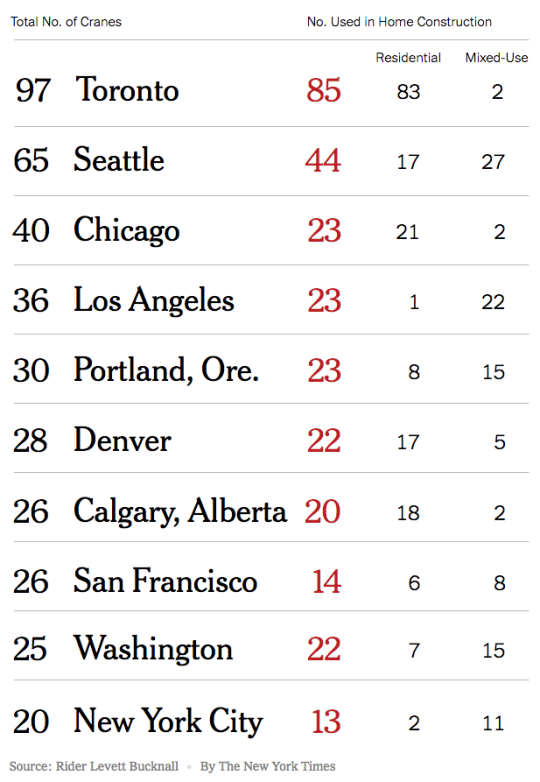
    Rider Levett Bucknall recently released its RLB Crane Index for Q3-2018. Here are the top 10 cities in North America (table via the New York Times):

    For the third consecutive reporting period, Toronto has taken the number one spot at 97 cranes – 85 of which are being used on residential projects. 

    I’m not at all sure how the study defines “mixed-use” projects. But given that Toronto only has 2 of them, it must not include projects with grade-related retail.

    Across North America, residential and mixed-use projects (whatever they are) make up approximately 70% of the total crane count. 

    I am surprised that Miami didn’t make the list.

  • Winner take all

    We have talked a lot on this blog about the concentration of economic activity in global cities. Here is an old post about a paper called “winner-take-all-cities”, which documents the overrepresentation of talent, economic activity, innovation, and wealth creation in a select number of alpha cities.

    But this same phenomenon is playing out in a myriad of different ways. Aaron Renn calls this the “superstar effect” and has been writing about it for years. Another more recent example is this post by Richard Kerby called: Where did you go to school?

    Kerby looked at where venture capitalists in the US went to school and discovered that around 40% of them have gone to one of two schools: Stanford or Harvard. His argument is that not only is the venture capital industry lacking in gender and racial diversity, but it’s also lacking in cognitive diversity.

    My point with this post, though, is one of hyper-concentration. Tech is a dominant force in today’s economy. And in 2017, nearly 45% of all venture capital investment in the US went to companies located in the Bay Area – meaning San Francisco and San Jose.

    So here is an example of a select number of schools training a select number of minds that then go on to invest in a select number of cities. Fred Wilson, who is a venture capitalist, has a good response to this problem of diversity in the VC industry.

    But, of course, this is bigger than just the VC business.

  • Red tide, scooters, and civic security

    image

    I am reading up on a few different things this morning.

    Southwest Florida, which is where I am right now, is in the midst of a “red tide” that began last November. These happen fairly regularly along the Gulf Coast, but this one is high up on the severity scale. There doesn’t appear to be a clear explanation for what causes them, but sustained warmer temperatures and fertilizer and other pollutant runoff are thought to stoke it. Whatever the cause, they are devastating to the environment. We are switching coasts tomorrow morning.

    Portland now has electric scooters. (Why don’t we have these in Toronto?) But to combat possible concerns around urban clutter, the company, Bird, has committed to collecting all of its scooters each night and has agreed to remit $1 per scooter per day to the city. These scooters are pissing off some cities (or maybe it’s just San Francisco), but I still believe the problem will eventually get resolved. City Observatory also has this interesting piece where it compares the above scooter pricing to car pricing. Are we underpricing cars?

    Finally, here is a short film on civic security in Paris. In an effort to mitigate terrorism, the city has, of course, been implementing and erecting fencing, barricades and other reactive security measures. But sadly, now that this has become a new reality, the capital is spending more time considering how these measures could be more thoughtfully designed. The video showcases some of them. Certainly a more deliberate approach, but are they just as reactive?

    Maybe one of these topics will be of interest to you too.

    Photo by Andreas Selter on Unsplash