Daily insights for city builders, delivered every morning at 6 AM ET. I’m Brandon Donnelly — a Toronto-based real estate developer and founder of Globizen. I’ve been writing here since 2013.

Tag: san francisco

  • Where are all the kids?

    This evening, when I was reading the internet, I came across this New York Times article from 2017 talking about how San Francisco has the lowest percentage of children of any of the largest cities in the U.S. It’s around 13% of the population. (Supposedly it was the second lowest in 2015. Pittsburgh was first.)

    The article goes on to claim that the city has approximately the same number of dogs as it does children. That number is somewhere around 120,000. Not surprisingly, many blame the city’s prohibitive housing costs as the main culprit for the lack of kids. Families simply cannot afford to live in the city.

    This got me searching for more information. Richard Florida looked at similar data back in 2015, but it’s important to note that he looked at metro areas and not the city propers. So the data doesn’t speak to whether families were forced to move out from the urban core to the suburbs in search of more affordable housing or for more space.

    Nevertheless, he finds no statistical association between the share of children in a city and things like urban density, economic output per capita, or median home prices. He instead finds that the share of children is positively correlated with two main factors: immigration and with ethnicity – specifically people of Latin origin.

    Click here if you’d like to read the rest of Florida’s analysis. And if any of you have additional data on this topic, please do share it below. I think I’m going to continue digging into this question of kids and cities.

    Image: Photo by William Bout on Unsplash

  • Car-dependent spatial structure

    Earlier this week a 58 year old woman named Dalia was struck and killed by a car near the University of Toronto’s downtown campus. This tragedy has everyone talking about and questioning how to make our roads safer, though the answers are not difficult to find. Here is an excerpt from a piece that Richard Florida penned following the incident called, Toronto’s Deadly Car Crisis:

    Today, more Torontonians die from being hit by cars than from being killed by guns. In 2016, nearly 2,000 pedestrians and 1,000 cyclists in the city were hit by cars. Of these, 43 resulted in fatalities. On average, a pedestrian in Toronto is hit every four or five hours, and a cyclist every eight or nine. This means that Toronto’s rate of pedestrian deaths was 1.6 per 100,000 people in 2016 — worse than in Chicago, Seattle, San Francisco, Boston, Washington, D.C., Portland, Pittsburgh, Cleveland, and Buffalo. It has risen to 1.7 deaths per 100,000 people in 2017 and is on track to rise still further to 1.8 deaths per 100,000 this year. And, children and the elderly face the greatest risk of being struck and killed by a car. The problem is only getting worse. Across Canada, pedestrian fatalities increased by more than 10 percent between 2010 and 2016; at time when they decreased by more than 25 percent in European countries like Norway, Switzerland, and the Netherlands.

    The broader issue is what he refers to as Toronto’s “car-dependent spatial structure.” And it is detrimental to not only our public safety, as we saw this week, but also to our ability to grow as a global city. The Greater Toronto Area is projected to reach 10 million people by 2041. I agree with Florida that, for a number of important reasons, we are going to need to commit ourselves to a new model for growth.

  • Tech salaries and brain drain

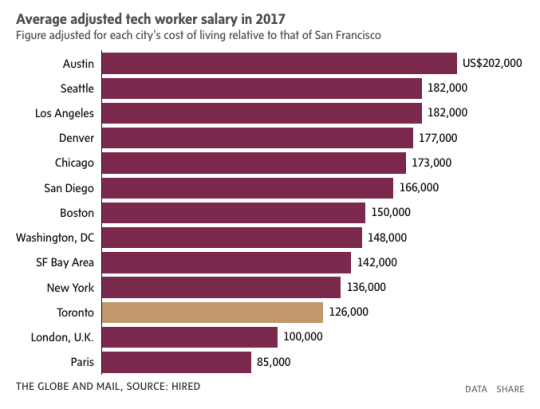
    The Globe and Mail recently ran an article arguing that tech salaries in Toronto are significantly less than those in the US and that it is leading to “alarmingly high rates” of brain drain. The claim is that the average tech salary in 2017 was US$73,000 in Toronto, compared to US$140,000 in the Bay Area or US$129,000 in New York City. 

    However, if you adjust these salaries for each city’s cost of living, the numbers look like this (chart taken from the same article):

    Now all of a sudden Toronto is lumped together with the Bay Area and New York City. It was adjacent to London even when you didn’t adjust the salaries. As Tobi Lütke – CEO of Shopify – points out in his Twitter rebuttal of the article, housing is the determining factor in this adjustment: “Toronto is a very expensive city, and Austin isn’t.”

    Lütke also points out, in case you’re in the market, that Canadian-based Shopify pays its tech employees well above market, provides stock compensation, and is currently “hiring like crazy”. But perhaps more importantly, he stresses the importance of Canadians building the economy of the country in which they are from. I feel exactly the same way.

  • Less, rather than more, housing

    Earlier this year I wrote about the California housing bill (827) intended to dramatically increase housing supply around transit stations all across the state. Well that bill was rejected last month and the Los Angeles Times wrote this post post-mortem explaining why and how it went wrong. Their argument is that it came down to opposition from low-income residents who feared that an increase in housing supply would lead to greater displacement.

    On a related note, the Official Plan Amendment and Zoning By-law Amendment that would permit laneway suites in Toronto went to Community Council this week. They voted to defer the decision for a month. Only 3 of 13 councillors voted to pass the proposal, despite there being 185 letters of support and only 4 letters of opposition. For more information on what the hell happened, check out this Lanescape post.

  • Likely to liquefy in an earthquake

    Today’s post is going to be a short add-on to yesterday’s post about the sinking Millennium Tower in San Francisco. Today, the New York Times published the below map showing the areas of the city likely to “liquefy in an earthquake.” It goes on to note that “at least 100 buildings taller than 240 feet were built in areas that have a “very high” chance of liquefaction.”

    The article might leave you with the feeling that current building codes are inadequate for the pending “Big One” in San Francisco. So I thought I would reblog this post from last fall which talks, in more detail, about how one of the best structural engineering firms in the world designed the tallest building in San Francisco.

    Image: New York Times

  • Sinking tower solution

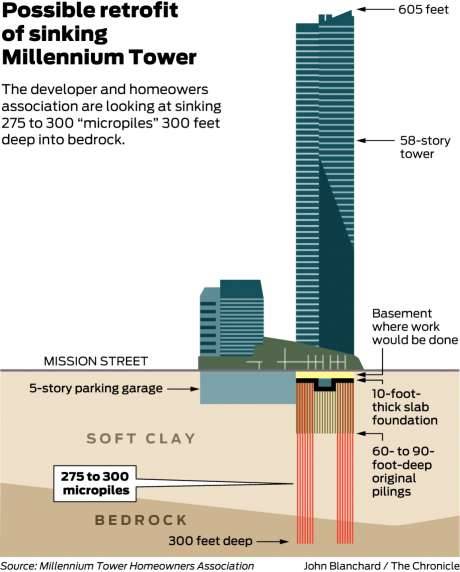
    Many of you are probably aware of the 58-storey Millennium Tower in San Francisco which is estimated to have sunk about 17 inches and to have tilted about 14 inches to the west since it was built.

    Well today it was announced that they may have a fix. Here is what is apparently being proposed as a retrofit (image from SFGate):

    image

    The tower was originally built on top of a 10 foot thick raft or mat foundation, which was then supported by concrete piles that went down 60-90 feet into soft clay. Notably, the piles didn’t reach bedrock.

    The proposed solution involves drilling 275-300 new micropiles into the bedrock below. But here’s where things get really interesting: The plan is to stabilize the west side of the building first and allow the east side of the building to continue sinking. In theory, this will give the building an opportunity to level out before they fully stabilize it. 

    According to SFGate, the entire retrofit is expected to take anywhere from 2 to 5 years, and cost somewhere in the range of $200 to $500 million. The original tower cost $350 million to build. (I’m assuming that’s just the hard cost number.)

  • Income sorting by city

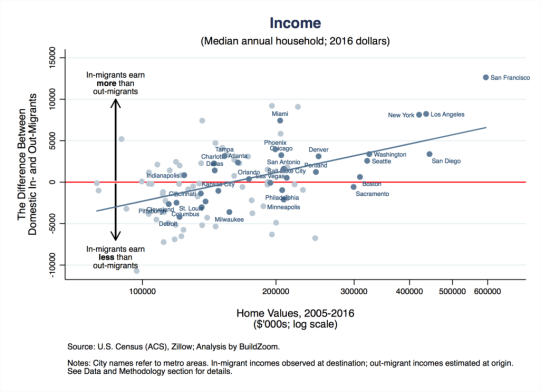
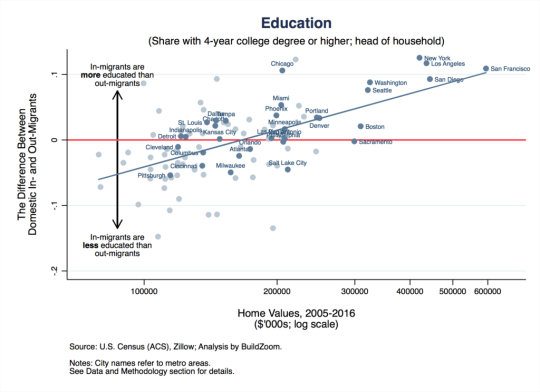
    This is a fascinating study by Issi Romem about the characteristics of cross-metropolitan migration in the United States. The key findings are that in-migrants to expensive coastal cities tend to have higher incomes and more education than the out-migrants, and that the opposite is true for the less expensive cities in the US. “Expensive” means expensive housing.

    Here is the income chart:

    Let’s use San Francisco as the example since it’s the most expensive metro (all the way to the right on the x-axis). The way to read this is that on average, from 2005 to 2016, in-migrants to the San Francisco metro area earned $12,640 a year more per household (y-axis) after they arrived compared to out-migrants before they left. This chart shows the difference between in and out incomes.

    Take note of Miami which is sitting at a similar place to New York and Los Angeles on the horizontal income line, but has home values similar to Phoenix, Chicago, and Philadelphia.

    Now here’s the education chart:

    Similarly, it is showing the difference in educational attainment between in and out migrants.

    So what does all of this tell us? 

    Well, it tells us, among other things, that US metros are continuing to sort based on income and that this process of polarization is probably contributing to home price appreciation. Because even if the incomes of current residents aren’t growing, these “expensive cities” are effectively swapping out poorer residents for richer ones. That, alone, would mean more money for expensive homes.

    For Issi Romem’s full article, click here.

  • Top US metro areas for VC investment

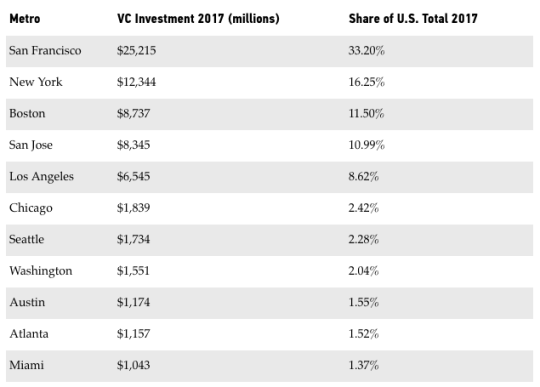
    Below is a list of the US metro areas that saw a billion dollars or more in venture capital investment last year (2017). It is taken from a recent CityLab article by Richard Florida where he talks about the “geographic inequality of high-tech venture capital.”

    image

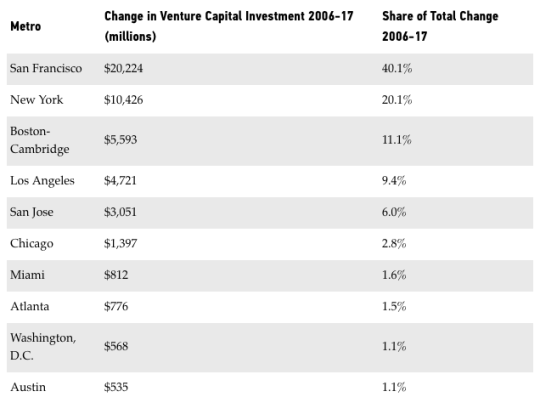
    It’s worth noting that San Francisco – not San Jose (Silicon Valley) – is at the top of the list with nearly 1/3 of the US total last year. It’s also interesting to note that when you look at each metro’s share of the total change from 2006-2017 (the chart below), you get Los Angeles now punching above San Jose. 

    image

    Florida also gets into which economic and demographic variables seem to be associated with higher levels of venture capital investment. For the rest of the article, click here

  • Thoughts on housing in the Bay Area

    I was out for drinks recently with a friend of mine who is a developer in California and she mentioned a few things to me that I thought were really interesting. 

    First, she talked about how virtually nothing gets built in the Bay Area “as of right.” And so the market is hugely supply constrained. She said, you’re lucky if you can get your entitlements in 2 years. It’s starting to take longer. I immediately said: “That’s Toronto.”

    Second, we talked about Proposition 13, which was timely given this recent post. One of the consequences of Prop 13, beyond helping golf clubs survive, is that longtime homeowners seem to be highly incentivized not to move. 

    Their property taxes are so below market that it can be more cost effective for them to stay put as opposed to downsize – even if they have too much house. This means far less turnover in the housing market.

    Third, there really does seem to be a feeling in the Bay Area that it’s at a breaking point in terms of affordability. When a successful software engineer making $200,000 a year can’t afford housing, people naturally start to look to other cities.

    We hear this refrain all the time in the media, but because I’m not active in that market, it was far more impactful hearing it from a friend.

  • Are we entering a new era of tech-driven city building?

    Emily Badger of the New York Times published an interesting piece yesterday talking about the tech industry’s current obsession with trying to fix cities. And there are certainly many problems to fix.

    Staying true to tech and engineering parlance, there’s lots of talk of optimization. How do you technologically optimize a city, for things such as affordable housing?

    There’s no doubt that many of you will sympathize with this statement: 

    To planners and architects, all of this sounds like the naïveté of newcomers who are mistaking political problems for engineering puzzles.”

    But naïveté is not always a bad thing and with all of the money sloshing around in this industry, there’s also no doubt that this is likely a new era of city building.

    The article ends by quoting JD Ross, the 27-year old co-founder of Opendoor – a startup that we have discussed many times before on this blog and is now valued at over $1 billion.

    It is him saying that he wants to figure out how to put $100 million into this space as soon as he can figure out the right target to optimize for. “It’s better than buying a Bugatti.”

    Of course Sidewalk Toronto – which is mentioned a few times throughout the article – is already a perfect example of tech infiltration.

    But I think Dan Doctoroff gets it right when he posits that the real naïveté will come from disrespecting urbanist traditions.

    Photo by David Alacaraz on Unsplash