Daily insights for city builders, delivered every morning at 6 AM ET. I’m Brandon Donnelly — a Toronto-based real estate developer and founder of Globizen. I’ve been writing here since 2013.

Tag: san francisco

  • What land-use restrictions are doing to our cities

    I have Richard Florida’s recent book, The New Urban Crisis, sitting on my bedside table. I’m only about ¼ of the way through it, but I’m really enjoying it. I’ll write more once I’m done.

    What I instead want to talk about today is a recent (and related) article that Florida published in CityLab called: Did Land-Use Restrictions Save the Rust Belt? 

    In it, he leans on the research of two economists – Chang-Tai Hsieh of the University of Chicago and Enrico Moretti of the University of California at Berkeley – and makes 3 valuable points.

    They are:

    It is estimated that land-use restrictions (which limit development / supply) have reduced overall GDP in the U.S. by about 9% or approximately $1.5 trillion per year. It is also estimated that housing supply constraints alone lowered overall growth by more than half between 1964 and 2009.

    At the same time, these land-use restrictions may have benefited other regions – such as the Rust Belt – that would have otherwise lost more people and jobs to places like New York and San Francisco. The research found that without these land-use restrictions, employment growth between 1964 and 2009 would have been more than 1,000% higher in New York and almost 700% higher in San Francisco.

    The final takeaway is one that we’ve talked about before on this blog. One of the most effective things we can do to counteract geographic inequality is to build great transit; transit that connects both people and land to the most desirable areas of our city.

    And with that, Happy Canada Day weekend all.

    Photo by João Silas on Unsplash

  • The U.S. cities that gained the most workers over the last 12 months

    One of the great things about social media is that it gives us access to data that previously didn’t exist or was difficult to collect.

    Take, for example, LinkedIn’s monthly report on employment trends called the Workforce Report. They look at which industries are hiring, where people are moving for jobs, and so on. Click here for the June 2017 edition. 

    Note that architecture/engineering hiring appears to be up nationally, which is usually a positive leading indicator.

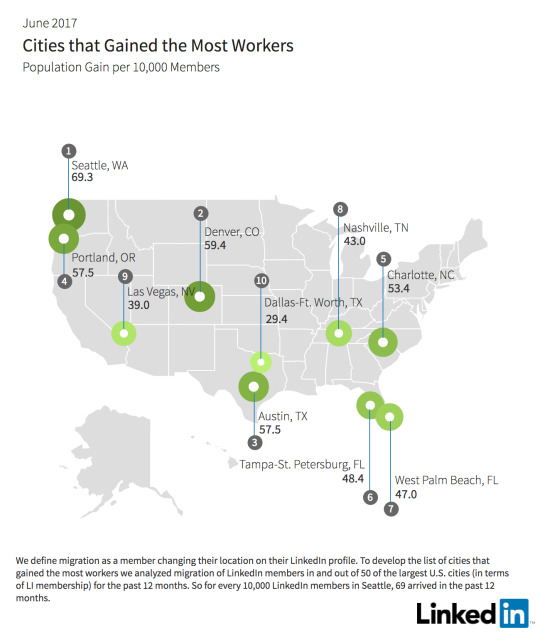
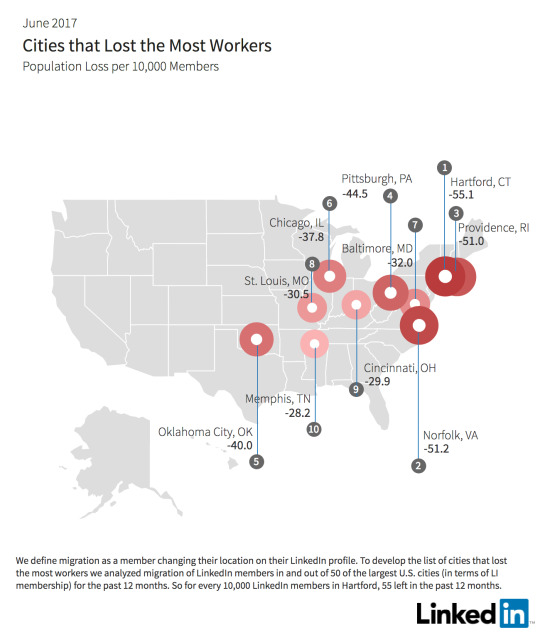
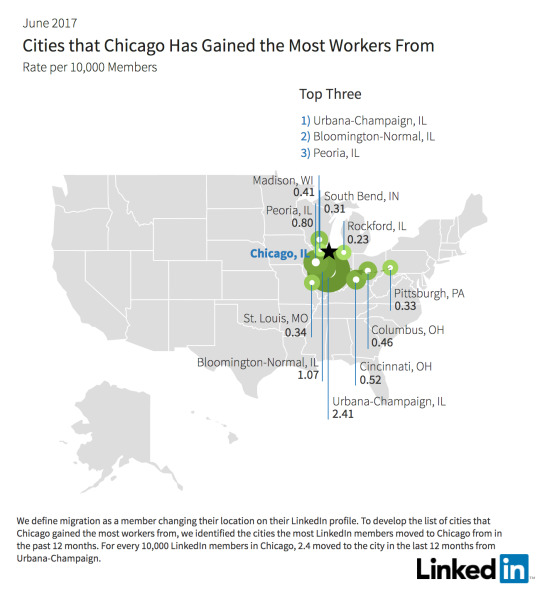
    I’ll leave you all to go through the report, but I did want to pull out a few of their maps and one of their takeaways. Below are maps of the cities that lost the most workers and gained the most workers over the last 12 months.

    The established trend of people moving from colder northern cities to warmer amenity-rich cities seem to play out here.

    That said, one of their “key insights” is that fewer workers today are moving to the San Francisco Bay Area. Since February 2017, there has been a 17% decline in the net number of workers.

    They blame housing affordability (ahem, lack of supply). People are simply turning to other great cities like Seattle, Portland, Denver, and Austin. They’re growing and cheaper.

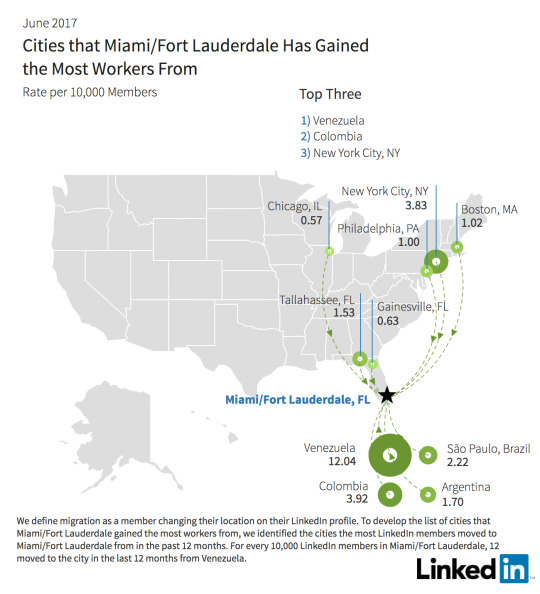
    One of the other cool things about the report is that you can drill down into individual cities to see where people are moving from. I looked up Miami and Chicago just to do a quick comparison. 

    Not surprisingly, Miami is seeing a significant contingent from South America. What’s interesting about this random comparison is how international Miami is and how regional Chicago is in terms of their draws.

    I would love to see similar data for Canada. This is valuable stuff.

  • The geography of superstars

    We often talk about superstar cities such as New York, London and, in the case of tech, San Francisco. But what about the superstar people that drive these economies?

    Aaron Renn recently wrote a post called “The Superstar Gap”, where he argues that the interior of the U.S. is suffering from a big handicap because of its lack of superstars. Chicago is one example he gives. Very good, but not the best.

    He also cites a 2010 analysis by Carl Wohlt that shows the “100 Most Creative People in Business” predominately living in the West and Northeast, compared to the Midwest and South.

    This is interesting because – if we assume this gap to be true – it gets me thinking about a number of important questions:

    • Is it that the interior isn’t effectively fostering superstar talent?
    • How much superstar talent is actually latent and untapped?
    • Is it that superstar talent is getting sucked into a select few superstar cities, away from other places? Definitely happening.
    • How many superstar cities (filled with superstar people) can sustainably exist in today’s world?

    Now by definition, superstar talent is going to be a smaller segment of the population – it’s one tail of the bell curve. 

    But I do think we should be careful not to assume that the raw talent doesn’t exist in certain cities. People and place are linked, and superstar cities are arguably just empowering new forms of individual superstardom.

    If we are to use successful startups as one measure of superstardom, it’s important to keep in mind that they are incredibly fragile in their nascent stages. The right people need to come together. The right funding has to fall into place. And the list goes on. 

    Below is an excerpt from a 2006 essay by Paul Graham (Y Combinator) called, Want to start a startup?

    Successful startups are almost never started by one person. Usually they begin with a conversation in which someone mentions that something would be a good idea for a company, and his friend says, “Yeah, that is a good idea, let’s try it.” If you’re missing that second person who says “let’s try it,” the startup never happens.

    That someone might have been a superstar.

  • Formula retail

    San Francisco has something known as the Commission Guide for Formula Retail. Formula retail = chain store. Formula retail uses are regulated by the San Francisco Planning Code. 

    The intent behind the guide is really twofold: It’s to help assess the appropriateness of chain store uses in specific locations and it’s to help counter their homogenizing force on neighborhoods.

    This, of course, is a perennial tension for city builders. The challenge is that formula retailers usually have the ability to pay higher rents compared to smaller independent businesses. And so that’s who landlords will often lease to.

    If you’re the kind of person who enjoys reading esoteric planning documents, then consider incorporating the above SF commission guide into your bedtime reading repertoire.

  • Studio Gang joins effort to re-imagine Yonge + St. Clair

    Today I am excited to announce that we (Slate) have retained Studio Gang Architects to design a new mixed-use residential tower at Yonge + St. Clair in midtown Toronto. 

    Alex Bozikovic was first to break the news in the Globe and Mail, but you can now also read about it at UrbanToronto.ca, in ArchDaily, and likely some other places.

    Here is something I said to Alex that we feel strongly about:

    “We’re considering the whole community,” Donnelly says. “By thinking of city-building rather than individual tower buildings, it opens up new possibilities.”

    This is particularly true because of Slate’s broader position at Yonge + St Clair.

    And here is something that Stefan Novakovic wrote over at UrbanToronto.ca that we were happy to read – thank you:

    With no renderings, no precise indication of height, scale, or programming, and no hint at the building’s aesthetic—yet—it’s already a lock to be one of Toronto’s most anticipated upcoming developments. That’s because Studio Gang is no ordinary firm.

    I’ve also pasted the full press release at the bottom of this post. 

    One thing you may notice is that we’ll be hosting a public consultation later this spring. This will be before we submit anything to the city. It’s part of our research and information gathering phase, and it will be used to inform the ultimate design.

    I’ve been admiring Studio Gang’s work from afar for well over a decade. So it’s personally very exciting to be starting work with them on an actual project. We are thrilled about this announcement and I hope that many of you are as well.

    Image: Folsom Bay Tower, San Francisco

    —————————————————————

    Slate Asset Management commissions acclaimed architecture practice’s first building in Canada

    March 10, 2017 (Toronto)—Slate Asset Management announces it has selected internationally celebrated architecture practice Studio Gang to design a mixed-used tower at the south-west corner of Yonge and Delisle. The announcement is the latest in a series of high-profile commissions by Slate, including an eight-story mural by international street artist Phlegm. The project will be Studio Gang’s first building in Canada, and is part of Slate’s overall effort to reimagine Yonge + St. Clair through the use of public art, world-class design, vibrant streetscapes and open spaces.

    “Yonge + St. Clair is on its way back. Having occasion to bring Studio Gang’s first project in Toronto to the neighbourhood signals to the rest of the city that we would like to create something special here,” says Brandon Donnelly, Vice President of Development at Slate Asset Management.

    The announcement comes just as Studio Gang Founding Principal, Jeanne Gang, is set to receive a 2017 Honorary Fellowship from the Royal Architectural Institute of Canada (RAIC) in May. The Honorary Fellowship is the latest in a series of accolades for Gang including a 2011 MacArthur Fellowship and the Architectural Review’s 2016 Architect of the Year.

    “As our practice’s relationship with Canada grows, we’re excited to explore Toronto and to understand the unique DNA of the Yonge + St. Clair neighbourhood,” says Jeanne Gang. “We hope to design a building that will strengthen relationships within the neighbourhood and the city.”

    Based in Chicago and New York, Studio Gang is widely recognized for elevating the urban environment while building connections between people and their environments. This ethos is visible throughout Studio Gang’s diverse portfolio, which includes Aqua Tower in Chicago, Folsom Tower in San Francisco, and 40 Tenth Avenue along the Highline in New York—each of which emphasizes connections between people, the city, and nature.

    With a practice rooted in research, engagement, sustainability and the innovative use of materials, Studio Gang will work with Slate to host a public consultation later this spring to gather community input prior to a design submission to the city. The final building will be primarily rental, with retail space at grade, in keeping with Slate’s long-term vision for the area. And while the design for the building is not finalized, Donnelly says a couple of decisions have already been made.

    “It’s not going to be a typical all-glass tower,” says Donnelly, citing a need to introduce material variety into Toronto’s ever-booming skyline. “We want to push boundaries in terms of sustainability and building efficiency, which means we are thinking carefully about the building envelope and its materials.”

    The decision to commission Studio Gang was made after an exhaustive selection process emphasizing design methodology, site context, and Slate’s aspirations for world-class architecture and a fresh vision. Yonge + St. Clair is a transit-rich node with a subway and dedicated streetcar tracks. At the same time, the dense urban realm is a short walk from some of the city’s most beloved neighbourhoods and a ravine system, offering direct access to quiet green space. This juxtaposition of natural and built environments will serve as an inspiration for the project.

    “There is a hill that crests at Yonge + St. Clair, which means the build site acts as both a pedestal and a view terminus from way uptown,” says Donnelly, detailing another unique advantage of both the site and the neighbourhood. “The challenge will be to develop a building worthy of being showcased, but we feel confident that we have the right team in place to do just that.”

    Over the last four years, Slate has purchased ten properties in the area, including all four corners of the intersection at Yonge and St. Clair. The Studio Gang commission will be the first ground-up tower in the area by Slate, marking a unique collaboration that combines global experience and high design with a serious investment in the neighbourhood. The area’s transformation kicked-off last summer with the introduction of the eight-story mural by Phlegm.

    Gang is being honoured at the RAIC/OAA Festival of Architecture in Ottawa, May 24–27. She will be named an Honorary Fellow of the College of Fellows of the Royal Architectural Institute of Canada and will deliver the keynote address at the festival.

    -30-

    For more information and images please contact kg&a
    Vakis Boutsalis
    Vakis@kga-inc.com
    416-537-0954

    About Slate Asset Management L.P.

    Slate Asset Management L.P. is a leading real estate investment platform with approximately $4.0 billion in assets under management. Slate is a value-oriented manager and a significant sponsor of all of its private and publicly-traded investment vehicles, which are tailored to the unique goals and objectives of its investors. The firm’s careful and selective investment approach creates long-term value with an emphasis on capital preservation and outsized returns. Slate is supported by exceptional people, flexible capital and a proven ability to originate and execute on a wide range of compelling investment opportunities. Visit slateam.com to learn more.

    About Studio Gang

    Founded by MacArthur Fellow Jeanne Gang, Studio Gang is an architecture and urbanism practice based in Chicago and New York. Known for creating innovative buildings that enhance the public space around them, Studio Gang has completed award-winning projects such as the Aqua Tower and Nature Boardwalk at Lincoln Park Zoo in Chicago, Illinois, USA, and the Arcus Center for Social Justice Leadership in Kalamazoo, Michigan, USA. The Studio is currently designing towers in Chicago, San Francisco, New York, and Amsterdam. In addition, Studio Gang is currently engaged in cultural and educational projects across the Americas, from the new United States Embassy in Brazil to the expansion of the American Museum of Natural History in New York and a consolidated campus for the California College of the Arts in San Francisco. In 2016, Studio Gang was recognized as Firm of the Year at the Architizer A+ Awards and Jeanne Gang was named Architect of the Year by the Architectural Review. Visit www.studiogang.com to learn more.

  • Transit Flow

    This is a map of the Bay Area Rapid Transit network:

    And this is an elegant visualization by Ray Luong of ridership levels over the course of one day: February 4, 2016. If you can’t see the embedded video below, click here.

    [youtube https://www.youtube.com/watch?v=owGgbAS7Wq8?rel=0&w=560&h=315]

    Note how the lines speed up as they go through the Transbay Tube connecting San Francisco and Oakland. That’s actually what happens. Within the 10 km-long tube, the trains reach ~130 km/h, which is more than twice as fast as the average speed throughout the rest of the network.

  • New York, San Francisco, Toronto

    Yesterday it was announced (here, here, and here) that Toronto-based Top Hat has raised $22.5 million (USD) in Series-C funding. The round was led by New York-based Union Square Ventures.

    I am always excited to see Toronto-based startups doing well and I am particularly excited by this remark in USV’s blog announcement:

    “Also worth noting is that Toronto continues to impress us with its quality and diversity of companies. We now have five investments there, placing Toronto third as a location in the USV portfolio after New York and San Francisco.”

    Here is another quote from Fred Wilson’s blog:

    “Toronto is a great place for startups. In addition to five investments of ours that are HQ’d there, I know of at least one other USV portfolio company that has much of their engineering team in Toronto. The talent, mindset, and quality of the people in the Toronto/Waterloo tech/startup community is really top notch and we love investing there.”

    Go Toronto. 

    (Of course, Toronto really means Toronto-Waterloo. That’s the geography of the ecosystem.)

  • This is not right

    I have largely avoided commenting on politics and Trump on this blog, but at this stage it is almost impossible to do that.

    Donations are starting to pile up for the American Civil Liberties Union (ACLU) as the tech community, and many others, begin to respond to Friday’s executive orders. Lyft announced a $1 million contribution to the non-profit group.

    Today, venture capitalist Fred Wilson wrote: Make America Hate Again. And yesterday, his business partner Albert Wenger wrote: Misleading the World on Immigration.

    At 6 AM this morning, Richard Florida started a tweet storm where he argued that “Trump’s immigration insanity” will fundamentally threaten the core of America’s innovation hegemony. 

    (He also argued that Canada, and more specifically Toronto, serve to “gain substantially”, as there will no doubt be a doubling down on tolerance to attract the best talent from around the world.)

    The Canadian tech community penned an open letter to reinforce the message that, here in Canada, diversity is our strength. This echoes similar messages from Prime Minister Justin Trudeau and Mayor John Tory.

    Mass protests have broken out at US airports (links to photos) spanning San Francisco to New York. 

    And I am seeing folks from Toronto offer up their homes (publicly on Twitter) to anyone who might be stranded at Pearson International Airport as a result of the orders. Many have even tweeted out their phone numbers.

    Everywhere I look this weekend I am seeing these sorts of messages. So while I could remain quiet, that doesn’t feel right. And that’s because what is happening is not right.

  • Ian Gillespie: It’s not about business

    The founder of Westbank, Ian Gillespie, recently sat down with Bloomberg TV to discuss the Toronto and Vancouver real estate markets; his Mirvish Village (Honest Ed’s) redevelopment project; affordable housing; and the markets he is and plans to be focused on (Vancouver, Toronto, Seattle, Tokyo, San Francisco).

    I like the part where he says that he’s really not that interested in business.

    If you can’t see the video below, click here.

    https://www.bloomberg.com/api/embed/iframe?id=6542ca85-017c-436e-aefc-25d8f4bb9b66

  • World’s best city brands

    Resonance Consultancy – they do brands and strategies for places and products – has just released a new report called: World’s Best City Brands – A Global Ranking of Place Equity.

    With all of these sorts of rankings, it really depends on the research methodology being used and the rigor in which it is being applied. In this case, they evaluated each city based on “six pillars of equity”:

    1. Place: Perceived quality of a city’s natural and built environment
    2. Product: A city’s key institutions, attraction and infrastructure
    3. Programming: The arts, culture and entertainment in a city
    4. People: Immigration and diversity of a city
    5. Prosperity: Employment, GDP per capita entertainment in a city and corporate head offices
    6. Promotion: Quantity of articles, references of a city and recommendations online

    What’s perhaps unique about this study is that it combines measurable statistics with “visitor perception metrics” – data that they mined from social media. Here’s an excerpt from the methodology page:

    “Our team became interested in the way visitors and citizens themselves influence the identity and perception of cities. Increasingly, they do it through their evaluation of experiences on social media and via the comments, images and reviews they share with family, friends and people around the world. These opinions and attitudes, much more than traditional marketing, influence the way people perceive places today.”

    This is a fascinating shift for city brands and is something that we have discussed before on this blog. All of us are now involved in telling the story of the places in which we live and visit.

    The entire report is well done and worth a read. It’s also a free download (you’ll need to enter your contact info). But below are the top 10 world’s best city brands. Not really any surprises for me. What about for you?

    image