Daily insights for city builders, delivered every morning at 6 AM ET. I’m Brandon Donnelly — a Toronto-based real estate developer and founder of Globizen. I’ve been writing here since 2013.

Tag: san francisco

  • Place is dead anyway

    Aaron Renn has a few observations up on his blog from a recent trip to San Francisco. Number 2 is as follows:

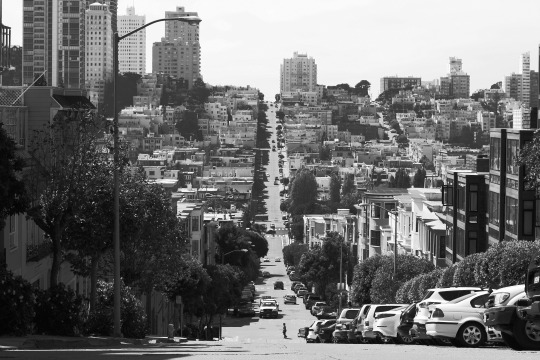
    “A curiously low energy city.  It’s tough to judge any American city’s street energy after living in New York, but San Francisco felt basically dead. Tourist areas around Union Square and the Embarcadero were crowded, and the Mission on a Friday night was hopping, but otherwise the city was very quiet. Haight-Ashbury was nearly deserted and many neighborhoods had the feel of a ghost town. It’s very strange to be walking around a city with such a dense built fabric but so few people.”

    I feel this way every, single, time, I visit San Francisco. I love San Francisco, but outside the main draws, the city feels eerily quiet. I have never understood why that is the case.

    This is something that I am sensitive to because I find it even impacts my own energy levels. For instance, Sundays in Toronto often feel too quiet for me. Fewer pedestrians. Slower drivers. Our collective metabolic rate slows down.

    I love the hustle of a busy city.

  • Inviting behaviors

    The following paragraph is a great way to describe urban cycling and to explain how our built environment can explicitly invite certain behaviors:

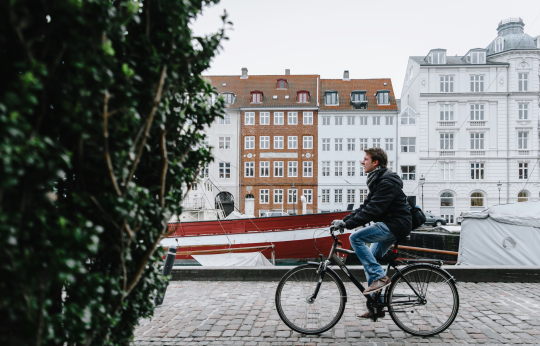
    “If you want people to drive, build more automobile infrastructure. If you want people to bike, build better bike infrastructure. In San Francisco, as in most US cities, we’ve treated the idea of bike infrastructure as secondary to optimizing traffic flow, and have wound up protecting parked cars with bike lanes instead of the opposite. Because of this our bike lanes are plagued with double-parking. While enforcement is an important piece of the puzzle, we usually fail to admit how inviting a striped space between parked cars and traffic appears to an Uber driver. Our built environment invites a driving behavior that causes cyclists to spend much of their commute pushed into traffic, encouraging a culture of every-man-for-himself cycling behavior, adding to the discouraging perception that bikes are for the young and fearless only. This perception is elevated by the fact that bicycling deaths in San Francisco are hovering at least four times higher than the average rate in Copenhagen, a city with ten times as many cyclists.”

    This snippet is from a blog post written by Alex Schuknecht (urban designer with Gehl). In the posts he also contrasts the cycling cultures of San Francisco and Copenhagen – two cities of similar size and density, but with fundamental differences. It’s a good read.

    Many of us probably assume that we are agents of our own lives. We decide what we do and when we do it. We’re our own boss. That’s at least how I want to feel.

    But the built environment is distinct from the natural environment in that we design it. It is not a given. And the environments we collectively choose to fund and build will ultimately have a significant impact on the way we “choose” to live our lives. 

    This gets back to the first line of the above quote: build more of this; get more of that. It’s also related to the startup mantra: “you make what you measure.” If all we’re measuring is traffic flow, then that’s the kind of city we will make. And that’s certainly be done.

    I don’t think a lot of us think in these terms. But we should.

  • Urban change through rapid prototyping

    image

    The Market Street Prototyping Festival is just finishing up in San Francisco. The festival, which is now in its 3rd year, is centered around urban interventions that can be rapidly prototyped and tested. The goal is to discover new ideas that could be used to transform and improve Market Street – the city’s civic spine. It is a joint effort of both the San Francisco Planning Department and the Yerba Buena Center for the Arts.

    Here is a list of all the prototypes. You can “like” projects, but I wish they would have made it easier to filter and see which ones are the most popular.

    One project that I liked is Vote With Your Feet. It consists of two doorways and a single crowdsourced YES/NO question above it. You vote by choosing a doorway. Once you walk through, you are then shown the results. Here’s a Boomerang video of it in action. I like it because it provides a frictionless way to acquire lots of ground-up feedback. Imagine placing something like this at the exit of a busy train station or transforming the existing doors.

    Tactical urbanism can be a great mechanism for investigating and instigating positive change. This is hugely important considering how slow moving and bureaucratic city building can be. It’s not the same format, but NXT City here in Toronto has similar ambitions. They source new ideas for our public spaces from young people. I am thrilled that both of these initiatives exist.

  • Vancouver-Seattle

    The New York Times has an interesting article up talking about how Vancouver and Seattle are trying to more closely align themselves and create a unified tech corridor. 

    BC premier Christy Clark and Washington governor Jay Inslee recently signed an agreement to that effect, which included more research collaboration between the University of British Columbia and the University of Washington.

    Seattle wants this because its companies need talent (read: foreign workers) and Vancouver’s borders are more open. Vancouver wants this because its tech industry is relatively small (go Hootsuite!) and it could benefit greatly from being more proximal to Seattle.

    On a side note, Seattle is an interesting case study. In terms of venture capital dollars invested, it is below top tier cities such as San Francisco, New York, Boston, and so on. But in terms of the companies it has birthed (Microsoft, Amazon, Zillow, Expedia…) it is certainly a heavy hitter.

    One of the key factors will be physical connectivity. There’s talk of high speed rail and/or a dedicated lane for autonomous vehicles. However it’s done, I think bringing this trip to < 1 hour would be the ideal scenario. There’s a psychological barrier beyond that.

    If any of you live/work in either of these cities today, I would be curious to hear your thoughts.

  • The rise of tech outposts

    What happens when wages and real estate prices become too high in a city? Companies start growing in lower cost locations. We’ve all seen this before. 

    Fred Wilson recently blogged about this “spillover effect”, citing a New York Times article talking about the growth of tech offices in Phoenix. As someone who sits on the board of many technology companies, he was noticing a thematic trend:

    “A big theme of board meetings I’ve been in over the past year is the crazy high cost of talent in the big tech centers (SF, NYC, LA, Boston, Seattle) and the need to grow headcount in lower cost locations.”

    We talk a lot about housing prices on this blog, and so I think it’s useful to see how this, along with high wages, also impacts companies. The two are interrelated.

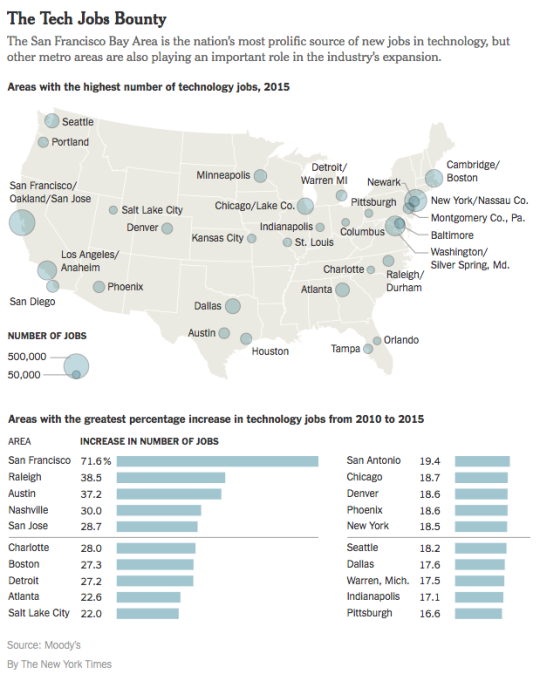
    Below is a chart from the NY Times article showing the US cities with the highest number of technology jobs and the most growth from 2010 to 2015. 

    San Francisco is in a league of its own. But overall, the growth is in tech and many cities are adding lots of technology jobs. Look at Detroit and Boston right beside each other (Detroit obviously has a smaller starting base). And look at how Miami is nowhere to be found.

    Of course, one interesting question is whether these new outposts – such as Phoenix – can truly come into their own and carve out a niche:

    “We don’t want to be San Francisco’s back office — we need more creators here,” said Scott Salkin, a founder and the chief executive of Allbound, which is based in Phoenix, makes sales software and has offices down the hall from Gainsight’s.

    Even with the high cost of living, it’s hard to supplant the coastal hegemony. That’s where people go to chase riches. As comedian Daniel Tosh likes to say, “the middle of the country is for people who gave up on their dreams.”

    Though for some, living in a place like Denver or Salt Lake City and snowboarding every weekend is a better outcome than living in a studio apartment and commuting an hour to work.

  • Building new, better cities

    Earlier today my friend Saadat sent me the following tweet:

    //platform.twitter.com/widgets.js

    It’s a link to a new research project by Y Combinator – the famed Silicon Valley seed accelerator. They want to explore the possibility of building new and better cities.

    I don’t have the time for something like this, but if any of you are city experts (I know a lot of you are) and you’re based in or willing to be based in San Francisco (I think they are flexible on this), you should absolutely consider applying to be their full time “Cities Researcher.” The deadline is July 30, 2016.

    Here’s a taste of what they are thinking about…

    There are many high-level questions we want to think through, for example:

    – What should a city optimize for?

    – How should we measure the effectiveness of a city (what are its KPIs)?

    – What values should (or should not) be embedded in a city’s culture?

    – How can cities help more of their residents be happy and reach their potential?

    – How can we encourage a diverse range of people to live and work in the city?

    – How should citizens guide and participate in government?

    – How can we make sure a city is constantly evolving and always open to change?


    And there are tactical questions we want to dig into, for example:

    – How can we make and keep housing affordable? This is critical to us; the cost of housing affects everything else in a city.

    – How can we lay out the public and private spaces (and roads) to make a great place to live?

    – Can we figure out better zoning laws?

    – What is the right role for vehicles in a city?

    – Should we have human-driven cars at all?

    – How can we have affordable high-speed transit to and from other cities?

    – How can we make rules and regulations that are comprehensive while also being easily understandable?

    – Can we fit all rules for the city in 100 pages of text?

    – What effects will the new city have on the surrounding community?

    The convergence of city building and tech is something that I’m deeply interested in. I also think it’s inevitable. And I think that Toronto – thanks to our robust real estate industry – is in an ideal position to be a leader in this space. So I would love to see someone from here take on this job.

    But even if you’re not from Toronto, you should still apply because it’s an exciting initiative 🙂

  • This building is shit. Or is it?

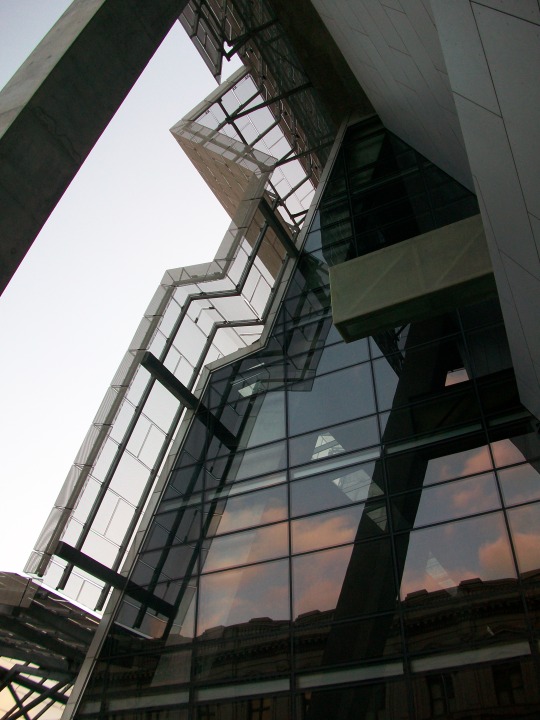
    I was looking through my photo archive this past week (which is all on an Apple Time Capsule) and I came across this photo:

    I took this photo in the winter of 2011 on a snowboarding trip to Lake Tahoe. It’s of the San Francisco Federal Building, which was designed by Morphosis and completed in 2007.

    The reason this photo stands out for me is because as my friends and I were taking photos of this building a man walked by us and said:

    “Why are you taking photos of this shit?

    …you guys must be architects.”

    To me this was a frank reminder that the designs that my architecture friends and I obsess over (at least the contemporary stuff) often go completely unappreciated by a lot of other people – perhaps the majority of people.

    This, of course, raises an interesting debate. 

    If the majority of the public think a building is shit, is it a failure? Should a building’s success be judged more by how its occupants feel about it? Or is it the “expert” opinion that really matters? (Expert is in quotations because I don’t like this term.)

    While important, I don’t think it’s as simple as these questions. Architecture can take years, decades, or even longer to settle in and become fully appreciated. Think about the buildings that your city may have demolished in the past but now regrets. Tastes change.

    With that, below is an excerpt from the architect’s own description of the Federal Building. Keep in mind that this project started construction in 2003 and so design would have started years before that. Hopefully it’s clear just how relevant the ambitions of this project remain some 15 or so years later.

    The re–definition of circulation and vertical movement paths provides opportunities for chance encounters, a critical mass in circulation, and places for employees to gather across the typical confines of cubicles, departments, or floor plates. The democratic layout locates open work areas at the building perimeter and private offices and conference spaces at the central cores. As Gladwell’s article points out, “…one study after another has demonstrated [that] the best ideas in any workplace arise out of casual contact among different groups within the same company.” Skip stop elevators, sky gardens, tea salons, large open stairs, flexible floor plans, and the elimination of corner offices endow the tower with a Jacobsian “sidewalk life” of cross-sectional interactions.

    Many of the same design decisions that create high quality workspace also maximize energy efficiency. The Federal Building is the first office tower in the U.S. to forgo air-conditioning in favor of natural ventilation. As a result of the tower’s narrow profile and strategic integration of structural, mechanical and electrical systems, the building provides natural ventilation to 70% of the work area in lieu of air conditioning, and affords natural light and operable windows to 90% of the workstations. A folded, perforated metal sunscreen shades the full-height glass window wall system and a mutable skin of computer–controlled panels adjusts to daily and seasonal climate fluctuations. With an energy performance that surpasses the GSA’s criteria by more than 50%, the project sets new standards for applications of passive climate control, while physically democratizing the workplace and enhancing employees’ health, comfort, and sense of control over their environment.

  • Market vs. subsidized

    Miriam Zuk and Karen Chapple of the University of California, Berkeley, recently published a research brief called Housing Production, Filtering and Displacement: Untangling the Relationships

    It’s a nuanced look at the impact of both market-rate and subsidized housing production on affordability and displacement within the San Francisco Bay Area.

    The report is essentially a response to the debate around whether increasing market-rate housing production alone can address affordability and displacement concerns, or whether the only way to do it is through subsidized housing. What they found was that both matter, but…

    “What we find largely supports the argument that building
    more housing, both market-rate and subsidized, will
    reduce displacement. However, we find that subsidized
    housing will have a much greater impact on reducing displacement
    than market-rate housing. We agree that market-rate
    development is important for many reasons, including
    reducing housing pressures at the regional scale and housing
    large segments of the population. However, our analysis
    strongly suggests that subsidized housing production is even
    more important when it comes to reducing displacement of
    low-income households.”

    If you’re interested in this topic, I recommend reading the full brief. It’s only 12 pages. I particularly liked the information around filtering and how new housing steps down over time to ultimately serve lower-income households.

  • The top 20 US neighborhoods for venture capital investment

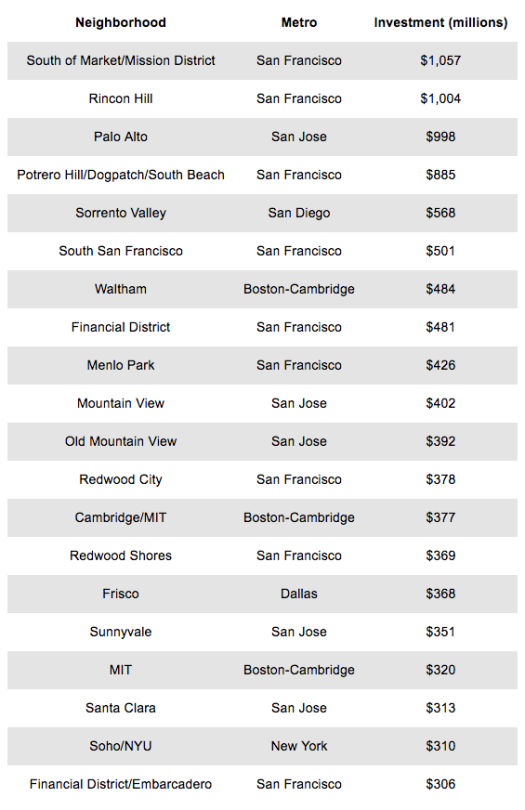
    There’s a lot of talk about how venture capital investment has shifted from the suburbs to cities and how it is also concentrated in certain metro areas. But a new report from the Martin Prosperity Institute has dug even deeper to look at the top 20 neighborhoods (zip codes) in the US for venture capital investment.

    Here’s a summary of what they found:

    “The top 20 neighborhoods or zip codes for venture investment include nine in San Francisco, five in San Jose, three in Boston-Cambridge (one in suburban Waltham and two in Cambridge close to MIT) and one each in San Diego (close to the University of California, San Diego), Dallas, and New York (close to New York University).”

    And here’s the full top 20 list:

    image

    Initially I looked at this list and thought that neighborhoods such as Menlo Park and Redwood City shouldn’t be labeled as San Francisco, since they are outside of the county. But technically they still fall within the San Francisco Metropolitan Area

    It’s amazing how San Francisco dominates this list.

  • Come original

    I am thinking about nonconformity and originality this morning because I just ordered a book by Wharton professor Adam Grant called, Originals: How Non-Conformists Move the World. I ordered it along with another book that was recommended by a regular reader of this blog. (Thanks Daniel.)

    I find this topic fascinating because there’s clearly a deep appreciation for originality and creativity in our society and yet I think we do a lot to encourage the opposite: conformity. Of course, part of this is that it’s inherently easier to conform. Think about how much pressure we have in our lives to please others and generally just “fit in.”

    This is something that I think about and try to fight in my own life, particularly as I get older. As a teenager, I was a skateboarder with bleach blonde hair who rode around in a t-shirt that said “skateboarding is not a crime.” That’s clearly not me anymore (I prefer my natural hair color), but I continue to believe that a bit of rebelliousness can be valuable.

    For instance, I don’t think it’s a coincidence that San Francisco – the epicenter of counterculture in the 1960s – ended up becoming such a hotbed of entrepreneurship.

    To drive that point home even further, here’s a quote from a recent interview with Adam Grant:

    “It often starts with a slight recalibration in perspective followed by a small, but defiant act. It’s the originals who keep pulling on that thread — they instinctively know that that’s the difference between inspiration and innovation.”

    So there’s also a lesson here for cities. Most cities around the world believe in the value of a thriving startup ecosystem. They want entrepreneurs to start companies and create jobs. But we shouldn’t forget that starting a company is also “an expression of nonconformity.” It is someone deciding to carve out their own path in life.

    If that’s what we’re trying to encourage – and most places are – I believe we should also think about what we’re doing and not doing to encourage the right kind of nonconformity in our cities.