
Daily insights for city builders, delivered every morning at 6 AM ET. I’m Brandon Donnelly — a Toronto-based real estate developer and founder of Globizen. I’ve been writing here since 2013.

Tag: real estate

  • Thoughts on big box retailing and the Stockyards

    image

    Tonight I finally got the opportunity to visit the Stockyards retail center at the corner of St. Clair West and Weston Road in Toronto. It’s a 550,000 square foot complex that was only recently completed. The major anchor tenant is Target and it just so happens to be the first new construction Target in Canada.

    What’s interesting about the Stockyards development is that it’s a reinvention of the suburban big box store format that we all know so well. You know, the big store surrounded by a sea of parking. And from my past experience working on projects similar to this one, I can tell you that the Stockyards project is generally loved by planners at the city.

    So what’s the big deal?

    Let’s first look at how it would work for a traditional big box store development. Assume you’re a developer and you’re trying to secure a 150,000 square foot big box store tenant for your site.

    Historically, in order for that tenant to even consider signing with you, you’d need to be able to offer her a single level format. In other words, her 150,000 square feet needs to be all on one level. Multiple levels are more expensive to build and they add another layer of complexity when it comes to shopping carts, back of house loading, and so on.

    On top of this, she’s going to have onerous parking requirements. It wouldn’t be unheard of for her to ask–or demand–for 3.5 parking stalls per 1,000 square feet of rentable area. If you do the math in this example (150,000 / 1,000 x 3.5), you get 525 parking spots. This number usually exceeds any of the parking requirements that your local municipality might have. And historically, it has always been surface parking. So forget about building a parking garage and don’t even waste a second thinking about underground parking. That’s way too expensive.

    Finally, the tenant will want her building oriented in such a way that the entrance is directly in front of the largest possible number of parking stalls. Usually this means that the front of the building is facing inward, away from the street, and the rear of the building is facing outward towards the rest of the city. If you could provide all of this and the demographics in your catchment radius were favorable for her business, you’d be in a pretty good position to sign a deal.

    The problem with this format is that most cities don’t want it anymore. It goes against everything that most progressive cities are trying to promote in terms of walkable and transit-oriented communities. Large surface parking lots don’t make for great cities and neither do introverted buildings. At the same time, land values are getting to a point where developers need to use their land more intensively. Big surface parking lots just aren’t the highest and best use.

    So how then do you make big box retailing work?

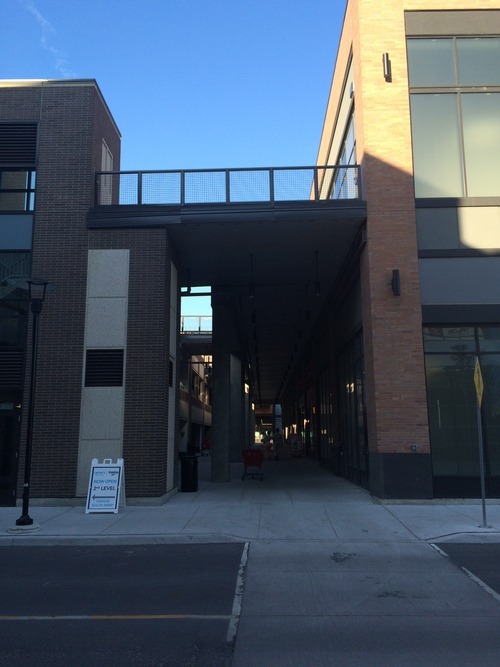
    That’s where the Stockyards comes in. What they’ve done is put smaller retailers along the perimeter of the site with direct access from the sidewalk; they’ve buried the parking in the middle of the site (and built structured parking); and they’ve moved the anchor and larger tenants (Target, Winners, etc.) to the second floor. I don’t think that all big box stores would go for this, but Target is known to be one of the more progressive in this regard.

    So functionally, if you’re taking transit and walking along the street, you have shops engaging you and you’re not looking at the loading area of some big box store. And if you happen to be driving–as many people do to big box stores–you can either drive in and park on the ground floor (and then take an escalator up) or you can drive up the second floor parking area and walk right into the store as you normally would. What they’ve basically done is adapted big box stores to a more urban context. 
    image

    Now, I can see why many at the city like this development and I certainly think it’s a step in the right direction in terms of getting both developers and tenants to think more urban. But I wouldn’t say that we’ve nailed the formula here. When I was there the space felt empty and I had trouble orienting myself after I parked. But it’s certainly a major improvement compared to the big box stores across the street.

    If you’ve had a chance to visit the Stockyards, I would love to hear from you in the comment section below.


  • Home remodeling site Houzz valued at $2.3 billion

    Earlier this week it was announced that home remodeling site Houzz raised a $150 million Series D round, which would value the company at around $2.3 billion, post-money. Meaning, that’s the value of the company including the money it just raised.

    If you’ve never used Houzz before, it’s a platform that offers design inspiration for remodeling projects, products for sale, and a directory of home professionals. The company makes money by selling products through its online storefront and through premium accounts for the pros.

    The perceived value of Houzz likely stems from the fact that it provides a platform to address the estimated $300 billion home improvement market. But what I see as really exciting is the potential for Houzz to bring even greater transparency to the whole renovation and construction marketplace.

    Already Houzz has started to aggregate data on average renovation costs throughout the US. But there’s a lot more they could do. Professional reviews and design inspirations are great, but I can imagine them “moving up the stack” to start acting as a king of virtual general contractor that manages more of the actual renovation process.

    And that would be pretty powerful.

  • Opening the doors to a presentation center

    This past week we opened the doors to the presentation center for Kingston&Co Condominiums. It was pretty chaotic leading up to the opening, but everything worked out and I think our party was a great success. 

    These early events are an opportunity for the media to see the project and the presentation center, and for the project team to enjoy some of the fruits of their hard work. I think those times are important. When everyone is moving quickly to meet deadlines, sometimes it’s easy for things to get impersonal. So it’s nice to be able to sit back, have a glass of wine, and tell someone that you appreciate all of their hard work.

    Below is another photo from the event. I’m the second from the right, wearing a sweaty pink shirt. I had planned to go home and change before the event, but I instead got wrapped up moving things around and getting the presentation center ready. On a related note, there’s a tree trunk beside the sofa in the reception area that weighs almost 400 pounds. If you can lift it on your own, or even just move it on your own, I’ll buy you a round of drinks.

    If you’d like to learn more about Kingston&Co, click here. And if you get a chance to check out the presentation center, make sure you tweet me and let me know what you think.

    Images: BuzzBuzzHome

  • Should you buy or rent?

    image

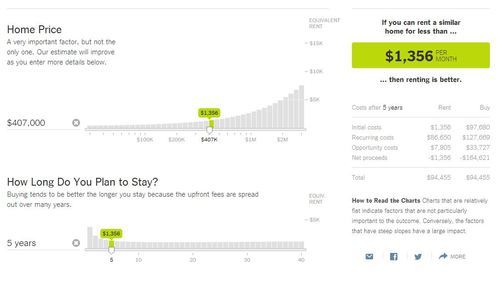
    The decision to buy or rent your home can be a big one–it’s both personal and financial. If you buy, you tie up capital that could be put to use elsewhere. But if you rent, you don’t get to participate in any of the upside should home prices appreciate.

    To help with this decision, the New York Times recently put together an online calculator. It takes into account the opportunity cost of your capital, inflation rates, the expected home price growth rate, and a myriad of other factors. It’s the most detailed of these types of calculators I’ve ever seen.

    If you’re thinking about this decision, you may want to take a look. Although, keep in mind that it’s a US model and in the US you can deduct the mortgage interest on your principal residence. You can’t do that in Canada.

    I also wrote a post a few months ago called: What I see as the fundamentals of real estate investing. You’ll find it interesting if you are, in fact, thinking about buying or investing in real estate anytime soon.

  • The first 100 people

    image

    This past weekend was a milestone weekend for Architect This City. The number of email subscribers surpassed 100 people for the first time. Now, that may not seem like a lot of people, but I think it is. I’m incredibly proud of and grateful for each and every one of you who subscribe to ATC. If I had all of your photos, I would make a collage just like the one above and call it “the first 100.”

    The reason I think 100 people is a lot is because I think of an email inbox as an incredibly personal thing. We live in an age of too much information and our inboxes certainly reflect that. So for somebody to invite and accept the ATC email into their inbox every morning (only a few people subscribe weekly), I consider that to be a big deal. Thank you for that. It really does mean a lot to me.

    I try to ensure that I’m always delivering value to you, which is why I ask for your industry on the full subscription page. I want to know where you’re coming from so that I can do my best to write content that will help you professionally, and perhaps even in life. But if you signed up elsewhere, you may have only entered your email. If you’d like to add your industry, click on “update subscription preferences” at the bottom of one of my emails.

    So far, I know that many of you are architects, city planners, real estate developers, brokers, policy makers, finance people, marketers, and entrepreneurs–to name only a few.

    If you have any specific feedback or have a topic you’d like to see covered on ATC, please feel free to email me or reply to this email (if you’re already a subscriber). I keep a queue of draft posts and I do eventually get to them when the timing is right. Finally, if you feel that somebody within your network would also get value out of what we’re all doing here at ATC, I would really appreciate it if you forwarded this email or shared this post.

    Happy Monday 🙂

    Image: Flickr

  • Could a decentralized sales model work?

    image

    Since I started blogging last year, I’ve been getting regular emails from both people I know and from readers I don’t know (but hope to one day meet) asking for advice on buying real estate. Usually somebody sends me the link to a place they’re thinking about buying, and they want to know what I think about the property and the neighborhood.

    I’m more than happy to help when I can and I try to be brutally honest in terms of what I think. What’s interesting about this dynamic though, is that I don’t have a vested interest in any of the outcomes. Whether I tell that person I love the place or that it’s shit, I don’t stand to gain anything. And that means I can be brutally honest. It’s for this same reason that customer reviews on websites can work so well. 

    Because on the flip side, if I make money when you buy, then guess what, I’m going to want you to buy. That’s how it works for any industry–from financial services to real estate to retail. That’s why some stores will promote the fact that their sales people are not on commission. Although you could argue that those sales people are then less motivated to help you.

    In any event, all of this got me wondering if there isn’t some way to take customer reviews to the next level. Could a decentralized sales model work?

    Last year I had a conference call with one of the chief officers of one of the top 3 real estate websites in the US and I was told that they had actually tested a “social buying model.” It ultimately failed, but it strikes me as an interesting concept. Reviews are starting to feel a bit dated now on the social web, but I think the idea of crowdsourced input is here to stay.

    Image: Flickr

  • Vancouver boomers are sitting on $163 billion of mortage-free property

    Continuing with our discussion of Vancouver, I was reading today that baby boomers in the metro area (those aged 55 and older) are estimated to be holding over $163 billion of clear title property. That is, homes without any mortgage. This figure comes from Rennie Marketing Systems out of Vancouver.

    What’s interesting about this number is that it signals both a lot of equity that could be used for downsizing, rightsizing and lateral moves into a condo, and a source of capital for millennials to buy their first home. In fact, according to a survey that Rennie Marketing also conducted, somewhere around 40% of first time buyers in Vancouver are getting deposit help from their parents and/or grandparents.

    But the question that comes to my mind is: Are there going to be enough middle aged people willing and able to buy $163 billion worth of real estate? Because one person’s sale is another person’s buy.

  • The why of ATC

    The journey of Architect This City has been an organic one. When I first started blogging regularly in September 2013, I had no plan in mind other than that I wanted to write about cities. I had just come off working full-time on my startup, Dirt, where I had gotten into the habit of writing and I enjoyed it immensely. So I wanted to continue.

    Cities seemed like the perfect umbrella to capture all of my passions: architecture, design, planning, real estate, and even technology. And so I rebranded brandondonnelly.com—which I had already been using as a microblog—and slapped the title “Cities” on it. (That personal microblog has since become brandondonnelly.me.)

    Then, after a few months of blogging, I was having drinks with a good friend of mine and telling her about my new daily discipline. She immediately asked me what it was called and, when I replied by saying that I didn’t really have a name for it, she insisted that I create one immediately. Since she’s one of the brightest people I know, I gave it some serious thought. A few days later, Architect This City was born.

    I liked the idea of having a distinct brand, because then it meant it could grow beyond just a personal blog. It could become a real community of people passionate and committed to building better cities. And that ultimately became the goal as I got deeper and deeper into writing.

    Since that time last year, I’ve had friends guest blog on ATC. It has gone on to become syndicated on Mobility Lab and Urban Times. And it has been featured by the Guardian in the UK has one of the big city blogs in the world. But even more exciting are the moments when somebody tells me, either face-to-face or through a quick message, that they’re really enjoying ATC and that they read it daily. That’s what keeps me going.

    Lately though, I’ve been thinking about what’s next. What’s the purpose of ATC? What’s the why? I thought about writing a manifesto of sorts, but that just seemed unnecessarily onerous. So I sat down, primarily on the subway, with Evernote, and I wrote a purpose statement for ATC:

    To promote the building of beautiful and environmentally sustainable cities that offer strong economic opportunities and a high quality of life.

    That’s really what I believe cities should do. They should be enjoyable and beautiful places to live life and they should empower people to get richer. At the same time, we need to be aware that as more and more of the world’s 7 billion people move into cities, the need for environmentally sustainable solutions is only going to increase.

    So those are the kinds of discussions I hope we can have on ATC. Regular scheduled programming will continue as usual, but hopefully now the why is clearer. If you have any feedback on the above statement, I would love to hear from you in the comment section below.
  • Looking east

    There’s a fairly real divide between east and west here in Toronto. When people talk about real estate or describe the kind of person they are, they often say things like: “I’m an east end kind of person” or “I only want to buy on the west side.” There’s such a split that somebody recently said in a meeting I was in that the east vs. west real estate divide is like Christianity vs. Judaism. 

    Historically, the west has generally been considered more desirable than the east–regardless of what scale you’re looking at. Downtown west vs. downtown east, Etobicoke vs. Scarborough, and so on. And for whatever reason, this seems to be the case in a lot cities I’ve been to. Consider Montreal, Vancouver, New York, and London, to name a few. 

    But lately, I’ve been noticing a growing acceptance of the east side. Friends are telling me that, even though they don’t know the east all that well, they’re almost agnostic to which side they buy a home on.

    At the same time, we’re seeing Toronto’s development boom spread to the east along streets like Church and Jarvis; paralleling the kind of intensification we’ve already seen on the west along Bay Street, University Avenue and further. I’m also noticing a lot of west end restauranteurs open up on the east side. See Carbon Bar and Gusto 501 as two recent examples.

    But with the neighborhoods like the Distillery District and Leslieville attracting lots of yuppies and with neighborhoods like Regent Park and the West Don Lands coming online, it shouldn’t come as a big surprise to you that developers and other entrepreneurs are looking east. Maybe you should too.

  • Information wants to be free

    The Globe and Mail ran a piece this morning called, The Realtors of Oz: Bidding wars are unnecessarily sleazy.

    For anyone who has recently tried to buy a house in Toronto, you’ll know that multiple offer scenarios, also known as “bidding wars”, are a fairly common occurrence. Demand for housing in the city is great and interest rates are low. And so homes are frequently being priced below market to generate a feeding frenzy.

    When I read articles like this, I’m reminded of how much frustration I have for the way the real estate market operates today. There’s poor liquidity, there’s a lack of transparency, and there are high transaction costs. I’m a free market kind of a guy and so I’m bothered by how “imperfect” the real estate market remains.

    A lot of people in the business like things just the way they are, but I believe that markets function better, for everyone, when they are open and transparent, and all participants have access to information. Thankfully, I do believe that we’re headed towards a world with more transparency, not less. Information wants to be free.