Daily insights for city builders, delivered every morning at 6 AM ET. I’m Brandon Donnelly — a Toronto-based real estate developer and founder of Globizen. I’ve been writing here since 2013.

Tag: real estate

  • Opendoor.com raises $9.95M to make selling your home as easy as a few clicks

    image

    If you’re a regular reader of ATC, you’ll know that I’ve been following the startup Opendoor.com for a few months now. I first wrote about it when it was codenamed Homerun and I just recently wrote about them as preface to a real estate survey I was conducting.

    Well, about an hour go it was announced that they’ve just raised $9.95M in venture funding from everyone and their grandmother. Here’s the list of investors (via TechCrunch):

    Paypal co-founder Max Levchin, Former YouTube and Facebook CFO Gideon Yu, Eventbrite co-founder Kevin Hartz, Y Combinator’s Sam Altman, Quora CEO Adam D’Angelo, Yammer co-founder David Sacks, Angelist’s Naval Ravikant, Yelp CEO Jeremy Stoppelman, Box CEO Aaron Levie, Initialized Capital’s Harjeet Taggar, Garry Tan and Alexis Ohanian, Former Twitter vice president Elad Gil, Blippy co-founder David King, Flixster co-founder Joe Greenstein, Angel investor Mike Greenfield, Quora co-founder Charlie Cheever, Path’s Dave Morin, Facebook vice president Dan Rose, Trevor Traina, Resolute Ventures’ Mike Hirshland, Caffeinated Capital’s Ray Tonsing, Felicis’ Aydin Senkut, True Ventures’ Om Malik, Thrive Capital’s Josh Kushner, Crunchfund’s Michael Arrington (who disclaimer: founded TechCrunch) and SV Angel.

    Not surprisingly, there are quite a few people who see an opportunity in the $20 trillion US residential real estate market – which I think is a good thing. This is a space that–despite its size–hasn’t seen an awful lot of innovation.

    There still isn’t a lot of information about the product, but there’s a clear focus on creating liquidity in the marketplace. Despite being located in San Francisco, the company will be launching in 3 markets outside of California – where liquidity isn’t as great for homeowners.

    The goal is to transform the typical 90 day selling process into a few clicks online. Homeowners submit their home to the platform and then Opendoor makes an instant offer to buy. Done.

    What I wonder then is if it’s going to be an arbitrage play. They buy the homes below market (because they’re offering total liquidity) and then they turn around and sell them at market.

    Do you have any guesses as to their business model?
  • Embracing 3D in the real estate industry

    I recently discovered a New York-based startup called Floored. What they do is create “interactive, online 3D models for real estate.” They take spaces that may or may not exist yet, and turn them into interactive experiences that can be accessed online from any browser.

    Here’s one they created for ClearRock Properties and Cushman & Wakefield, designed to show how two adjacent retail spaces would look if they were combined into one.

    There’s been a lot of talk over the years about how limiting 2D floors plans are for communicating space to potential tenants and purchasers. But in the same way that virtual reality has never really taken off, neither have 3D floor plans, interactive walkthroughs, and other more sophisticated tools. When people buy a new condo, for example, they still buy it based on a floor plan.

    However, as the technologies get better–and perhaps as BIM supersedes CAD as the dominant platform for architects and designers–I think we’ll see these 3D tools become standard in the industry.

    And one of the things that I think it will allow us to do is be much more iterative in the way we design and build spaces. Right now it’s almost impossible to test different iterations of a building in the same way that, for example, a web developer might test different websites. Construction is a pretty permanent act. But 3D could open up that possibility.

  • Thoughts on real estate marketplaces

    The responses are still coming in from yesterday’s real estate marketplace survey, but I wanted to thank everyone who took the time to complete it. I really appreciate it. I was reviewing the responses this morning and I thought there were a couple of interesting takeaways.

    First, most people who own a home have at one point or another thought about selling that home. And even the people who haven’t thought about it, said they would be willing to sell under the right circumstances. That is, they would sell for the right price, for a better place, and so on. At the time of writing this, nobody said they would never ever sell.

    I think this is interesting because, even though the real estate market is a highly illiquid market, my hunch is that it could be made a lot more liquid with the right frameworks in place and if the barriers to selling could be reduced.

    And sure enough, many of the folks who said they have thought about selling (but haven’t yet), said it’s partially because it’s too expensive and too much work to sell. But in addition to these barriers, two other points emerged that I hadn’t given a lot of thought to before – but make total sense. 

    Homeowners also said that they haven’t sold because they’re too emotionally attached to their home and because they’re afraid they won’t be able to find another place to move into. 

    Because of how illiquid the real estate market is and because home transactions are typically asymmetric (that is, buying and selling are independent actions), there appears to be a real concern that you could sell your home and never find anything better.

    And since a home is such an emotion filled asset (as opposed to, say, a stock), people are naturally afraid of making the wrong choice. But then that begs the question: Are we, as real estate consumers, being left with suboptimal outcomes because we’re simply too afraid of the making the wrong choice?

  • Your thoughts on the real estate marketplace, please

    If you know me at all, then you’ll know that I’m a big proponent of introducing more technology into the real estate space. I think the industry is one that has been incredibly slow to embrace technology, but that it’s only a matter of time before it does.

    Two months ago I wrote a post talking about how entrepreneur and venture capitalist Keith Rabois is working on a home buying startup codenamed Homerun — now called Opendoor. Here’s how he recently described the state of affairs:

    “My friend [PayPal and Palantir cofounder] Peter Thiel suggested that I come up with an idea to innovate in residential real estate,” Rabois told VentureBeat in April. “It’s the largest part of the economy unaffected by the Internet. And that was definitely true then, and even with things like Trulia and Zillow, it’s fundamentally true today. But the process of [selling a home] hasn’t been transformed by technology.”

    What Opendoor is trying to do is really interesting, but I have a different idea. It’s called Unlyst. And today I’d like to ask the ATC community for a small favor. I’ve created a short home buying and selling survey (embedded below) that will take you at most 2 minutes to complete.

    If you could please take the time to do that, I would greatly appreciate it. I’ve made the results public as well, so you’ll be able to see how buyers and sellers currently feel about the real estate marketplace. If you can’t see the survey below, please click here. Thanks for your help!

    [googleapps domain=”docs” dir=”forms/d/1bKvHYdSUfYH3AGX7LcLIK0_-i7nt7WIdTmHeaJ8P7pY/viewform” query=”embedded=true” width=”760″ height=”500″ /]

  • Without trust, you have nothing

    I was reading Fred Wilson’s AVC.com blog this morning (as I do every morning), and I thought his post on trust was a really important one. He was talking about it in the context of building successful web applications, but I don’t think it’s only applicable to internet businesses.

    As marketer Seth Godin wrote on his blog earlier this year, the most important questions are not:

    Is my price low enough?

    Is it reliable enough?

    Do I offer enough features?

    Am I on the right social media channels?

    Is the website cool enough?

    Am I promising enough?

    No, the most important question in marketing something to someone who hasn’t purchased it before is,

    “Do they trust me enough to believe my promises?”

    Without that, you have nothing.

    I thought this was such an awesome, yet simple, post that I actually circulated it to a bunch of people in the office after I read it. Because whether you’re marketing widgets, marketing private cloud storage, marketing to investors, or marketing new condominiums, that question of trust is paramount.

    And it’s for that reason that I think social media and mediums such as blogging have become so important. Customers want to feel like they trust you before they buy your product. The best brands know this and forge “relationships” with their customers. And with the tools at our disposal today, it’s become a lot easier for companies to do that.

  • Introducing Polyform Labs

    image

    A few weeks ago I had coffee with a friend of mine who is a partner at a Toronto-based enterprise software company called Polyform Labs. Their products are geared towards the commercial real estate industry and, since I’m a big proponent of introducing more technology into the real estate space, I thought I would share a little bit about them with you all today.

    The first of their 4 main products is called Lingo, which is a machine learning tool that helps companies quickly review legal documents and contracts. In the case of commercial real estate firms, the most obvious use case is leases. These documents are often hundreds of pages long and, if you have a big portfolio of properties, I’m sure you can imagine how quickly these pages add up.

    What’s neat about Lingo is that you basically upload a lease and then the tool interprets and summarizes all of the clauses for you. It then tells you where you’re potentially exposed and where your risk factors are. And if by chance it gets it wrong, you can correct it and the system will actually get smarter – hence the machine learning part.

    I’m not going to go through their entire product line, but I did also want to mention one more called Aura. They call it a “location-aware loyalty engine”. And you may have heard of similar products out there in the marketplace. What it does is use the MAC address on mobile phones (which is a unique, but anonymous, identifier) to track how people and crowds move through spaces.

    The most common use case I’ve come across is within shopping malls and retail spaces. It’s used to determine which stores have the most foot traffic, which departments and aisles draw the most people, how long people stay in each store, where they buy, and so on. So even if you didn’t already know about this technology, you may have already been giving up your location data. There are lots of mall landlords using it.

    And it’s producing some interesting data. For example, as soon as somebody buys one thing in a mall, their propensity to buy something else grows exponentially. This is what the data tells us and I can certainly relate to it from my own experience. So as a mall landlord and tenant, you are obviously trying to figure out ways to encourage people to make that first purchase. 

    The other use case that (obviously) came to my mind was with respect to city planning and urban design. How could we harvest anonymous location data to improve the way we design both our private and public spaces? Imagine if we had this data for subway stations, public parks, public plazas, and so on. I bet we would discover all kinds of ways to improve the experience within our cities. I’d like to see the location data for Trinity Bellwoods Park in Toronto on a sunny summer day.

    But I digress.

    If you’d like learn to more about Polyform Labs and their real estate products, click here

    Image: WPC

  • Why Vancouver’s housing market hinges on China’s economy

    Last week a friend of mine sent me a really fascinating article from The Economist talking about the role of foreign investors in Vancouver’s housing market. If you subscribe to The Economist, you can click here to read the article. If you don’t subscribe, you’ll have to rely solely on what I’m about to say.

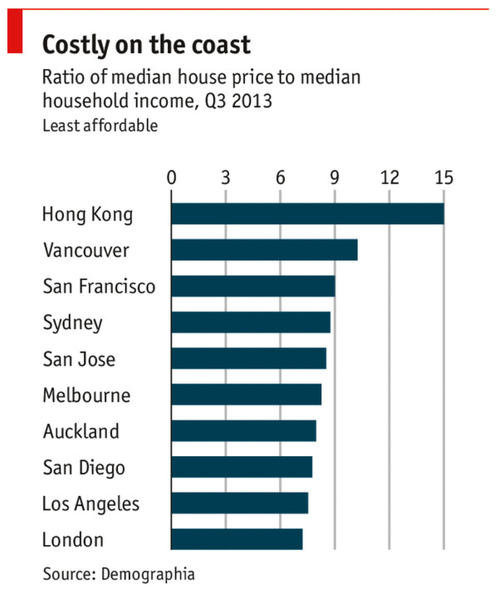
    In case you weren’t aware, Vancouver is an incredibly expensive city when it comes to real estate. The average price for a single-family detached house is now around C$1 million. By some measures, that makes it the most expensive housing market in North America. Here’s a chart that looks at house prices as they relate to household income:

    image

    According to The Economist, the median household income in Vancouver is $68,970. This places them 23rd out of 28 in terms of Canada’s major cities. So how is it that homes are, on average, selling for $1 million? The locals don’t seem to be able to afford them.

    Well, it’s a well known fact that Chinese buyers continue to be an integral part of Vancouver’s housing market. In fact, up until this year, Canada offered a fast track option for citizenship applications if you brought at least $800,000 into the country.

    So we know that foreign buyers are having an impact. It’s a phenomenon we’re seeing in many other cities around the world, such as London. But to what extent is hard to measure–which has forced analysts to get creative.

    To try and figure out what percentage of homes are going to foreign buyers, analysts have been looking at macro data, filing through sales records, and even monitoring utility bills to see which homes might be sitting empty.

    What they found is that there’s a fairly significant correlation between economic activity in China, and Vancouver’s housing market. When the Chinese economy does well, so do Vancouver homes. Interesting. Still, that doesn’t quantify impact.

    When analysts looked for utility bills that would suggest an empty home, they found that only about 8% of high end downtown condos were likely sitting empty. That’s a relatively small amount. It could be vacancy rate.

    But when they looked for “mainland Chinese-sounding names” on sales records, they found that for homes priced $3M and up, almost ¾ of the buyers could be from mainland China. Now that’s a significant number!

    I found this all rather fascinating and I thought you all might as well. It yet again reminds me of how much opacity there is in real estate markets. We’re all craving better data. Why else would people be scouring utility bills?

  • Stuck in condoland?

    Toronto Life recently published an interesting article called Stuck in Condoland. A lot of people have mentioned it to me, so there seems to be a lot of interest in the topic. It basically profiles the lives of a few young families who live downtown and are trying to raise young children in relatively small condos (think 700 square feet).

    I thought it was interesting because I like the idea of small and efficient living. The average post-war bungalow in Toronto was probably less than 1,000 square feet. And so this modern notion that you need a big house in order to properly raise a family is a relatively recent phenomenon. Although we’re a richer city today and that’s what happens when people become wealthier: they consume more.

    But the article also makes it seem that developers only want to build small condos and that larger condos and single-family homes just aren’t profitable enough. Thus the reason all these families are being forced to into tiny shoeboxes in the sky. But that’s not really true.

    Look, just like every other for-profit business on the planet, developers are concerned with making money. And so they will always look for ways to increase efficiency, drive down costs, and so on. But there are certain realities of the market that developers don’t have control over.

    First, developers aren’t building new single family homes in the city (at any sort of meaningful scale) because there’s no land to do so. And because the land use policies in place and the current thinking around how we can more sustainably build our cities for the future dictate that we should be building more intensely. In other words, building up. So it’s not a question of developers not wanting to build single family homes; it’s a question of not being able to.

    Second, trust me when I say that if the market wanted large 3 bedroom family units, developers would build them. Mandating them is a useless exercise if people don’t want them or are unable to afford them.

    The challenge we face is that a reinforced concrete condo tower is more expensive to build than a wood-framed single family house. So until land values get to a point where single family homes become the more expensive option (compared to condos), I don’t think we’ll see a huge rush towards 3+ bedroom suites.

    This is my hypothesis at least. Because when you buy house, you’re really buying two things: the house itself and the land. If the house itself (wood) is cheaper to build on a per square foot basis than a condo (concrete), then the variable that will make a difference is the land. And as people like to say: “buy land, they ain’t making any more of it.”

    So what I’m saying is that I just don’t think the situation is as simple as: “developers are bad, all they want to do is build tiny condos and make lots of money.” It’s more complicated than that. But I do believe the question of how families are going to live in the city is an important one.

  • What the hell does gesamtkunstwerk mean?

    image

    I’m a big fan of Canadian developer Ian Gillespie and his firm Westbank. They are the developers behind projects like the Shangri-La Vancouver, the Shangri-La Toronto, the mixed-use Woodward’s complex, and the upcoming Vancouver House (shown above) designed by Danish architect Bjarke Ingels (who just so happens to be one of my favorite architects). I would easily count them as one of the preeminent city builders in the country today.

    In support of their commitment to city building (and as a way to offer the public a peek of Vancouver House), they recently staged an exhibition called Gesamtkunstwerk. I think this is great on so many levels. Not only was it probably a great sales tool, but it’s also introducing the public to a largely obscure and academic term, and showing off a deep commitment to design. Unless you studied art, architecture, or something like the philosophy of aesthetics, you probably haven’t come across this term before.

    Gesamtkunstwerk is a German word, which literally translates into a “total work of art.” It was introduced in the 19th century by an opera composer by the name of Richard Wagner, who felt that opera represented a total, or complete work of art. Later, the term was picked up by architects. Some interpreted it to mean that architects should be responsible for everything from the building itself to the furniture and everything else that goes inside of it. Everything was art.

    Westbank now wants to introduce the idea of gesamtkunstwerk into the real estate development business. They want to use it as a guiding philosophy for all of their projects. And what that means is that the building itself and its relationship to the greater city should be thought of as a “total work of art.” They seem to be reintroducing the term with an inherent city building tinge–one that I don’t think was ever there before. 

    What a great philosophy.

    Image: Westbank

  • A century of homeownership and renting in England and Wales

    This morning while I was reading about gentrification in Berlin, I clicked through to an interesting overview of homeownership and renting in England and Wales over the last century. Here’s a video. If you can’t see it below, click here.

    [youtube https://www.youtube.com/watch?v=LDnGryGJ1ZA]

    The video starts in 1918, where the vast majority of households (77%) rented. As of 2011, this number has reversed. 64% of households in England and Wales now own their home.

    If you compare this housing trend to what happened in the United States and Canada, you’ll see a similarity. Although, the US was ahead in terms of promoting homeownership. They reached 50% ownership somewhere in the mid 1940s, whereas England and Wales didn’t reach this number until around 1971.

    image

    All of this is an interesting reminder that our obsession with homeownership is a relatively new one. But it’s also not a universal one. The homeownership rate in Berlin is 15.6%, and it’s only 49.5% in London. People in big cities tend to rent more.