
Daily insights for city builders, delivered every morning at 6 AM ET. I’m Brandon Donnelly — a Toronto-based real estate developer and founder of Globizen. I’ve been writing here since 2013.

Tag: real estate

  • Should condo reserve fund balances be made publicly available?

    No Need For Love by Michael Muraz on 500px.com

    https://500px.com/embed.js

    I’ve been thinking a lot lately about condominium governance and how things might be improved.

    If you own a condominium, you pay a monthly maintenance fee. Let’s say, for example, you own a 833 square foot condo and your maintenance fee is $500 per month. That works out to be $0.60 per square foot.

    For a lot of people, this fee probably feels like a bit of a black hole. The money goes out every month and that’s the end of it.

    But as I explained here, a portion of that fee goes into the condo’s reserve fund to cover future capital expenditures. This is basically an investment you are making for the future benefit of the building.

    As an example, if you’re paying $500 per month, somewhere around 25% could be going towards your condo corporation’s reserve fund. That’s $125 per month. $1,500 per year. $7,500 over a 5 year period. And $15,000 over a 10 year period.

    Now this is an investment that you’re obliged to make, but one that you might not be around to directly benefit from if you decide to sell before capital expenditures are made using the money you’ve invested.

    Of course, if you’re a savvy buyer, you’re going to scrutinize the reserve fund and the corporation’s overall financials before you buy into a building. And sometimes the unit valuations do get deeply depressed by out of control maintenance fees and/or special assessments. So you could maybe argue (as an owner) that your reserve fund investment ends up getting recaptured in an eventual sale.

    But what I wonder is to what extent a properly funded reserve gets accurately reflected in the valuation of the individual units. I suspect not that well. And as far as I know, there isn’t great data on this metric. (If you know of anything, please share it in the comments.)

    It’s certainly important information to have and consider. Again, when you buy a condo unit you’re not only buying the unit itself, you’re also buying the future investments (and liabilities) that others have left before you.

    So what I really want to know: Why aren’t reserve fund balances and building studies made publicly available? This is not easy information to get today.

    But imagine what would happen if the market had full transparency. Imagine if you could see a map of every condo building in your city and sort by age and reserve fund balance. In theory, unit pricing would become more accurate. But even more than that, there would be significant opportunities for collective intelligence.

    Now all of a sudden buildings would be able to benchmark themselves against other buildings to see if their reserve fund is sufficient, as well as learn from other buildings with respect to their history of capital expenditures. It would also hold the building’s management more accountable and allow owners to easily see if the contracts in place are competitive with the overall market.

    I know that a lot of people get nervous when it comes to sharing information like this. I mean, what would happen if your building is underfunded relative to its peers? Would that pull down property values? It certainly could. But if you’re underfunded and you get stuck with a special assessment in 5 years, then your property values are going to drop regardless.

    So I would love to see a lot more condo information made available to the public for free. In my view the benefits outweigh the potential negatives, particularly if this were to be done at scale. Condo corporations are also non-profit entities, so it’s not as if their balance sheets and income statements are filled with sensitive trade secrets.

    But what do you think? Would you feel comfortable if your condo’s reserve fund balance was made available online to the public? Do you even know off the top of your head what the balance is for your own building? I would be curious to know.

  • Sam Zell’s Equity Residential sells 23,000 suburban apartment units

    Earlier this week it was announced that Sam Zell – the billionaire who initially made his money in real estate – is selling over 23,000 apartment units to Starwood Capital Group (Barry Sternlicht) for $5.4 billion. The units are all controlled by Zell’s company, Equity Residential.

    This is interesting for a number of reasons, but I’d like to point out two of them today.

    Firstly, Zell is famous for selling another one of this companies, Equity Office Properties Trust, to Blackstone for $23 billion in 2007. This was right before the market fell out and so some people are asking whether this signals the end of the apartment run. Average apartment rents in the US have increased roughly 20% over the last five years.

    But at the same time (and this is my second point), it might not be that at all. Instead, it could simply be a rebalancing of the portfolio. Here’s an excerpt from the Wall Street Journal:

    …Equity Residential has become “less aggressive as buyers of assets” in recent years, Mr. Zell said in an interview late Friday. Instead, it is getting out of suburban markets and into downtown urban centers, where young people are moving and where it is more difficult to build, he said.

    Most of the 23,300 apartment units in the deal, roughly a quarter of Equity Residential’s total, are low-rise and mid-rise units in suburban markets in and around southern Florida, Denver, Seattle, Washington, D.C., and Southern California. Analysts expect a significant amount of new supply to be concentrated in those markets in coming years.

    Of course, Sternlicht is buying these suburban properties and so he clearly has a different investment thesis. (The purchase price works out to be $230,600 per unit at a cap rate of roughly 5.5%.) But that’s what makes these deals so interesting to scrutinize. Nobody really knows what the future holds.

  • How small is too small?

    I was up early on Sunday morning and I tweeted this out:

    //platform.twitter.com/widgets.js

    It’s a link to a Dwell article about a New York family of four that lives in a 620 square foot apartment. It’s technically a one-bedroom apartment but the way they have it set up is that the two kids share the bedroom and the parents sleep in the living room similar to as if it were a studio apartment.

    And my question in the tweet was, could you do it?

    Part of the reason the article caught my attention was because I currently live in a 640 square foot apartment – but as a family of one. And not surprisingly it’s more than enough space for me. Would I still feel the same way if it were a family of two? I believe so. But what about if it were a family of 3 or 4? I suspect it wouldn’t be as effortless, though certainly not impossible.

    I love the idea of distilling one’s life down to only what is absolutely necessary. And if you happen to live in a city, like New York, where the median price of a one-bedroom apartment is somewhere around $3,400 per month, there can certainly be lifestyle advantages to doing more with less.

    So I’d like to re-ask the question here to the Architect This City community: Could you do it? How minimalist could you go?

  • The contradiction in American housing policy

    I really like this post by Daniel Hertz talking about the inherent tension in American housing policy.

    Here’s his conclusion:

    We are, in conclusion, profoundly conflicted as a nation when it comes to housing: we want it to be affordable, but we also want its prices to rise fast enough to be valuable as a financial investment. That’s a contradiction we need to acknowledge if our housing policy debate—and, ultimately, our housing policy—is going to be coherent and constructive.

    Of course, this situation isn’t unique to the US. Though the US does have homeownership subsidies – such as the mortgage interest tax deduction – that other similar countries, like Canada, do not have.

    Still, I feel a similar kind of contradiction here. We worry about excess supply and housing bubbles when the reality is that both of these things are desirable outcomes if, and only if, the primary objective is to maintain housing affordability.

    But I don’t think that is the primary objective in practice. At least in this part of the world, I think we worry first and foremost about making sure that home prices continue to go up and that wealth is being built. Then, we worry about providing affordable housing for those that are unable to participate.

    I’m not making a judgement call on whether or not that’s a good or bad thing. It just strikes me that this tension, and there certainly is a tension, is not an equal one.

  • What tax policy could be doing to home sizes in Ontario

    Golden City (of Toronto) by Evgeny Tchebotarev on 500px.com

    https://500px.com/embed.js

    In yesterday’s post I made a remark that we have antiquated tax policies here in Ontario that encourage the building of smaller new construction condominiums. There seemed to be a lot of interest in that comment, and so I’d like to talk about that today.

    Some people thought I was referring to development charges, but I was actually thinking of the GST/HST New Housing Rebate in Ontario

    The way it typically works in Ontario is that when buy a new construction home, the price you pay is inclusive of HST (harmonized sales tax) and net of any applicable rebates, such as the rebate program mentioned above. 

    This means that the price you see on your agreement is usually the price you pay. I say usually only because there are ways that you could disqualify yourself from the New Housing Rebate program. But that’s a different post.

    So what does this mean in practice?

    Let’s say you went out and bought a new construction condo for $368,200 (there is a reason I’m picking what seems like an arbitrary number). If there was no such thing as the New Housing Rebate program, then the sales tax owing on this home would be the full 13%. And that would mean that the price paid before any taxes is actually $325,841 (x 13% = $368,200). This is an important number because it represents revenue to the developer.

    But since there is a New Housing Rebate program, the effective tax rate actually works out to be 5.20% for this particular sale price, which means that the price paid before any taxes is now $350,000 (a nice whole number). And so because of rebates and because they are now paying less HST, the developer’s revenue number has increased. It has gone from $325,841 to $350,000.

    The way this logistically works is that purchasers usually assign the New Housing Rebate benefits to the developer who then processes all the paperwork. This is what I mean when I say that the “sticker price” is inclusive of HST and net of any rebates – it already factors in the possible deductions.

    So far things are looking good. And I want to be clear that I don’t have concerns with the New Housing Rebate program in its entirety. In fact, it’s a hugely important part of the new home industry. Without it, many projects would simply not be feasible to build.

    However, as the price of the new home increases (which typically happens as the home gets bigger), the rebates start to fall off. The federal portion of the rebate maxes out at a base purchase price of $350,000 (which is why I chose that number) and the Ontario portion maxes out at a base purchase price of $400,000.

    What all this means is that as the unit sizes get bigger and more expensive, the effective tax rate is no longer at 5.20%, as was the case in the example I gave above. It increases. And if you hold prices constant for the purchaser, it means that the developer’s revenues now start to drop.

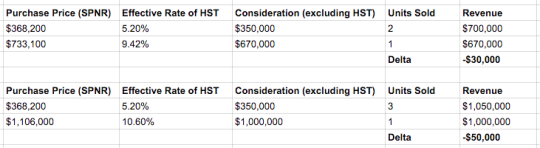
    To illustrate why this matters, consider the following chart:

    image

    In the first scenario, the developer builds and sells 2 units for a price of $368,2000. This translates into revenue of $700,000. However, if the developer instead decides to combine those 2 units and sell the larger single unit for $733,100 (roughly double the price) then the effective rate of HST goes up and revenue drops by $30,000.

    The second scenario is similar to the first one except that instead of 2 units, it’s 3 units which then get combined into one. Here revenue drops even further – by $50,000.

    Now, you could argue that there are some cost savings associated with building fewer suites, but I don’t think it would offset the differentials shown above, especially if you multiply those revenue numbers across an entire project. So what this all means is that it can be more profitable for developers to build smaller units priced below the thresholds mentioned above, as opposed to a smaller number of larger units. 

    Again, I’m not saying that HST rebates are bad. They’re critical to the industry. I love them. But I do believe we should be thinking about the possible implications that the current set up could be having on what we’re building and in particular on unit sizes.

    If you’d like to learn more about how the rebates work, check out this PDF from the Canada Revenue Agency. I tried to keep things simple in this post.

  • Pre-sales, shear walls, and condos, oh my

    Work In Progress 2 by bryan simpson on 500px.com

    Pre-sales are a big part of many condominium markets. The way it typically works is that developers sell suites in their building before construction has even started and then uses those purchaser deposits (which are held in trust) to obtain a construction loan to actually build the building. Part of the reason this is done is that it, in theory, reduces speculative overbuilding.

    Nobody really knows the exact number, but here in Toronto many suites within a new building often end up getting sold to investors. And in some locations and some buildings, it could be most suites.

    On the one hand this is a good thing. Because in a way they provide the short-term money that gets new projects off the ground. And if they end up holding onto their suites, they also become landlords for new rental housing. Here in Toronto condos have been almost the only new rental stock built in this city for decades. (Purpose-built rental is now starting to come back though.)

    But one of the potential negatives is that buildings could be getting designed more around investor needs as opposed to end user needs. And that is happening because many end users – particularly when it comes to larger suites – find it difficult to make such a big life decision 3-5 years out. Doing that means saying to yourself: Okay, I’m going to buy this 3 bedroom condo today because 4.5 years from now when it’s complete I expect to be married and have 1.5 kids. Life doesn’t always work that way.

    We also have antiquated tax policies in Ontario that encourage the building of smaller suites. And I believe they should be modernized. (This topic deserves a dedicated post.)

    So if we are to think of these condo suites as products, then you could say that there are two broad customer segments: the investor and the end user. There are obviously sub-segments within each, but let’s assume that those are the top of the funnel.

    The challenge now facing developers creating new product is that the system we have put in place arguably privileges one customer segment over the other. And it’s a problem that is somewhat unique to the real estate industry because it takes so damn long to bring new supply to the market. (If you sell jets or yachts, maybe you have a similar problem.)

    Now one way to solve this might be to create lots of flexibility in the product. That is, you could allow people to adjust and combine suites to fit their current needs. And that’s what great products do: they meet specific needs and solve problems. In this scenario, perhaps the single person could “add-on” to their suite as they enter a new life phase. And indeed, this is something people are experimenting with by way of things like “knockout panels.”

    But the problems with this are twofold. 

    Firstly, this requires an adjacent and suitable suite to come on the market so that you can buy it. And that may not happen 6 months before the baby comes. 

    Secondly, most Toronto condominiums are built using something called shear walls. These are structural reinforced concrete walls that cannot be removed without compromising the integrity of the entire building. And most purchasers like these walls between them and their neighbors because they’re worried about noise. So combing suites isn’t always as straightforward as we might think. There are many constraints.

    One way to mitigate these problems is through smaller projects. That reduces the lead time between purchase and occupancy. But I am sure there are probably other creative solutions that we could come up with to better align product and customer needs.

  • Thoughts on land-value taxation

    Yesterday I wrote about a new book that was just released called The Next Urban Renaissance

    The first essay in the book, written by Ingrid Gould Ellen of New York University, is centered around three ideas to help cities deal with the affordable housing problem. This is something that successful cities all around the world are grappling with.

    The first idea is land-value taxation, which is also known as a “split-rate” tax. I’ve touched on land-value taxation before on ATC, but I never really dug into it. So this was a good reminder to do that.

    The idea behind land-value taxation is to split property taxes into a land tax and an improvements tax (i.e. the building), and then shift more of the burden over to the land side. Economists tend to really like this model because taxing buildings/improvements can discourage property investment and development, whereas taxing land doesn’t impact supply. The supply of land is fixed.

    So in the context of affordable housing, land-value taxation is thought to be a way to encourage more development and to increase the supply of new housing – which is usually a good way to keep home prices in check.

    Here’s how Ingrid Gould Ellen described it:

    …a land tax would discourage speculators from hoarding
    undeveloped land and incentivize them to develop their parcels to the
    full extent allowable. Regardless of whether a parcel sits vacant, houses a
    partially occupied, one-story retail strip, or holds a 30-story apartment
    tower, the annual tax bill would be the same. By switching to a land tax,
    a city could therefore increase the supply of housing and, by doing so,
    reduce prices across the board.

    But I can’t help but wonder if this isn’t more applicable to cities or areas that are currently struggling to encourage development. For instance, would boom town Toronto really benefit (in terms of affordable housing) from a tax change that ends up encouraging more high-rise development?

    It also strikes me as being exceptionally difficult to implement, particularly in city like Toronto that is growing and changing so quickly. Is it reasonable to ask the owner of a small downtown parking lot to being paying property taxes as if a 90 storey supertall had been built on top of it? Because that is the reality in some parts of this city.

    And if we opted to phase in this new land tax, would it then become a game of arbitrage where developers look for properties with the lowest land taxes but the highest achievable densities?

    Finally, I wonder if it wouldn’t exacerbate some of the problems that already exist in rapidly growing cities, one of which is the preservation of smaller heritage buildings in centrally located neighborhoods:

    In the case of a split-rate tax,
    the losers will be owners of parcels with high land-to-building value
    ratios, or owners of small buildings on valuable, centrally located parcels,
    who will likely see an increase in their tax bills after the switch to
    a split-rate tax.

    Land-value taxation is something that I’ve been thinking about for a number of months now. But I am struggling to come up with a decisive position. If you have any thoughts on this, it would be great to hear from you in the comments.

  • Multiple representation

    house by Edoardo Panella on 500px.com

    https://500px.com/embed.js

    If you’ve ever bought a property, you might be familiar with something called “multiple representation.” It’s when one real estate agent represents both the seller and the buyer for a particular transaction. It may also be called “dual agency.”

    The reason this can happen is because, here in North America at least, real estate sales are typically done with two agents: a seller’s agent and a buyer’s agent. The real estate commissions are (directly) paid by the seller to the listing brokerage, but it’s usually split between both brokerages and agents involved in the transaction.

    However, if you’re an agent-less buyer and you happen to come across a property that you like on your own (perhaps by browsing around online), the selling agent will likely ask you to also sign a representation agreement with them. And that means entering the world of “multiple representation.”

    Here’s some of the wording that the Ontario Real Estate Association uses:

    MULTIPLE REPRESENTATION: The Listing Brokerage has entered into a Buyer Representation Agreement with the Buyer and represents
    the interests of the Seller and the Buyer, with their consent, for this transaction. The Listing Brokerage must be impartial and equally protect
    the interests of the Seller and the Buyer in this transaction. The Listing Brokerage has a duty of full disclosure to both the Seller and the Buyer,
    including a requirement to disclose all factual information about the property known to the Listing Brokerage.

    But I don’t understand how this can work.

    You now have a sole agent that is supposed to act as a neutral facilitator between (1) a party that is paying them all of their salary for the transaction (and which increases as the selling price goes up) and (2) a party that just came off the street (and where there’s no preexisting relationship).

    That’s why multiple representation scenarios always make me uncomfortable. Real estate already has too many information asymmetries for my liking and this feels like a conflict of interest in almost all of the cases. I guess that’s why they are not allowed in many states in the US.

  • City building jobs

    I get a lot of emails from readers of this blog. I try my best to answer every single one of them, but sometimes I fall behind and fail spectacularly at that. (The snooze feature in Mailbox and Google Inbox is one of the best inventions ever.)

    One of the most common emails I receive is about careers. Sometimes it’s someone looking for a new job or for advice on how to break into the industry (usually real estate development). And sometimes it’s an employer (or recruiter) with a role they need filled. 

    It’s hard to match up supply and demand when they arrive in my inbox on an ad hoc basis like this, but I have been thinking about ways I might be able to help these people out.

    So today I thought I would try something new. If you have a relevant job listing that you’d like me to distribute to the ATC community (something in architecture, planning, real estate, tech, and so on), email it to me at b@brandondonnelly. 

    If I get enough high quality listings, I’ll send them out in my newsletter. And if everyone finds it valuable, I may make it a regular feature.

  • Blogging as city building

    This past week I received 2 separate invitations to talk at events about blogging as a form of city building.

    The first is a Pecha Kucha talk being held here in Toronto on Tuesday, October 20th, 2015. If you’ve never heard of the Pecha Kucha movement, it’s basically all about rapid fire presentations. Each person gets 20 slides and 20 seconds for each one. 

    Here are the details for the upcoming Toronto event:

    image

    The second event is being held in Ottawa in the new year. I’ll write more on that closer to the date when I have more information to share.

    I haven’t yet figured out exactly what I’m going to talk about at each event, but I am starting to think about a few things.

    When I started writing this blog, it was intended simply as an outlet for my own city-related – and also personal – thoughts. Ultimately, the blog evolved into having its own mission, which is to promote the building of beautiful, sustainable, and globally competitive cities. And so clearly in my mind blogging was and is in fact a form of city building.

    But writing is vastly different than the kind of city building I do for a living. During the day I worry about things like rental rates, building setbacks, bulkhead locations, parking counts, and a bunch of other fun stuff.

    The two are certainly related, but the latter feels a lot more tangible. The result is spaces that people will occupy and buildings that will have some sort of impact on the overall built environment.

    But as you all know, city building is a lot more than just bricks-and-mortar. It is political. It is emotional. It is subjective. It is ego-driven. And it is so many other things. Because of this, words do have a role to play in shaping the cities we live in. And hopefully my words are having some kind of positive impact.

    At the same time, I see myself as simply part of a larger set of trends that are happening in both city building, as well as in many other sectors. Trends around transparency, decentralization, and the democratization of information.

    Technology today allows us to connect at zero marginal cost. And that is empowering people like me to self-publish, people to crowdfund real estate development projects, people to crowdsource community feedback for projects, and to do many other exciting things that weren’t possible before. Without this blog, most of you reading this right now would have absolutely no idea who I am.

    So I guess I kind of do know what I’m going to talk about.