Daily insights for city builders, delivered every morning at 6 AM ET. I’m Brandon Donnelly — a Toronto-based real estate developer and founder of Globizen. I’ve been writing here since 2013.

Tag: real estate

  • My blogging methodology

    I often get asked about the methodology behind my blogging. (Though I have written a few posts about it already.) 

    Most people seem to assume that I sit down on the weekends. Draft a content calendar. Write a bunch of posts. And then queue them up for the coming weeks. 

    I don’t do any of that (besides sit down).

    Instead, I get up every morning and I write something. Sometimes I wake up with an idea that’s been bouncing around in my head and sometimes I wake up with no idea what I’m going to write about. 

    In the latter case I just start reading the internet over breakfast until something interesting catches my attention.

    But in both cases, what you are reading about is what I am thinking about at that moment in time. 

    Because in addition to a blog about cities, this blog is about a discipline and a habit. It is about taking time every day to step away from tasks, sort through my thoughts, and write something. It’s one thing to think about something; it’s another thing to write about it.

    And so as much as I hope you all get value out of this blog, it also very much about the personal benefits I receive from doing this same thing over and over and over again.

    Now, in terms of the content, the focus is obviously on city building. But I’m more specifically interested in the following 3 areas and their overlap:
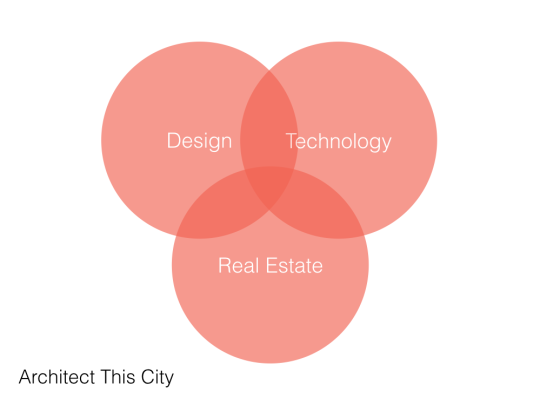
    If you’re a regular reader you know this.

    I didn’t set out to focus in this way, but it just happened over time. This is what I’m passionate about and so I naturally started applying it to our discussion on cities and city building.

    And finally, in terms of writing style, I’ve found myself adopting a particular structure.

    I often start with a personal note – almost as if this were purely a personal blog. Then I dig into a particular city building issue and try to uncover one particular way of looking at it. And then I end with a decisive position. I’ve seen this format on other blogs and I really like it.

    Obviously I don’t always follow this structure. For example, sometimes I haven’t made up my mind on a particular issue. But I try to. I lean towards the belief that a decisive wrong answer is better than a wishy washy right answer. So I push myself to take stances and have an opinion. 

    But in the end, the goal of every post is simply to present one idea for all of us to think about and then discuss. I’d like to believe that it keeps us all sharp. Hopefully it’s working for you.

  • A guide to digital marketplaces

    Version One Ventures – which is an early-stage venture capital fund based in Vancouver – recently published a free handbook called, A Guide to Marketplaces.

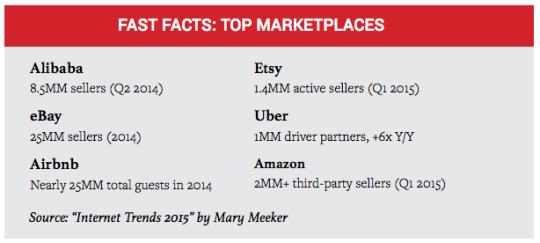
    Online marketplaces are really fascinating because they are perhaps broader in scope than you might initially think. For example, Uber is a marketplace. There’s a supply-side (drivers with cars) and a demand-side (people needing rides). Uber connects these two groups together and acts as a kind of digital middle person. Uber does not own any of the cars.

    This is an incredibly power business model and it can and is being applied in many different ways. Here are the top internet marketplaces (via the handbook):

    I have been interested in this space for years because I have been very curious as to why we haven’t seen more innovation when it comes to online real estate marketplaces. Yes, there are platforms like Zillow.com. But Zillow has not done to real estate what Uber is doing to urban mobility.

    My thinking is that it comes down to supply-side aggregation. Online marketplaces in general are hard to get started, which is why investors love them. They have defensibility. But real estate, in particular, is even harder to jumpstart compared to the incumbent models because of what I see as constraints on the supply-side.

    That’s why I am so excited about what BuzzBuzzHome.com is doing on the new construction side of the business. They are aggregating supply.

    If you’d like to download the guide to marketplaces in PDF, click here. It’s a great read and I’m glad that Boris and Angela took the time to assemble. Thank you 🙂

  • What a “buy now” button will mean for the new construction real estate industry

    Colored apartments by Pierre-Yves Babelon on 500px.com

    https://500px.com/embed.js

    Recently it has been in the news that BuzzBuzzHome.com – the new construction real estate site – will be launching a “buy now” feature in the new year (2016).

    This will allow people to buy condos and homes online with their credit card, which means that people will be able to pay the $5,000 deposit online and process all the paperwork that today happens within a sales office.

    This is huge.

    If you’re somebody who has used a computer and the internet before, the process today feels archaic. Typically you go online to register for a project and then somebody will call you to arrange an appointment. If you ask them to email you the price sheet and floor plans ahead of time, they’ll almost always tell you that they can’t do that and that you’ll need to come into the sales office for an appointment. 

    But what about if you end not liking the floor plans and you’re about to waste a few hours of your time? Too bad. The sales funnel requires you to be present in person. This is nothing against the many talented sales professionals working in new construction; it’s just that if I can design and price out a car online and if Mark Cuban can buy a $40 million jet online, then I should be able to shop for a new condo online.

    BuzzBuzzHome has been chipping away at the current model for years and they’ve managed to get a lot more information online than was previously available. When Matthew and Cliff first launched BuzzBuzzHome in the late 2000s it was almost unheard of for developers to put any sort of pricing and floor plans online. Now they at least have some of that on their site. I’m glad they stuck with it.

    Because what’s equally exciting about what BuzzBuzzHome is doing is that in order to offer a “buy now” feature, they also need to have an accurate account of all developer inventory on hand. And so alongside this “buy now” feature they’re also building out a full cloud-based inventory management system for developers. 

    This means that BuzzBuzzHome will soon be managing the supply-side of the new construction marketplace. Think of the data and analytics you can extract from a platform like this. It’s going to bring much greater transparency to this industry.

    But if your business is in any way connected to the new construction real estate market, I would take this morning and think about how the above innovations could impact your business model. I can think of a few winners and losers.

    Some of you might be thinking that people aren’t going to make the biggest purchase of their life online. But I would bet the farm that many people will. I know I would.

  • The value equation

    On Tuesday night I attended a great industry event that Quadrangle Architects organized about mid-rise buildings. 

    Mid-rise buildings (somewhere around 4-12 storeys) are all the rage in Toronto these days. But there are many challenges associated with this building typology and this was an event to talk about them and hopefully push things forward.

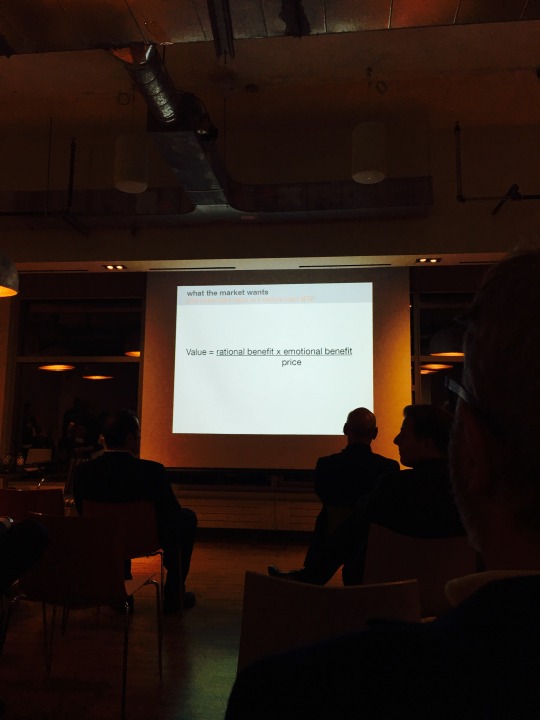
    One of the speakers at the event was Jeanhy Shim of Housing Lab Toronto. And I’d like to share one of her slides here:

    It reads:

    Value = (rational benefit x emotional benefit) / price

    I believe she admitted to taking it from someone at Bruce Mau Design. But that’s okay. That’s how ideas build. What I really like about it is that it attaches a value to the things that are difficult and sometimes impossible to measure: the emotional stuff.

    As I mentioned in this post over the weekend, we are all obsessed with the quantitative side of our businesses. In the case of development, we look at prices, per square foot prices, apartment sizes, and the list goes on. And we often reduce our “products” to these sorts of key metrics.

    But if you’re competing just on numbers, then you’re missing a big and important part of the equation. People consume things – and housing is no different – for a number of different reasons. We buy things because of how it makes us feel, how it reinforces our sense of self, how it improves or promises to improve our lives, and so on. These are all harder to measure than square footage. 

    But we are living in a data driven world and more and more of this type of information will become available for city building. If you and your business can get your head around it first, you’ll have a huge advantage. 

  • Real estate + tech

    If you’re interested in tech and tech products, you might be familiar with a platform called Product Hunt that helps you discover new products/startups on a daily basis. They launched back in 2013 and have since become an important part of the startup ecosystem.

    Here in Toronto, the Product Hunt community has been incredibly active with organizing regular meetups. Every 2 months they host an event, which includes a keynote speaker, 3 product demos from local startups, a panel discussion, and of course the usual drinks.

    The next Product Hunt Toronto event (#7) is scheduled for Thursday, November 26th at 6pm and the focus is on digital products serving the real estate industry. Back when I became obsessed with this space, this would have been considered pretty niche. But today there’s a tremendous amount of interest in the overlap between real estate and tech. And I’m thrilled to see that.

    If you’re also interested in this space, you should grab a ticket right now. They just went on sale yesterday, but usually sell out within a few days. At the time of writing this post, there are only 82 tickets left. I’m also going to be delivering the keynote talk. So I hope to see you there 🙂

  • #donthave1million

    Tiny Park by David Brookfield on 500px.com

    https://500px.com/embed.js

    After I wrote this week’s post about Chinese homebuyers in Vancouver, I was surprised to learn about the racism debate that flared up in the city / on Twitter. I guess this really is a touchy subject. (See: #donthave1million)

    My reaction to the research was: Great to see someone (Andy Yan) putting in the time to try and better understand a market phenomenon. It’s painful how opaque real estate markets can be. Let’s get even more data so that we can make even better policy decisions. I didn’t read it as: let’s deliberately single out a race.

    Because the reality is that we all knew this was happening.

    Bloomberg recently published an interesting and related article that talks about China’s money exodus and how the Chinese logistically get their money out of the country. There are restrictions in place. 

    But first, here are two snippets from Bloomberg that describe the order of magnitude we’re talking about:

    This flood of cash is being felt around the world, driving up real estate prices in Sydney, New York, Hong Kong and Vancouver. The Chinese spent almost $30 billion on U.S. homes in the year ending last March, making them the biggest foreign buyers of real estate. Their average purchase price: about $832,000.

    In total, UBS Group estimated that $324 billion moved out last year. While this year’s numbers aren’t yet in, during the three weeks in August after China devalued its currency, Goldman Sachs calculated that another $200 billion may have left.

    Now here’s how it is being done:

    It works like this: Chinese come to Hong Kong and open a bank account. Then they go to a money-change shop, which provides a mainland bank account number for the customer to make a domestic transfer from his or her account inside China. As soon as that transaction is confirmed, typically in just two hours, the Hong Kong money changer then transfers the equivalent in Hong Kong or U.S. dollars or any other foreign currency into the client’s Hong Kong account. Technically, no money crosses the border – both transactions are completed by domestic transfers.

    And here’s a snippet that stood out for me because it shows how easy this has become:

    While the first exchange has to be set up face-to-face, customers can place future orders via instant-messaging services such as WhatsApp or WeChat, and money changers set no limit on how much money they can move.

    Given the scale and complexity of this issue – housing affordability – I have to believe that cities and policy makers would be far better off with more, rather than less, information. I hope we can work towards that.

  • Will parking spaces in cities become more, or less, valuable in the future?

    Parking Garage by Nuno Silva on 500px.com

    https://500px.com/embed.js

    Lately I’ve been having discussions around the future value of parking spaces in urban centers. So yesterday I tweeted out this poll:

    //platform.twitter.com/widgets.js

    The sample size is very small, but for what it’s worth, there are some/many people who believe that urban parking spaces will become more valuable in the future.

    This is a reasonable assumption. 

    Over the last couple of decades here in Toronto, I would guess that parking ratios for new multi-family developments have probably fallen by more than half. It used to be that you had to build 1 to 1.5 parking stalls for each unit and now we seem to be sitting somewhere close to 0.5. Although, there are also exceptions and some projects today are getting built with no parking.

    So given that the supply side of urban parking spaces seems to be getting constrained and many cities are actively trying to encourage other forms of mobility, it’s not unreasonable to believe that parking stalls will only become more valuable. That’s why a new underground spot in Toronto might cost you $60,000 today and why some spots in New York can even fetch a $1 million

    But this assumes that the demand for parking will remain more or less the same. What if it doesn’t stay the same? What if we were to experience a tipping point that rearranged urban mobility? What if the cost of driving became so high that people stopped driving at scale? In these scenarios, the demand side of the equation would change.

    If you’re a regular of this blog, you probably know what I’m going to say next. But already I can think of two innovations that would contribute to the above scenarios: Uber and driverless cars.

    Uber’s goal is to continually drive down the cost of transportation and eventually get you to no longer own a car. They know very clearly that the demand for transportation services is highly elastic and that the cheaper they get the more you will use them. And the way they get cheaper is by continually increasing the utilization rate of their drivers/cars. An idle driver/car is the enemy.

    Of course, the other way to drive down fares is to remove the driver all together. And once you’ve done that, there is, in theory, no reason that a car should ever sit idle – like they do today. (The utilization rate for my car is around 2%.) And if a car is never sitting idle, then why would you ever need to park it? Certainly you wouldn’t need to park it as often as you do today.

    All of this isn’t going to happen tomorrow, but I believe – despite the supply constraints – that we are going to end up with excess parking spaces in our cities. And that will mean that they are going to be perceived as less valuable than they are today. I also believe that it will eventually seem silly to drive your own car. 

    What do you think?

  • Throwing butts

    For whatever reason, some of the people living in high-rise buildings believe that if you flick a cigarette butt off a balcony that it will magically disintegrate on the way down. It’s either that or they don’t give a shit about anyone else.

    Because if you happen to live in or manage a building which has patios or terraces at the base of tower, I bet you have this problem:

    image

    Above is a picture of a Belmont cigarette burning through the tarp covering the wooden harvest table on my patio. 

    It’s a destruction of property, an environmental concern (many butts end up in stormwater drains), and a pretty scary fire hazard. I know of many incidences where thrown cigarette butts have started fires in a high-rise building. It happened last year in my mother’s building.

    However, the frustrating thing about this problem is that it’s exceptionally difficult to stop. I know this because I sit on the board of my condo building. The typical response is for management to send out notices to all the residents asking them to stop doing this. But frankly, that does nothing.

    So if any of you know of a company or service (or have a product idea) that can help with this, please contact me. But if no such company or service exists, I am positive that you could create it today and sell to almost every condo corporation and property management company that have a condition where terraces or patios sit below a tower. Because inevitably, there will be someone upstairs throwing butts.

    Many buildings have a similar issue with dog poo. People simply don’t pick up after their dogs. So some property managers have started taking stool samples of every dog who lives in the building. That way they can easily determine which residents aren’t picking up after their dogs. I guess that’s what it takes to get some people to give a shit.

    Of course, this isn’t a problem just in buildings. Cities in general are always fighting litter. That’s why you see ideas like this pop-up:

    //platform.twitter.com/widgets.js

    This particular one (in London) was designed to stop people from throwing their cigarette butts on the street. Instead, you use your butt to vote. In this case: England vs. Australia.

    We talk a lot about big ideas here on Architect This City. What driverless cars will mean for cities, how laneway housing could help with housing affordability, and so on. But the smallest ideas can also matter a lot for city building. Sometimes we forget that.

  • The impact of Chinese buyers on Vancouver’s single family home market

    I have a new favorite blog that I think you might all enjoy as well. It’s called BT | A | Works and it is the “architectural and urban research and development division” of Bing Thom Architects in Vancouver. 

    I think it’s it’s important to have people in a firm who are researching and experimenting with ideas beyond the day-to-day tasks of a job. So I was excited to discover their work this morning.

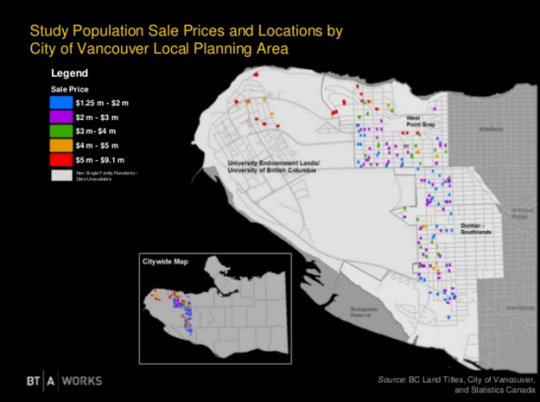
    Their most recent post is a look at ownership patterns of single family homes sold in 3 west end neighborhoods in Vancouver from September 2014 to February 2015 (a 6 month period). These are some of the most expensive areas in the city and, collectively, they found 172 properties sold with an aggregate value of around $520 million.

    Given the presence of foreign buyers in Vancouver’s real estate market, one of the things they then did was identify “non-anglicized Chinese names” on the title records. This means names like “Li Xian”, but not names like “Andrew Shui-Him Yan”, because the anglicized first name suggests that they are probably not a new immigrant or probably not living abroad.

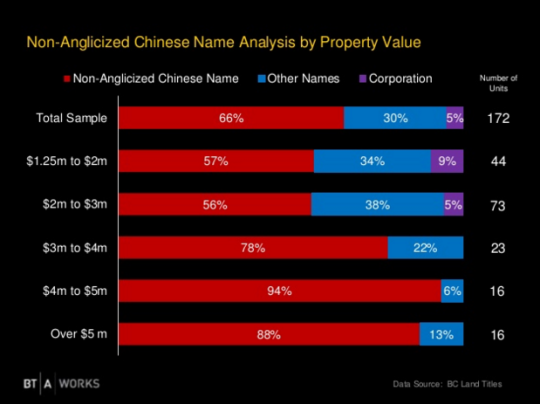
    Here’s what they found:

    In total, 66% of the properties in the sample (172 properties) were associated with a non-anglicized Chinese name. And for properties over $5 million, the percentage jumps to 88%. The other interesting thing worth noting is that 23% of the registered owners declared their occupation as “homemaker/housewife.”

    I thought this would serve as an interesting follow-up to the post I wrote about a month ago called, Is Hongcouver better off than Vancouver? If you’d like to see the full BT | A | Works presentation, click here.

  • How we perceive commuting

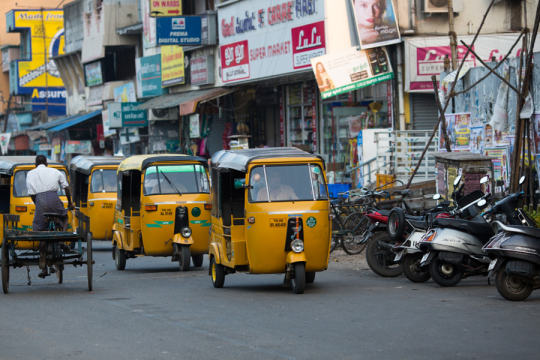
    CHENNAI, INDIA-FEBRUARY 10: Street of Indian city 10, 2013 in Ch by sergemi on 500px.com

    https://500px.com/embed.js

    Wharton real estate professor, Mariaflavia Harari, recently published a paper that looks at the relationship between urban geometry (specifically compactness) and inner city commuting efficiency across 450 cities in India.

    Consistent with previous research done in this space, she finds that people generally prefer compact cities and that they are willing to pay a premium for it. It increases overall welfare. Here’s an excerpt from her paper:

    “My findings are broadly consistent with compact city shape being a consumption
    amenity. All else being equal, more compact cities grow faster. There is also evidence that
    consumers are paying a premium for living in more compact cities, in terms of lower wages and,
    possibly, higher housing rents.”

    So her recommendations for the Indian cities she analyzed was that they should relax land use restrictions to allow for more vertical / compact development and that they should focus on improving urban transport in order to offset some of the negatives externalities associated with sprawl. This is no different than the approach that many cities in the developing world are adopting or looking to adopt.

    One of things that really stood out for me in her paper though is the way people perceive commuting:

    “The loss associated with non-compact
    shape appears to be substantial: a one-standard deviation deterioration in city shape, corresponding
    to a 720 meter increase in the average within-city round-trip, entails a welfare loss
    equivalent to a 5% decrease in income. This is considerably larger than the direct monetary and
    opportunity cost associated to lengthier commutes. Less compact cities also appear to attract
    fewer low-income immigrants, as captured by the share of slum dwellers.”

    What this is saying is that we tend to overvalue the negatives of commuting, beyond the direct costs of gas, insurance, car payments, our time, and so on. We hate it so much that we also want to be compensated for the mental anguish. Here is that same idea said differently:

    The estimated welfare loss from longer commutes appears to be large, relative to the immediate
    time and monetary costs of commuting. This is consistent with the interpretation that
    commuting is perceived as a particularly burdensome activity. The behavioral literature has
    come to similar conclusions, albeit in the context of developed countries. Stutzer and Frey
    (2008) find a large and robust negative relation between commuting time and subjective wellbeing,
    using German data. They estimate that individuals commuting 23 minutes one way
    would have to earn 19 percent more per month, on average, in order to be fully compensated.

    So I guess I’m not the only one who thinks commuting and driving sucks.