Daily insights for city builders, delivered every morning at 6 AM ET. I’m Brandon Donnelly — a Toronto-based real estate developer and founder of Globizen. I’ve been writing here since 2013.

Tag: real estate

  • Photoblog: Sunrise at Ten York

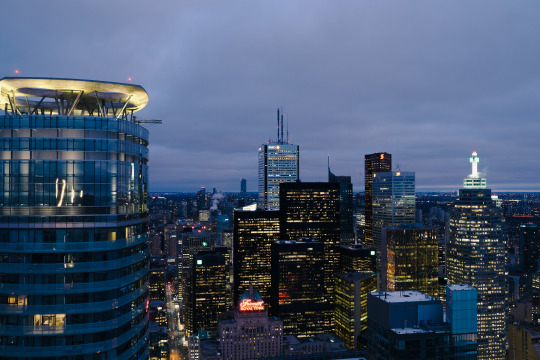
    This morning I watched the sun rise from the the roof of Ten York Condominiums, some 735 feet up. This is what that looked like (the sky initially had a purple hue to it):

    It was cold as all hell, but sometimes you have to work for your photos.

    Some of you may also remember that I wrote about this building a few months ago. Tridel, the developer, is calling the project its first “smart condominium.”

    Regular scheduled programming will resume tomorrow.

  • Multi-storey retail

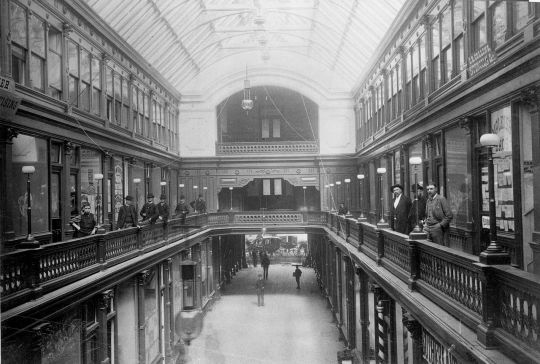
    I was at the St. Lawrence Market over the weekend and I saw a poster up for the original Yonge Street Arcade building, which was located at Yonge Street and Temperance Street here in Toronto. Initially constructed in 1884, the building was ultimately demolished in 1952 and replaced with today’s building by 1960.

    Here is a photo of the original arcade dated 1885:

    image

    The Yonge Street Arcade has been fairly well documented online (check out here and here). But what interested me when I saw the poster was the building’s retail characteristics.

    Modeled after the glass-roofed malls being constructed in Europe at the time – the Galleria Vittorio Emanuele II opened in Milan in 1867 – the Yonge Street Arcade is said to be Canada’s first enclosed shopping mall.

    The galleria was 267 feet in depth and 3 storeys high (pictured above). The ground floor contained 32 retail units, each 12 feet wide by 29 feet deep. 24 of the units were in the galleria and the other 8 faced outward toward each street frontage.

    On the 2nd floor were 20 more units. Some sources say they were intended to be offices, while others say they were retail units. The above photo makes me think they were retail. The 3rd floor then had offices and maybe some artist studios.

    Either way, the mix of uses is interesting (and maybe a first for Toronto). And if you know anything about retail, you’ll know how difficult it can be to successfully pull it off across multiple levels. The Yonge Street Arcade shows that we’ve been (possibly) trying it for well over a hundred years in this city.

  • Airbnb announces new Backyard initiative

    Airbnb has just announced a new initiative called Backyard, where it will be looking at new ways in which homes can be designed, built, and shared. They are, in a broad sense, becoming architects.

    The initiative has been in the prototyping phase for some time now, but the plan is to put forward some sort of product in 2019. Despite the name, the initiative won’t just be focused on small backyard cottages or accessory dwelling units.

    Here is an excerpt from Fast Company:

    “Backyard investigates how buildings could utilize sophisticated manufacturing techniques, smart-home technologies, and gains vast insight from the Airbnb community to thoughtfully respond to changing owner or occupant needs over time,” Gebbia says. “Backyard isn’t a house, it’s an initiative to rethink the home. Homes are complex, and we’re taking a broad approach–not just designing one thing, but a system that can do many things.”

    This is yet another example of tech and real estate coming together. But as I’ve mentioned before on the blog, I think eventually we’ll stop making that distinction; it will just become the way in which we build companies.

  • Evolution of online marketplaces

    I have written a lot about Opendoor over the past few years because it is one of the most promising “proptech” startups in operation today and I am obviously very interested in the impact of tech on the real estate industry. 

    I also have a fascination with online marketplaces. From the Greek agora to today’s mobile apps, the exchange of goods and services is a fundamental human activity. Uber, Alibaba, Instacart, Airbnb, Amazon, and Kickstarter are all marketplaces. I think sometimes people forget that.

    Andrew Chen, who is a general partner with the venture firm Andreessen Horowitz, recently published an essay on the future of online marketplaces, where he argued that what’s next is a reinvention of the $10 trillion service economy.

    Andrew posits that the internet has brought about 4 eras of marketplaces. They are:

    1. The Listings Era (1990s)
    2. The Unbundled Craigslist Era (2000s)
    3. The “Uber for X” Era (2009-)
    4. The Managed Marketplace Era (Mid-2010s)

    The listing era birthed marketplaces that were essentially online versions of the things that already existed offline. Craigslist, for example, simply took the classified section and put it on the internet.

    Over time, these online marketplaces began to focus on specific verticals (the unbundling of Craiglist) and they started to introduce services and features that were native to the internet and later to mobile. Uber obviously only works when everyone has a smartphone.

    Today we are living in the era of what Andrew calls the managed marketplace. Opendoor – to get back to the first paragraph of this post – is a managed marketplace. Instead of just connecting homeowners with buyers, they take on specific steps of the value chain. They buy and fix up the homes themselves.

    So what’s next? 

    Supposedly it is regulated services (2018-?). As of 2015, it was estimated that about 26% of employed people in the US carried some sort of license. These are healthcare practitioners, architects, engineers, real estate agents, financial advisors, trades people, and so on.

    And the argument is that a lot of how we regulate services today is a result of us creating them before the internet. We needed licenses and certifications to signal to us who was qualified and who was not. But now we have technology to help us do that, which is why this could be the next great era of online marketplaces.


  • A decentralizing or centralizing force?

    I was on two panel discussions over the last week and, as is the case with all real estate panels, the topic of parking invariably came up, as did the impact of autonomous vehicles.

    There seems to be a general consensus that the advent of driverless cars will result in less demand for parking. Every developer I know is trying to build as little parking as possible and is thinking about how – when the time comes – they might convert their parking into something more productive. I have yet to speak to anyone who is building excess parking in order to prepare for autonomy.

    Where there’s a split, however, is whether autonomous vehicles will represent a decentralizing or a centralizing force for our cities. Historically, new technologies have lowered transportation costs and encouraged decentralization. Before the advent of rail, the US population hugged the coasts, because it was cheaper to navigate across the Atlantic than it was to move inland.

    A similar phenomenon also played out with our streetcar suburbs and with our car-oriented suburbs. These new technologies made it possible for people to travel further distances in order to get to work and other places. So it is not at all surprising that many people today are inferring that autonomous vehicles will produce this same outcome.

    But there is a counterargument. 

    We know that the demand for transportation services is highly elastic. Uber and other ride sharing apps have demonstrated this to us. Lower fares translate into dramatic increases in demand. So the opposing argument is that as the cost per kilometer drops – autonomous electric vehicles are going to be much more cost effective to operate – we’re going to see boatloads of induced demand.

    This induced demand will then force us to look toward road pricing and other demand management tools in order to cope, which then begs the question: How much cheaper and more convenient will autonomous vehicles really be? 

    At the same time, it is important to acknowledge that autonomous vehicles should correct many of the inefficiencies currently caused by humans acting like humans. There is also the opportunity to operate these autonomous vehicles more like public transit than as personal vehicles. And that will have a profound impact on urban mobility.

    Still, it is not yet clear, at least for me, that autonomous vehicles will be the decentralizing force that many assume they will be.

  • The next 20 years

    image

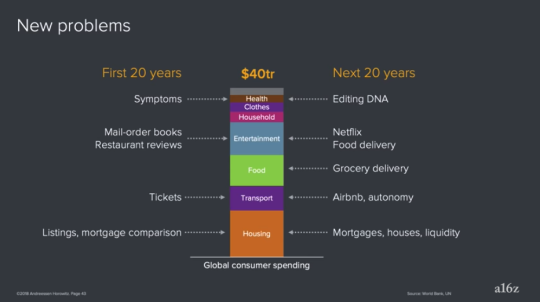
    Above is a screenshot from a presentation about the future of tech that Benedict Evans gave last week at venture capital firm a16z’s annual conference. And below is a video of the talk. If you can’t see it, click here.

    [youtube https://www.youtube.com/watch?v=RF5VIwDYIJk&w=560&h=315]

    The talk is positioned as “the end of the beginning.” In other words, here is where the internet and smartphones have taken us, but that’s just the beginning. Quote: “We used to do apartment listings [online] and now Opendoor will buy your home.”

    It’s only 24 minutes and well worth a watch.

  • Apple now owns 7,376 acres of land

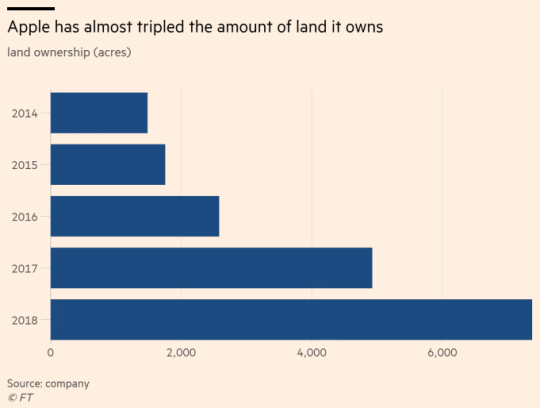
    In 2011, Apple owned 584 acres of land.

    As of this year, and according to the Financial Times, the company now owns about 7,376 acres. 

    Apple uses its “facilities and land for corporate functions, R&D and data centres.” The latter would include server farms for its various online services, such as iMessage, Apple Music, and the App Store.

    It can be easy to think of “the cloud” and the online services we use every day as existing only in some ethereal world up in the sky or in a distant land.

    But the reality is that these services have very real physical space requirements. The above chart begins to speak to that.

  • Tech and the North American office market

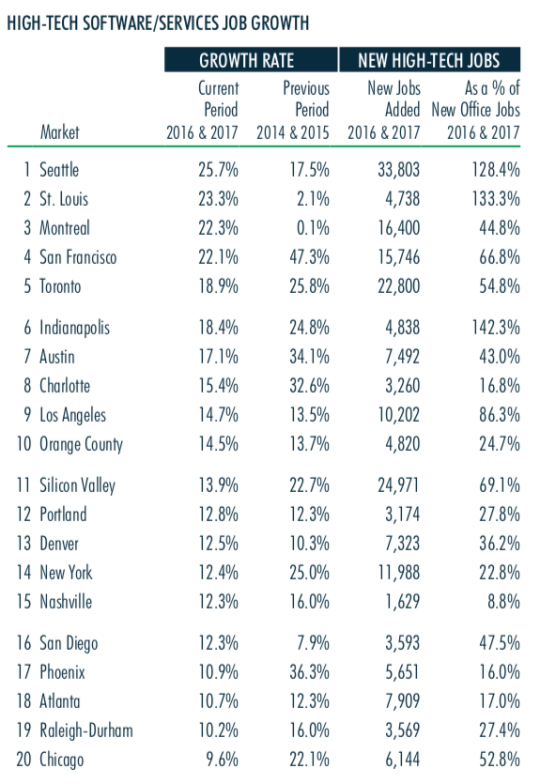
    CBRE recently published this report looking at the impact of the “high-tech software/services industry” on the North American office market. 

    Here are a few highlights:

    – Since 2010, tech has created ~1.1 million jobs in the US at an annual growth rate that is 3x the national average.

    – Seattle currently has the fastest tech job growth in North America. This is the first time in 7 years that San Francisco hasn’t been at the top of their list.

    – Silicon Valley, Toronto, New York, and Los Angeles all added more than 10,000 tech jobs from 2016 to 2017.

    – The biggest “momentum markets”, relying on 2016 and 2017 data, are Montreal, St. Louis, and Seattle.

    – Over the past two years (Q2-2016 to Q2-2018), Atlanta, Los Angeles, Orange County, Seattle, and Portland have all seen double-digit rent growth.

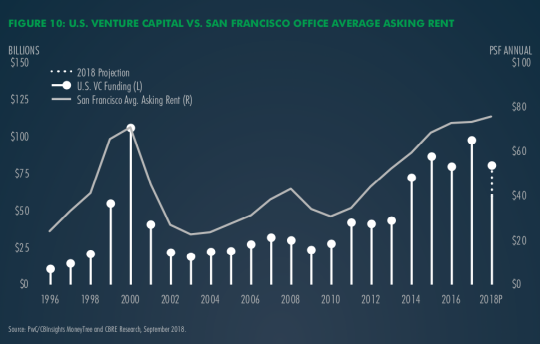
    One figure that also stood out for me was this one here showing the relationship between US venture capital investment and the average asking rent for office space in San Francisco.

    If you’d like to download the full report, click here. You’ll need to sign up for an account with CBRE, but it’s free to do that.

  • Buy land, Chip. Buy land.

    Bloomberg Businessweek just published a longish article about Vancouver and the Chinese capital that fuels it. It’s called, The City That Had Too Much Money

    Most of you are already familiar with this narrative, but here’s an excerpt that talks about the city’s economic base and its apparent dependency on foreign capital:

    Change will be difficult and fraught. Vancouver has been closely connected to Asia since the late 19th century, when the first Chinese laborers arrived to help build the trans-Canada railway, and the city is proud of its record of integrating immigrants. Also, beyond real estate, Vancouver’s economic base is shallow. It’s not the business capital of western Canada—that’s Calgary—and it has few major corporate headquarters or large-scale manufacturing operations. “Asian capital has kept this economy alive, end of story,” says Ron Shon, a Chinese-Canadian venture capitalist who arrived as a teenager in the late 1960s. “You can see it in every aspect of our lives.”

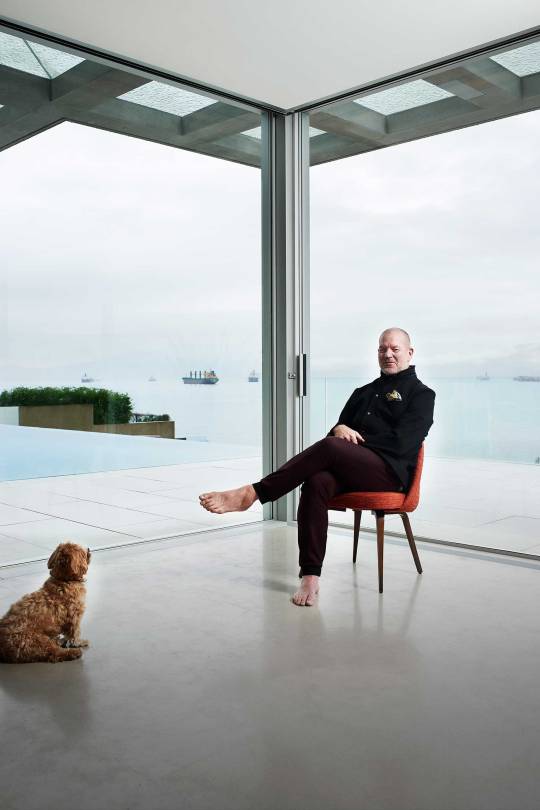
    One of the things I found particularly interesting were Chip Wilson’s comments around what is going on. Chip is the founder of Lululemon and is largely credited with pioneering the current “athleisure” trend.

    Yet as Wilson explains, sitting in his office on the top floor of a century-old warehouse, these days he’s as interested in bricks and mortar as in quick-drying fabrics. “The global capital flowing out of China across the world, you’d have to be an idiot not to acknowledge it,” he says. “You know, we could just be at the cusp of that.”

    To profit from the deluge, he’s been buying up land all over town, especially in False Creek Flats, a derelict industrial area that’s slated for redevelopment. He estimates that about a third of his holdings are now in real estate. British Columbia’s current government may succeed in slowing inflows temporarily, Wilson says, but China’s boom has created many multimillionaires who need a place to put their money. “So where do you go if you’re Chinese? Sydney, maybe. But nowhere, probably, is more friendly than Vancouver.” One way or another, he says, those funds will find their way to Canada.

    That’s why, Wilson says, whenever he returns from a trip to Asia, his first thought is simple: “Buy land, Chip. Buy land.”

    For the full article, click here.

    Image: Jens Kristian Balle/The Forbes Collection/Contour/Getty Images (via Bloomberg)

  • The tallest residential building in the world

    Earlier this month, Extell Development Company announced the launch of sales for its Central Park Tower – which it is calling “the definitive New York skyscraper”, as well as the tallest residential building in the world. 

    The project is located on Billionaire’s Row in NYC and it will be 1,550 feet tall when completed. That puts it well into supertall territory.

    According to Curbed, the smallest apartments start at 1,435 sf and the largest will be an estate in the sky at around 17,500 sf. 

    The projected sellout for the project is, or at least was, $4 billion back in 2017. That will set all sorts of records upon completion. At the time of the above filing, the average price was pegged at $7,106 per square foot.

    If you’d like to read up on the project’s capital stack, you can do that here. And for those of us who are used to having to pre-sell condos before digging, you may find it interesting to know that this project started construction in 2014.

    I wonder how much a parking spot costs (assuming there is even parking).