Daily insights for city builders, delivered every morning at 6 AM ET. I’m Brandon Donnelly — a Toronto-based real estate developer and founder of Globizen. I’ve been writing here since 2013.

Tag: real estate

  • Q4-2018 high-density land sales in Toronto

    image

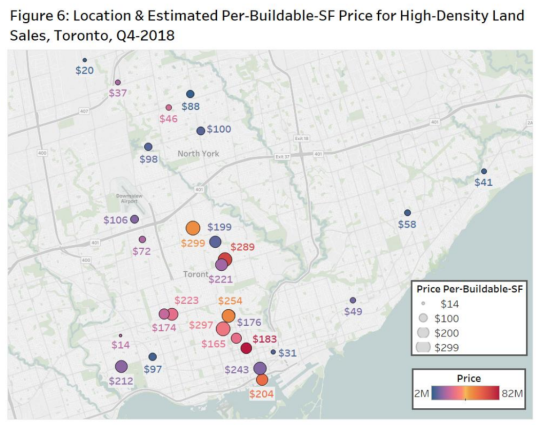
    Bullpen Research & Consulting and Batory Management just published their Q4-2018 High-Rise Land Insights Report for the Greater Toronto Area. 

    Above is a mapping of the estimated per square foot buildable prices for the land that traded hands specifically in Toronto last quarter. 

    The average is $178 per square foot. And the projected average sale (condo) price is $1,097 psf. That sounds right. You basically need that kind of end pricing to make the math work with today’s costs.

    Across the GTA, the average spread between zoned and unzoned land was almost $40 psf. $159 psf versus $120 psf, respectively.

    A full copy of the report can be downloaded here

  • Laneway house on the market for $2,845,000

    I was looking at this laneway house for sale in Toronto today. It’s located near Queen and Bathurst. It has 3 bedrooms and 3 bathrooms and is about 2,331 square feet (that looks to include a basement). The lot appears to be just over 13′ wide. And the asking price is $2,845,000.

    Single family homes aren’t typically considered on a per square foot basis, but if you do the math here, it works out to be around $1,220 psf. The property previously sold in 2017 for $805,000, which was prior to it being redeveloped. So it likely traded based on land value.

    When Toronto first started considering modern laneway houses, some people thought that only individuals of questionable moral fiber would want to live in one. But today, there are countless examples of some pretty remarkable laneway houses. 

    And in some cases you might need about $3 million or so.

  • Real estate startup Knock raises $400 million

    I have been writing about the real estate startup Opendoor for many years here on the blog. Another promising startup in this space is Knock, and today it was announced that they just raised a $400 million Series B round (led by Foundry Group).

    They share some similarities with Opendoor, but they are also different in that their focus is on home trade-ins. They tell you what your current home is worth, help you find a new home, and then coordinate “a seamless swap.” For more on how they work, go here.

    One of the ways in which they are similar to Opendoor is that they front the cash for new home purchases. In the case of Opendoor, they buy your home with the plan of selling it in the future. And with Knock, they buy your home with the understanding that your old home will get sold.

    It is certainly a more capital intensive model compared to the way that home sales are handled today. But many investors are clearly betting that it is exactly what is needed to change the status quo. 

    (Credit to Jeremiah Shamess for sharing the above news with me today.)

  • Are you happy with where you live?

    This past weekend I saw a few people reacting on Twitter to this article by Wendell Cox talking about how Canadian families are being denied their preferred housing choice: the detached single family home.

    The fact that the article is by Wendell Cox should tell you everything you need to know. But essentially the argument is that misguided planning policies are driving up the cost of housing and that we should, instead, be encouraging unfettered sprawl.

    There’s lots to discuss here, but the first thought that actually came to mind was: “How would this article sound if we replaced all of the references to housing with references to cars?” In case you too are wondering that, this is how the first paragraph would read:

    A new poll by Sotheby’s International Realty suggests substantial disappointment among Canada’s young urban families, unable to afford to purchase the types of [cars] that they prefer. The poll determined that young urban households in Canada strongly prefer [Aston Martins], but they are often “motivated by (financial) necessity to purchases [sic] [cars], especially [BMWs], they do not prefer.“

    The article is clearly one-sided. I don’t disagree that there are people who – all things being equal – would prefer to raise a family in a ground-related single family home. Backyards serve a purpose, as do large basements equipped with beer fridges.

    But all things are not equal. And there also people who value walkability, a reasonable commute, and the kind of urban amenities that come along with being in a dense city. I am one of those people.

    Photo by Adrien Olichon on Unsplash

  • Risk game

    “Francis is one of the most decisive people I know. He made a commitment to invest in our first venture capital fund in a five-minute cab we shared to work one morning.”

    —Fred Wilson, Co-Founder, Venture Capitalist, and Blogger, Union Square Ventures

    Francis Greenburger, who is founder and CEO of the real estate investment and development firm Time Equities, recently appeared on Barry Ritholtz’s Masters in Business Podcast.

    They touch on a number of topics, including why development sometimes produces more bankruptcies than billionaires; why development margins are compressed in Toronto; and how Francis popularized the co-op in New York. 

    Francis is also the author of Risk Game: Self Portrait of an Entrepreneur. So if you like the podcast – which is a great listen – there’s also a book for you. Click here for the podcast.

  • Director, Real Estate

    The University of Toronto is looking for a Director, Real Estate to manage their tri-campus portfolio of income producing real estate, as well as the development opportunities that they have on and adjacent to their three campuses. The downtown campus alone is over 120 buildings across 130 acres.

    A good friend of mine is helping with this search; I went to the University of Toronto (twice); and I believe that institutions, such as U of T, play an important city building function. So I’m sharing this opportunity with all of you today. For more on the University’s development strategy, click here.

    They are looking for someone with 10+ years of experience. The salary will be competitive and commensurate with this level of experience. And you would be reporting directly to the Chief of University Planning, Design & Construction. 

    If you’re interested, you can apply here. You have until January 25, 2019 to do that. I hope the position gets filled with a star. Also, sorry if this post isn’t relevant to you. Regularly scheduled programming will resume tomorrow.

  • And we’re back

    Welcome to 2019.

    I am currently in transit and catching up on some internet reading and email on my way back to Toronto.

    At this time of year it is, of course, common to reminisce (or lament) about what happened over the last year, as well prognosticate what may come.

    Over the last few years, I have done a bit of that on the blog. But I clearly didn’t do that this year while in Brazil (and away from any semblance of a workspace).

    So here’s what others have been writing and thinking about over the holidays:

    – 2018’s tech trends and tribulations in 14 charts. RecodeLink

    – 2018 was the year of the YIMBY. CityLab. Link

    – A cool girl’s guide to Toronto. Vogue. Link

    – Amazon’s annual Christmas press release. Link

    – Best travel posts of 2018. Design Milk. Link

    – Here’s (Almost) Everything Wall Street Expects in 2019. Bloomberg. Link

    – Here’s what to expect in cybersecurity in 2019. TechCrunch. Link

    – Naive to hope Toronto can change in 2019? That means we have work to do. Shawn Micallef. Link 

    – The 10 largest US venture rounds of 2019. TechCrunch. Link

    – What is going to happen in 2019. Fred Wilson. Link

    – Will a recession hit in 2019? Alan Murray. Link

    – Year in search 2018. Google. Link

  • Toronto condo market outlook

    BNN Bloomberg just published this article on the Toronto condo market. It is based on a roundtable discussion that was held at their Toronto office last week with Jim Ritchie of Tridel, Jared Menkes of Menkes Developments, Shamez Virani of CentreCourt, and Jane Renwick of Diamond Kilmer Developments.

    The overarching theme is that, after a couple of frenetic record setting years, the market should settle down in 2019, which is likely a good thing. Hopefully that will also temper construction cost inflation. We have been seeing double digit increases over the last few years (hence some of the cancelled projects).

    But as Jared points out, the fundamentals here are still strong and there are a number of supply constraints creating upward pressure on pricing:

    Jared Menkes, executive vice president of high-rise residential at Menkes Developments was unwavering for the future. “There’s a lot of red tape that’s slowing down bringing more product to market,” Menkes said. “I promise you, pricing is going up.”

    For the rest of the article, click here.

  • One Delisle unanimously supported at Design Review Panel

    One Delisle was at the City of Toronto’s Design Review Panel today where it received unanimous support. For those of you who may not be familiar with the process, at the end of every DRP session the panel members – who are all independent design professionals – vote on the project. They can support it, support it with conditions, or they can not support it and send it back for a redesign. One Delisle received 100% support.

    There were a number of positive comments around the need for more projects like this, and for better design in general, here in Toronto. That was really nice to hear. I also liked the comment that One Delisle feels like a tall building that one might find in London. And since every tall building in London has an endearing nickname – Gherkin, Walkie-Talkie, Cheese Grater, and so on – this too deserves one. 

    So let’s find a name. I have one in mind, but I’d love to hear from you in the comment section below.

  • International Blockchain Real Estate Association

    I was at a Proptech dinner earlier this week (graciously hosted by Venturon) and I was introduced to the International Blockchain Real Estate Association (also known as IBREA). I feel like I should have known about this group. They have over 5,000 members and host an annual summit focused on blockchain + real estate.

    They have several videos from this year’s summit up on their website – everything from blockchain for titles to the tokenization of real estate assets. There are also a number of industry working groups that have been set up, which bring companies together around specific problems and ambitions (such as, creating a universal property identifier).

    To get you started, here is Blockchain Real Estate 101. If you can’t see the video below, click here.

    [youtube https://www.youtube.com/watch?v=1WcLOcWyfHk&w=560&h=315]