Daily insights for city builders, delivered every morning at 6 AM ET. I’m Brandon Donnelly — a Toronto-based real estate developer and founder of Globizen. I’ve been writing here since 2013.

Tag: real estate developer

  • How developers shape public life

    The most recent episode of The Urbanist is about the role of private developers in shaping public spaces and public life within our cities. How do you balance private and public interests?

    Much of the discussion focuses on the redevelopment of King’s Cross in London, which is generally considered to be a successful example of large-scale, developer-led, urban regeneration. Andrew Tuck is less complimentary of Hudson Yards in New York.

    One point that I found interesting was the remark that modern zoning tends to force buildings apart. It creates more in-between space. The result is that we are losing some of the more intimate public spaces found in older neighborhoods.

    To listen to the full 30 minute episode, click here.

    Photo by Josh Edgoose on Unsplash (King’s Cross, London)

  • The story of Florence Casler

    Curbed has a section on their website dedicated to “deep dives on cities, architecture, design, real estate, and urban planning.” It is called Longform. And they have some great stories, including this one on “the female powerhouse [Florence Casler] who developed 1920s Downtown LA.”

    Florence was born in 1869 in Welland, Ontario, about 25 kilometers south of Niagara Falls. She married an American — a plumber — and eventually settled in Buffalo, New York. After her husband left to pursue riches in the gold mines, she became a licensed plumber and took over the business.

    Eventually this love of plumbing grew into a love of building, and somehow she found herself, with her daughters, in Los Angeles at the beginning of the 20th century.

    By the 1920s, she had become a dominant force in the real estate business. Some 60 buildings are credited to Florence and she is thought to be largely responsible for ushering in a new era of multifamily apartments in Los Angeles. Unfortunately, many of her buildings have since been demolished.

    As one of the first women in Los Angeles to head a development and/or construction business, I think this is a wonderful story worth telling. For the full Curbed article, click here.

  • Finding meaning in life and business

    I started my undergraduate degree as a computer science and physics student. But despite my love of technology (and physics, incidentally), I quickly realized that I didn’t want to end up as a software developer. I was interested in so many other things: art, design, business, real estate, entrepreneurship, cities, and so on. And at the time, I was struggling to remain focused on writing code.

    So by the middle of my second year, I decided to drop every single one of my classes and construct my own program until I figured out what I truly wanted to major in. My course schedule ended up spanning everything from the urbanization of ancient cities to the philosophy of aesthetics. It was a pretty great program if you ask me. But others wondered what I was doing.

    I did, however, already have leanings toward architecture. It felt like the perfect combination of art and science. And so while enrolled in my made up program, I started exploring the possibility of transferring schools and switching majors. Around this time I also started meeting with architects to try and learn more about the profession and see if this is something that I really wanted to pursue.

    I’ll never forget this one lunch. The architect I met with — who will, of course, remain nameless — told me very clearly: “You should do anything besides architecture. If you like drawing become an animator. If you like design, do graphic design. Just don’t become an architect.” Naturally, I came out of that lunch and decided to spend the next seven years getting two degrees in architecture.

    And even though I never became a licensed architect, and almost certainly never will, I would do it all over again given the option. I loved the journey and it is this circuitous journey that led me to where I am today, which is in a highly fulfilling career in real estate. I create new things and those things have the opportunity to improve people’s everyday lives. I’m grateful for that. But the path was anything but clear at the time.

    I am telling all of you this story because I was reminded of it when I read this fantastic article by Charles Duhigg called, Wealthy, Successful and Miserable. It is the story of how Charles, a Harvard Business School graduate, discovered that — despite obtaining boatloads of financial success — many of his classmates actually ended up miserable after school.

    Sure, we all need and deserve basic financial security. And when we don’t have it, money can really buy a great deal of happiness. But there’s lots of research out there, some of which I have written about before, that suggests that happiness quickly plateaus once our basic needs are met.

    As soon as we’re no longer worried about money, we actually crave other things from our paychecks. We want it to also be a source of purpose and meaning. To give one concrete example, the article cites a study about a set of enthusiastic and high performing janitors in a large hospital. What was ultimately found was that they saw their jobs not just as cleaning, but as a kind of healing for the patients. They had purpose.

    But what I found most interesting about the article was the discovery that finding happiness in life and business might require, or be aided by, a bit of struggle along the way:

    And many of them had something in common: They tended to be the also-rans of the class, the ones who failed to get the jobs they wanted when they graduated. They had been passed over by McKinsey & Company and Google, Goldman Sachs and Apple, the big venture-capital firms and prestigious investment houses. Instead, they were forced to scramble for work — and thus to grapple, earlier in their careers, with the trade-offs that life inevitably demands. These late bloomers seemed to have learned the lessons about workplace meaning preached by people like Barry Schwartz. It wasn’t that their workplaces were enlightened or (as far as I could tell) that H.B.S. had taught them anything special. Rather, they had learned from their own setbacks. And often they wound up richer, more powerful and more content than everyone else.

    We are, of course, talking about the “also-rans” at Harvard Business School. They’re no slouches struggling to find work. But I don’t think that negates the point being made here. It can be easy to get caught up doing what we think we ought to be doing when in reality we should be finding meaning in something we hopefully love doing.

  • The paperless developer

    image

    I’m working on integrating an iPad (back) into my workflow as a developer.

    I used an iPad 2 (c. 2011) while I was completing my MBA. I mainly used it for taking notes and saving money on hard copy textbooks. But after it got old and painfully slow, I stopped using it. It was a nice to have, but I never felt the need to replace it with a newer model.

    Lately, however, I have been hearing from a number of developer friends that an iPad – along with an Apple Pencil – is simply invaluable for people, like me, who are constantly reviewing, signing and marking up documents and drawings. So I have decided to reevaluate how I work.

    I am still getting set up, but I can already see how it is going to dramatically streamline some of my workflows (for one, there will be much less scanning).

    I am currently on the hunt for apps that can help with floor plan designs – something that will work like trace paper but with dimensions. We spend a lot time working to make these perfect. It’s the core product, after all. So far I’ve found TracePro by morpholio. Maybe you all know of something better.

    Outside of the office, I also think I’ll be able to replace my laptop when it comes to writing this blog and editing photos on the road. There’s Lightroom for iPad and all you need is an SD card reader to download all of your photos to it. (Too bad it isn’t possible to connect my Fujifilm directly.)

    I’ll let you know how all of this goes. But if any of you have already gone paperless, please feel free to leave your tips in the comment section below.

    Photo by Kelly Sikkema on Unsplash

  • The Trump family real estate empire

    He is tall, lean and blond, with dazzling white teeth, and he looks ever so much like Robert Redford. He rides around town in a chauffeured silver Cadillac with his initials, DJT, on the plates. He dates slinky fashion models, belongs to the most elegant clubs and, at only 30 years of age, estimates that he is worth “more than $200 million.” 

    Judy Klemesrud, New York Times, 1976

    Last week the New York Times published a special investigation looking at the Trump family’s real estate empire and the suspect tax schemes that they allegedly employed over the years to preserve, grow, and pass it down. 

    According to the Times, all of which has been rebuked by a lawyer for the president, Donald Trump received at least $413 million in today’s dollars from the family empire. 

    I just finished reading the investigation in its entirety. It’s a long one. But if you’re interested, you can do the same here. If you’d prefer the Coles Notes version (Cliff Notes for you Americans), have a scroll through the headlines in this article instead.

  • Five year anniversary

    Today is the five year anniversary of this daily blog. That’s over 1800 posts. 

    It’s almost hard to believe that it has been that long. It seems like just yesterday I was on year 2 or 3. But at the same time, it’s almost hard for me to remember a time when I didn’t blog every day. I guess we’re calling it a habit at this point.

    One of the most common questions I get regarding this blog is: “Do you pre-write posts?” The answer is never. Okay, almost never. Sometimes I’ll pre-write a post if I know I’m going to be on a plane for 12 hours and I won’t make the timezone cutoff. But generally as a rule I don’t.

    Part of the reason I don’t is because it breaks the habit. This is something I do every day. And I like that routine. I also want the posts to be timely and I want to be able to write about things that may be on my mind that day.

    Momentum is a powerful thing. And when you’ve been doing something for a number of years, and especially something as public as this daily blog, there’s a powerful incentive to keep doing it. That’s how streaks work.

    However, in the world of development, five years is perhaps not that long. It’s maybe one project. Streaks take a lot longer to establish.

    This summer One Delisle by Studio Gang went public and you’re now starting to see (bright neon) teasers for Junction House. Both of these projects are many years in the making. The Junction House story started in early 2016.

    So I reckon that this blog needs at least another five years so that there’s enough time for the really juicy stories to surface. I’ll endeavor to do exactly that. 

    Thanks for reading and making this community what it is. See you tomorrow.

  • The biggest challenge in revitalizing the Rust Belt

    image

    Jason Segedy, who is the Director of Planning and Urban Development for the city of Akron, Ohio, recently penned a two-part series in the American Conservative about urban revitalization in the Rust Belt. Part two is specifically about the importance of new housing in “cities left for dead.”

    As I was reading through the piece, my first thought was that it would be a good follow-up to yesterday’s post on “winner-take-all-urbanism.” The contrast between alpha cities like San Francisco and Rust Belt cities like Akron is stark.

    The former city can’t build housing fast enough. And the latter city was forced to implement a citywide, 15 year, 100% residential property tax abatement program just to induce new investment. Any and all new housing is eligible.

    But as I got further down the article, I was struck by something else. I was surprised to hear Segedy say that, rather than market forces, community opposition is “perhaps the biggest challenge of all” when it comes to delivering new housing in these markets.

    Here is a longish excerpt that I would encourage you to read:

    Although you might think that people living in neighborhoods with a large number of abandoned houses and vacant lots would be thrilled to see new houses being built, you might be surprised to learn how often this is not the case. Sometimes neighbors prefer to have the vacant lot remain as green space. Sometimes they worry that the new housing will not be expensive enough, and will bring their property values down. Other times, they worry that the new housing will be too expensive, and will bring their property values (and taxes) up.

    When it comes to new housing, everyone is a critic. I have heard people complain that housing which they will never live in is too dense; that housing which they will never purchase is too expensive; that housing which they will never be inconvenienced by will generate too much traffic; and that housing which they will never look at is not architecturally appealing.

    After 23 years as an urban planner, I can honestly report to you that, contrary to popular belief, most people are strongly in favor of heavy-handed and draconian government regulation of private property—as long as it is someone else’s private property, and not their own.

    Residents and community activists who are opposed to new housing often demonize the real estate development profession as being “greedy”, overlooking the fact that their own home was developed by a developer, built by a builder, and sold by a realtor—most likely for a profit. This isn’t to argue that every development professional is a white knight, but it is important to remember that the vast majority of people who work in the real estate and construction sectors are not the enemy of neighborhoods. Without them, there would be no neighborhoods.

    According to Segedy, Akron has lost 32% of its peak population. Cleveland has lost 58%. And Detroit has lost 64%, leaving almost 1/3 of its land parcels vacant. (These are 2017 figures.) Surprisingly, this doesn’t appear to change how many people feel about new development. 

    No more new housing. We’re full. Unless, of course, that housing is for me.

    Photo by Nolan Issac on Unsplash

  • Learning about O-zones

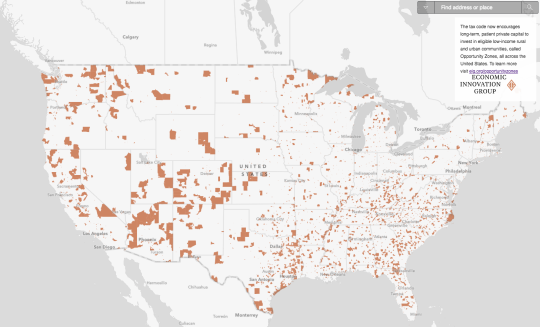
    I spent this evening reading about Opportunity Zones, or “O-zones”, in the United States. 

    For a census tract to become an O-zone, it has to have a poverty rate of 20% or higher, or the median household income has to be less than 80% of the surrounding area. Governors are also only able to designate 25% of their eligible census tracts.

    Here is a map of the areas that have been designated as Opportunity Zones.

    image

    Here is how these O-zones work. (All excerpts taken from this Forbes article.)

    The law’s engine is a new breed of financial product, the opportunity fund, that offers investors a trifecta of attractive tax breaks. Here’s how it works. Investors who sell assets have 180 days to plow their taxable capital gains into an approved opportunity fund, which must hold 90% of its assets in Opportunity Zone projects. To put money to work fast, the law requires that the funds invest all of their cash within some specified time frame. (The Treasury Department is still deciding on that and other crucial details.) Tax on the original reinvested gain isn’t due until 2026, and the taxable gain is cut by 15%. Meanwhile the new opportunity investment grows tax-free, like a Roth IRA, provided it’s held for at least ten years. (If it’s sold earlier, it can be rolled into another opportunity fund and remain tax-free.)

    Here is how it could get the real estate industry to take action.

    For real estate developers, O-zones offer cheap real estate and unlimited, untaxed upside if a neighborhood takes off. Developers must do more than stash cash in crumbling property. To qualify for tax perks, they must make swift and significant upgrades (at least equal to the cost of the initial purchase). With real estate projects come new office buildings, industrial districts, restaurants and affordable housing—all of which can lay the groundwork for an economic boom. “The real estate aspect is a great catalyst to attract new businesses,” says AOL founder Steve Case, an early supporter of the O-zone initiative, whose Rise of the Rest Fund invests in backwater areas. “But it’s the startups that will be the real job creators.”

    And here is how it could influence where new businesses decide to locate.

    “If Facebook could have chosen to locate itself in an Opportunity Zone, like the Tenderloin in San Francisco, the investors would’ve paid no capital gains on their equity,” says Parker, who presumably would have been one of the big winners. The promise of mega-returns could send VCs, investment banks and private equity firms scrambling to launch their own opportunity funds to create incubators, scour second cities for overlooked talent or move portfolio companies into O-zones. “It wouldn’t surprise me if a lot of Silicon Valley VCs started to tell founders, ‘We’d like you to go over the bridge to Oakland, or we’d like you to go to Stockton,’” Parker says.

    If you’d like to learn more about Opportunity Zones, check out the Forbes article.

  • The impact of inclusionary zoning on development feasibility

    image

    After my recent post on inclusionary zoning in Ontario, I was asked to provide my comments on the draft regulation and on how inclusionary zoning could and will impact development feasibility. So I will endeavor to do that today.

    It’s important to first understand the costs and inputs that go into a development pro forma and how overall project feasibility is determined. For simplicity, let’s breakdown the costs as follows:

    – Land

    – Soft Costs

    – Financing Costs

    – Municipal Fees/Charges

    – Hard Costs

    All of these costs buckets are significant. For a project to be feasible, you obviously need the revenues of the project to be greater than the above costs. There also needs to be a remaining profit margin that is commensurate with the risk profile of the project and that meets your investor’s return expectations. Most developers rely on outside equity and debt to finance their projects.

    One of the misconceptions that I often hear is that people seem to think that the profit margin on projects is so great that developers could simply build affordable housing (or do many other things) if they weren’t so greedy. The reality is that development happens on the margin. It’s not easy to find sites and projects that make any sort of financial sense. More often than not they don’t.

    The other reality is that in a growing market all of the above costs are also continually increasing. If revenue (i.e. rents and condo prices) is also growing, as has been the case here in Toronto for many many years, then developers can generally absorb reasonable increases and continue building. But if revenue stops growing, grows at a slower pace or, worse, shrinks, then feasibility could disappear and development would stop.

    Now let’s talk specifically about inclusionary zoning. IZ is typically an incentivized or mandated requirement to provide a certain number of below-market housing units as part of new developments. Affordable housing is important. That’s why a number of cities already have inclusionary zoning policies – though it remains a fairly controversial tool.

    From a development feasibility standpoint, a mandatory inclusionary zoning requirement represents a decrease in revenue. There’s now a percentage of the units that can no longer be rented or sold at market prices. And so to maintain the project’s feasibility – because remember development happens on the margin – something has got to change.

    There are a few options.

    Option One: You could simply try and pay less for the land. As we have talked about many times on this blog, land is supposed to be the residual claimant. Work backwards from revenues and your other costs to determine what can be paid for the land. The problem with this option is that land prices tend to be sticky.

    Many or most landowners don’t give a shit about your development pro forma. They often have a number in mind and if you try and tell them that development charges just went up and you can’t pay as much for their land, they’ll simply sit on it and wait for someone else – even if that means waiting for the market to catch up (i.e. waiting for rents to go up).

    Option Two: Charge more for the remaining market units. If the market is sufficiently robust, perhaps this is an option. This is one of the reasons why inclusionary zoning often produces more units in markets where there’s already strong demand for new housing.

    But it’s also one of the reasons why IZ is controversial. You’re asking the other renters/buyers in the project to effectively subsidize the below market units. And there is research out there (previously posted on this blog) suggesting that in some instances IZ policies have created additional upward pressure on market rents and home prices.

    Option Three: Incentives are provided by the municipality to offset some or all of the additional burden placed on the project. This could come in the form of a density bonus, financial contribution, a waiving of other municipal charges/fees, and so on.

    Though I have questions about the details, this is something that was proposed in Ontario’s draft regulation (albeit not to the extent that the industry wanted). Now you know why I said and why I believe that these offsets are important to the industry and to overall housing affordability.

    My hope with this post was to provide the developer’s perspective, but also take a very matter of fact approach to inclusionary zoning. Most people recognize the importance of affordable and accessible housing. The question is how best to execute.

    Photo by Toa Heftiba on Unsplash

  • How to make money with low-risk licensing deals

    image

    This morning the Toronto Star published a detailed autopsy of the failed Trump International Hotel and Tower Toronto. It outlines the players, the investors, and what supposedly went wrong. Of course, the headline is all about how Trump managed to make money from the deal – through his well-publicized licensing business – even though the project went bankrupt.

    At the beginning of this year, the Washington Post reported that Trump’s name had been licensed and linked to over 50 properties and that these contracts have earned him at least USD$59 million in revenue. Outside of the US and Canada, the Trump Organization has (or had) deals in Brazil, Turkey, Azerbaijan, India, Indonesia, the UAE, and so on.

    There would have been more money to be made in the actual development of these properties, but the beauty of these licensing deals – for Trump – is that they are “low-effort, low-risk, high-reward.” In fact, this past summer it was reported that the breakup fee at Trump Toronto – the fee to exit all contracts with the Trump Organization – was at least $6 million (guessing that’s in USD).

    This story is not unique to Toronto. And so I have got to believe that there’s major brand dilution happening here. Does the Trump name really bring credibility to projects in some markets? How sustainable is this licensing business? 

    The only other thing that I would add to the Toronto Star article is that the hybrid condo-hotel model has proven to be difficult in this city. It’s perfectly fine to have residential condos and a hotel in one tower. There are lots of successful examples of those. But when the condo units can be put into a hotel pool (and there’s an IRR expectation on the part of individual owners), many seem to have been disappointed.

    Part of the challenge with this model here in Toronto is that the condo-hotel units typically end up with a commercial property tax rate, which, in this city, is much higher than the residential rate. This can suppress values.

    Photo by NeONBRAND on Unsplash