Daily insights for city builders, delivered every morning at 6 AM ET. I’m Brandon Donnelly — a Toronto-based real estate developer and founder of Globizen. I’ve been writing here since 2013.

Tag: real estate developer

  • Building relationships

    2003/2004 was roughly the time period when I started to become interested in development as a career. My good friend Rick Sole and I used to talk about it all the time in architecture school. How do we break into this space? There are no formal paths, like law for instance, and so we felt like we had to create our own opportunities.

    What I ended up doing was creating a list of every developer that I felt was doing cool and interesting work. I didn’t know enough about the industry at the time to assess other things and so that was really my only criteria. Do they care about design in their projects? I then started cold emailing and cold calling.

    Not everyone got back to me, but many did and some agreed to meet with me. This was at a time when I had zero experience and I was frankly not very valuable as a hire. So I am incredibly grateful to all of the people who said yes and took the time to speak and meet with me.

    As you go through your career, this curve eventually flips. You go from having no experience and begging people to meet with you to having experience (and other things you can offer people) and people now wanting to meet with you. Generally people want to meet when they think they can gain from you.

    But the best way to build a relationship is to start when you don’t need anything. I will never forget the people that met with me when I had nothing to offer them. And you can bet that I will always have all the time in the world for them.

    I’m not going to claim that I respond to every one of my cold emails. I definitely do not. But I respond to as many as I can and I try and pay it forward with some time. You could say it’s playing the long game, but it’s probably also the right thing to do.

    How do you approach relationship building?

  • Laneway housing — right now feels different

    image

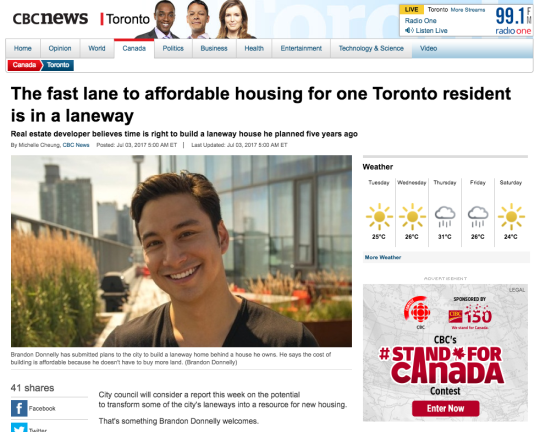
    The CBC published a piece this morning on my laneway house proposal. The subheadline: Real estate developer believes time is right to build a laneway house he planned five years ago

    It’s true. As many of you already know, this proposal has been in the works for a number of years. But right now feels different. I continue to be encouraged by all of the interest and support surrounding laneway housing in this city. 

    Thank you Michelle Cheung for covering this.

  • Screw Toronto

    Hamilton, Ontario is on the rise. It’s no secret. 

    In fact, Toronto Life just ran a piece called The New Hamiltonians, where it profiled ex-Torontonians who have made the move west for more affordable housing and a higher quality of life.

    What stands out for me about the article is how there’s already growing resentment toward both developers and the local business owners who are helping to revitalize the city. Here is an excerpt:

    As builders encroach on Hamilton’s old neighbourhoods, a simmering resentment is building toward the upstart businesses that make rundown areas attractive to developers in the first place. Dave Kuruc, who owns Mixed Media, says that last year, the front door of his and neighbouring shops got slapped with a sticker that read “FUCK YOUR BOUTIQUE. DEFEND HAMILTON.” Last June, a bus tour for ­developers—branded “Try Hamilton!”—was interrupted by masked activists spraying sour milk out of water pistols and wielding signs that read “Developers + Investors = Predators.”

    So it’s not just developers. It’s also those damn boutiques. But the City of Hamilton eliminated development charges and put in place many other incentives for a reason. It wants to see more new construction. 

    Some people clearly aren’t happy about that.

  • Big bad developer

    I just stumbled upon an older (2014) article by Oliver Wainwright in the Guardian called, The truth about property developers: how they are exploiting authorities and ruining our cities. In case the title didn’t give it away, it’s a scathing article about the current state of real estate development and city building.

    Here’s an excerpt:

    “Across the country – and especially in superheated London, where stratospheric land values beget accordingly bloated developments – authorities are allowing planning policies to be continually flouted, affordable housing quotas to be waived, height limits breached, the interests of residents endlessly trampled. Places are becoming ever meaner and more divided, as public assets are relentlessly sold off, entire council estates flattened to make room for silos of luxury safe-deposit boxes in the sky. We are replacing homes with investment units, to be sold overseas and never inhabited, substituting community for vacancy. The more we build, the more our cities are emptied, producing dead swathes of zombie town where the lights might never even be switched on.”

    Now, I’m not that familiar with the London market, so I can’t really comment on the dead swathes of zombie town. But I did enjoy the insights into the UK entitlement process.

    At the same time, my overarching thought as I read through the article was that I don’t believe that making money and doing what’s right need to be mutually exclusively. You can do both in development and in business. Making money as a developer does not mean you have to build shitty buildings.

    Part of the development game is managing an endless number of competing tensions. And profitability and responsible city building is just one of them. Of course, you have to want to do the right thing in the first place.

  • Harry Macklowe, 80

    For those of you interested in real estate development (and architecture), the New York Times recently published an article about New York developer Harry Macklowe

    At 80 years old, he has been in the business for almost 60 years and he has what some might describe as the typical developer story. He has seen ups. And he has seen downs. As a result of the 2008 economic crisis, he was forced to give up seven landmark properties in New York.

    The article doesn’t paint a particularly nice picture about developers. It talks about how he demolished several single room occupancy hotels in midtown Manhattan (hours before a new moratorium was set to go into effect) and how he recently filed a lawsuit against his son, William Macklowe. After their relationship went south, William went off and started his own real estate company and presumably that is causing some problems.

    There’a also mention of a book called The Liar’s Ball, which I am pretty sure would be a good read:

    Real estate “is not an industry full of camaraderie and good will,” said Vicky Ward, the author of “The Liar’s Ball” (Wiley, 2014), a book about Mr. Macklowe and the G.M. building. Developers “are set up to dislike each other, yet occasionally they do come together to partner.”

    If the real estate business has anything, it has characters. Click here for “Harry Macklowe on New York Real Estate.”

  • Episode 15: The Master Builder

    My friend Ben Stevens runs a blog called Skyline where he interviews people involved in the built environment (architecture, real estate, planning, and so on). You might remember that I did an episode with him about a year ago where we talked about the overlap between architecture and development.

    His most recent episode is with San Diego-based architect-developer Jonathan Segal. I’ve mentioned Segal before on this blog and that’s because he is well known and admired in certain circles for (re)creating a process that places the architect in the position of “master builder.”

    He is singularly driven by one goal: to have ultimate control over the architecture that he creates. Making money is secondary. It is a byproduct of goal number one.

    To achieve this, he has worked to cut out every conceivable middle person. Design is in-house. Construction management is in-house. Property/asset management is in-house. He even avoids bringing on investors for his projects, out of fear that they will start to dictate what he can and can’t do.

    If this approach resonates with you, I definitely recommend you watch the interview. Click here if you can’t see it below.

    [youtube https://www.youtube.com/watch?v=r7UT–CAS1g?rel=0&w=560&h=315]

  • BARED: Howard Cohen, Context Development

    image

    Howard Cohen was initially trained as an architect. But throughout his schooling he gradually became more interested in urban design and city planning. So after graduating in the late 1960’s from the University of Manitoba with a degree in architecture, he took a job within the planning department at the City of Winnipeg. There he helped to author the “Downtown Winnipeg Plan” and quickly earned the reputation as one of the most creative people in the department.

    But after about a year and a half on the job, he decided that he wanted a change in scenery and so he quit and took off to Europe with his wife. Upon returning, with no money to his name, he managed to strum up two potential job opportunities; both of which were, thankfully, not in Winnipeg. One was an architecture job in New York City and the other was a planning position for a neighborhood on the east side of downtown Toronto known as Trefann Court.

    Since planning had become more interesting to him than architecture, Howard decided to fly to Toronto for the job interview. He vividly remembers staying at the Sutton Place Hotel – which is today being converted to condos – and walking down Bay Street to City Hall for his interview. He also remembers being so nervous that he had to smoke a joint prior to, in order to calm his nerves. The interview was with the chief planner, deputy chief planner, and with local residents from the area. They offered him the job on the spot.

    He accepted the position in 1970 and stayed at the City of Toronto until 1978. Howard was contemporaneous to figures such as John Sewell – the former mayor of Toronto who was also heavily involved in Trefann Court. Howard features prominently in John’s book: “How We Changed Toronto – The inside story of twelve creative, tumultuous years in civic life, 1969-1980.”

    Interestingly enough, during his time at the City, some of the land use policies that Howard was championing were actually quite contentious within the development community. For instance, Howard believed that Toronto’s downtown residential neighborhoods – neighborhoods such as Cabbagetown – should be preserved, and not razed and turned into replicas of St. James Town. This is an outcome that I am sure most of us today now appreciate.

    However, this is not to say that he was anti-development. Howard also firmly believed that high-density residential should be encouraged throughout the core of the city. We take this for granted now, but he remembers being called a zealot at an Ontario Municipal Board hearing because of his belief that people may actually want to live at the corner of Bay Street and Dundas Street. This was supposed to be a place for working and shopping, but definitely not living.

    Towards the end of his tenure at the City, Howard had become for all intents and purposes the chief planner of Toronto. He was the guy. However, without the actual title he was starting to get restless and decided to look elsewhere for opportunities.

    In 1972, the federal government formed a new Crown corporation known as the Harbourfront Corporation. This was after having expropriated over 100 acres of derelict industrial land along Toronto’s waterfront. The mandate was to revitalize the central waterfront, but after failing for 5 years to make anything meaningful happen, responsibility was ultimately turned over to local leadership.

    Shortly thereafter, Howard left the City and became the first head of Harbourfront Corporation. As coincidence would have it, he was offered the position on the same day that David Crombie – who was mayor at the time – called him to formally offer him the role of chief planner. However, Howard felt that there were more exciting challenges at Harbourfront and so that’s where he went.

    One of his first tasks at Harbourfront was to write the business plan that would set the course for the corporation and allow it to become self-sustaining. The model became about leveraging the value of the corporation’s land to not only create a thriving mixed-use community, but to also create a set of cultural institutions along the waterfront.

    The legacy of Howard’s work can be found in the Power Plant Contemporary Art Gallery, the Harbourfront Centre outdoor skating rink, the Queen’s Quay streetcar, as well as a number of other initiatives ranging from cultural programs to development projects. Some of his development deals included the affordable housing built at Bathurst Quay, the Admiral Hotel, and the Queen’s Quay Terminal developed by Olympia & York – a pioneering mixed-use development that to this day serves as one of the most important anchors on Toronto’s waterfront. It was also through these development projects that Howard would increasingly get into the mindset of a developer – something that would obviously serve him well later on.

    Despite being a financial success, Harbourfront Corporation was ultimately disbanded, partly due to controversy over some of the high-rise towers being developed along the waterfront. At this point, Howard was 44 years old and had spent his entire working career in the public sector. With the experience he had gained at the City and at Harbourfront Corporation, he decided that it was time to move over to the private sector and make some money. He went to work for a developer.

    Howard landed at Murray Goldman’s development company – the Goldman Group – and would spend 4 years there as President. He didn’t necessarily have all the finance and marketing chops, but he did have a lot of other relevant experience. Perhaps his best known project of this era is the Castle Hill townhouse complex at the foot of Casa Loma.

    After stepping down from the Goldman Group in the early 90’s, Howard then turned to consulting. This was a period of time when many in the industry were licking their wounds, but Howard managed to amass a diverse set of clients, including Innis College at the University of Toronto and the nascent Design Exchange. Initially hired as a consultant in 1992, Howard would later get asked to head up in the Design Exchange in 1994. He would spend 2 years in this role and raise over $7 million in donor money during one of the worst recessions in recent history.

    As his consulting business chugged along, Howard would later reconnect with an architect by the name of Lloyd Alter. Lloyd had done some work for the Goldman Group when Howard was there and they decided to join forces and create a larger consulting business known as Cohen & Alter. Business was good for the two of them. They were busy.

    They hadn’t really planned on getting into the development business, but then one day an agent came knocking with a small piece of land on Niagara Street. It was located in today’s King West neighborhood. Barbara Hall was mayor at the time and the city was starting to talk about new policies to open up “The Kings” to revitalization. “The Kings” being the two shoulders of downtown Toronto: King Street West and King Street East.

    Toronto was still in a recession at the time and nobody wanted the site. It was also fairly non-consensus to think that people would want to live in these gritty old parts of downtown. Only zealots believed this to be true. So the agent told Howard and Lloyd that they could option the site for $1 – basically tie it up for free.

    This was the birth of 20 Niagara.

    Since the recession had also left architects without work, they managed to get Peter Clewes (today of architectsAlliance) to defer his fees on the project. The deal was that when the project got off the ground, everyone would get paid. It was the ultimate in bootstrapping.

    Around this same time, Howard and Lloyd met Tom Schwartz, who would become a kind of mentor and advisor to the aspiring developers. Tom, who today is the President and CEO of CAPREIT, was already a successful developer through the founding of Intraurban Projects in 1976.

    Tom introduced Howard and Lloyd to a company called Equivest, which was owned by Gerry Schwartz (of Onex fame) and Stephen Gross. Equivest would become the financial backer for their fledgling project and set the stage for a go-forward funding model.

    Howard and Lloyd would also turn to a guy named Brad Lamb to sell the project. Brad had just started his own brokerage after working under Harry Stinson – a real estate broker turned developer who is perhaps best known for his cheesy late night infomercials. Brad had two employees at the time and would go on to personally sell 20 Niagara Street.

    20 Niagara launched in 1996.

    The project contained 30 condo units and was about 40,000 square feet. It took a year to sell the first 20 units – at some absurdly low price – and ultimately didn’t make any money for both Howard and Lloyd. Howard would spend the next two projects paying back the hangovers from 20 Niagara. It did, however, give birth to Context Development.

    Howard and Lloyd ended up parting ways after 20 Niagara, but the partnership of Howard Cohen, Stephen Gross, and Peter Clewes would go on to build some of the most design-forward and contextually sensitive projects in the city. The core philosophical beliefs were that housing of every varietal belongs downtown and that modern architecture has a place in the mass market. Again these principles may seem obvious today, but they weren’t as obvious in the late 90’s.

    Context Development would later develop adaptive reuse projects such as the Kensington Market Lofts and the Tip Top Lofts, award winning projects such as the Mozo, and wildly innovative projects such as the District Lofts (pictured above). This 14-storey “twin tower” condominium used Le Corbusier’s “skip-stop” system to create two-storey through units. Context would also go on to develop two buildings that I have personally called home – one of which I am sitting in right now as I write this post.

    For me, the story of Context has always had a particular resonance. As a trained architect who then entered the development business, Howard’s story showed me that I too could leave the world of architecture and do something positive for cities. He was a significant inspiration for me early on in my career when I was figuring out which path I wanted to take.

    Every developer brings their own background and sensibilities to their projects. And in the case of Howard’s projects, I know that Toronto is a better city because of it. Thank you, Howard.

    Image: District Lofts via Context

    ———————————————————

    This is the third post in my blog series called BARED (Becoming A Real Estate Developer). If you’d like to be featured in this series, send me an email or tweet me. The links are at the top of this page. Also, email subscribe to this blog to stay in the loop.

  • The institutionalization of development

    Jones Lang LaSalle recently asked: Is there still room for the buccaneer property developer?

    But in the contemporary world of real-estate – corporatized, institutionalized and massively capitalized – is there any longer room for the swashbuckling “merchant developers” or are they doomed to go the way of the wildly-gesticulating floor traders in colourful blazers that once symbolized financial markets?

    “There is always room for the entrepreneur,” says Richard Bloxam, JLL’s head of capital markets, Europe, the Middle East and Africa. “It is, however, fair to say that real estate has been on a journey away from total reliance on the entrepreneurial model.”

    I’ve written about the institutionalization of the business before. And it’s something I’ve been asking developers that I interview for my BARED blog series. Are the days of the eccentric and larger than life developer behind us?

    The consensus appears to be no. 

    All that has changed is the capital source / stack. The skills that make for a successful developer haven’t changed. You still need to be creative and look for opportunities that others don’t see. You still have to navigate through all of the various constraints – of which there is probably more of today. You still need to be entrepreneurial in spirit.

    What I wonder though is if this change hasn’t undemocratized the business to a certain extent. It seems to me that it’s harder, today, to fly by the seat of your pants with just an idea (and no capital). The barriers to entry feel more significant. But as Richard says, “there is always room for the entrepreneur.” And I believe that.

    I would be curious to hear your thoughts. 

    Also, the next BARED post will be up shortly. Stay tuned.

  • BARED: David Wex, Urban Capital Property Group

    image

    David Wex started his career working for one of the big Seven Sister law firms in Toronto. But right from the outset, it was clear that he wasn’t in it for the long run.

    In fact, only a few days after he started, David had the clever idea of turning his desk around so that it faced the window, instead of the hall. That way, he could avoid eye contact with partners as they walked by his office, and reduce his chances of being assigned a file.

    Of course he couldn’t avoid being tracked down all the time. But whenever someone would try to assign him work, he would simply say: “I’m sorry, but I’m really busy working on something right now.” His nickname quickly became “One File Wex” and it was clear that he was headed towards the departure lounge and not a corner office.

    But already, David had his mind set on doing something related to cities. So while still working as a lawyer he decided to complete his Graduate Record Examination (GRE) in preparation for going to planning school. Ultimately, he decided not to go back to school, but instead leave the firm and just figure things out. He left in 1992.

    After leaving, he did in his words, “nothing” for a few years. He lived off his savings, spent some time working with a bunch of guys cleaning up the Don River, and tried to figure out a way to put together a development project.

    Eventually he met a friend of the Goodman family and this led to an introduction to the Dundee Corporation.

    It was the early 90’s and nothing was happening by way of development in Toronto. The real estate industry was in a deep recession. Ask anyone who was “active” during this time. It was a painful time to be in the business. But the Goodmans told David that he if could find a suitable site to develop, they would invest. Lesson: Developers are constantly leveraging other people’s money.

    So David went out and found a site on a sleepy street named Camden in Toronto’s Fashion District. This is not the Camden Street of today, which has an Ace Hotel currently in the works. It was a dead zone. By this point we are in 1995 and few people believed that anyone would want to live on a downtown street like Camden.

    Given the perceived undesirability of the site and the continued lull in the market, David tied up 29 Camden for C$700,000 with a 2 year option. What this means is that he had 2 years to figure out if he actually wanted to close on it. He could put very little money down and get the project going before having to worry about carrying the land. It wasn’t until midway through sales that he actually went firm.

    It’s hard to imagine being able to do this in today’s competitive real estate market, but that was the market at the time.

    Of course, the flip side to all of this is that it also took him 2 years to sell about 20 condominium units (out of a total of 55), at an average price per square foot of $195. Today you could sell those units in 2 hours at $800 psf.

    Brad Lamb – who was just starting out at the time – was the broker on the project. And activity at the sales office was so scant that everyone would get excited even when a car would drive down Camden Street. That’s how dead it was in the Fashion District.

    Eventually Dundee got impatient. Sales were slow. A lot of money had been spent on marketing. And the partners didn’t believe that “the bump and grind of Queen Street” (original marketing pitch) was the right way to position the product. David was also in the midst of rebranding his company from Red Rocket (named after our transit commission) to Scrappy Dog Real Estate Investments. By that point Dundee came in and said: “You’ve fucked up this project. You’re out.”

    David had felt like he had made it and become a developer with Camden Lofts. But just like that – before construction had even started – he was off the project.

    The deal that David struck with his partners was that he didn’t want any money out of the project (it didn’t end up making much money anyways). But he wanted to stay involved and be able to call Camden Lofts his project. And so to this day, Camden Lofts remains the first development project of his very successful real estate career.

    But Camden Lofts didn’t solidify David as a real estate developer. After the fumble, David took on the role of managing a loft conversion for what turned out to be some pretty dodgy landowners. The total management fee was a princely $5,000, but David wanted to complete his own project from beginning to end. And so he did just that with Century Lofts at 365 Dundas Street East. He also spent a great deal of time learning Illustrator, Photoshop, and other design tools so that he could do all of the marketing himself. This is an experience that would later manifest itself in his company’s business model.

    After tuning his craft for a couple of years, David met his current business partner, Mark Reeve. Mark was a corporate real estate developer and planner, and they talked about doing something together. So they did, and the result was Urban Capital Property Group. Mark was also able to planning consult on the side and that helped fund their fledgling business as they worked on breaking into the development game.

    The first project to come out of this relationship was The Sylvia, which was also on Camden Street (#50). However, you won’t find this project on their website because it was done in partnership with developer Intracorp. The relationship ended up not being a productive one and both David and Mark vowed never again to be involved in a project that they weren’t actively managing themselves. That vow continues to this day.

    The first project that Urban Capital did on their own was the 66-unit Charlotte Lofts. It’s the first project they completed from A to Z. They sourced the site, secured the financing, worked on the design, marketed it, and constructed it. It was a success.

    The partners did well but the learning curve remained so steep that neither felt that they had really “made it” with this project. Indeed, my interviews have uncovered that this is a common experience amongst new developers. It can take a few projects before they really hit their stride and, in some cases, even make any money.

    But who ever remembers the stumbles?

    Today, Urban Capital has completed over 4,000 urban condominiums and has another 2,500 in the works. They have developed over $2 billion worth of real estate to become one of Canada’s most influential urban infill developers.

    Unlike other Toronto-based condo developers, they have branched out beyond Toronto: east to Montreal, Ottawa and Halifax; and west to Winnipeg and Saskatoon, with other cities on the horizon. Their mission is to act as an urban regenerator by bringing high design urban living to new markets across the country.

    They have come a long way since the days of Scrappy Dog Real Estate Investments. Clearly David is the furthest thing from “One File Wex.”

    You can follow Urban Capital on Twitter and on Facebook.

    Image: River City 2, Toronto

    ———————————————————

    This is the first post in my new blog series called BARED (Becoming A Real Estate Developer). More posts to come in the following weeks. Subscribe to stay in the loop.

  • Empire and ego

    This morning I stumbled upon an old New York Times article from August 7, 1983 called: The Empire and Ego of Donald Trump.

    Here’s an excerpt you might find interesting:

    The essence of entrepreneurial capitalism, real estate is a business with a tradition of high-rolling megalomania, of master builders striving to erect monuments to their visions. It is also typically dynastic, with businesses being transmitted from fathers to sons and grandsons, and carried on by siblings. In New York, the names of Tishman, Lefrak, Rudin, Fisher, Zeckendorf come to mind.

    And now there is Trump, a name that has in the last few years become an internationally recognized symbol of New York City as mecca for the world’s super rich.

    “Not many sons have been able to escape their fathers,” said Donald Trump, the president of the Trump Organization, by way of interpreting his accomplishments. Three of them, built since 1976, stand out amidst the crowded midtown landscape: the 68- story Trump Tower, with its six-story Atrium housing some of the world’s most elegant stores; the 1,400- room Grand Hyatt Hotel, and Trump Plaza, a $125 million cooperative apartment. And more is on the way.

    “At 37, no one has done more than I in the last seven years,” Mr. Trump asserted.

    As I read this, 3 things came to mind.

    1) One could argue that, as real estate development institutionalizes, the megalomanic and dynastic nature of the business is being somewhat muted.

    2) I hope we are well beyond the point where a “dynasty” has to be transmitted only through men. We are, right?

    3) Trump sounded the same at 37.