Daily insights for city builders, delivered every morning at 6 AM ET. I’m Brandon Donnelly — a Toronto-based real estate developer and founder of Globizen. I’ve been writing here since 2013.

Tag: public space

  • Project Profile: New Central Library, Calgary

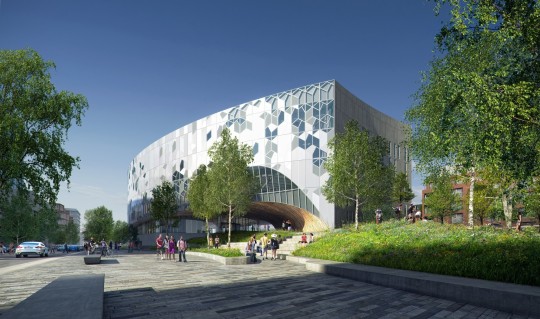
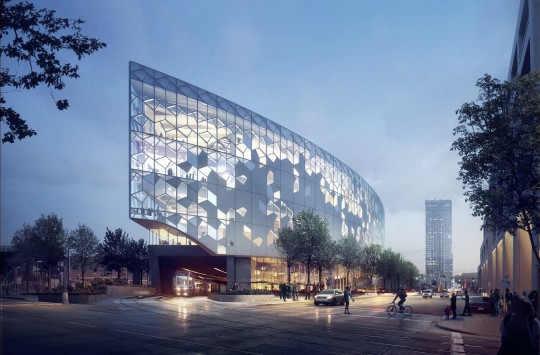
    The City of Calgary opened up its New Central Library this past week on November 1st, 2018, after a five-year construction process. 

    Designed by Snøhetta (design architect) with Dialog (architect of record) and Entuitive (structural engineer), the building was previously named one of “the 12 most anticipated buildings of 2018″ and one that will surely serve as a landmark for the city.

    One of the most interesting things about this project, for me, is how it both gives back and integrates with the broader urban fabric. 

    It is both a library and public plaza, and it sits atop the city’s busiest LRT line. About 40% of the site area is taken up by tracks (and probably setback), which means that the structural system of the building was forced into 12m (~40 foot) clear spans (done in concrete). It is the first time in the city’s history that an active LRT line has ever been encased and built over.

    It is a magnificent building and reason enough to visit Calgary, if you aren’t already there. I am hoping to get out there and photograph this project sometime soon.

    Images: Snøhetta and Entuitive 

  • Project Profile: Coal Drops Yard

    A new retail district called, Coal Drops Yard, opened this week in King’s Cross, London. The architecture is by Heatherwick Studio and the project is absolutely stunning. I love the idea of taking the roofs of the existing buildings and delaminating them to create the new spaces. It is a good example of old meets something new and cool. Here is a short video that I think many of you will enjoy. If you can’t see it below, click here.

    [youtube https://www.youtube.com/watch?v=iLUGxPP0iNw&w=560&h=315]

    Image: Heatherwick Studio

  • Apple and the Milanese piazza

    image

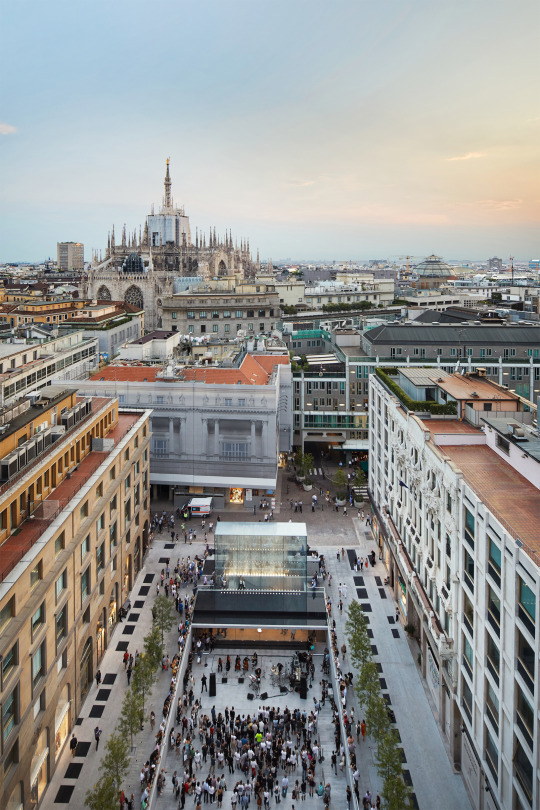
    This past July, the Apple Piazza Liberty opened in Milan. Above is a photo from the opening via Apple. There’s a band playing in the middle of the piazza.

    The store is central to Apple’s vision of transforming its retail locations into “town squares.” And in this case, the store is quite literally an Italian piazza.

    There’s a lot that is interesting about this store and this strategic move, as well as what this could signal about the future retail. (Curbed discusses that here.)

    The urbanists who read this blog will likely lament the privatization of public space. Because at the end of the day, it is a gray area. Can I hang out an Apple Town Square all day and just read a book?

    But at the same time, this is not necessarily a new idea. From the very beginning, the modern shopping mall was intended to be a new kind of town square. Or at least that’s how Victor Gruen saw it.

    However, what is perhaps new is this appropriation of public spaces for the purposes of what is arguably a new kind of retailing experience – one that almost feels paradoxical. 

    In the case of Apple Piazza Liberty, as well as in some of its other town squares, the actual retailing space is mostly hidden. Here it is underground. (How much to rent the basement?)

    And yet, Apple’s presence feels monumental and almost sublime. Glass box, waterfall, and subtle Apple logo sitting in the middle of a beautiful Milanese piazza.

    What a statement.

    Image: Apple

  • The public life data protocol

    The Gehl Institute has just launched (in beta) something called the Public Life Data Protocol. It was developed by the Institute, as well as by Gehl (the practice), the Municipality of Copenhagen, the City of San Francisco, and Seattle’s Department of Transportation.

    The goal of the protocol is to improve the way in which we collect, share, and compare public space information. It is about improving public life in public spaces.

    To do this, they have proposed a series of metrics that measure everything from “posture within the space” to “objects brought into the space.” They also propose spatial metrics that help to analyze public life in relation to its physical context.

    Gehl is a real leader in this space. I commend them on opening up their methodology and working to create “a common language for people data.” Great data will only help us to build more human-centered cities.

    To download a full PDF of the protocol, click here

    Photo by Thaddaeus Lim on Unsplash

  • So, what’s a town square?

    Earlier this week, Apple let us know that it is now calling its stores “town squares.” Not surprisingly, this elicited more than a few reactions. The Verge called it a “pretentious farce.” Others called it arrogant. Who is Apple to think that its stores could ever come close to a real town square?

    It also raised important questions around the actual “publicness” of the spaces within our cities. Traditionally, town squares have indeed been public. But our cities are now also filled with many privately owned public spaces (POPS). Most of the time you don’t know the difference. Though sometimes you do

    The reality is that there is a longstanding tradition of private retail-oriented spaces trying to simulate the experience of a town square, and certainly of a gathering space. The creator of the modern mall, Victor Gruen, always thought of his “garden courts” as a kind of substitute for traditional urban spaces. This was him trying to nobly urbanize the suburbs.

    What is perhaps unique about Apple’s town square nomenclature is that – beyond simply wanting to be a Starbucks-esque “third place” – they seem to be telling us that they want to usurp the public nucleus away from the proverbial “garden court” and place it in their individual stores. 

    And the reactions we have seen are because that feels far fetched.

    However this plays out, this is a very clear acknowledgement by Apple that in today’s world being a store simply isn’t enough. That’s no longer interesting. Consumers have far easier options at their disposable. You need to give us more of a reason to visit you in your store or, dare I say, your town square.

  • Fall event roundup

    image

    It’s still sunny and beautiful outside, so I don’t mean to be the one who prematurely calls fall. But I would like to get 3 Toronto events on your radar for the coming two months. 

    Full disclosure: These are all events that I support and/or my company supports in some way. 

    If you’re not based in Toronto and you don’t plan to be here this fall, you can stop reading right now and check back tomorrow. I promise to will try to be less Toronto-centric.

    1. EDIT: Expo for Design, Innovation and Technology, September 28 – October 8

    This is a 10-day immersive experience that will showcase how the intersection of design, technology and innovation can change the world. Think exhibits by Bruce Mau and Carlo Ratti; talks by David Suzuki and Scott Dadich (former editor-in-chief of WIRED and creator of the Netflix series The Art of Design); and projects spanning 3D-printed prosthetics to indigenous housing solutions. 70 speakers. 40 workshops. And over 150,000 sf of exhibits. Too much to write about here, but all topics and themes we frequently explore on this blog. Ticketing information here.

    2. NXT City Public Space Symposium, October 13 – 14

    This is a two day symposium about public space on a global stage. Talks. Public space tours. Round table sessions. And an epic after-party. Some of the speakers include Jeff Risom (Partner at Gehl Architects); Enrique Norten (Founder of TEN Arquitectos in Mexico City – and one of my grad school professors); and Mirik Milan (Amsterdam’s Night Mayor and someone who has gotten quite a bit of airtime on this blog). If you click here to grab your tickets, you’ll get 15% off. If for whatever reason that doesn’t work, use the code BDONN15.

    3. lost&gone: Romeo & Juliet, October 19 – 21 and October 27 – 28

    This is, I think, Toronto’s first truly immersive theater experience. For those of you who aren’t familiar, immersive theater is about turning the audience into participants of the production. It eliminates the “fourth wall” that traditionally divides audience and performers. I’ve heard great things about similar productions elsewhere in the world. The venue is a secret, so the show starts today with you having to try and figure out where it is in the core of Toronto. When you buy your tickets, you’ll also have to let them know if you’re a guest of the Capulets (Juliet’s family) or a guest of the Montagues (Romeo’s family). 

    Enjoy 🙂

    Photo by Brxxto on Unsplash

  • Short term, lasting impact

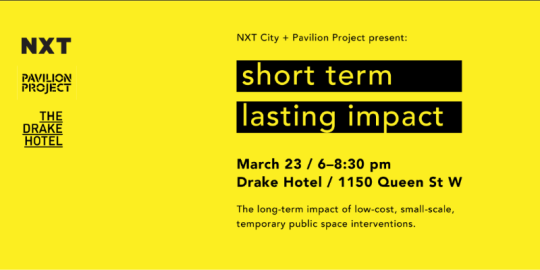
    NXT City and Pavilion Project are hosting an event on March 23, 2017 here in Toronto (at the Drake Hotel) called Short Term, Lasting Impact

    It’s all about how “temporary, low-cost and scalable [urban] interventions” can bring about lasting / meaningful change within our cities.

    Here’s some info on the panelists / topics:

    Matt Rubinoff, Tusk Global // STACKT

    This temporary shipping container market proposes a visionary complex with everything from retail and restaurants to studio spaces and a brewery. What are some of the challenges of bringing an unconventional project to life?

    Rui Pimenta & Layne Hinton, Art Spin // IN/FUTURE ART FESTIVAL

    This art experience reclaimed a beloved Toronto space, transforming it briefly through a multidisciplinary art and music festival. What opportunities can site-specific events bring to celebrate underused spaces?

    Michael McLelland, ERA Architects // PORTLANDS PROJECT

    There are many long-term and competing visions for Toronto’s Portlands. How do we make best use of this prime city site today? How can short-term planning inform a future agenda and create critical cultural space in the near-term?

    I know the folks behind both of these non-profits (NXT City and Pavilion Project), and so I am happy to support this event. Tickets are $10 and can be purchased here.

  • re:Public + NXT City Night

    On Friday, November 25th, NXT City will be hosting a one-day symposium here in Toronto (re:Public) that brings together some of the top people, projects, and ideas in the world of public spaces. Following that will be an after party (called NXT City Night) that runs from 8pm to very late. 🙂

    Here are some of the organizations that will be represented at the symposium: City of Toronto, Uber, CivicAction, Monocle, Arup, STEPS Initiative, Breather, The Laneway Project, Oxford Properties, as well as many others. It will be a great event.

    For the full speaker list, the agenda, and to buy tickets, click here. There’s an under 35 / student offering for both the symposium during the day and the after party at night. If you attend during the day though, you automatically get a pass to the after-party. I hope to see you there.

    Here’s a time lapse video from NXT City Night (edition 2015). If you can’t see it below, click here.

    [youtube https://www.youtube.com/watch?v=_i6R687sdk0?rel=0&w=560&h=315]

  • AMYGDALA — An installation that converts social media sentiment into audiovisual art

    It’s becoming harder and harder to think of tech as a distinct silo. Tech is embedding itself into so many traditional industries that, one day, every company will probably be a software/technology company in some regards. 

    It’s for this reason that I often think and write about tech and its impacts on the built environment.

    An interesting example of this phenomenon is a recent art installation by fuse* called AMYGDALA. What it does is translate collective social media sentiment (specifically from Twitter) into an audiovisual art installation housed within an urban space.

    Here’s how they describe the project:

    “The news and thoughts of users spread across social networks in real time. And so an event with worldwide implications immediately involves millions of people sharing their own opinions and emotions: happiness, anger, sadness, disgust, amazement or fear. Thus, imagining Internet as a living organism, we might think that its emotional state may be given by the overall emotions shared by users at any given time. AMYGDALA listens to shared thoughts, interprets states of mind and translates the data gathered into an audiovisual installation capable of representing the collective emotional state of the net and its changes on the basis of events that take place around the world.”

    And here’s a video of it in action (click here if you can’t see it below):

    [vimeo 154049756 w=500 h=281]

    What I like about the project is how it takes something digital and ephemeral and then both aggregates and translates it into something physical within the urban environment. It’s a perfect visual representation of how technology and networks are – for better or for worse – seeping into our daily lives.

  • The year of the laneway

    Earlier this week, Metro News published an article saying that it’s going to be a big year for laneways in Toronto:

    “2016 is going to be the year where the evolution of our laneways lands at the forefront of our public realm strategy,” said Downtown Yonge BIA chair Mark Garner, who’s heading up the revitalization of O’Keefe Lane near Ryerson University.

    In addition to the Downtown Yonge BIA, much of this is being spearheaded by the non-profit group, The Laneway Project. This year they are expected to unveil plans for the revitalization of 3 laneways in the city – one of which is right in my backyard.

    I have a lot of respect for what The Laneway Project, the Downtown Yonge BIA, and others are doing in support of rethinking our laneways. And so today I just wanted to publicly thank them for their efforts. Thank you 🙂