Daily insights for city builders, delivered every morning at 6 AM ET. I’m Brandon Donnelly — a Toronto-based real estate developer and founder of Globizen. I’ve been writing here since 2013.

Tag: property

  • The long and narrow of property affordability

    image

    Lots sizes and dimensions vary from city to city, as well as from neighborhood to neighborhood. They come in many different shapes and sizes from long and narrow (common in Toronto) to rectangular or even wide and shallow. Charlie Gardner wrote a terrific post on this last year where he used Bing Maps to illustrate some of these differences. Tokyo, for instance, is shown as having more rectangular lots (32′ x 38′), whereas Buffalo is shown as having more long and narrow lots (30′ x 175′). Charlie then asks: why the prevalence of inefficient long and narrow lots? These dimensions obviously produce long and skinny houses.

    As he rightly points out in his post, there are economic reasons for this. Assuming you’re starting with deep blocks and lots, then there’s going to be a natural tendency toward subdividing and going long and skinny. That’s because the key dimension is frontage onto the street. The more frontages you create, the more front doors can be built, the more lots with access to the Mississippi can be created, etc. And that’s how you end up with 10-12′ wide row homes, which also helps to address overall housing affordability. This is not a new phenomenon.

    To further demonstrate this point, let’s look at how this phenomenon has translated into the condo market – specifically the mid-rise condo market here in Toronto. In this case street frontage morphs into window frontage (access to light). That’s now the guiding dimension. In a 1 bedroom apartment, that dimension might be something around 6-7m. That allows you to have both a bedroom and a living room with a window. So it makes for a great 1 bedroom or 1 bedroom + den apartment. (I’m ignoring corner suites for this thought exercise.)

    However, a tension often arises when you begin to look at larger suites, such as 2 bedrooms and 3 bedrooms. The obvious response would be to simply give over more window frontage. So instead of 6-7m, the suite may get 10m. This would allow you to create a split 2 bedroom apartment (both rooms get windows) with a living room in the middle. This would be considered a highly desirable floor plan.

    But up until now we’ve been ignoring the depth of the apartment. And as is the case with lot dimensions, this can have an impact on the amount of street/window frontage that gets designed. We’ve talked a lot about mid-rise buildings before on this blog and one of the challenges here in Toronto is that the 45 degree angular plane guideline produces deep floors on the bottom of the building and narrow floors on the top. Given this, it would not be unheard of to end up with 12m apartment depths on some of the lower floors.

    The counter argument would be that nobody is forcing these larger floor plates. Simply carve the building back. But the economic reality is that the margins are so thin on mid-rise buildings, that it would be inconceivable to give up this floor area. You have to max out the envelope.

    Why does this matter? Well let’s assume that the average downtown Toronto condo will cost you $857 per square foot. Using back of the envelope math, that means that the above 6m x 12m apartment (1 bedroom) could cost around $663,000 (774 square feet x $857 psf). And that the above 10m x 12m apartment (2 bedroom) could cost around $1,106,000 (1,291 square feet x $857). 

    These are obviously big numbers. Question becomes: Who will be able to afford these?

    So naturally the design exercise becomes about reducing the size of the apartments and often this means reducing the amount of window frontage. Of course when you do this, it means that one or more of the bedrooms will need to be pulled back from the front windows, which is how you end up with inset / recessed bedrooms (indirect light) and long and narrow apartments. These are often pejoratively referred to as “bowling alley suites”, but they are driven by a push for greater affordability.

    Again, this is not a new phenomenon. It is simply a trade-off that gets made. It’s the long and narrow of property affordability.

  • It sold for what?

    Today I spent the day at the Land & Development conference here in Toronto. If there was one running theme throughout the day, it was: “Holy shit, I can’t believe that X piece of land sold for $Y million. How will they (the developer) ever make the numbers work?”

    Outside of the real estate development community, there’s often the perception that developers are building everywhere and that there’s lots of land left in cities, like Toronto. When you see all the cranes in the skyline, it naturally seems like we’re building a lot. Things seem easy.

    But the reality is that it’s extremely difficult to find “land” in markets like Toronto and Vancouver. And by “land”, I mean properties that can be feasibly acquired/assembled, entitled, developed, and then brought to market. The way the speakers today spoke about land it’s as if it were a rare precious commodity.

    I say all this, not to complain about how tough things are, but simply to shed light on the process. A developer’s job is to take a piece of property and figure out a way to create additional value. But to do that, they need to find a suitable piece of real estate. “Land” is an input.

    This has implications for consumers, because inputs turn into outputs. And if one of the inputs is becoming scarcer, then it’s pretty safe to assume that the outputs, such as new housing, are also becoming scarcer.

  • I’m writing a book on becoming a real estate developer

    typerwriter closeup by Sean Gladwell on 500px.com

    https://500px.com/embed.js

    One of the most common questions I get from readers of this blog is: How do I become / get into real estate development?

    In fact, I get it so often that I’ve decided to write a book as my response. It may be a short one or it may end up a long one. If you’ve emailed or messaged me with this question and I haven’t responded, I’m sorry. There’s a lot of you out there. But I do want to help and that’s why I’ve decided to take on this hobby book project.

    As part of the book, I’ll be talking about my own journey, as well as the actual nuts and bolts of development. But I would also like to feature some much more established players in the business. In order to do that, I’ve decided to crowdsource some of the content for this book. 

    So here’s my ask to you: If you’re a real estate developer and would like to share your story, please complete this short questionnaire. You can be located anywhere in the world.

    My plan is to select a handful of developers from around the world and then feature their stories, one-by-one. I’m confident that there will be a lot of interest in hearing how successful developers established their careers and/or own businesses.

    I’ve been thinking about doing this for quite awhile now. It feels good to get started. 

  • Honduras is building a decentralized land registry system using the bitcoin blockchain

    Tegucigalpa by José López on 500px.com

    https://500px.com/embed.js

    I am very interested in bitcoin because of the underlying technology behind it – namely the blockchain. And that’s because it has the potential to be applied to and to disrupt many different industries and sectors, including real estate.

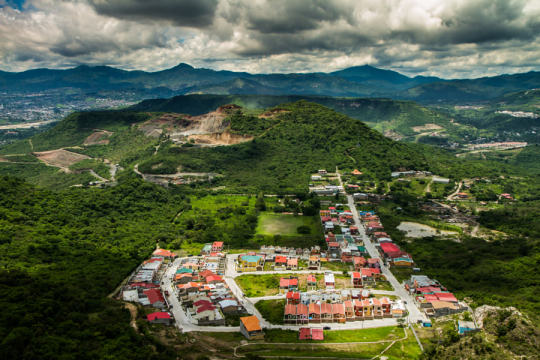
    That’s why I was fascinated to learn over the weekend that Honduras, with the help of a Texas-based company called Epigraph, is in the midst of building a permanent land title registry system based on the blockchain architecture.

    This is particularly important for Honduras because the country currently suffers from a significant amount of land fraud. And according to Reuters, 60% of land is actually undocumented. So the impact of a secure blockchain-based registry system could be transformational.

    Obviously the impetus for Honduras doing this is to fix the broken system that they currently have in place. But there’s no reason that it couldn’t also be done in the developed world to reduce transaction costs and improve overall transparency in the marketplace.

    Hopefully Honduras will show us how it is done.

    If you’re curious and would like to learn more about the blockchain, here’s a short primer. Once you’ve read that, you can then check out this post I wrote talking about how the blockchain could be applied to real estate.

  • The impact of Chinese buyers on Vancouver’s single family home market

    I have a new favorite blog that I think you might all enjoy as well. It’s called BT | A | Works and it is the “architectural and urban research and development division” of Bing Thom Architects in Vancouver. 

    I think it’s it’s important to have people in a firm who are researching and experimenting with ideas beyond the day-to-day tasks of a job. So I was excited to discover their work this morning.

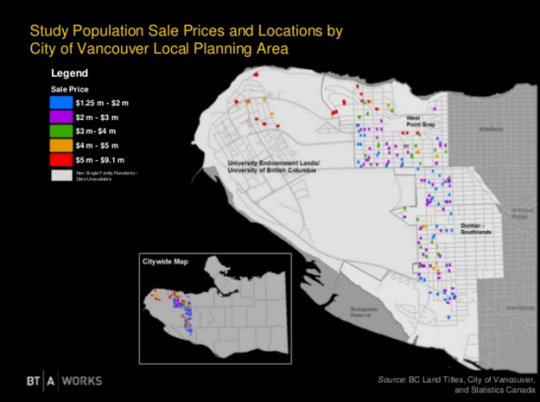
    Their most recent post is a look at ownership patterns of single family homes sold in 3 west end neighborhoods in Vancouver from September 2014 to February 2015 (a 6 month period). These are some of the most expensive areas in the city and, collectively, they found 172 properties sold with an aggregate value of around $520 million.

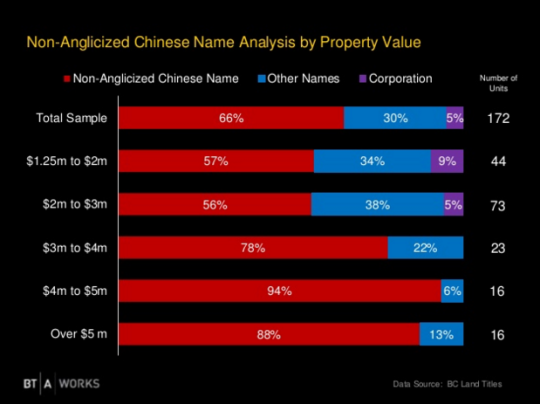
    Given the presence of foreign buyers in Vancouver’s real estate market, one of the things they then did was identify “non-anglicized Chinese names” on the title records. This means names like “Li Xian”, but not names like “Andrew Shui-Him Yan”, because the anglicized first name suggests that they are probably not a new immigrant or probably not living abroad.

    Here’s what they found:

    In total, 66% of the properties in the sample (172 properties) were associated with a non-anglicized Chinese name. And for properties over $5 million, the percentage jumps to 88%. The other interesting thing worth noting is that 23% of the registered owners declared their occupation as “homemaker/housewife.”

    I thought this would serve as an interesting follow-up to the post I wrote about a month ago called, Is Hongcouver better off than Vancouver? If you’d like to see the full BT | A | Works presentation, click here.

  • The global pyramid of wealth

    Every year the London-based property consultancy Knight Frank publishes something called The Wealth Report. And it’s one of those reports that I could go through for hours. 

    It includes a ton of really fascinating stats that speak volumes about where in the world wealth is being created and how it’s moving around. And of course there are a lot of connections between wealth, real estate, and city building.

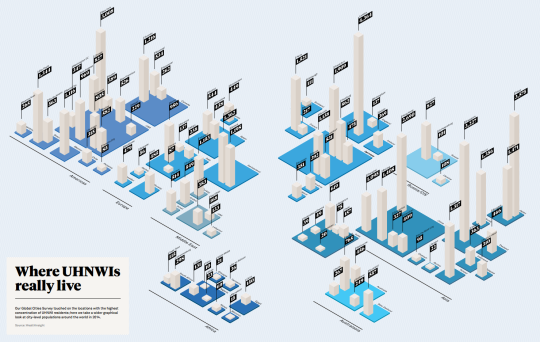
    Below are 3 diagrams that really stood out for me in the 2015 version. 

    The first diagram shows which cities have the most Ultra High Net Worth Individuals (UHNWIs). An UHNWI is defined as an individual with assets exceeding US$30 million, but excluding personal assets and property (such as one’s principal residence). Click here to see the full size image (I know the numbers are small).

    image

    Not surprisingly, London (4,364), Tokyo (3,575), Singapore (3,227), New York (3,008), and Hong Kong (2,690) are at the top of the list. But I was a little surprised – albeit happily surprised – to see Toronto (1,216) come in at #2 in North America, beating out Mexico City (1,116), Los Angeles (969), and Chicago (827). 

    The second diagram shows you how many square meters of luxury property (apartment) you can buy for US$1 million in a bunch of different cities around the world. 

    In Monaco (top end), that’ll buy you 17 square meters (183 square feet) and in Cape Town (bottom end), that’ll buy you 208 square meters (2,196 square feet).

    image

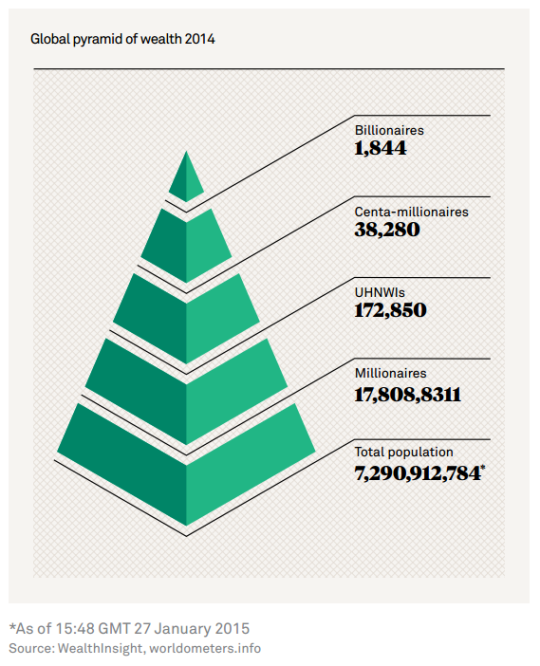
    The third and last diagram is what they call the global pyramid of wealth. It’s a pyramid of everyone in the world and then the number of millionaires, UHNWIs (see above), centa-millionaires, and billionaires. And if you do the math, the top of this pyramid comes nowhere close to 1% of the global population.

    image

    It’s fascinating (and exciting) to see where and how global wealth is concentrating. But it should also make you think about rising income inequality. I know it does for me.

  • Introducing The Spaces

    image

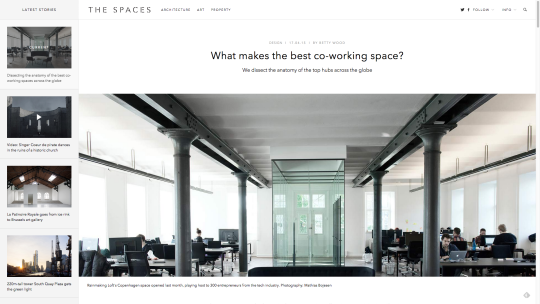
    At some point in the past, I preregistered for a site called The Spaces. I don’t remember doing it, but I’m sure that the site seemed promising when I landed on it and so I gladly handed over my email address. I’m always on the lookout for new and interesting things.

    Today that site has (soft) launched. And if you like architecture, design, art, and/or property, I am certain you will love it. I am already a fan.

    Based in London, The Spaces is about exploring the new ways in which are we living and working. Spaces ranging from residences to coworking spaces and everything in between. It’s about unique and progressive spaces and the people behind them. I love the concept.

    Since this is still a soft launch, I am sure the team is looking for feedback from the market. So if you have some, please share it in the comment section below. I will make sure they read it.

    Click here to check out The Spaces. Happy Friday all 🙂

  • The threat to big box retailing

    image

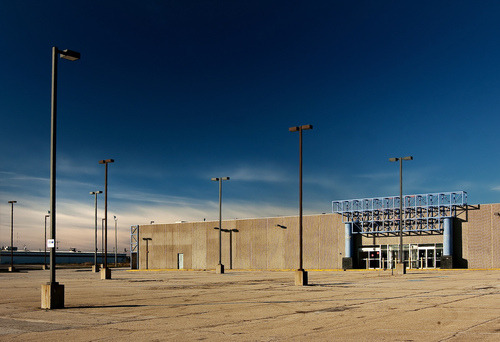
    Earlier this week, I was having a conversation with a number of smart real estate people about the future of retail in today’s internet and smartphone world. This, of course, isn’t a new topic. The industry has been discussing it for years. And while internet retailing still accounts for a relatively small percentage of overall retail sales (~10%), we all know that change is coming.

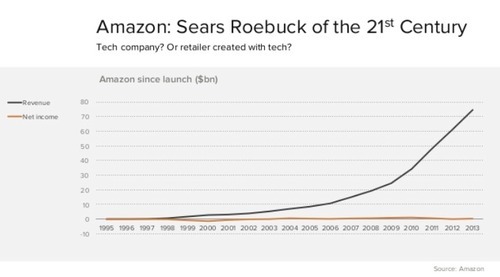
    One company that came up during our discussion was not surprisingly Amazon.com. But the initial comment was that they don’t make any money. Fortunately for me I had just gone through a presentation by venture capitalist Benedict Evans the night before called: Mobile is eating the world. And so I pulled out my phone and presented this slide:

    image

    The fact that Amazon operates with basically no net income is on purpose. Look at their revenue growth! So I wouldn’t dismiss them as being a fad. They may only account for 1% of all US retail sales today, but I’d put money on that percentage growing.

    The other reason I bring up Amazon is because, in some ways, I think of them as the online equivalent of a big box store. Just like a Walmart or Costco, where you can buy everything from tires to groceries to prescription drugs, I buy a lot of different things, besides just books, off of Amazon.com. You might do the same as well. And this is where I see the immediate threat to offline retailing and retail real estate: big box stores.

    In the second half of the 20th century, big box stores were incredibly disruptive to the retail landscape (and to cities). They used cheap land on the outskirts of cities, cheap buildings, and economies of scale to offer rock bottom prices to consumers. The value proposition was about cheap, not about differentiation. But as cheap as they may be, the internet can still do it cheaper.

    And retailers know this, which is why I think they all now sell groceries. Groceries have a very low online penetration. Basically everybody still buys groceries in-person. So if you offer that, you have a reason to draw people inside your store, where they will hopefully buy all the other stuff that they need. But as the online value proposition continues to get stronger, I think we’ll see many other, more significant, changes.

    Image: Flickr

  • London garage to sell for £550,000

    image

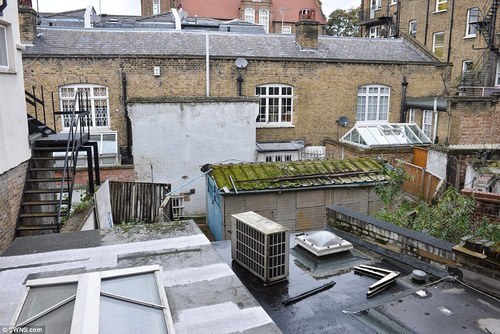
    The garage shown above (with the pseudo green roof) is located in the Chelsea neighborhood of London. It measures about 11’ x 7’ and it – along with the site it sits on – is about to go up for auction.

    It’s expected to go for more than £550,000 according to the DailyMail UK, which would make it the most expensive garage ever sold in the UK. The site area is 535 square foot – about the size of an average 1 bedroom condo in Toronto.

    Below is an aerial view of the site. It basically looks to be residual land.

    image

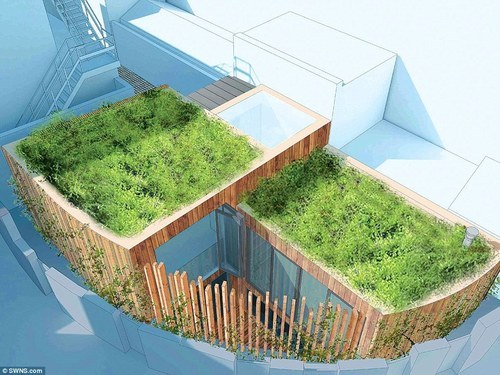
    But as awkward as this site might appear, the expected value is being driven by the fact that planning permissions were granted to turn it into this:

    image

    It’s a 2 bedroom house that feels a lot like a laneway house. It certainly fits the description of “a house behind a house”, which is often how laneway housing gets described here in Toronto.

    I wanted to share it because it supports my belief that, sooner or later, Toronto will come around to laneway housing. As property prices rise and affordability continues to erode, people will – quite justifiably – start looking in all sorts of new places for a decent urban home.

    Many thanks to my friend Adrian for sending me the link.

  • How technology could completely change the real estate development industry

    If you’re involved in the built environment in any way, shape, or form – as a developer, architect, policy maker, and so on – I would highly recommend you watch the video below. My friend Candice Luck, who I went to Rotman with, sent it to me this morning with a link starting at the 24 minute mark. I haven’t yet watched the whole thing, but given how interesting this short section was, I plan to.

    The video is a talk by Steve Jurvetson, who is a venture capitalist with DFJ. He was one of the founding investors in Hotmail and currently sits on the board of companies like SpaceX and Tesla Motors. At the 24 minute mark he talks about a startup called Flux.io that hasn’t yet launched their product, but is working towards “reimagining building design”. They’re a spin-off from Google X and plan to officially launch in early 2015.

    Rather than try and describe the video here, I will just say that it’s an incredible example of how technology and digitization could completely change the real estate development industry. If you can’t see the video below, click here. The video starts at the Flux.io section.

    [youtube https://www.youtube.com/watch?v=IPgyb6euISs]