Daily insights for city builders, delivered every morning at 6 AM ET. I’m Brandon Donnelly — a Toronto-based real estate developer and founder of Globizen. I’ve been writing here since 2013.

Tag: property

  • 1,688 new condominiums were sold last quarter in the Toronto region

    Urbanation just released its Q2-2024 condominium market survey for the Greater Toronto & Hamilton Area (GTHA), and we should probably talk about some of the data:

    • The new condominium market reported 1,688 sales in the quarter. Outside of Q2-2020 (the pandemic), this is the lowest in the past 20 years. Note: This number is self-reported by developers.
    • Of the 3,625 homes launched for pre-sale during the quarter, only about 17% got absorbed/sold. That’s about ~616 homes, which isn’t very much when you spread it out across the region’s projects.
    • Unsold inventory increased to 25,893 homes. Urbanation equates this to 34 months of supply, versus a more “balanced level” of 10-12 months. This number breaks down to 15,157 homes in pre-construction projects, 9,788 homes in projects under construction, and 948 homes in recently completed buildings.
    • This is higher than Urbanation’s 20-year average, but the way I see it is that the ~15k homes in pre-construction projects could very quickly evaporate. If those projects don’t get to construction (and most probably won’t in the short term), then that inventory will disappear from the market. On the other hand, the ~11k homes under construction or recently completed is a hard number. These homes exist, or will soon exist, and they’ll need to get absorbed at some point.
    • There are also going to be homes that are currently sold, but where buyers ultimately say “yeah, I’m not going to be able to close.” So there will be some non-zero percentage of homes that will need to be reabsorbed. I don’t know what this percentage will be, but if it’s something like 5%, that’s not nothing. (See below for the number of condominiums under construction right now.)
    • Not surprisingly, average asking prices for unsold homes only declined about 2.6% over the past year. Prices have remained markably sticky. And this is how you know that development happens on the margin. Because developers are infinitely better off selling homes and starting construction, compared to holding lots of unsold inventory and starting construction, whenever. The fact that developers aren’t dropping prices to sell more homes demonstrates that they can’t. They’re hitting the floor of financial feasibility.
    • Finally, last quarter saw 727 new condominium homes start construction. In theory, this could have been a single tall building, though that probably wasn’t the case. As new starts fall, the number of condominiums under construction will naturally also fall. The current number is 87,508 homes, which is almost 19,000 less than a year ago. I expect this number to keep coming down.
  • Toward more rental housing

    The Greater Toronto and Hamilton Area is expected to see 6,821 new rental homes completed this year. This is a “multi-decade high”, according to Urbanation’s latest rental report. Indeed, you need to go back to the 1970s to get rental supply figures of this magnitude.

    A big part of this has to do with the fact that we are now taxing rental housing less. Toward the end of last year, the federal government removed their portion of the HST on new rental housing and, then in November, the province of Ontario followed with theirs.

    This was “a big first step” for the industry, according to leading apartment developers like Fitzrovia.

    But there’s another reason that many developers are now looking to purpose-built rentals: fewer people are buying new condominiums. And if you can’t presell condos, well then you’re going to need to find another path forward for your land.

    However, flipping over to rental is not necessarily a panacea. The margins are generally razor thin (+/- 50 bps). It requires more and different capital (typically). And you need to believe in some fairly non-consensus assumptions (high rent growth, low cap rates, etc.).

    It’ll be interesting to see how many developers are able to successfully flip over to rental and how sustained this rental supply number will be.

  • Software eats real estate

    At the beginning of this year, a16z announced that they co-led a $175 million investment in the real estate company Loft. Based in São Paulo, Loft is doing in Brazil what Opendoor is doing in the US. They are bringing more liquidity to the residential real estate marketplace, and it turns out that the need for this is even greater in Brazil. That has apparently made Loft one of the fastest growing real estate companies in the world today. Here are some interesting facts about residential real estate in São Paulo. And here is a talk by Alex Rampell (general partner at a16z) on how software is going to eat the real estate world.

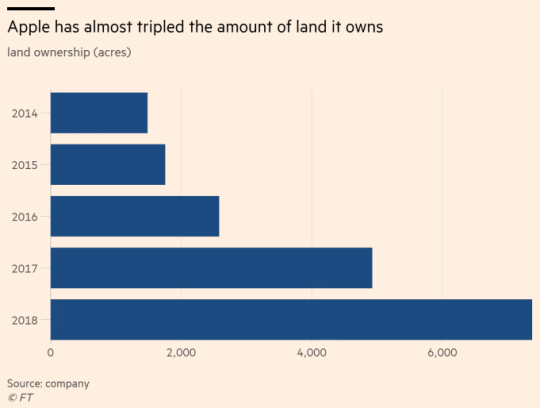
  • Apple now owns 7,376 acres of land

    In 2011, Apple owned 584 acres of land.

    As of this year, and according to the Financial Times, the company now owns about 7,376 acres. 

    Apple uses its “facilities and land for corporate functions, R&D and data centres.” The latter would include server farms for its various online services, such as iMessage, Apple Music, and the App Store.

    It can be easy to think of “the cloud” and the online services we use every day as existing only in some ethereal world up in the sky or in a distant land.

    But the reality is that these services have very real physical space requirements. The above chart begins to speak to that.

  • The rise of proptech

    A friend of mine flipped me this New York Times article today talking about the rapidly growing interest in proptech and about Opendoor – a topic and a company that I have written about many times before on the blog.

    Here’s a snippet about proptech:

    The hauls are part of a race by investors to pour money into technology for real estate, or what Silicon Valley now calls proptech. Having watched tech start-ups upend old-line industries like taxis and hotels, venture capitalists are casting about for the next area to be infused with software and data. Many have homed in on real estate as a big opportunity because parts of the industry — like pricing, mortgages and building management — have been slow to adopt software that could make business more efficient.

    On the Opendoor front, which is the largest/most valuable company in the proptech category, they have now raised over $1 billion. By the end of this year they plan to be in 22 cities across the United States.

    Interestingly enough, they have started experimenting with other business models, beyond just buying and flipping homes. They now circumvent agents and sell some homes directly to customers.

    But Eric Wu, the CEO of Opendoor, believes that you can’t automate proper advice and so that will remain. The role of agents is simply about to shift from “administration” to that of “advisory”.

    I have been arguing for years that the home buying and selling process is ripe for change. And what we are seeing today is really the start of that.

    According to the NY Times, real estate tech startups raised $3.4 billion in funding last year. Some firms, such as Fifth Wall Ventures, are entirely dedicated to the space.

    This is money betting on change.

    Photo by Grant Lemons on Unsplash

  • Public access at Martin’s Beach

    I just learned about the ongoing legal dispute on Martin’s Beach (south of San Francisco) through this New York Times article

    To briefly sum it up, tech billionaire Vinod Khosla bought a 53-acre beachside village known as Martin’s Beach in 2008. On the land is about 47 beach houses, a shop that sold ice cream at one point in its life, and a road that provides the only access to the beach. The road is private, but over the years and before Khosla purchased the property, it provided both parking for and access to the beach. 

    After acquiring the property, the county told Khosla that he had 2 options with respect to the road:

    (1) Keep it open (there’s a gate that controls access). And charge no more than $2 a car for parking, which was the rate charged in 1972.

    (2) Apply for a Coastal Development Permit to change how the access works.

    Khosla opted to do neither and in turn the residents of Martin’s Beach sued him. He’s been in a legal battle ever since. But according to the New York Times, he has about $3 billion sitting in his war chest. For him it is both a matter of principle and a matter of protecting property rights.

    Not surprisingly, tech billionaire fighting to keep people off a public beach makes for a sensational headline in the media. The NY Times argued that every generation has some sort of rich Californian fighting to privatize the waterfront. Khosla is this generation’s “beach villain”.

    But beneath the headlines lies a fascinating legal debate that you can read more about through a blog post that Khosla published earlier this year. For you property lawyers out there, I would be curious to hear your thoughts in the comment section below.

  • The blue (real estate) bible

    Back when I was in grad school studying real estate, we used to refer to the below book as the “blue bible.” It is a comprehensive look at real estate finance and investments, and also development. But perhaps more importantly, it is written in a way that is clear, direct, and immensely practical to the actual world of real estate.

    image

    The reason I mention this today is because the fifth edition is out and my friend Bruce Kirsch is now an author, along with Peter Linneman. Thankfully the cover is still blue, otherwise I might be a little sad and this post wouldn’t make a lot of sense.

    Bruce has an MBA in Real Estate from Wharton (at Penn) and is the founder and CEO of Real Estate Financial Modeling, LLC, which I recommend to absolutely everyone who wants to get better at financial modeling and deal underwriting.

    I have a lot of people who reach out to me on a regular basis and want to ask me about getting into real estate, and in particular, development. I try my best to make time because I was once in their shoes. Usually that means an early morning coffee in Toronto’s PATH.

    My advice is fairly consistent. You have two options. Try and get your foot in the door at a shop or, if you’ve got the gall, go out and try and do it on your own. I have friends who have successfully done the latter with very little in the way of formal real estate training.

    Whatever your decision, knowledge of the industry will obviously serve you well. Oftentimes I’m meeting with design and/or planning professionals who bring a lot to the table, but usually lack the finance and investments knowledge. That’s when I remind them of my story: Don’t screw up the numbers.

    This is also when I suggest taking one of Bruce’s classes. I’ve taken a number of them. Because to learn how to model something in Excel you have to understand how it actually works and Bruce helps you do exactly that. Garbage in, garbage out. That’s how models work.

    But the other thing one should consider doing is picking up a copy of the blue bible. I have a copy sitting on my desk right now and will tell you that it’s a “must read”, whether you’re a designer and just want to learn more about the other side of the business, or you’re an experienced real estate professional.

    For more on the book, click here and then on Textbook at the top. Oh, and Bruce, congratulations on the new book!

  • Reprivatization in Warsaw is a double-edged sword

    The Guardian has just published a fascinating article about the reprivatization of property in Warsaw. This is the process by which previously nationalized property is returned to pre-communist owners, or their heirs.

    Not surprisingly, the government gets a lot of these sorts of claims, though many of them are clearly bogus. Between 2007 and 2017, Warsaw City Hall estimates that 447 properties, representing about 4,479 dwellings units, were reprivatized.

    For some, all of this is restitution for widespread expropriation during the communist era. But for others, it quite simply means eviction. 

    The story at the beginning of the article – about a family who is immediately evicted from their apartment and has their belongings thrown out – seems almost hard to believe. One would think that there would be more sensible transition policies in place.

    Another negative has to do with the uncertainty that this creates in the market. Why would you buy and/or invest in a property if there was any inkling that it could be taken away from you? You wouldn’t. 

    Click here to read, ‘They stole the soul of the city’: how Warsaw’s reprivatisation is causing chaos. If any of you are familiar with the Warsaw property market, please do leave a comment below.

  • Airbnb-ing your way to homeownership

    I just discovered an interesting new Seattle-based startup called Loftium

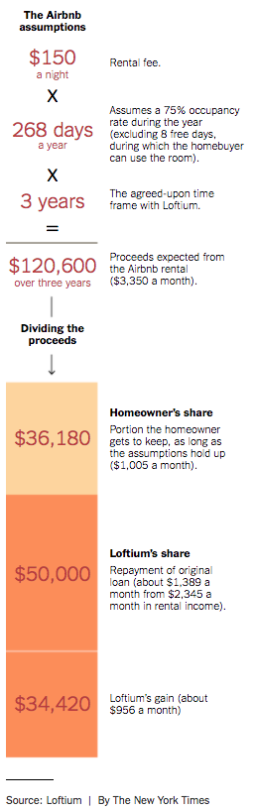
    The way it works is that they provide down payment assistance (up to $50,000) to prospective homeowners as long as they commit to renting out one of the home’s bedrooms on Airbnb for 12 to 36 months. Loftium is positioning it as a way to help first time buyers get onto the property ladder.

    Here’s an example of how the math might work (taken from the New York Times):

    The details certainly matter a great deal here but, high level, the homeowner gets $50k upfront, ~$1k per month in shared Airbnb revenue, and the opportunity to buy a home. You just have to be committed to being a host.

    And from Loftium’s perspective, they put out $50k at the outset and get back just over $28k a year for 3 years. Assuming these assumptions are correct, that’s a pretty good IRR. 

    However, if the home doesn’t generate enough Airbnb income during the agreed upon term, Loftium is on the hook because the homeowner doesn’t owe anything after the “services contract” expires.

    Think this will fly? Would you use it?

  • Will Zillow’s new “Instant Offers” disrupt real estate agents?

    Last month Zillow.com launched a new feature called “Instant Offers.” Press real estate can be found here.

    It is:

    “…a way for homeowners to sell their homes quickly by providing them with offers from investors and a comparative market analysis (CMA) from a local real estate agent, as an estimate for what the home might fetch on the open market.

    Here is a bit more about how it works:

    “To participate in Zillow Instant Offers, verified homeowners interested in receiving investor offers confirm information about the home (number of bedrooms, square footage, etc.), highlight any updates and provide several photos of the home. From there, select investors who buy homes in the area can present their offers alongside the CMA from a local real estate agent. Any investor offers and the CMA will include an overview of fees associated with each option, to enable sellers to make an informed apples-to-apples comparison.”

    When I first saw the headline, I thought they were copying Opendoor. But it’s not the same model. They aren’t buying the homes, like Opendoor, they are simply working to coordinate an “instant” transaction. Still, I’m sure that Opendoor provided at least some of the impetus for this feature.

    Of course, the most interesting question with these online real estate platforms is: Will they disrupt real estate agents? Mike Delprete wrote a great post about this in the wake of Zillow’s announcement.

    But ultimately he concludes something that I have felt strongly for years:

    “So, while real estate sites are best positioned to disrupt the real estate industry by displacing agents, they’re also the least likely to do so, because agents are their biggest customers and source of revenue.”

    The irony.

    About 70% of Zillow’s revenue comes from real estate agents. So it seems unlikely that they – at least currently – will be the ones that turn the tables on agents. 

    Some real estate platforms have started diversifying their revenue streams for probably this exact reason. But who knows, it may be a new entrant, rather than an incumbent, who pulls this off.