
My friend David Wex of Urban Capital Property Group — who I featured in my “BARED” blog series back in 2016 — was recently interviewed by architect Vincent Van den Brink (of Breakhouse) for the firm’s podcast called, Design Makes Everything Better. It’s a great listen and I particularly like the bit around branded vs. opportunistic real estate development. In the case of Urban Capital, David would describe his firm as being a branded developer. They build a specific product and it doesn’t really change when they build across Toronto and in other markets. Expect exposed concrete ceilings and exposed ducts, among other things. If you can’t see the embedded podcast above, you can have a listen over here.
Tag: product
-
Der Wickelfisch
A colleague in the office recently introduced me to a Swiss invention called the Wickelfisch (or baby fish). Below is a video showing you how they work. They’re so neat. So Swiss. And I obviously just ordered one. They’re available via this US company for $12-20, depending on the size.
The video is of people swimming in the Rhein. Because swimming downstream in rivers — and ending up in a different location — is so popular in Switzerland, the Whickelfisch was invented as a way to keep your clothes and belongings dry. It also acts as a flotation device.
I’m not planning on floating down the Don River anytime soon, but a Wickelfisch looks like the perfect bag to bring to the beach. Especially if you don’t want to leave your stuff unattended to while you go for a swim.
Of course, the other neat thing about this video is that it shows you how awesome it is to have clean and swimmable water running through the middle of a city. Most people I know are afraid to swim in Lake Ontario out of fear they might grow a 6th toe.
That’s too bad.
-
Create things people love
I just finished listening to this podcast about venture capital and consumer products. One of the underlying questions is whether we are currently in a “consumer downturn.” Rebecca Kaden of Union Square Ventures (USV) talks about the importance of “platform shifts” for venture returns. These are moments where a new technology hits the marketplace and there’s a corresponding mass consumer adoption. When and where will that next shift occur? Maybe it’ll be in real estate.
I like the discussions at 10:00 and 13:50. The first deals with the importance of non-paid customer acquisition strategies for consumer products. Rather than relying on bought attention, you really need organic growth strategies, which is often an indication that people are passionate about your product. This is arguably more important when you’re fundamentally reliant on massive growth/scale, but whether we’re talking about software or a home, I still believe it’s paramount. Create things people love.
The second point is about commerce, Amazon, and how USV avoids investing in companies that are unlikely to ever win against Bezos. Kaden’s position is that Amazon’s advantage is and has been more executional than structural. They are simply really good at doing things better. But Amazon wins at logistics, speed, and value. They are not as focused on experience, entertainment, and discovery. And people still want that.
I’ll stop there. If you can’t see the podcast below, click here.
[soundcloud url=”https://api.soundcloud.com/tracks/507691569″ params=”color=#ff5500&auto_play=false&hide_related=false&show_comments=true&show_user=true&show_reposts=false&show_teaser=true&visual=true” width=”100%” height=”300″ iframe=”true” /]
-
World’s best city brands
Resonance Consultancy – they do brands and strategies for places and products – has just released a new report called: World’s Best City Brands – A Global Ranking of Place Equity.
With all of these sorts of rankings, it really depends on the research methodology being used and the rigor in which it is being applied. In this case, they evaluated each city based on “six pillars of equity”:
- Place: Perceived quality of a city’s natural and built environment
- Product: A city’s key institutions, attraction and infrastructure
- Programming: The arts, culture and entertainment in a city
- People: Immigration and diversity of a city
- Prosperity: Employment, GDP per capita entertainment in a city and corporate head offices
- Promotion: Quantity of articles, references of a city and recommendations online
What’s perhaps unique about this study is that it combines measurable statistics with “visitor perception metrics” – data that they mined from social media. Here’s an excerpt from the methodology page:
“Our team became interested in the way visitors and citizens themselves influence the identity and perception of cities. Increasingly, they do it through their evaluation of experiences on social media and via the comments, images and reviews they share with family, friends and people around the world. These opinions and attitudes, much more than traditional marketing, influence the way people perceive places today.”
This is a fascinating shift for city brands and is something that we have discussed before on this blog. All of us are now involved in telling the story of the places in which we live and visit.
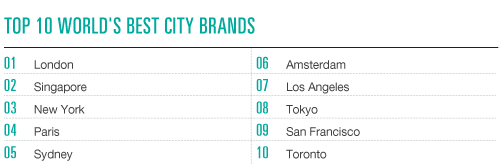
The entire report is well done and worth a read. It’s also a free download (you’ll need to enter your contact info). But below are the top 10 world’s best city brands. Not really any surprises for me. What about for you?
-
That emotional connection
Marketing guru Seth Godin recently published this value
triangle on his blog: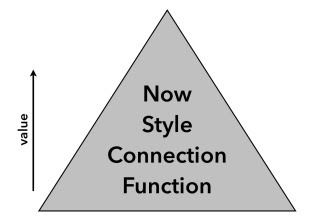
No matter what business you’re in, it’s worth giving some thought to this. What do you offer?
At the bottom of the triangle is function. A hotel room functions as a place
to sleep. A smartphone functions as a device to make calls, send text messages,
and download some apps. A condominium functions as a place to live, eat, sleep, have sex, and so on. But all functions being equal, most of us will buy whatever product is the cheapest.That is until there’s an emotional connection. I love the
way Seth frames it: “Where do people like me do things like this?” It is about defining
who you are. Am I the kind of person who buys A or am I the kind of person who buys
B? If I care deeply about the environment and B promises to respect that, I am
likely to buy B.But then, moving even further up the triangle, if two items offer the same function and the
same emotional connection, many of us will go for the one that appears sexier, shinier (the new iPhone 7 is very shiny), and more
stylish. It just deepens the connection.Finally, at the very top of the triangle is now. This is
about scarcity. What’s hot right now?
Think of that new restaurant that just opened downtown that you haven’t been
able to get a table at. It’s now and you want to Instagram the food so badly so
that you can show everyone you were there. You want to be now.The point of all of this is that we consume things for
reasons that go well beyond simple function. That’s just the start of it all.
One could argue that all of this is simply smoke and mirrors, but that’s a
topic for another blog post. This is our reality.To relate this topic back to architecture and real estate, I
am curious how many of you have made a housing decision that you believe went
beyond function. How much of it was based on connection and style?Not surprisingly, for me, architecture and design matter a
great deal.Earlier this summer I was driving around the city with my
father and he was pointing out to me all of the new build single family homes
that were sprouting up. He then asked me what I thought of them. I responded: “They’re
shit.”What I was really saying with that glib remark was that
those homes – no matter how expensive – didn’t reflect my own belief system
about the world. Sure they served their function, but they didn’t offer the
connection and style that “people like me” like to praise. To borrow once again
from Seth: we are all part of a certain tribe.What tribe do you belong to? And does your housing choice
reflect that? -
Transparent offer platform
A new “transparent offer platform” called Haus has just launched in California to serve the residential real estate market. The way it works is that all offers are submitted online. And once an offer has been confirmed, it – along with all of its terms – gets revealed to every other potential buyer. See image below.
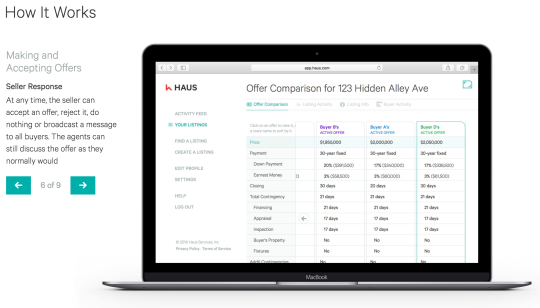
I’ve seen a number of different iterations of this same idea, which tells me that this is a well-identified problem in the real estate market. Here’s a snippet from a recent TechCrunch article announcing Haus:
“We think the openness will create a more efficient market and that the number of offers and price will ultimately be dependent on demand,” said Haus GM Sarah Ham. “Bidding wars are a common, almost accepted, part of the real estate process today. But with our approach, buyers know where they stand. Buyers will know what they need to offer to make their offer competitive, but they also won’t negotiate against themselves.”
I completely agree that this is a problem that needs to be solved. It will create a more efficient marketplace. However, in this market, I suspect that the current information asymmetries largely benefit sellers, to the detriment of buyers. So I wonder if the supply-side of the marketplace will be willing to participate at scale. What’s really in it for them?
Side note: Haus is the latest project from Expa, which is a “startup studio” that works on its own ideas, as well as partners with other founders. I am very interested in this approach to creation because I think you have to try and make a lot of things if you want to do truly innovative things.