Daily insights for city builders, delivered every morning at 6 AM ET. I’m Brandon Donnelly — a Toronto-based real estate developer and founder of Globizen. I’ve been writing here since 2013.

Tag: planning

  • Guest Post: How We Changed Toronto

    This past summer I participated in a Jane’s Walk here in Toronto, where I was the only speaker to advocate for removing the eastern portion of the Gardiner Expressway.

    After my short talk I was feeling a bit like the black sheep of the group. Either nobody felt the same way as me, or nobody was willing to speak up. Most of the other people there seemed more enamoured by architect Les Klein’s “Green Ribbon” proposal.

    But as I put down the megaphone and began walking to the next stop, a man came up to me. Truthfully, I didn’t know who he was at first, but he reassured me that it was the right thing to do. The Gardiner East should come down.

    Eventually he gave me his business card. On the front it said: John Sewell. And as soon as I saw that I said out loud: “I know this name!”

    John Sewell was a member of Toronto City Council from 1969 to 1984 and was Mayor of Toronto from 1979-1980. Today, he is a Toronto activist and has written dozens of books, mostly relating to urban issues.

    His latest book, released last month, is called: “How We Changed Toronto – The inside story of twelve creative, tumultuous years in civic life, 1969-1980.”

    And today I’m delighted to share a guest post that he has written for Architect This City. The focus of his post below is on the importance of community participation in the planning process and how it was used in this city in the 1970s.

    If you’re a developer, this post might scare you. I think there’s often the perception that communities will generally oppose any sort of development. But there are developers in this city, such as Westbank, which have been taking a more proactive approach to community consultations. And it appears to be working for them. So maybe this is something we should be talking about.

    If you have any thoughts on this, let’s have a discussion in the comment section below. I hope you enjoy the guest post. Thank you again, John.

    _________________________________

    Transportation plans, redevelopment schemes, urban expansion: municipalities address big issues like these in several different ways. A staff report can be requested; consultants can be called in; a competition can be held.

    The device used most successfully by Toronto City Council in the 1970s was a committee of citizens working directly with city staff and council members. It produced enormously successful results, as I recount in my new book `How We Changed Toronto’, but sadly it is rarely used in the 21st century.

    In 1970 City Council appointed a working committee of local residents and several councillors to create a new plan for the Trefann Court Urban Renewal Area, a neighbourhood that had been fighting the city’s plan of demolition for half a dozen years. With the help of a city planner hired specifically for this task, a new plan satisfactory to the different factions in Trefann was hammered out within a few years, then successfully implemented.

    In 1973, when the new Council pondered how to rethink a downtown designated for more office towers, it appointed the Core Area Task Force, a body of community representatives and developers, to give direction to city planners as a new approach to the downtown was devised. The result was the remarkable Central Area Plan which encouraged housing downtown and mixed uses, put an end to windy plazas, and generally created an environment that was active and felt comfortable to anyone on foot.

    In 1974, as Council faced the problem of how it would redevelop 45 acres of wasteland on the edge of the downtown, it appointed a working committee of concerned residents and councillors to give direction to city staff. It’s fair to say that no one had a good idea of how the site should be developed, but the working committee and city staff conceived a brilliant plan which was quickly executed – the first new building was under construction within two years of the working committee being established – and the neighbourhood, now known as St. Lawrence, remains one of the great successes of the latter half of the 20th century.

    From the 1980s onward, City Council has touted the idea of citizen participation, but confined that activity to public hearings on decisions recommended by staff. That generally is the practice today, although open houses have been added, as though showing people plans and getting informal comments is a good way of involving people.

    What’s lost in public hearings and open houses is the creativity that a group of committed, diverse individuals can bring to a problem when they meet together over a number of weeks and months. The members of the group know the local scene but they aren’t experts, so they must be advised by planners and other professionals about the issues they should address, the pitfalls of some options, and the trade-offs available before decisions are taken. It is an open ended process fueled by debates about different opinions, but held together by a common purpose and the realization that those around the table are playing an important role in shaping the direction of the city.

    The working committee that started meeting in Trefann had no clear idea in advance of what the plan it finally arrived at would look like. It was the same with the Central Area Plan, the St. Lawrence community, and the other processes in the 1970s which I touch on in the book. The process that the politicians, staff and residents committed themselves to made all the difference.

    One reason this kind of process is not employed much today is because too many elected figures take an ideological approach. They think they have the answers which they have been elected to implement, rather than to establish ways in which many more minds can be involved in seeking results which are widely agreed on.

    As well, city staff are not seen as independent professional advisors serving the public at large, but as a part of a corps serving the mayor and city councillors. In the 1970s in Toronto there was a clear separation between the politicians and the administration, and there were frequent (and welcome) debates on the floor of City Council between the two factions. Both were there to serve the public although they might have different ideas of how that should be done. This kind of tension was seen as entirely appropriate.

    In Toronto (and probably other cities) the situation is now even more complicated as councillors see themselves not as public servants for a few years, but rather as individuals with a lifetime commitment to holding public office. Too many members of Toronto City Council have been there for more than 15 years, and they fear that taking a principled stand on an important issue might result in the worst of all possible outcomes, their defeat. They decide not to take on the big issues.

    Toronto is currently facing significant problems.  The downtown is being overrun with new tall condo towers, for which the city does not have the infrastructure, and the new housing is not designed to meet the needs of future residents. It is the perfect opportunity for a new look at the Central Area Plan, using the same mechanisms as in the 1970s: a holding bylaw so the new plan won’t be pre-empted by development applications; a citizen-led task force including some councillors, advised by city staff. Who knows what brilliant plan an open ended process can recommend?

    Another problem is money. Toronto does not have enough money to upgrade its transit system or repair the affordable housing it owns, let alone build the new affordable housing it needs. The demands of the mayor that other governments should pay are understandably disregarded. It is time that the city had its own revenue sources, and what better than a citizen led initiative to point the way?

    It’s the same with a plan to build the affordable housing the city needs, to ensure development activity enlivens the near suburbs, to put some restraint on the continued low density subdivisions which are being unrolled far beyond the city’s borders, to restructure the megacity into something which works for the different communities within the city. These challenges all need strong citizen driven processes.

    As I recount in `How We Changed Toronto’, the 1970s really did change Toronto for the better. The city has been coasting ever since on those successes. It is time for renewal, and using the successful mechanisms from forty years ago is something worth doing.

    -John Sewell

  • City building jobs

    I get a lot of emails from readers of this blog. I try my best to answer every single one of them, but sometimes I fall behind and fail spectacularly at that. (The snooze feature in Mailbox and Google Inbox is one of the best inventions ever.)

    One of the most common emails I receive is about careers. Sometimes it’s someone looking for a new job or for advice on how to break into the industry (usually real estate development). And sometimes it’s an employer (or recruiter) with a role they need filled. 

    It’s hard to match up supply and demand when they arrive in my inbox on an ad hoc basis like this, but I have been thinking about ways I might be able to help these people out.

    So today I thought I would try something new. If you have a relevant job listing that you’d like me to distribute to the ATC community (something in architecture, planning, real estate, tech, and so on), email it to me at b@brandondonnelly. 

    If I get enough high quality listings, I’ll send them out in my newsletter. And if everyone finds it valuable, I may make it a regular feature.

  • Blogging as city building

    This past week I received 2 separate invitations to talk at events about blogging as a form of city building.

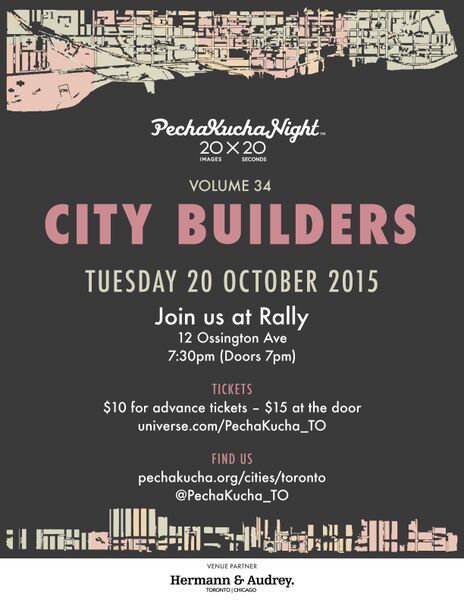
    The first is a Pecha Kucha talk being held here in Toronto on Tuesday, October 20th, 2015. If you’ve never heard of the Pecha Kucha movement, it’s basically all about rapid fire presentations. Each person gets 20 slides and 20 seconds for each one. 

    Here are the details for the upcoming Toronto event:

    image

    The second event is being held in Ottawa in the new year. I’ll write more on that closer to the date when I have more information to share.

    I haven’t yet figured out exactly what I’m going to talk about at each event, but I am starting to think about a few things.

    When I started writing this blog, it was intended simply as an outlet for my own city-related – and also personal – thoughts. Ultimately, the blog evolved into having its own mission, which is to promote the building of beautiful, sustainable, and globally competitive cities. And so clearly in my mind blogging was and is in fact a form of city building.

    But writing is vastly different than the kind of city building I do for a living. During the day I worry about things like rental rates, building setbacks, bulkhead locations, parking counts, and a bunch of other fun stuff.

    The two are certainly related, but the latter feels a lot more tangible. The result is spaces that people will occupy and buildings that will have some sort of impact on the overall built environment.

    But as you all know, city building is a lot more than just bricks-and-mortar. It is political. It is emotional. It is subjective. It is ego-driven. And it is so many other things. Because of this, words do have a role to play in shaping the cities we live in. And hopefully my words are having some kind of positive impact.

    At the same time, I see myself as simply part of a larger set of trends that are happening in both city building, as well as in many other sectors. Trends around transparency, decentralization, and the democratization of information.

    Technology today allows us to connect at zero marginal cost. And that is empowering people like me to self-publish, people to crowdfund real estate development projects, people to crowdsource community feedback for projects, and to do many other exciting things that weren’t possible before. Without this blog, most of you reading this right now would have absolutely no idea who I am.

    So I guess I kind of do know what I’m going to talk about.

  • Toronto housing — where we came from and where we’re probably headed

    This morning I’m working on a presentation that I’m going to be giving one evening next week to a delegation coming in from the US. The title of the presentation is the title of this blog post: Toronto housing – where we came from and where we’re probably headed.

    My plan is to start in and around the 50s and 60s and talk about Toronto’s first tower boom following the war. For this time period, I’m relying a lot on the work of Graeme Stewart of ERA Architects, who is one of, if not the, expert on post war towers in this city.

    image

    I’m then going to move onto our current high-rise condo boom and compare the two.

    Because the interesting thing about the first boom is that, after it finished, we basically returned to the typical North American housing model: building single-family homes. And it wasn’t until this recent boom of the early 2000s that we once again resumed building more high-rise than low-rise housing. That is still the case today.

    But the question I want to address is really, what’s next? Where are we headed? Is history going to repeat itself or is – dare I say – this time different?

    I’ll eventually get to those questions here on Architect This City, but first I want to hear from you. So here’s what I’m proposing: leave your thoughts in the comment section below and I will feature the best ones in my presentation next week as the voices of Toronto. I’m sure many of you know that I’m a big fan of crowdsourced information.

    So here goes. Where is Toronto housing headed and how will we be living in the next 10+ years? Will we be raising families up in towers or not? Please comment by Sunday, September 27, 2015 at 6pm (ET) to make sure I have time to feature you in the presentation. 

    Thanks for participating 🙂

  • Those troublemakers

    Toronto City Hall by Sébastien Pacaud on 500px.com

    https://500px.com/embed.js

    Jennifer Keesmaat is the Chief Planner of Toronto. She was hired for this job in 2012.

    She has a Masters in Environmental Studies (Politics and Planning). She is a Registered Professional Planner with the Canadian Institute of Planners. And she was also the founder of 2 (city) planning firms prior to taking the position of Chief Planner for Toronto.

    So presumably, she was hired for this job because she possesses some sort of expertise in the realm of planning. I also presume that she is expected to make her opinions known to other people so that informed planning discussions can occur and decisions can be made.

    So I find it curious that in some circles, and in the media, Jennifer Keesmaat is being branded as a “troublemaker.”

    A lot of the recent chatter stems from the fact that Keesmaat was at odds with Mayor Tory during the Gardiner Expressway East debate (quote via Toronto Life):

    Eventually Tory had enough and pulled Keesmaat into a meeting where he basically told her to zip it. “The mayor has said it is perfectly appropriate for staff to make their opinions public, as Ms. Keesmaat has done,” wrote his communications chief, Amanda Galbraith, in a statement. “It is not appropriate for city staff to campaign against councillors or the mayor on social media or through other public platforms.” Keesmaat counters that she never campaigned. “I stated an opinion,” she says simply.

    But the “troublemaking” didn’t just start with the Gardiner East. Pretty much since the moment she took the position of Chief Planner and launched her own blog (ownyourcity.ca), she was dubbed a shit disturber. (Those bloggers!)

    But if you ask me, these criticisms stem from an old and outdated way of thinking.

    The last thing we need from government is less transparency and more politicking. We should be working towards more, not less, information. Even if that information doesn’t butter our metaphorical bread.

    What do you think?

    I think this will make for a great discussion in the comment section below.

  • The Beijing supercity

    image

    A few weeks ago I wrote a post talking about megalopolises and the importance of the Great Lakes region in North America. And I suggested that high speed rail could be one way to better stitch together the region.

    To some, I’m sure this sounded like a bit of a pipe dream. But thinking at the megalopolitan scale is something that I think we are going to need to do. Other parts of the world certainly are.

    The Chinese government is in the midst of developing a supercity around Beijing that is called Jing-Jin-Ji. It will span about 82,000 square miles and will house approximately 130 million people. 

    As part of the plan, a high-speed rail network is being built that will bring the region’s major cities within an hour’s commute. The objective is to compete with the Pearl River Delta and the Yangtze River Delta regions in the south.

    It’s a scale of planning and development that most people aren’t used to thinking about. But it’s happening right now.

    Image: New York Times

  • Vancouver isn’t immune to the urban-suburban divide

    https://500px.com/embed.js

    In the comment section of my post about Vancouver’s transit referendum, a reader suggested I take a look at an article by Peter McMartin called, The real Vancouver emerges (from the ruins of the plebiscite)

    McMartin’s argument is basically that Vancouverism – the name given to the city’s progressive architecture and planning approach – isn’t as widespread as it might seem. The reality is that Vancouver, much like Toronto and other cities, is divided.

    “Vancouverism might be a reality for two or three neighbourhoods huddling in the downtown, and that greener, more progressive ethos might hold sway in one or two more.

    But Vancouver — and I speak of it in the metro sense — is the sum of its parts, and most of its parts are suburban in their sensibilities, and that includes not just all of the suburbs but most of the neighbourhoods in the City of Vancouver proper.

    They’re resistant to change. They abhor densification. They’re conventional in their sensibilities and they’re highly dependent on the automobile. More importantly, they’re not just dependent on the automobile, they prefer it.”

    Here in Toronto, we know our city is divided. And many people see it as evidence that amalgamating the city in 1998 was a big mistake. The inner suburbs are holding back old Toronto and elitist old Toronto just doesn’t understand the priorities of the inner suburbs.

    But I’m not convinced that amalgamation is to blame.

    Most cities have long histories of amalgamating adjacent towns, villages, and cities, and I suspect that there was opposition all along the way. At what point is amalgamation acceptable and and what point is it problematic?

    The anti-amalgamation camp here in Toronto seems to believe that it would have allowed old Toronto to continue doing what it wants to do and allowed the inner suburbs to do what they want to do.

    But this to me feels parochial.

    Our cities need to think bigger than that. We need to think as cohesive urban regions. And as Vancouver demonstrated this past week, that’s not always easy. But I don’t think the answer is to just think smaller and ignore the people whose views don’t match our own.

    Interestingly enough, what a lot of this comes down to, I think, is built form. 

    Because different kinds of built form will encourage and often mandate different kinds of transportation choices. And how you get around a city will inform a big part of what you value and what you vote for.

    Over time though, I believe that we will see built form start to level out across our city regions through continued intensification. Many people won’t be happy about this change. But it is likely that it will end up creating more cohesive cities. 

    Built form is no small thing.

  • Why I write something every single day, even if it’s garbage

    I was out for brunch last weekend with a few close friends from high school. It’s a “monthly reunion” that happens nowhere close to every month. But the hope is certainly there.

    During brunch the topic of my blog came up. And one of my friends asked me how I got started and how the hell I keep up with one blog post every single day. (I get that second question all the time.)

    I’ve written about this before, but I think it’s worth revisiting.

    Earlier this week venture capitalist Fred Wilson wrote a post on his blog called The Blank Screen. And I really liked how he described the experience of writing a daily blog post:

    Sometimes this process produces great insights for me and possibly others. Sometimes it produces garbage. But I’ve come to realize that the daily post, and its quality or lack thereof, is not really the thing. It is the ritual, the practice, the frequency, the habit, and the discipline that matters most to me. And, I would suspect, the same is true of the readers and commenters who frequent this blog.

    Fred’s blog was a major source of inspiration for me. I saw him doing it. I saw the value he was getting out of it. And I wanted to do it too. So I did, almost 2 years ago. 

    But he also inspired me in another way.

    Venture capital and real estate development share many similarities in my mind, even down to the way that deals are often structured with preferred returns and promotes.

    But the interesting thing about venture capital is that it went from a largely closed and “ivory tower” kind of industry to now one where almost every venture capitalist blogs, tweets, and strives for greater transparency (when possible).

    I thought this was a fascinating shift and it made me think that the exact same thing was bound to happen in real estate development. So I am trying to make that happen. Hopefully this blog is helping.

  • 14 CityBuilders come together in support of removing the Gardiner East

    This will probably be my last Gardiner East post before the decision goes to City Council next week on June 10th. But I have such good news that I need to share it with you all.

    This morning 14 “CityBuilders” came together for the first time in support of removing the elevated Gardiner East and replacing it with a surface boulevard. They are real estate developers, investors, and other prominent business leaders in the city. And they sent a letter this morning to every single Toronto City Councillor outlining their position. 

    I can’t tell you how thrilled I am to see this happen, so I’d like to call out each and every member of the CityBuilders. They are (in alphabetical order):

    1. Castlepoint Numa
    2. Cityzen Development Corporation
    3. Context Development
    4. Continental Ventures
    5. Daniels Corporation
    6. Distillery Historical District
    7. Dream Unlimited Corporation
    8. Greybrook Capital and Greybrook Realty Partners
    9. Kerbel Group Inc.
    10. Manulife Real Estate
    11. QQE 162
    12. Streetcar Developments
    13. TAS
    14. Tridel Group of Corporations

    These are some of Toronto’s most important city builders and I am sure this will get the attention of both Mayor John Tory and the rest of City Council.

    If you haven’t yet signed the Gardiner East petition that Stephen and I started, please do so by clicking here.

    Happy Friday 🙂

  • The perfect high street

    How do you create and maintain a thriving high street in this era of increasing online shopping? This was one of the questions that Monocle asked at its recent Quality of Life Conference in Lisbon and here’s a video with its recommendations. Click here if you can’t see the video below.

    [youtube https://www.youtube.com/watch?v=Ox2WJwDbuIo?rel=0&w=560&h=315]