Daily insights for city builders, delivered every morning at 6 AM ET. I’m Brandon Donnelly — a Toronto-based real estate developer and founder of Globizen. I’ve been writing here since 2013.

Tag: planning

  • Kanju (and the future of cities)

    There is so much interest in cities right now and I think that is absolutely wonderful. Earlier today my friend Derek shared a video with me on Twitter called, The Future of Cities. It’s by YouTuber Oscar Boyson, who I recognize from some of Casey Neistat’s videos, but whose own videos I have never watched before.

    I highly recommend you watch this video. It’s just over 18 minutes. If you can’t see the video below, click here.

    [youtube https://www.youtube.com/watch?v=xOOWk5yCMMs?rel=0&w=560&h=315]

    It’s well-executed, a joy to watch, and packed full of information and ideas. There are soundbites from lots of well known urbanists (both living and dead). And I also love how Oscar crowdsourced ideas and content from cities all around the world.

    The title of this blog post will make sense once you’ve watched the video.

  • The yellowbelt

    We talk a lot about the greenbelt here in Toronto. Some argue that it’s squeezing the housing market and driving up prices.

    But what about the yellowbelt? (Credit to Gil Meslin for the term.)

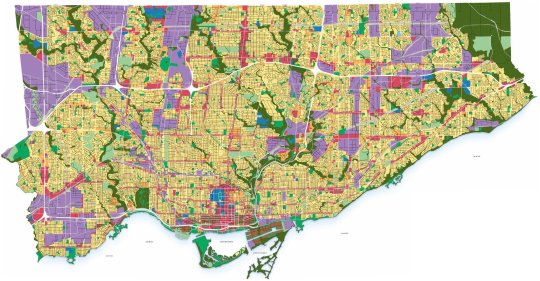
    Here is a land use map of Toronto:

    The yellow areas are “neighborhoods.” They, along with parks, ravines, watercourses, and valleys, make up ¾ of the city’s land area. The Official Plan describes these areas as being “stable” – meaning they will see little physical change. Supply cannot adjust to demand.

    I get why this is the way it is and I understand how difficult it would be change something like this. But let’s not ignore the impact that this land use constraint has and will continue to have on the housing market. 

    It’s the yellowbelt. Thank you Gil for letting me to steal the name.

  • Building crap

    Last night I participated in an excellent dinner discussion with a group of planners, architects, city officials, and politicians from Amsterdam. They were visiting Toronto to see first hand what rapid intensification has done to this city. And I very much appreciated the invite. Thank you.

    My message was that intensification has created a far more vibrant and exciting city compared to 15 or so years ago. It’s hard to know what exactly could be correlated with intensification, but we have certainly seen an explosion of culture, innovation, and pride in this city – among many other things. (It could be all Drake’s doing.)

    However, the counter argument at the dinner table was that Toronto is letting unfettered development produce unremarkable architecture. We are simply building glass tower after glass tower. And I know that, for many of you, this will ring true. I hear it all the time, including in the comments of this blog.

    Now, I will be the first to admit that there has been a lot of shit built in this city. No argument there. Some people have no taste. But at the same time, I think it’s myopic to assume that it’s strictly because of profit-motivated developers. 

    Oftentimes the perception is that development projects are awash in cash. There’s tons of money in which to do the right thing. Developers just need to stop being so greedy and start being more creative.

    The reality is that developers operate within a market. There are real limits to what people will pay for new space. And when, for instance, land prices go through the roof (an input), municipal fees jump (cost of doing business), and approvals drag (time value of money), guess where everyone starts looking for savings? In the build.

    I say this not to justify building crap. If I had it my way, everything would be beautiful. I champion design whenever possible. I say it simply to shed light on the process. Because when we all understand the factors at a play, I believe we all become more effective at finding solutions.

  • We’re eliminating parking minimums

    I’ve been writing about the hypocrisy of parking minimums for years now. Some posts here, here, and here

    To me, it doesn’t make sense to try and promote more sustainable forms of urban mobility while at the same time mandating a minimum number of parking stalls in every new development. 

    Do you want people driving or not driving? Pick one.

    That’s why I was happy to see the following action item in the province of Ontario’s five year plan to transition to a low-carbon economy and fight climate change (thank you Ken Wilcox for bringing it to my attention):

    image

    I haven’t gone through the entire action plan and so this post is not a commentary on that. It is, however, a commentary on subsection 1.4. I believe it is the right thing to do and I’m stoked to see it in the plan.

  • The Scarborough Subway Extension is a mistake

    Last weekend over dinner, a friend of mine asked me what I thought about the Scarborough Subway Extension debate going on in Toronto right now. Costs are coming in higher than initially projected and the usual back and forth is taking place. Transit blogger Steve Munro has a good post on this called Spinning a Tale in Scarborough.

    I haven’t written much about the Scarborough Subway, but I do have a strong opinion. I believe it’s a mistake. I am not saying that we shouldn’t be building higher order transit in Scarborough – we absolutely should – but it does not need to be an expensive subway line. There are more sensible solutions.

    Here are a few things to consider:

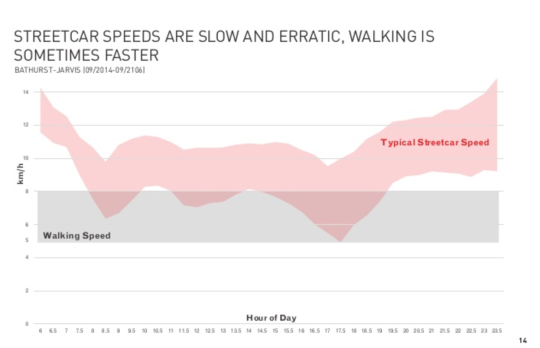
    Light rail transit (LRT) does not equal streetcar. As an avid user of the King streetcar, I’ll be the first to admit that something needs to be done to address the city’s busiest streetcar routes. They are broken. But this is not what was being previously contemplated for Scarborough. True LRT – which Toronto does not yet have – is far more effective at moving people.

    Scarborough Centre is seeing almost no new residential and commercial development. In fact, the “Centres” in general are not seeing much development. The largest share is happening downtown, along the central waterfront, and along the “Avenues.” We shouldn’t ignore this when making our investment decisions. Transit and built form go hand in hand. 

    I also do not buy the argument that we are building this subway in anticipation of demand 50 or 100 years from now. We are not in a position to be proactive about our infrastructure. We are desperately playing catch up and there are already lots of high growth and high density areas in the city which today are completely underserved by higher order transit. 

    Finally, a new subway line with low ridership will mean higher operating cost subsidies to keep it afloat. And at the rate that Scarborough Centre is growing today, this would likely continue for many years into the future. Not only is this debate about spending money today, it is about spending money well in the future, month after month.

    So let’s be clear: the Scarborough Subway Extension debate is about politics. It is not about transportation planning.

  • The cost of parking minimums

    Access Magazine has a good piece on parking minimums and the cost they create for our cities. The article is by Donald Shoup, who is Professor of Urban Planning at UCLA. He is also the author of The High Cost of Free Parking.

    Here is his argument:

    “Minimum parking requirements create especially severe problems. In The High Cost of Free Parking, I argued that parking requirements subsidize cars, increase traffic congestion and carbon emissions, pollute the air and water, encourage sprawl, raise housing costs, degrade urban design, reduce walkability, damage the economy, and exclude poor people. To my knowledge, no city planner has argued that parking requirements do not have these harmful effects. Instead, a flood of recent research has shown they do have these effects. We are poisoning our cities with too much parking.”

    And here’s his summary of what it costs to build a parking stall in various US cities (both underground and aboveground):

    To put these numbers into perspective, he also looks at the median net worth of US households (2011) to show just how expensive this parking is for some groups. 

    Because remember, these parking costs get embedded into the cost of housing, retail stores, and so on.

  • The unbranding of this blog

    You’ve probably noticed that I have removed the Architect This City branding from this blog and gone to just my name. I like to refer to it as unbranding. (Though one could argue that a person’s name is still just another brand.)

    Already I’ve received a few emails from people telling me that they prefer the old look and feel of ATC and that there’s some level of brand equity there. But let me explain my thinking.

    First and foremost, this is a personal blog. I’ve written about that before. And it’s why it’s hosted at brandondonnelly.com. But along the way, as readership grew, I attached a name to it (ATC) and it started to become a kind of pseudo-independent brand. 

    When I would speak at events, people would introduce me as the founder of Architect This City, which always struck me as a bit odd because, again, this is just my personal blog. People also started asking me why I wasn’t turning ATC into some big company and started treating the blog as a media channel. You should see how many press releases I now find in my inbox.

    Of course, these are good “problems” to have. It means my writing is getting out there and I am thrilled about that. But I was starting to feel increasingly uncomfortable with the grey area between a personal and independent brand. I also felt like it was starting to impact my creative writing because I would sometimes wonder if I was going too personal on “Architect This City.”

    To reinforce that point, below is a snippet from a post that Fred Wilson wrote on his blog last summer. His 10+ year old blog has been a huge inspiration for me.

    “There is something about the personal blog, yourname.com, where you control everything and get to do whatever the hell pleases you. There is something about linking to one of those blogs and then saying something. It’s like having a conversation in public with each other. This is how blogging was in the early days. And this is how blogging is today, if you want it to be.”

    So I decided to clarify the brand. I wanted to make it clear that this blog is about my personal musings on city building, among the other things that I’m passionate about. And I wanted it to not pretend to be anything else.

    Ultimately, regular scheduled programming won’t really change for you. The content on this blog is still going to be heavy on city building, real estate development, design, planning and so on. And I will endeavor to create as much value as I can for all of you on a daily basis. (I am humbled by the number of people who now subscribe.) But hopefully it will end up feeling a bit more personal.

    Of course, now there’s the question of what do I do with the ATC brand (and social accounts). Do I let it die or do I spin it off into something else? I’m considering the latter. I’ve been obsessed for years with the idea of crowdsourcing and collecting meaningful real estate and city building activity, so maybe ATC will turn into some kind of open platform for that.

    But for now, I am feeling pretty excited about the unbranding of this blog. Hopefully some of you feel the same way.

  • Have your say in the future of downtown Toronto

    I was recently on a call with someone living in California, but who is originally from Toronto. He told me that every time he comes back to Toronto to visit, it feels like the city has changed, grown, and become even more cosmopolitan.

    That is a great compliment, because every city today is in a competition to remain relevant. Which means that if a city is not changing, evolving, and adapting, then it is falling behind. Competition is fierce and it’s global.

    Toronto is fortunate enough to be experiencing rapid population growth and that is driving a lot of this change. But at the same time, it naturally raises questions about how to best manage and leverage that growth, particularly in areas like the downtown core where a lot of that intensification is happening.

    To that end, the City of Toronto has been working on a three year study called TOcore, that will, among other things, result in a new comprehensive plan for the downtown core. (I’ve blogged about this before and it has come up in the comments a few times.)

    Today, however, marks the start of their public engagement process. And so if you’d like to have your say (there will be implications for developers, architects, and other city builders), you can do that here. There’s an online survey, an email address, events you can attend in person and, of course, a hashtag: #DTadvice.

    But the tool I think is really neat, is their “Favourite Places” map. What it allows you to do is drop pins onto a map of downtown and describe your “Favourite Places” and places that have “Great Potential.” Notice that the focus is on positivity. There’s no pin for “Shitty Places.”

    I have a lot to say, so I’ve been flooding the map with pins. I would be curious, though, to hear what you would like to see happen in downtown Toronto – and so would the TOcore team.

  • Easier said than done

    Earlier this week I saw the Chief Planner of Toronto, Jennifer Keesmaat, tweet this out:

    //platform.twitter.com/widgets.js

    I responded with the below quote retweet because I figured I should probably devote a blog post to this topic and not just a tweet.

    //platform.twitter.com/widgets.js

    Now, I don’t know for sure, but I am guessing that her tweet was in response to the criticism from architects and developers that Toronto’s design guidelines are creating homogenous architectural outcomes. Some people – and I’ve written about this before on ATC – believe they’re too prescriptive.

    So today I’d like to talk about why playing creatively within the guidelines/zoning envelope, particularly at the mid-rise scale, is a lot easier said than done.

    Generally speaking, the value of land is dependent on what you can do with it or, in this case, what you can build on it.

    If all you could do was plant things on it, then the value of the land would be correlated with crop yields. If on the other hand you could build a building, it would be correlated, at least in theory, with the amount of space you could build and the rents you could charge for that space.

    Of course, this isn’t a perfect science. That’s why I said “in theory.”

    Landowners obviously want to maximize the value of their asset when it comes time to sell. So they, along with their brokers, will naturally try and stretch what is possible with the land. Why else do you think the best neighborhoods seem to magically grow new boundaries?

    When you combine this with the fact that mid-rise buildings are inherently less efficient to build and with the fact that their smaller size creates diseconomies of scale, it can be exceptionally difficult to find development sites where the numbers make any sort of financial sense. That is, even if you “maximize the envelope” and push rents or sale prices.

    So, with all due respect, not maximizing the envelope is almost unthinkable, unless you somehow managed to get a bargain on the land.

    Many of you will likely respond in the comments saying that all of this is simply a result of real estate developers being greedy capitalist pigs. But what we are talking about is no different than in any other competitive business environment. 

    Developers rent and sell products – albeit products that take an incredibly long time to make and bring to market. To make those products, there are a many costs, ranging from the cost of land to the cost of drawings. But hopefully within all of those numbers sits a profit margin that makes sense given the amount of work and risk that the developer has taken on. 

    Put differently, telling developers not to maximize the envelope is like telling a pizza maker to throw out 10-15% of her dough before she makes every pizza – even though she already (over)paid in full for the dough.

    If you’ve ever created a development pro forma, you’ll know that it’s not easy getting the numbers to work when you’re operating in a competitive market. This is not a knock against creative design. Trust me, I am a design snob. This is just business.

  • My approach to blogging

    In yesterday’s post about the city as an egg, I received a comment basically saying that I use this blog to carefully curate my own image and that I would never argue against “dumb Toronto planning” because, after all, I’m a developer. I am going to do what breads my own butter.

    I welcome intelligent debate on this blog. That’s why it is open to anyone who would like to comment. But since I’ve received similar comments in the past, I thought I would use the opportunity to talk broadly about my approach to blogging.

    Firstly, there will always be some level of curation involved. That’s inevitable. We see it all over social media. But I’m a big believer in transparency and I try to do exactly that on this blog. I am keen to push the boundaries in this regard.

    At the same time, part of what makes blogs unique is that they’re often personal. That is the origin of blogging. Some of my favorite blogs to read are the ones that have figured out how to combine a particular niche topic with personal stories. And since ATC is ultimately my personal blog, I am going to continue taking that exact same approach.

    Secondly, I only write about things that I’m passionate about. I get asked all the time to write about and promote specific projects, causes, and events. But almost all of them do not get written about it. Because if I don’t care about it, then I’m not going to write about. It’s as simple as that.

    Thirdly, I believe in positivity over negativity. I believe that optimists, not pessimists, change the world. President Obama won his first term with a message of hope, not despair. To me, that is a stronger motivator.

    I’ve been told before that I’m overly optimistic and that my youthful exuberance will one day wear off. Boy, I sure hope it doesn’t. Because would you rather have a beer with someone who is optimistic or someone who is pessimistic? I will always take the former.

    However, this is not to say that I want to be blind to the realities of the world. Last summer I disagreed with Toronto’s decision to rebuild the elevated Gardiner Expressway East along the waterfront, and I continue to disagree with that decision. 

    When I believe something is a mistake, I am happy to make it public and put it in writing on this blog. But as a developer, I suppose I have certain biases working against me. That’s just the way it is.

    In any event, this is my rough and ever-evolving approach to blogging. As usual, I welcome any and all comments.