Daily insights for city builders, delivered every morning at 6 AM ET. I’m Brandon Donnelly — a Toronto-based real estate developer and founder of Globizen. I’ve been writing here since 2013.

Tag: planning

  • What to do when a car is blocking your bike lane

    I was out for a bike ride last night and, on my way home, I decided to try out the new dedicated bike lane on Adelaide Street. Usually I would take King Street, but it was completely full because of Caribana parties.

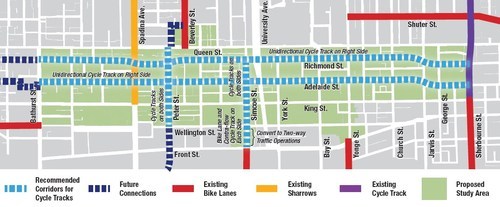
    For those of you who may not be aware, the city of Toronto is currently piloting two dedicated bike lanes on Adelaide Street and Richmond Street in the downtown core. Both streets are one-way and because the lanes were so big to begin with (highway-like spacing), I’m told that these new bike lanes didn’t even eat up a driving lane.

    Here’s a map of the pilot area:

    image

    Given that dedicated bike lanes are a scarce resource here in Toronto, I have to say that it was rather luxurious having my own piece of road. And because there’s no longer any fear of parked car doors swinging open, I was able to ride a lot faster than I normally would. 

    But as my friend Evgeny pointed out earlier this week, there’s a big difference between dedicated and grade separated bike lanes. Indeed, on my trip from Bathurst Street to Church Street last night, I encountered 3 cars parked in my lane.

    //platform.twitter.com/widgets.js

    So, I hope that these bike lanes become a permanent fixture downtown, but that the city makes them grade-separated. I’m sure people will use them. At the same time, I think they could also act as a catalyst for more pedestrian life along both of these streets.

    If you haven’t yet tried them out, I would encourage you to do so. The city is tracking usage and so you would be supporting the cause. And if there’s anybody parked in your lane, below is one way to handle it. It’s a video by Casey Neistat out of New York. If you can’t see it below, click here.

    [youtube https://www.youtube.com/watch?v=bzE-IMaegzQ?rel=0]

  • Who should zone cities?

    image

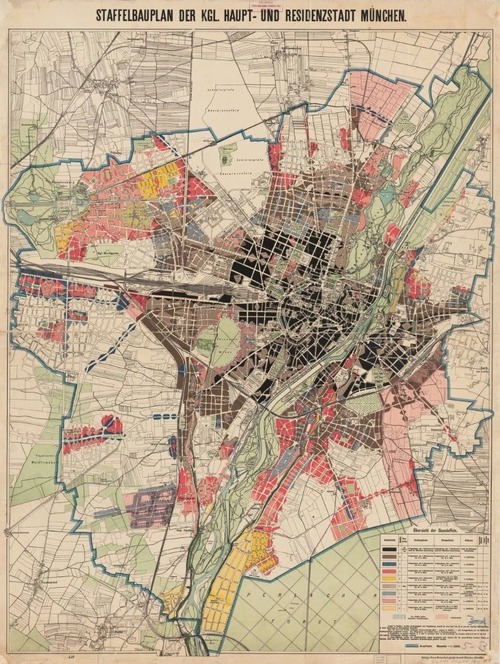
    The Old Urbanist has just published an informative post called “Where Zoning Went Wrong.” In it, he talks about some of the defining characterstics of American city planning and suggests that the delegation of planning authority from states to local municipalities is what has caused many of the challenges that city builders now face.

    But before we get into that discussion, let’s outline the characeristics. By way of Edward Bassett’s handbook on zoning (1922), the Old Urbanist outlines 9 characeristics of American planning. They are:

    1. Approval of the exclusion of commercial activity from residential zones
    2. Failure to disapprove of the exclusion of multifamily from residential zones
    3. Extreme deference to localities
    4. Insistence on a “comprehensive” plan
    5. Irreconcilable conflict between planning and zoning
    6. Heavy reliance on legal process as a substitute for sound policymaking
    7. Rejection of aesthetic concerns
    8. Concern with protecting the wealth of well-to-do homeowners
    9. Lack of comparative focus

    If you’re a planner or city geek, some of these items will be familiar to you – particularly the first one. Single-use zoning (or Euclidean zoning) is widely criticized as being hugely detrimental to cities, which is why mixed-use is so much in vogue right now. We’ve realized that there are tremendous benefits to creating neighborhoods and precincts where people can live, work, play, and learn. And not just do one of those things.

    But one point that somewhat surprised me was number 3: the deference to localities. The Old Urbanist’s argument is that around the world – from Germany to Japan – state and federal governments play a much more active role in city planning as compared to the US. And that the result is a different kind of city. As one example, most other countries don’t have single-family detached-only residential zones. The US does.

    Now, you could argue that it’s partially cultural. The US is all about individualism, whereas many other countries around the world have a greater sense of collectivism. But as the Old Urbanist suggests, it could also be because local municipalities are more prone to NIMBYism, which can ultimately lead to downzoning and more restrictive land use policies. Interesting.

    It was surprising to me though because I’m a firm believer in strong cities. They drive the economy and I generally believe that they deserve to look after themselves. And so could it really be that they need higher levels of government to keep advocacy groups and community opposition in check?

    Immediately I thought of the planning environment here in Toronto and Ontario. The Places to Grow Act, which is largely responsible for the intensification we’re seeing across the region, is provincial legislation. And “the Board” (OMB) that hears appeals arising from the municipal planning level is also provincial. So in other words, provincial decisions trump municipal ones.

    Many people believe that the OMB should be abolished. But probably an equal number of people believe that it’s critical to keeping development moving in Ontario. And, given our discussion here, it could be keeping our land use policies in check.

    But at the same time, I wonder if there isn’t a way to structure local planning such that it doesn’t succumb to individual interests and instead keeps the greater city building agenda at the forefront. If you have any thoughts on this, I’d love to hear from you in the comment section below.

    Image: Old Urbanist

  • Further evidence that laneway housing is going to happen

    image

    Earlier this week Fast Company ran a piece talking about “the next big thing in urban planning” – backyard cottages. As the name suggests, backyard cottages are basically accessory dwellings built in the backyards of existing single family homes. And the idea is that they’ll provide new affordable housing options in competitive and supply constrained markets such as the Bay Area in California.

    While somewhat different than laneway housing–which you probably know I support here in Toronto–they do share many similarities. We’re talking about the intensification of our residential neighborhoods at the scale of the single family home. And the potential benefits go beyond just affordability. It would also make our communities more sustainable, more walkable, and more conducive to transit.

    But there are challenges. I don’t know about the Bay Area, but many municipalities don’t allow a “house behind a house” and many communities don’t want to see their neighborhood itensify. However, we are seeing companies, like New Avenue, emerge to help homeowners navigate the process of building a backyard cottage. This company in particular claims to have worked with over 90 homeowners. 

    So I think we’re going to see more, not less, of these types of housing solutions. Vancouver is already doing it. And so is Portland

    Now here’s a question for you. If you owned a house in a single family neighborhood, would you be fussed if your neighbor erected a backyard cottage or laneway house? I’d love to get your opinion. Let me know in the comment section below.

    Image: New Avenue

  • Architect This City is The Guardian Cities blog of the week

    image

    ATC was featured in The Guardian Cities today as the city blog of the week. It’s a Q&A about Toronto and the idea is for it to be an “urbanist’s guide” to the city. They asked me to be playful and humorous in my responses, and so I tried to do just that.

    But my underlying message was that–despite being an awesome city–Toronto needs to get its act together with respect to mobility and transportation. I also recorded a video talking about this problem, which I believe will be released in the next week or so.

    A big thanks to The Guardian Cities for asking me to participate and to Athlyn Cathcart-Keays for continuing to be an avid supporter of Architect This City.

  • A data-driven approach to city building

    Yesterday I wrote a post talking about the rise of community involvement in the city planning process and how many people feel that it’s undermining the expertise of trained city planners.

    My position is that community participation is only going to become more pronounced and that it’s likely a natural outcome given the internet and what we’re seeing with many other industries.

    So instead of lamenting, I think we as city builders need to figure out how to create better frameworks and processes for dealing with the changes that are currently underway.

    Because it’s not just community involvement that’s getting in the way of city building, it’s also politics. In too many cases we are allowing self interest to get in the way of rational city building.

    But what I was starting to get at yesterday is that as city building becomes more open and transparent, and we find new ways to collect and leverage decentralized data (traffic flows, public space usage, and so on), I think it’ll open up the possibility of a more data-driven approach to city building.

    Cities are complex systems and in the past we’ve made a lot of mistakes because our assumptions were incorrect. We assumed, for example, that building more highways would quickly solve congestion. It didn’t.

    But with more openness, more transparency, and more data at our disposal, I’m hopeful that we’ll discover countless ways to build better cities. And when that happens, I think we’ll find that the naysayers don’t have as much to say.

  • The death of planning expertise

    image

    Yesterday a friend of mine sent me this article written by a city planner talking about the death of planning expertise. The article talks specifically about the rise of “community participation” and how it has undermined the modern planning process. (I guess it’s not just architects who feel undermined.)

    …we have lost respect for “experts”—those who have knowledge and/or experience in a particular field—and have replaced it with a kind of “expertise egalitarianism” whereby everyone’s opinion is given equal weight. But it is not only that the layperson’s opinions are given equal weight, experts increasingly face outright hostility. Laypeople attack experts as being arrogant, elitist, and imposing, if not outright threatening, often because the expert insists he or she knows something the other does not. Even more ridiculous, rather than being viewed as helpful or even essential, expertise is viewed as harmful or even antithetical to community participation.

    But to be clear, the author is not arguing for technocratic rule. He simply believes that community input has reached a point where laypeople with only anecdotal evidence are given equal weight as planning experts, and that it’s miring the planning process and causing less than desirable outcomes.

    This topic is interesting to me for 2 reasons.

    First, it’s interesting because we’re basically talking about a form of decentralization, which, just so happens to be one of the macro trends being ushered in by technology and the internet. It used to be that we couldn’t decentralize. Communication costs were too high and the ability to share information in real time wasn’t possible.

    But today we can. So instead of, for example, only getting the news from one source (a newspaper, perhaps), we get it from millions of people on platforms like Twitter. We trust laypeople, just as much as we do “expert” reporters, to tell us and show us what’s happening in the world. Just yesterday I turned to Twitter to see what was happening with Toronto’s torrential rainfall (#TorontoStorm).

    And as a result of this trend, we’re seeing startups like Popularise that are, in some regards, trying to decentralize the planning process. The platform allows communities to decide what they want to see in their neighborhood and then share it. Think your neighborhood could use an organic grocery store? Great, you can spec that on Popularise.

    The second reason I find this topic interesting is because there’s a school of thought (let’s call it the “wisdom of crowds” school of thought, to name it after a book), which believes that in aggregation the opinions of many can actually be better than those of a few so-called experts.

    And in many ways I agree with this—though there are a number of prerequisites that need be met in order for this to hold true. For example, you can’t have groupthink taking place, which I think you could argue is what often happens with NIMBY movements.

    Nonetheless, there’s a shift taking place and it’s impacting not only the planning profession, but many others. In the end though, I don’t think it will make experts irrelevant. In fact, as industries continue to “open up” and as we harvest more and more data (that previously wasn’t available), I think we’ll all be surprised at how beneficial this ends up being. 

    Image: GSAPP

  • We want what we want

    This past Sunday night I was out for a bike ride with a few friends all around downtown Toronto. According to Strava, we did almost 22 km. Click here to see our route. During the ride, one of my friends said something to me that stood out. He said that when he’s on a bike he wants all cars off the road; but when he’s in a car, he wants all bikes off the road.

    Now, this may seem like a fairly banal statement, but I think it demonstrates a number of things about people and the way we interact with cities. First, we’re all probably pretty selfish. We want what we want at a specific moment in time and we easily forget what it’s like to be on the other side of a situation.

    Second, I think it reinforces what I wrote a month ago in a post called: Every street can’t be everything to everyone. If we want to improve the user experience for a variety of different use cases (driving, biking, walking and so on), we should decide when and where we’re going to optimize for each. 

    The reason my friend said what he said was because we were riding on a road with no bike lanes. We were swerving in and around cars. And when the street is shared like this it naturally becomes a competition of who can be the most aggressive and dominate the road–bikes or cars. But as exciting as that might be, it’s probably not an ideal way to build our cities.

  • The why of ATC

    The journey of Architect This City has been an organic one. When I first started blogging regularly in September 2013, I had no plan in mind other than that I wanted to write about cities. I had just come off working full-time on my startup, Dirt, where I had gotten into the habit of writing and I enjoyed it immensely. So I wanted to continue.

    Cities seemed like the perfect umbrella to capture all of my passions: architecture, design, planning, real estate, and even technology. And so I rebranded brandondonnelly.com—which I had already been using as a microblog—and slapped the title “Cities” on it. (That personal microblog has since become brandondonnelly.me.)

    Then, after a few months of blogging, I was having drinks with a good friend of mine and telling her about my new daily discipline. She immediately asked me what it was called and, when I replied by saying that I didn’t really have a name for it, she insisted that I create one immediately. Since she’s one of the brightest people I know, I gave it some serious thought. A few days later, Architect This City was born.

    I liked the idea of having a distinct brand, because then it meant it could grow beyond just a personal blog. It could become a real community of people passionate and committed to building better cities. And that ultimately became the goal as I got deeper and deeper into writing.

    Since that time last year, I’ve had friends guest blog on ATC. It has gone on to become syndicated on Mobility Lab and Urban Times. And it has been featured by the Guardian in the UK has one of the big city blogs in the world. But even more exciting are the moments when somebody tells me, either face-to-face or through a quick message, that they’re really enjoying ATC and that they read it daily. That’s what keeps me going.

    Lately though, I’ve been thinking about what’s next. What’s the purpose of ATC? What’s the why? I thought about writing a manifesto of sorts, but that just seemed unnecessarily onerous. So I sat down, primarily on the subway, with Evernote, and I wrote a purpose statement for ATC:

    To promote the building of beautiful and environmentally sustainable cities that offer strong economic opportunities and a high quality of life.

    That’s really what I believe cities should do. They should be enjoyable and beautiful places to live life and they should empower people to get richer. At the same time, we need to be aware that as more and more of the world’s 7 billion people move into cities, the need for environmentally sustainable solutions is only going to increase.

    So those are the kinds of discussions I hope we can have on ATC. Regular scheduled programming will continue as usual, but hopefully now the why is clearer. If you have any feedback on the above statement, I would love to hear from you in the comment section below.

  • Is there an urban planning pendulum?

    Take a look at this tweet I came across yesterday:

    image

    A different way of thinking, a century apart. pic.twitter.com/GoxUQs0bB4

    — Darren Proulx (@dnproulx)

    May 5, 2014

    //platform.twitter.com/widgets.js

    On the left is a picture of some crowded and dense city at, I presume, the turn of the 20th century. And on the right is a picture, today, of your generic suburban city with lots of cars, a broad street and auto-oriented signage everywhere.

    As the captions say, the city on the left is what modernist architects like Le Corbusier and powerful city builders like Robert Moses were trying to fix. What we ended up with, as a result of these efforts, is the city on the right. Now, today, we–architects, planners and urbanists–are all trying to correct what we see as a huge misstep in the way we designed and built cities.

    But is it really an anomalous misstep or is it simply a preferential pendulum that swings back and forth from generation to generation? One generation thinks cities are dirty and evil and that they need to be evacuated. And then the next generation loves them and wants to move back into them, which is what’s happening today.

    Dogma–particularly when it comes to cities–takes a long time to percolate through the system. Le Corbusier was espousing his city building ideals of “towers in parks” in the 1920s. That’s when he proposed to demolish 2 square miles of Paris (Plan Voisin) and turn it into what most people today would think looks like a New York public housing project.

    But for these new ideas to take hold, young architects, planners and builders first need to become indoctrinated in school or wherever they’re learning the ropes. Then, they need to get out and start practicing and mature to a point where they’re starting to influence and control substantial city building decisions. That’s why, I think, Le Corbusier’s ideas of the 20s really only became widely accepted as planning principles in the post-war years.

    Because of this though, I sometimes wonder if I too am just following the natural cycle of changing tastes. When I went to architecture school, we were taught that public transit is more efficient than private cars, density is good for the environment and for economic development, and that Le Corbusier was generally a crappy city builder. And if you’re a regular reader of this blog, you’ll know that that is generally the view I take here.

    But when I ask myself this question, I think of a few things. First, if you look at the urbanization of ancient cities, they were always organized around strong public spaces. The desire for human beings to be able to walk around, conduct business and socialize with each other is not a new phenomenon. And our post-war planning ideals put a strain on that.

    Second, take a look at the world and what’s happening. The majority of people now live in cities and we’re continuing to urbanize at a frenetic pace. Shenzhen in China went from a population of just over 300,000 people in 1979 to over 10.5 million people today. That is the pace of urbanization that city builders need to deal with. It’s unprecedented.

    And to even begin to make that manageable, I don’t think we can continue to build cities like the ones on the right side of the picture, above. It’s unsustainable both environmentally and from a mere space planning standpoint. There simply isn’t enough room.

    So call me a product of the times, but I just don’t see our current planning goals as one side of a swinging pendulum. I see them as a return to what cities have always been about: a place for people to interact, socialize and generate wealth.

  • Is Chicago’s zoning code broken?

    This may sound crazy, but I’ve never been to Chicago. It’s on my list, but I just haven’t gotten around to it and I’ve never had a specific reason to go. Hopefully I can make it this summer.

    Lately though, I’ve found myself reading more and more about the city. Given that it’s also a Great Lakes city and it’s of comparable size, Chicago is an interesting case study for Toronto. But one thing that seems to keep coming up, is the need for zoning reform.

    About a month ago I wrote a post called “The tale of 2 Chicagos”, which was inspired by the blogging of Aaron Renn (The Urbanophile) and Daniel Hertz (City Notes). The discussion was around the prevalence of single-family zoning in most parts of Chicago and how it’s creating a supply constrained market (driving up prices).

    But there’s another outcome. Here’s what Daniel Hertz recently argued:

    When places in and around downtown become more desirable, developers build more housing, and more people get to live there. But when non-downtown neighborhoods become more desirable, developers can’t build more housing: it’s against the law. So instead, they profit by tearing down old two-flats and building mansions in their place. And as a result, fewer people get to live in those neighborhoods, even as more and more people want to.

    Effectively, his argument is that gentrification leads to a loss of housing units. Developers can’t build more housing, so they replace housing. And it all stems from a restrictive zoning code that aims to maintain the character and scale of established neighborhoods. I get that, but you could easily argue that it exacerbates the negatives of gentrification.

    It strikes me that Toronto and Chicago are in somewhat similar places in terms of their growth. Without any real natural barriers, both cities had the luxury of being able to develop through horizontal sprawl when they were younger.

    But with people now returning to city centers, we’re faced with a series of difficult decisions: How do we balance preservation and growth? How do we balance low-density with high-density? How do we maintain the character of what people love while still creating an inclusive city?

    It absolutely can be done, but it’s going to mean embracing a certain amount of change. And that’s not always an easy sell.