Daily insights for city builders, delivered every morning at 6 AM ET. I’m Brandon Donnelly — a Toronto-based real estate developer and founder of Globizen. I’ve been writing here since 2013.
The American Institute of Architects just presented its 2019 Housing Awards. 12 housing projects were recognized across four categories.
Some of the projects I have written about before — such as the Tiny Tower in North Philadelphia. But most of the projects haven’t been covered on this blog. One of my favorites, among the winners, is the Oak Park Housing project in Sacramento by Johnsen Schamling Architects.
I like that the massing is simple and that it’s a dense — 6 unit — urban infill project in an area of Sacramento that has been struggling with disinvestment for many decades. According to the architect, it is one of the first residential projects in the neighborhood since the Oak Park Riots of 1969.
Three of the homes front onto the main street. And the other three front onto and are accessed from a rear alley. Each home is just over 1,500 square feet. The project also had “an ambitiously limited construction budget“, so let’s call it an example of good design not having to necessarily cost a lot of money.
ISA Architects recently completed a project in North Philadelphia called Tiny Tower.
It is a 6-level, 1,250 square foot single family home built on a small 12′ x 29′ lot. That’s about the footprint of two parking spaces. It feels like a house you might find in Japan.
Its siting is on a secondary street, akin to a laneway here in Toronto. As you can tell from the above picture, the adjacent parcels are largely undeveloped and/or used for parking.
The height of the house is 38 feet and the section looks like this:
The kitchen is in the basement (along with a light well). The living room is on the main floor (entrance to the house shown below). The third level is a workspace. And the rest of the floors are bedrooms. There’s also a rooftop patio. All of the circulation happens on one side of the house.
I don’t consider 1,250 square feet to be a small house and so this post is not about that. “Tiny Tower” does, however, feel like an accurate name.
I like these kinds of projects because they are about taking something with little perceived value — in this case a small parcel of land — and creating something cool.
That’s how you create the most value. You have to discover and do things that most other people are overlooking.
Three years ago I wrote about how I was one step closer to not only going cashless — I had pretty much already done that — but also going walletless. (That’s one of the things about writing a daily blog — there’s a public record.) I still carry a wallet in most cases, but I couldn’t tell you the last time I paid for something using cash here in Toronto. It was probably at a Vietnamese restaurant.
I did, however, notice on my trip last month that Germany and Austria are still quite reliant on cash. Many places only accepted cash and many places wouldn’t accept credit cards under a certain minimum spend. Fewer opportunities to just tap as well. I had forgotten how annoying it was to carry around lots of coins. You really need a change purse.
Still, a paradigm shift has taken place. And because of this shift, there’s a growing movement in cities toward banning cash-free businesses. Philadelphia, Chicago, San Francisco, New York City, and Washington, DC are all working on policy. The concern is that not accepting cash discriminates against lower-income patrons.
An additional 24.2 million US households (additional 18.7% of all households) are estimated to be “underbanked”, meaning they have at least one account at an insured institution, but they also rely on outside financial products — such as payday loans.
When surveyed, somewhere around half tend to cite “not having enough money” as one of the reasons for being “unbanked.” But the good news is that the percentage of people without a bank account seems to be declining (see above chart).
This is important because we all know where things are headed. And banning cashless businesses isn’t going to stop that march. There are deeper issues that need to be addressed. Here is an excerpt from a recent CityLab article on the topic:
“I certainly don’t think [this bill] is the right long-term solution,” said Rogoff. “The future does not lie in this direction. The future lies in giving people free debit cards and financial inclusion.” He cited the case of India. The country launched a program to decrease the number of unbanked and saw the percentage decrease from 47 percent of adults in 2014 to 20 percent unbanked in 2017 according to the World Bank Global Findex Report. “If India can manage to give people free debit cards, so can the U.S.” Rogoff said.
Kenneth Rogoff is a professor of public policy at Harvard University, the former chief economist of the IMF, and author of The Curse of Cash. If you’re interested in this topic, his book may be a good one to check out.
Architect Robert Venturi died this week at his home in Philadelphia. He was 93. Here is his obituary from the New York Times.
Robert Venturi was, along with his partner and wife Denise Scott Brown, a central figure in 20th century American architecture. He is often referred to as one of if not the father of postmodernism. But apparently he wasn’t too keen on that moniker.
Venturi is famous for writing both “Complexity and Contradiction in Architecture” and “Learning from Las Vegas”. But his firm also employed somewhere around 100 people at its peak.
Venturi was critical of modernism for its hatred of ornament and for its purist belief that “less is more.” He argued that decoration had long been used in architecture to convey meaning, hence the response: “less is a bore.”
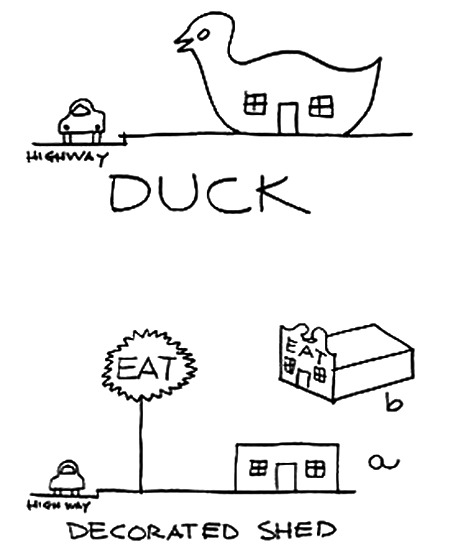
Out of his work in Las Vegas came the notable comparison between a “duck” and the “decorated shed.” See above. The duck is modernism. The building itself becomes the symbol. No ornament is needed.
The decorated shed, on the other hand, uses signage and other ornament to convey its symbolic qualities. The building itself can then be fairly nondescript, which also makes it flexible to a variety of different uses.
This decorated shed approach is what guided the firm’s work and in 1991 he was awarded the Pritzker Prize in Architecture.
I love that he tried to have the award go equally to his partner Denise Scott Brown. The jury declined his request but he still used “we”, instead of “I”, throughout the entirety of his acceptance speech. Good.
Thank you, Robert Venturi, for all of your contributions to architecture, as well as to the University of Pennsylvania.
As part of the Amazon HQ2 bid process, a number of cities produced videos. I only discovered them today and so maybe some of you also missed them when they were released last fall. There are videos from Detroit, Boston, Pittsburgh, Philadelphia, Dallas-Fort Worth, Las Vegas, Louisville, Atlanta, and maybe others that I am still missing.
Some of the videos are bad. (I’ll let you make your own judgement calls.) I like the idea behind Atlanta’s video, which is the journey of someone named Georgia physically delivering their bid to Seattle. And Philadelphia’s video made me feel really nostalgic about my time there. Those were some great years.
But my favorite video is Detroit’s video. It feels authentic. The footage is outstanding. And it feels powerful. Though it is probably too long. It was a good reminder that I’m overdue for a visit. So here is Detroit’s video. If you can’t see it below, click over to YouTube.
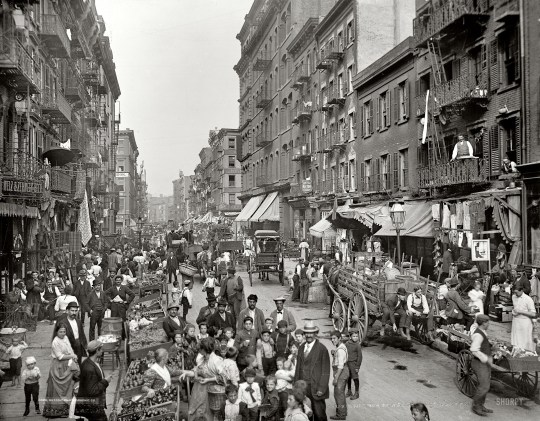
This morning I stumbled upon an old (2013) post from Rebel Metropolis that documents urban American life through street photos taken before the automobile.
Above is Little Italy, New York City, 1900. All of the photos in the post are from Shorpy.
The photos are beautiful architecturally and from a photography standpoint. But as is pointed out in the post, they also speak to a different kind of street:
What’s more, the street here is not purely the thoroughfare – it is the essential common gathering place for demonstrations, for buying and selling food, for children to play in, for celebration, for lingering and people watching.
That sounds like a great street. And now I am off to start my day. Because I have meetings all around the city today, I’ll be driving to the office.
City Observatory tracks something that they call “The Young and Restless.” It refers to the segment of the US population that is between 25-34 years old and has a bachelor’s degree or higher.
We know that people in this age bracket tend to be relatively mobile and that the likelihood of moving decreases as people age. So it’s a potential leading indicator for the city regions of the future. It also adds a bit more nuance to the urban vs. suburban growth debate.
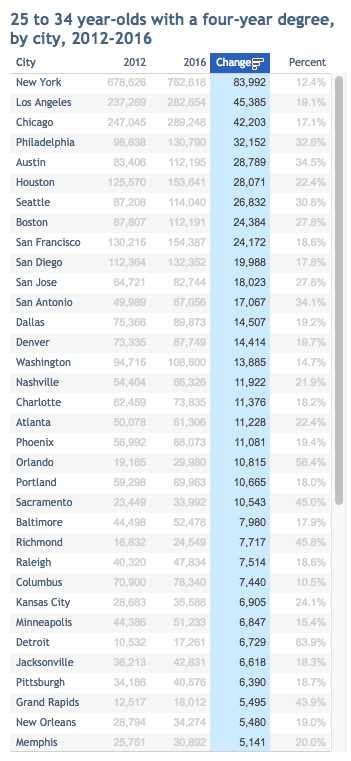
According to City Observatory, between 2012 and 2016 the number of 25 to 34 year olds with a 4-year degree living in one of the 53 largest largest cities in the US increased by 19%. This is compared to a 4% increase in the overall population in these cities.
This increase in young well-educated adults is also happening 50% faster in the largest cities. So the young and educated still seem to be demanding city living, even if the world is arguably still suburbanizing.
Below is a snapshot of City Observatory’s latest data. I’ve sorted the list by total change in population (2012 to 2016). Happy to see Philadelphia near the top. If you do it based on percentage, Detroit wins with a 64% increase.
The latest data from the American Community Survey (2012 to 2016) has placed the suburban and exurban share of the US population (53 major metropolitan areas) at 85.5%. Back in 2000 this number was thought to be around 83.5%.
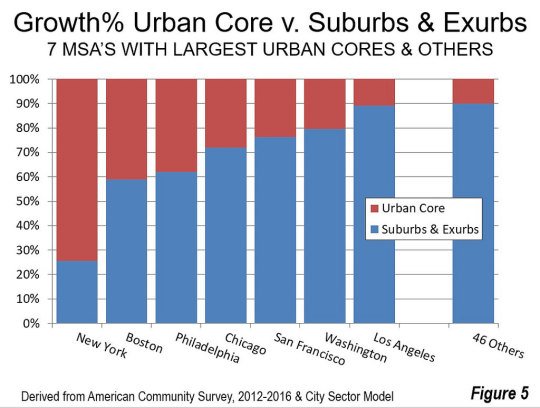
Since 2010, automobile oriented suburbs and exurbs have also accounted for 90.5% of population growth. The US – and Canada would be no different – is by and large a suburban nation. And the data suggests this isn’t about to change.
The one exception is the New York metro area. From 2012 to 2016, 74% of its growth happened in the urban core. No other major metropolitan area in the US comes close to this sort of urbanity. Below is a chart from New Geography that shows you how NYC compares.
All of the data for this post was also taken from New Geography.
When I lived in Philadelphia I survived on food truck food. My go-tos were an egg and cheese breakfast sandwich for $2.50, a bowl of spaghetti for $4.50, and a pretty substantial chicken burrito for somewhere around $5 or $6. The food was good. It was filling. And it was all priced perfectly for a poor student, which I was at the time.
I still remember when Renzo Piano came to the University to talk about potentially renovating the design school. Somebody stood up and asked if he had considered the placement of food trucks in his plans. Piano responded by saying: “I am Italian. Don’t worry. I will provide for the food.” This is how ingrained food trucks were and are in the culture of the city.
The other great thing about these food trucks is that they are a low-cost way of starting your own culinary business. Many were run by immigrants. And some of these “trucks” were so small that I used to have to duck in order to make my way to the concession window. There was nothing fancy about them. But they worked.
These days I don’t really eat at food trucks anymore. They are not as widespread here in Toronto as they are in Philly. I also find them expensive and the portions are usually so small that you have to order 2 or 3 things. They feel like the anti-food truck.
I appreciate that there’s a growing market for trendy and “gourmet.” But there’s value in low-cost options and in lowering the barriers to entry for aspiring food entrepreneurs. There are numerous examples of humble food trucks growing into full fledged restaurants. Let’s encourage more of that.
One of the small things that I liked about living in Philadelphia was the rational way in which street addresses tended to work.
Here’s an example.
Let’s say you wanted to go to Brooks Brothers in Center City and you discovered that the address was 1513 Walnut Street (which it is).
By looking at the first two numbers, you would immediately know that the store sits between 15th Street and 16th Street on Walnut.
If the address you were given was 1601 Walnut Street, you would know that your destination is now between 16th Street and 17th Street, but probably right at 16th.
You would also know that the numbered streets run north-south and the streets named after trees run east-west. (Of course, not all of the east-west streets are named after trees.)
No need to pull up the Google machine.
All of this stems from William Penn’s incredibly rational 17th century grid plan for the city – one of the first examples in North America.