Daily insights for city builders, delivered every morning at 6 AM ET. I’m Brandon Donnelly — a Toronto-based real estate developer and founder of Globizen. I’ve been writing here since 2013.

Tag: parking minimums

  • BC has proposed building more housing near transit

    These days, it is cool to be pro housing.

    Unaffordability has apparently gotten so bad that we are now seeing a groundswell of support for increasing overall housing supply. So politicians are doing things. And this week, the Province of British Columbia proposed some new legislation related to transit hubs.

    As proposed, the legislation will require BC municipalities to designate Transit Oriented Development Areas (TOD Areas), mandate minimum heights and densities within certain radii (broadly 800m in the case of rapid transit stations), and remove parking minimums.

    Not surprisingly, a lot of people are excited about this and, there’s no question, that this is directionally the right thing to do. But I have two immediate thoughts.

    The first is that the devil is always in the details. This all sounds good, but: Are the proposed minimum densities and heights going to be enough to stimulate development? For example, is 4 the right minimum FAR for 300m from a transit station?

    The second thought has to do with the level of excitement surrounding this announcement. (I’m going strictly based on Twitter, which admittedly could just be my bubble). The fact that city builders are so excited about this announcement tells us a lot about the current state of affairs.

    Because what this proposed legislation is more or less saying is the following: “Hey, here’s a great idea! Let’s build more housing around higher order transit and not force the market to build unnecessary parking.”

    Is this really something that should be considered novel? I thought this was just how cities should work.

  • Parking minimums are so last decade

    What is the case for having parking minimums? (i.e. Mandating a certain number of parking spaces in new developments.) I guess the argument is that if you don’t require developers to build it, they won’t build enough. And then people will not have parking and so they will be forced to park on the street somewhere. This might annoy the incumbent residents, who will in turn complain, and so it is best and safest to just to build a lot of parking.

    This is pretty much the only reason that I can think of for why a city might want to maintain parking minimums. Because, what’s the worst thing that could happen if you didn’t build enough parking? In the best case scenario, the developer builds fewer parking spaces and people are fine with it. This is ideal because it means people are getting around in other ways: walking, cycling, taking transit, and/or using car share. So it is the most sustainable outcome!

    A bad scenario would be that the developer builds too few parking spaces, nobody will rent the spaces, and then goes bankrupt. This would be very bad for the developer; however, it would be a lot less of a concern for the city. The developer is the one who screwed up. Too bad for them. So when I see new transit-adjacent developments — like this one here in Burnaby, BC with 14 levels of below-grade parking — one can’t help but think: WTF!

    To be clear, this is not a criticism of the developer. I don’t do that sort of thing on this blog. This is a criticism of parking minimums. They are so last decade. And I’m even being generous with this timeline.

  • Toronto’s elimination of most parking minimums is now official

    We knew it was coming. But it’s important and worth mentioning again. This week, Toronto City Council adopted new Zoning Bylaw Amendments that will remove most parking minimums across the city. We now join many other cities across North America who have done similar things in order to try and encourage more sustainable forms of mobility.

    If you’d like to take a spin through the draft amendments, you’ll find them linked here. I haven’t gone through them in detail, but I did do a word search for “maximum” given that this week’s adoption represents a pretty clear change in perspective. Here’s an excerpt from the staff recommendation report that speaks to what I’m talking about:

    Recognizing these challenges, this review of the parking standards in the city-wide
    Zoning By-law 569-2013 was guided by the principle that parking standards should
    allow only the maximum amount of automobile parking reasonably required for a given
    use and minimums should be avoided except where necessary to ensure equitable
    access. The previous review, which began in 2005, was guided by the principle that the
    zoning standards should require the minimum responsible amount of parking for a given
    land use. This is inconsistent with Official Plan policies which discourage auto
    dependence.

    One other thing I found in the documents that went to Council was this map of parking spot selling prices in active high-rise developments across the city. Not surprisingly, downtown and midtown are showing the highest prices per parking space. I can’t vouch for the accuracy of all of these dots, but it looks directionally right and I can tell you that at least one of them is correct.

    All of us in the industry know how much parking drives decision making. There’s a joke (half-joke) that when you’re designing a building, first you lay out the parking and then you design all of the residential suites around that structural grid. That’s not the way things should be done. The future of this city should not and cannot be centered around the car. This week’s adoption is in service of that.

  • Toronto to eliminate parking minimums

    For the last year or so the City of Toronto has been doing a review of parking requirements for new developments. This would include things like how much car and bike parking needs to be provided for each residential unit in a new building. More information on this work can be found here.

    City staff are now preparing to release their initial findings and, as I understand it, it is going to include the removal of most minimum parking standards across the city and the introduction of some maximum parking standards. What this should mean is that in most cases you can build as little parking as you want, but in some cases you’ll be stopped from building too much of it.

    There are lots of examples of other cities doing this. Buffalo is one example and I recently wrote (over here) about what happened to new developments once its minimums were eliminated. Among other things, it revealed where the previous parking requirements were overshooting what the market was actually demanding.

    Urban parking is heavily dilutive to new developments. It drives up the cost of new housing. It is also hypocritical to claim that we want to encourage alternative forms of mobility while at the same time mandating that we build a certain amount of car parking. Do we want people to drive or do we want people to do other things? Which is it?

    Some will bemoan this inevitable loss of parking (though it was already happening). But I think this is a great thing. It is Toronto growing up and continuing to realize that it’s pretty damn hard to build a big and well-functioning global city if everyone is driving around everywhere. Maybe one day we’ll even allow e-scooters.

  • What happens when you eliminate parking minimums? Lessons from Buffalo.

    Back in 2017, the City of Buffalo introduced something known as the “Green Code.” It was the first overhaul of its zoning code in over 60 years. I wrote about it here. One of most notable changes as part of the Green Code was the complete elimination of parking minimums. Which is another topic that has gotten a lot of air time on this blog.

    Now that it has been a few years, Buffalo provides an interesting case study: What do developers do once you eliminate parking minimums in a mid-sized city? I mention mid-sized because I think the size of the city is relevant here. There is a common argument that you can’t eliminate parking minimums unless you’re in a big and transit-rich city. “This isn’t [insert big city]. People drive here.” I am sure that many of you have heard this before.

    But is that really the case? Here is what Daniel Baldwin Hess & Jeffrey Rehler found when they studied the development response to removing parking minimums in Buffalo:

    • The study looked at 36 major developments in the first two years after parking minimums were eliminated
    • In aggregate, the 36 developments built 21% less parking spaces than what was previously mandated, likely demonstrating that the old zoning code was resulting in an excess supply of new parking
    • Mixed-used developments (of which there were 14, generally consisting of residential + retail) built 53% less parking than what was previously required
    • One exception to this trend is that single-use projects (both residential and commercial) built either the same or more parking (most of these projects were in the suburbs outside of the downtown core)

    What this suggests to me is that the previous zoning code was maybe appropriate for what the market was demanding (for parking) in suburban locations. Maybe. But it was certainly overshooting what the market was and is willing to accept in more urban locations in Buffalo. Mixed-used (i.e. being able to support retail at grade) is likely a good measure of the project’s urbanity.

    Perhaps more importantly, I think this study shows that developers are incentivized to build what the market wants — no more and no less. Building parking that nobody wants is bad business. As is building too little parking such that you can’t rent or sell your space(s). A Goldilocks parking ratio is what you’re after, but it is constantly changing and finding it can be a bit of an art. Eliminating parking minimums is a good way to let the market try and figure it out.

    Photo by Seth Yeanoplos on Unsplash

  • Thoughts on driving and parking

    Adrian Cook’s recent blog post about parking got me thinking about a few driving-related issues. Adrian points out that most condo buildings only allow owners to rent out their parking spots to people who already live in the building. But oftentimes, that’s not the customer. The people in the market for a downtown spot are the ones who commute into the city. And so what we are seeing in many downtowns is an oversupply of parking. Municipalities need to adjust their requirements.

    What I have found is that most, but not all, cities are now fairly flexible when it comes to urban parking requirements. They recognize the hypocrisy in trying to encourage alternative forms of mobility while at the same time mandating a certain number of parking spots. And so the driver is more typically the market. Empty nesters and families who buy larger suites — at least here in Toronto — still almost always want parking. And it’s a deal breaker for them. Sometimes they want 2 spots.

    Of course, there are also many instances where the location and unit mix of a project can support building absolutely no parking. There are lots of examples of the market excepting this, and so my view on parking is that there needs to be flexibility. Parking is typically a loss leader. The incentives are in place to build a hell of a lot less of it. But developers build it because they have to.

    Lastly, I find that discussions around car dependency tend to ignore that we have designed vast swaths of our cities to be positively inhospitable to people who aren’t driving. Adrian is right in that if you look at the modal splits for people who live in downtown Vancouver and downtown Toronto, you will find a lot less drivers. And that’s because the environment is much better suited to other forms of mobility. The solution starts with urban form.

    Photo by Claudio Schwarz | @purzlbaum on Unsplash

  • One year of Inclusionary Housing in Portland

    image

    About a year ago, Portland enacted “Inclusionary Housing” policy requiring new apartment buildings of 20 units or more to offer up a portion of the units at below market rents.

    Developers are able to select from a few different options and the rents are calculated according to a percentage of the city’s median family income (30-80%). I’m not sure how this policy would apply to new condo buildings.

    This is an interesting account by The Portland Mercury of what this policy may be doing to the housing market. I say may because it’s only been a year and there could be other factors at play.

    Between 2013 and 2017, Portland typically built between 3,000 and 6,000 new units per year. Since the IH policy went into effect on February 1, 2017, 682 new units have applied for permit. 

    About half are coming from one developer who appears to be building the requisite affordable units in exchange for no parking minimums. They are now proposing buildings with zero parking.

    Again, in all fairness, it’s only been a year. But already Mayor Ted Wheeler is looking at other incentives to encourage more new construction in the central city. The biggest levers: height and density.

    All of this begins to speak to the very real impact of inclusionary zoning on development feasibility.

    Photo by Zach Savinar on Unsplash

  • How will self-driving vehicles change our cities and our habits?

    Last night
    I had a dream that I was driving around in a snowstorm and, for whatever
    reason, my tires had almost no tread on them. So I was all over the road.
    Strange. I have no idea what this means, if anything at all.

    But it did
    remind me that I can absolutely imagine a time when the thought of driving your
    own car (outside of it being maybe a hobby) will seem positively archaic. I
    mean, think about how messy our current system is. Roads are a chaotic and
    oftentimes dangerous place.

    The more
    interesting question for me though is: how will self-driving vehicles change
    our cities, our habits, and so on? In Elon Musk’s recently published Master
    Plan (Part Deux)
    he outlines 4 main goals for Tesla:

    1. Create stunning solar roofs with
      seamlessly integrated battery storage
    2. Expand the electric vehicle product
      line to address all major segments
    3. Develop a self-driving capability
      that is 10X safer than manual via massive fleet learning
    4. Enable your car to make money for
      you when you aren’t using it

    Let’s think
    about what these could mean.

    One
    translates into decentralized energy generation and storage. Now all of a
    sudden the cars on our roads will be roaming around our cities collecting and
    storing energy, eventually returning home at the end of the day to power our homes.
    I can already imagine fleets of sun worshipping cars chasing the light as it
    moves across our cities.

    Two is recognition
    that self-driving vehicles are going to have a meaningful impact on traditional
    public transit. (Elon reveals that Tesla is working on high passenger-density
    urban transport.)

    Three
    addresses the chaotic current state and the massive potential of networked
    cars.

    Four is particularly
    interesting to me. I wonder to what extent this income will simply subsidize
    car ownership or if it could actually transform cars into an investment (rather
    than purely an expense). Will people end up buying self-driving vehicles in the
    same way that people buy real estate for yield?

    Furthermore,
    how does this notion of a shared vehicle pool now completely change the way we
    think about parking requirements. For instance, today we think about parking in
    terms of individual usage. This tenant requires/wants X amount of parking. All
    2-bedroom apartments require Y amount of parking.

    But if we’re
    now all sharing our vehicles, parking requirements would then be based on some
    broader and collective demand curve. Parking would become less individualistic
    and instead become more of a yard where self-driving vehicles come to store
    themselves when not in use.

    Once again,
    we reach a point where utilization rates go up for each vehicle and overall
    parking demand goes down. Good thing we’re getting rid of parking minimums.

    What else could
    you see happening?

  • We’re eliminating parking minimums

    I’ve been writing about the hypocrisy of parking minimums for years now. Some posts here, here, and here

    To me, it doesn’t make sense to try and promote more sustainable forms of urban mobility while at the same time mandating a minimum number of parking stalls in every new development. 

    Do you want people driving or not driving? Pick one.

    That’s why I was happy to see the following action item in the province of Ontario’s five year plan to transition to a low-carbon economy and fight climate change (thank you Ken Wilcox for bringing it to my attention):

    image

    I haven’t gone through the entire action plan and so this post is not a commentary on that. It is, however, a commentary on subsection 1.4. I believe it is the right thing to do and I’m stoked to see it in the plan.

  • The cost of parking minimums

    Access Magazine has a good piece on parking minimums and the cost they create for our cities. The article is by Donald Shoup, who is Professor of Urban Planning at UCLA. He is also the author of The High Cost of Free Parking.

    Here is his argument:

    “Minimum parking requirements create especially severe problems. In The High Cost of Free Parking, I argued that parking requirements subsidize cars, increase traffic congestion and carbon emissions, pollute the air and water, encourage sprawl, raise housing costs, degrade urban design, reduce walkability, damage the economy, and exclude poor people. To my knowledge, no city planner has argued that parking requirements do not have these harmful effects. Instead, a flood of recent research has shown they do have these effects. We are poisoning our cities with too much parking.”

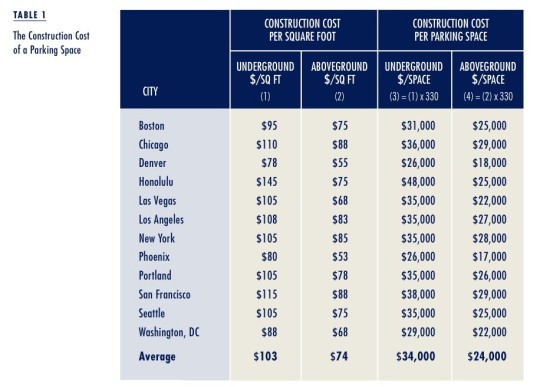
    And here’s his summary of what it costs to build a parking stall in various US cities (both underground and aboveground):

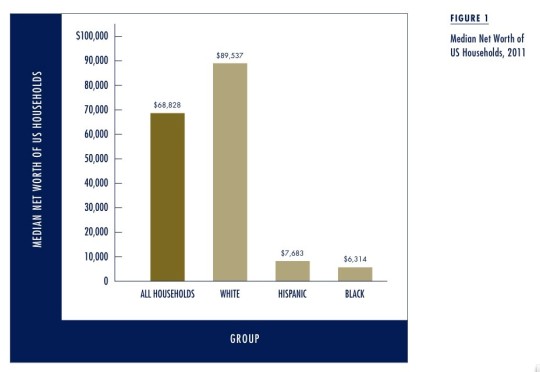
    To put these numbers into perspective, he also looks at the median net worth of US households (2011) to show just how expensive this parking is for some groups. 

    Because remember, these parking costs get embedded into the cost of housing, retail stores, and so on.