Daily insights for city builders, delivered every morning at 6 AM ET. I’m Brandon Donnelly — a Toronto-based real estate developer and founder of Globizen. I’ve been writing here since 2013.

Tag: parking minimums

  • What it takes to unlock infeasible development land (and some thoughts on parking)

    image

    One of the questions that came up after my recent post about land pricing was: what is it going to take to develop underutilized land on the outskirts of city centers?

    So today I thought I would talk about a new development project that was also discussed at the Land & Development conference I recently attended. I think will begin to answer this question.

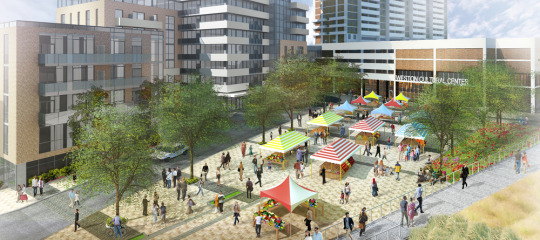
    The project today is known as the Rockport Weston Community Hub & Rental Building. And it’s going to include a community cultural hub, 26 live/work artist spaces, and 300 rental apartments. 

    It’s located in the Weston neighborhood of Toronto, which is designated as a “Neighborhood Improvement Area.” These are lower-income areas that the city considers to be “at-risk.”

    Given this, rents are naturally lower here than in other parts of the city, which means that it’s basically infeasible to develop here. There has been no large scale development in this community since the 1970s!

    To put some numbers to this, the developer said they were projecting rents somewhere around “two and a quarter.” So let’s assume for a second that the average apartment rents will be $2.25 per square foot. 

    At this rate, it means that a 600 square foot one-bedroom apartment will have a face rent of $1,350 per month. This may seem fairly high, but it almost certainly wouldn’t be enough to get a project like this off the ground under normal market conditions. At least, that’s the case here in Toronto with current cost structures.

    So what had to happen was a fairly complicated public-private partnership, which you can read all about here. But at a high level, there seems to have been 3 main economic factors that allowed this project to move forward:

    1) The developer was able to acquire the land for cents on the dollar. As I said in this post, land is expensive. So this helps a lot.

    2) The developer was able to make use of extra parking in an adjacent building. Assuming that underground parking could cost around $50,000 per stall, this is a huge cost savings.

    3) Lastly, the project is benefiting from the public invest made in the airport rail link that now quickly connects this site to both Pearson International and downtown Toronto.

    The moral of the story is that infeasible sites require some sort of subsidy or top up to make them work. Or, there needs to be an exceptional circumstance. Because if the rents aren’t there, nobody is going to build. It’s as simple as that.

    That said, here’s one idea…

    This discussion reminds me of a post I wrote a while back called, The hypocrisy of parking minimums. Frankly, I don’t understand why a city like Toronto still has parking minimums. If anything, we should have parking maximums.

    Underground parking is a huge cost that has to get carried by purchasers and renters in a new building. For example, let’s assume that 300 apartment suites would require 180 parking stalls (ratio = 0.6). Assuming $50,000 per stall, that’s a $9 million cost.

    So the second takeaway is that it’s probably time we took a good hard look at how we think about and plan for parking in our cities. Especially since the entire mobility space is being quickly disrupted.

    Image: Rockport
  • Will parking spaces in cities become more, or less, valuable in the future?

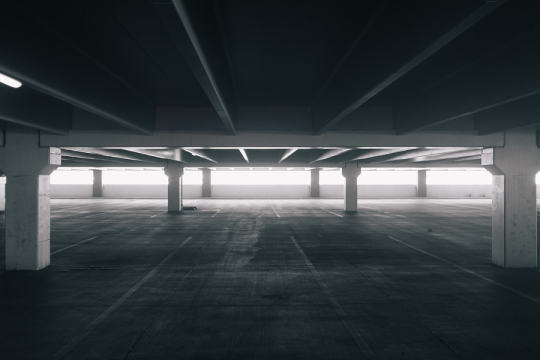
    Parking Garage by Nuno Silva on 500px.com

    https://500px.com/embed.js

    Lately I’ve been having discussions around the future value of parking spaces in urban centers. So yesterday I tweeted out this poll:

    //platform.twitter.com/widgets.js

    The sample size is very small, but for what it’s worth, there are some/many people who believe that urban parking spaces will become more valuable in the future.

    This is a reasonable assumption. 

    Over the last couple of decades here in Toronto, I would guess that parking ratios for new multi-family developments have probably fallen by more than half. It used to be that you had to build 1 to 1.5 parking stalls for each unit and now we seem to be sitting somewhere close to 0.5. Although, there are also exceptions and some projects today are getting built with no parking.

    So given that the supply side of urban parking spaces seems to be getting constrained and many cities are actively trying to encourage other forms of mobility, it’s not unreasonable to believe that parking stalls will only become more valuable. That’s why a new underground spot in Toronto might cost you $60,000 today and why some spots in New York can even fetch a $1 million

    But this assumes that the demand for parking will remain more or less the same. What if it doesn’t stay the same? What if we were to experience a tipping point that rearranged urban mobility? What if the cost of driving became so high that people stopped driving at scale? In these scenarios, the demand side of the equation would change.

    If you’re a regular of this blog, you probably know what I’m going to say next. But already I can think of two innovations that would contribute to the above scenarios: Uber and driverless cars.

    Uber’s goal is to continually drive down the cost of transportation and eventually get you to no longer own a car. They know very clearly that the demand for transportation services is highly elastic and that the cheaper they get the more you will use them. And the way they get cheaper is by continually increasing the utilization rate of their drivers/cars. An idle driver/car is the enemy.

    Of course, the other way to drive down fares is to remove the driver all together. And once you’ve done that, there is, in theory, no reason that a car should ever sit idle – like they do today. (The utilization rate for my car is around 2%.) And if a car is never sitting idle, then why would you ever need to park it? Certainly you wouldn’t need to park it as often as you do today.

    All of this isn’t going to happen tomorrow, but I believe – despite the supply constraints – that we are going to end up with excess parking spaces in our cities. And that will mean that they are going to be perceived as less valuable than they are today. I also believe that it will eventually seem silly to drive your own car. 

    What do you think?

  • We are all selfish bastards

    cyclist on bike lane by Axel Bueckert on 500px.com

    https://500px.com/embed.js

    We are all selfish bastards when it comes to sharing road space and public space.

    When we drive, we complain about pedestrians jumping out in front of us, crazy cyclists who get in our way, and under-utilized bike lanes that are taking away valuable driving space and creating traffic jams.

    When we take surface transit (such as buses and streetcars), we want all the cars out of the way so that we can move more efficiently. And we complain about drivers who don’t stop to let us off and on when the streetcar doors open. (Toronto specific reference.)

    When we cycle, we complain about cars parked in the bike lanes, people who don’t look before changing lanes or opening their car doors, and drivers who honk at you because they just want you off the road and onto the sidewalk.

    And when we walk, we complain about cyclists who ride on the sidewalk (they should be on the road!), cars that don’t stop to let us go, and slow walking groups who linearly block the entire sidewalk so you can’t pass.

    We are never happy. And we automatically assume that we could do it better. (I know I’m guilty of this.)

    But here are a few things to consider the next time you’re flipping the bird to someone on the streets. Here are a few things that we do know about urban mobility.

    There is an unprecedented number of condominiums in the development pipeline right now in Toronto. For argument’s sake, let’s assume 75,000 condominium suites – many of which will be built in central areas of the city.

    At a parking ratio of 0.6 stalls per unit, which isn’t an unreasonable assumption today, that’s 45,000 new parking spots and potentially 45,000 new cars in the city. 

    If you think that 45,000 new cars will be able to get fully absorbed into the core and somehow move around in an unfettered way, then I believe you are mistaken. 

    If you think that there’s something that can be done to magically expand road capacity to handle all of these additional cars in the city, then I believe you are mistaken.

    And if you think that adding a bike lane is the only reason you are currently stuck in traffic, then I believe you are missing the bigger picture.

    Over a decade ago, we made a decision in this region to encourage building up, instead of building out. And along with that decision came a necessary rethink of how we get around. That transition is what we are living through right now.

    The other thing we know is that the 4 modes of mobility that I started this post with are ordered from least sustainable to most sustainable. 

    Electric self-driving vehicles will reduce the impacts of driving, but it will also transform it into something that feels more like transit and less like the driving we know today. That will be a very good thing.

    But I’m not yet convinced that it will solve all of our problems. To do that I think we will need to adopt a much more balanced and unselfish view of what it takes to move around a city. That, of course, isn’t always easy.

  • The hypocrisy of parking minimums

    image

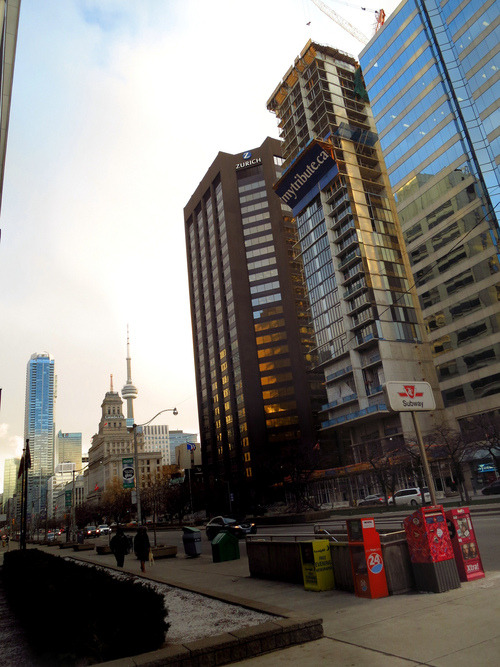
    Earlier today, Christopher Hume of the Toronto Star published a review of The Residences at RCMI building currently under construction on University Avenue. He gave the building a ‘B’ grade. 

    His main criticism was the faux facade that has been integrated into the base of the building:

    Then there’s the question of the historic 1907 building the RCMI occupied until recently. Though listed as a heritage site in 1973, the city approved its demolition. Planners also allowed the neo-classical front façade to be replaced with a replica that will fool no one, another example of the city talking out of both sides of its mouth.

    But faux facades aside, one of the things that makes this development project unique in Toronto is actually something that you can’t see from the outside: there’s no resident parking. Apparently there’s 9 spots for deliveries and other short-term uses, but for the 315 suites in the building there’s no parking.

    Depending on where in the world you’re from this may not seem like a big deal. I’ve written before about minimum and maximum parking requirements, and how some cities – such as Berlin – don’t have them. But here in Toronto, we do. And the city generally takes them very seriously.

    “To assume a residential development of the project’s scale might be totally car-free runs counter to expert study and experience,” municipal staffers argued. “Although there are many households in the downtown without cars, it would be highly unlikely to find 315 of them permanently concentrated in one building.”

    The fact planners were dead wrong is a shocking sign of a department either out of touch or that doesn’t believe its own hype.

    In so many ways – as Hume pointed out in his article – this is complete hypocrisy. We’re always talking about building walkable communities and encouraging alternate forms of mobility, but when it comes time to build anything new, we force a certain number of parking spots to be included. And so we end up encouraging the exact opposite.

    This also has a significant impact on the way we build our cities. Parking minimums can actually render smaller sites “undevelopable” simply because there isn’t enough room to lay out the required parking. In fact, it might surprise you how much of what we do ends up being governed by cars, parking, and traffic.

    That’s why I think this image is so impactful:

    //platform.twitter.com/widgets.js

    But I’m certain that a lot of this will change as Toronto continues to grow. Progressive cities all around the world are rethinking their positions on parking, and on cars in general.

    Earlier this year Sao Paulo joined the club and got rid of parking minimums for sites along major transit corridors. And they actually imposed a parking maximum: 1 spot per residence. The expectation is that this will reduce traffic and improve housing affordability.

    Parking minimums may not seem like a big deal, but the reality is that their impacts are far reaching. They change development patterns, they change project economics, and they send a message about the kind of city you hope to build.

    Image: Looking south on University Avenue in Toronto (Flickr)

  • Revisiting Charlotte

    image

    Earlier this week, I wrote about the Charlotte Apartments in Berlin and tried to back into some of the numbers for the project. I wanted to compare the economics behind a mid-rise project in Berlin to one in Toronto.

    After I wrote that post I forwarded it to Michels Architecture – who are the architects behind the project. I thought they might be interested in reading about my (crappy) back of the napkin type of assessment and I was also hoping that they might be able to shed some additional light on the details.

    Well, they responded and graciously offered to do exactly that. So today I thought I would write a follow-up post with some additional details. I obviously don’t have everything – because they weren’t the developer for the project – but I still think you’ll find the information I got interesting.

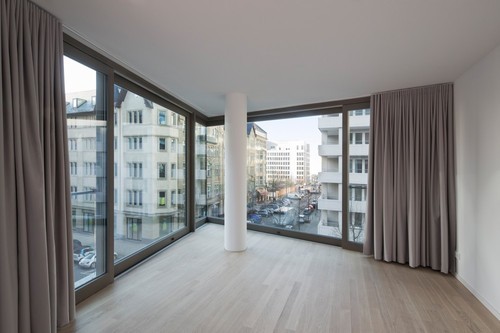
    The building has a total of 3 parking spots and they’re all on the ground floor (you can see them in this post in the second photo towards the right). They were for the penthouse maisonette/duplex units. This means that there’s only one level below grade and it’s basically for mechanical systems, storage, and waste disposal. So why does this matter?

    It matters because it means lower construction costs and the ability to develop smaller sites where you may not be able to properly layout a parking garage without car elevators and other clever strategies. This is possible because, unlike Toronto, Berlin doesn’t have any parking minimums or maximums

    With respect to unit sizes, the penthouse units are 135 square meters or 1,453 square feet which, according to the architect, are small. From the 2nd to 6th floor, there are 4 units per floor and the sizes are 37 sm / 398 sf, 65 sm / 699 sf, 68 sm / 732 sf, and 81 sm / 872 sf. On the ground floor there are 5 units and they’re at 34 sm / 366 sf (x 2), 42 sm / 452 sf, 45 sm / 484 sf, and 76 sm / 818 sf. I would say that this is comparable to what you might find in a downtown Toronto condo project. Side note: Apparently the smallest units sold the quickest.

    As of December 2011, the average sale price was 4,120 € per square meter. At today’s exchange rate, that would convert to $5,815 per square meter or $540 per square foot (in Canadian dollars). If we translate that into 2014 dollars, that’s about $575 per square foot, which would be low for prime locations/buildings in Toronto.

    A big thanks to Michels Architecture for providing this additional information. It’s always great to get local insights. I hope you all enjoyed it – happy Friday.

    Images: Werner Huthmacher

  • Is it time to get rid of parking minimums?

    The cost of a parking spot in downtown Toronto has reached as high as $60,000 (per stall) in some new construction projects. If you convert that to a per square foot price (which is typically how people measure condo prices), you’re looking at over $350 per square foot for that parking stall. Is it worth it?

    Most cities around the world have what is called a parking minimum. This means that to build, say a new residential condo, developers need to provide a certain number of parking stalls. In Toronto, those minimums will depend on your unit mix. Bigger units have more stringent parking requirements. 

    In some cities, though it’s much rarer, they actually have parking maximums. Portland, for instance, has a maximum number of parking stalls that you’re allowed to build, which fluctuates based on the development’s proximity to transit.

    And finally, there are some cities, such as Berlin, with no parking minimums or maximums at all. In those cases, the market dictates the number of parking stalls that should be built. If people want a parking spot with their apartment and won’t buy or rent it without one, then the developer builds it.

    Though parking variances do happen in Toronto (for reasons such as proximity to transit), the city is generally skeptical of a market led approach to parking requirements. And there are a couple of reasons for that. They worry that investors might be buying the units (with no parking) and so the sales data may not be indicative of the end-user market.

    The city also worries that developers might actively discourage purchasers from buying parking spots, as it’s usually more profitable not to build them. Underground parking is costly and often subsidized by the sale of the condo units themselves. In fact, I’ve heard of instances where underground parking has cost upwards of $100,000 per stall because of buoyancy forces and other technical details.

    But I’m generally a free market guy. So I question if the market really isn’t capable of figuring out how much parking there truly needs to be. Undoubtedly, there will be families who demand 2 parking spots. I also bought a parking spot with my condo. But there may also be a number of people who would rather pay less for their home than subsidize a parking garage that they’ll rarely use.

    And as I wrote in a recent post called, Is traffic the right question?, we could be losing sight of the greater goal. If we truly want to build a sustainable and livable city, then we should be considering how our development activity encourages transit usage over driving, and how we can promote a more balanced modal split across the city.

    What are your thoughts? Would you buy a home without parking? Should we get rid of parking minimums, just as cities like Berlin have?