Daily insights for city builders, delivered every morning at 6 AM ET. I’m Brandon Donnelly — a Toronto-based real estate developer and founder of Globizen. I’ve been writing here since 2013.

Tag: office

  • Checking in on office utilization in Toronto

    Let’s check in on office utilization (in Toronto). The last time we talked about this was in April. At that time, the average weekly utilization figure was 63%. The peak day — Wednesday — was 73%. And the low day — Friday — was 40%. Today, well as of September 15, these numbers are now 69%, 79%, and 39%, respectively (see above chart). So we continue to climb. The only slight downward trend is Fridays. People don’t like coming into the office on Fridays. Still, the average is up 6% over the span of about 6 months. This makes you continue to wonder: When does this level off? I also don’t know what this index looked like before 2020. Are we back, or not yet?

  • “Offices are over”

    This is an interesting article from Brookings that talks about the “myths of converting offices into housing.” What I especially like about the article is that it’s nuanced, and it directly addresses many of the myths that currently surround offices. The first one is that “offices are over.”

    Regular readers of this blog will know that I don’t agree with this. And the article provides some good data points to support this:

    • Office utilization may be below pre-pandemic levels in many cities, but the data suggests that we have not yet hit a plateau. Utilization rates continue to increase, albeit gradually. So if we are to be more precise here, it’s not that some people will never return to the office, it’s just that it’s taking longer than I think many people expected.
    • That said, this is not the case in all cities. Downtown Salt Lake City, as we have talked about before, is the busiest it has ever been. Similarly, ridership on the Utah Transit Authority network is up 26% from pre-pandemic levels.
    • Europe is generally ahead of North America with utilization rates in the 70-90% range, according to JLL. And Asia is even further ahead with rates in the 80-110% range. Meaning that, similar to downtown Salt Lake City, there are (many?) cities in Asia where more people are in the office today compared to in 2019.

    So I would not be so quick to claim that “offices are over.”

    For the full article, click here.

  • Out of office

    I have been fortunate to be able to travel a fair bit this year. But the vast majority of that travel has been me working remotely. In my mind, that means a few things: (1) I remain committed to staying on top of and clearing out my inbox each day; (2) I still take all meetings as if I were 100% in the office (which is my preferred way to work); and (3) I don’t put on an out-of-office reply. That’s the signal that you should expect a response. Today, however, is not one of those days. I just finished putting on my out-of-office reply and that is me capitulating against the looming email torrent.

    On past vacations I have done things like turn this blog into more of a photoblog. I will probably do a bit of that, but my plan this time around is to concoct some combination of a photoblog, travel blog, and foreign city building blog. Travel is a great way to learn from other cities, and I will endeavor to share some of what I find in France and Sicily. (Sicily is in Italy, but not really, right?) Some of you seem to get a little grouchy when I stray from our regularly scheduled programming on this free and personal blog. So if this doesn’t sound all that appealing, you may want to check back in October.

  • Remote work & innovation

    Here are two interesting studies that explore the relationship between remote work (distributed teams) and innovation:

    1. This one explores how distributed teams have impacted “disruptive scientific discoveries” from 1961 to 2020. To measure this they look at scientific discoveries that end up becoming widely cited, which they take to mean that the work has supplanted an existing body of knowledge. Here they find that distributed work is inversely correlated with disruptive innovation. It is fine for incremental improvements, but it is less than ideal for new foundational ideas. That said, they do note that new technologies — stuff like Zoom — have started to minimize the innovation gap by helping people communicate as if they were co-located.
    2. But stuff like Zoom isn’t perfect. The second study looks at the impact of virtual communication on idea generation. And what they find is that videoconferencing is bad for that, largely because it focuses people on a screen and “prompts a narrower cognitive focus.” So if your job involves coming up with new ideas, Zoom may not be the best forum for that. But you probably already knew that.
  • Workplace occupancy-sensor company raises $125 million funding round

    Density, which is a company that provides occupancy-tracking sensors, announced this week that it has just completed a $125 million funding round at a ~$1 billion valuation. This is their Series D. Official announcements, here and here.

    On a practical level, the company provides workplace space analytics. They offer sensors that allow companies to anonymously measure how people are using their offices.

    How long people are at their desks for (possibly weird), which conference rooms are most used, where people socialize, and so on. With the idea being that if you measure it, you can then optimize it. It’s about how to best use your real estate.

    But their overarching mission is “to measure and improve out footprint on the world.” Their ambitions seem to go beyond just office space. It’s about how we occupy our cities, and using analytics to more efficiently design and build them going forward. And that’s pretty interesting.

    I’m not intimately familiar with the company, but I thought I would share the news with all of you in case you’d also like to check them out.

  • Apartment rents in San Francisco have yet to fully recover

    On last week’s earnings call, apartment landlord Equity Residential mentioned that the two US markets most impacted by a delayed return to office appear to be San Francisco and Seattle. They went on to say that San Francisco is the only market in which they operate where rents have not fully recovered to pre-pandemic levels.

    According to Bloomberg (which is relying on employee swipe-card data), office utilization in the San Francisco area is sitting at around 25% as of October 20, 2021. This is compared to a national average of around 37%. The obvious rationale here is that large tech companies have delayed their return to office and/or been more aggressive in adopting remote/hybrid work.

    Looking at these numbers, it is clear that as someone who has been going into the office every day since the start of summer, I am currently in the minority.

  • Returning to an office-centric culture

    Earlier this week, Amazon announced that it plans to return to an “office-centric culture” as its baseline. Its rationale was that being in an office allows the company to better “invent, collaborate, and learn together.” All of this was laid out in an announcement that was distributed to its teams globally. On the other end of the spectrum, Twitter continues to double down on working from home. The company, which is currently hiring, is even trying to target talent that may be disgruntled by the fact that their current company is planning for them to return to the office. Two very different approaches. So which one is right?

    This is, of course, a great debate right now and the right answer probably depends on a myriad of different factors, some of which are likely specific to the company. Dror Poleg has been trying to think through this problem with something he calls the talent equation (because it’s all about talent). It works like this: level of in-person interaction x overall size of talent pool = innovation and financial success. The basis behind this equation is pretty simple. In-person interaction is great for business. This much we know. But you also need the right talent interacting. Allowing remote work is one way of expanding the size of your talent pool. But again, you do this at the expense of in-person interaction.

    In-person interaction is what makes cities the great organisms that they are. And I believe firmly in this side of the equation over the long-term. Even right now I find that when I go into the office, my call and Zoom volumes go down dramatically and I have more time to think, collaborate, and do, you know, actual work. This is because many interactions don’t require a Zoom meeting when you’re in the office. You stop by someone’s desk. You ask a thing (usually pretty quickly). And then you go off and action that thing. But I also acknowledge that for some companies, access to the right talent — and lots of it — may be a real challenge, particularly in smaller cities.

    Like Amazon, I am a supporter of office-centric work cultures. But I do think that Poleg’s talent equation is a useful way to think about this debate right now.

    Photo by Shridhar Gupta on Unsplash

  • We’re all going back to offices — most of us anyway

    I was speaking with a writer from the Globe & Mail today about the future of office. We were half talking about a new AAA strata office building — called Capital Point — that we (Slate) are in the midst of launching in the Metrotown neighborhood of Burnaby, BC. And we were half talking about whether or not we’re all going to return to offices.

    This is one of the great debates of the pandemic but, as I mentioned in my 2021 predictions post, I think it’s overblown. The longer I work from home and spend my entire day on video calls (only to start actual work in the evening), the more I become convinced that this is a suboptimal arrangement for productivity, collaboration, personal motivation, employee morale, and talent retention (among many other things).

    We have complete conviction around great offices in the right locations. That’s why Amazon and whoever else continue to build. They’re rightly looking past this period of dislocation (12-24 months of suck). Again, this is not to say that there won’t be some changes and that certain pre-existing trends haven’t been accelerated, because they have been. But I believe that humans will continue to cluster for work.

    In fact, it’s hard to disentangle cities and offices. Cities are labor markets. It’s where agglomeration economies take hold and where people come to improve their socioeconomic standing in the world (as well as meet people and have fun). To say that we no longer need to come together in person for work is to say, in a way, that we no longer need cities. We can all decentralize.

    That is not a bet that I am prepared to make.

    For more information about Capital Point and to register for the project, click here.

  • Tech and the North American office market

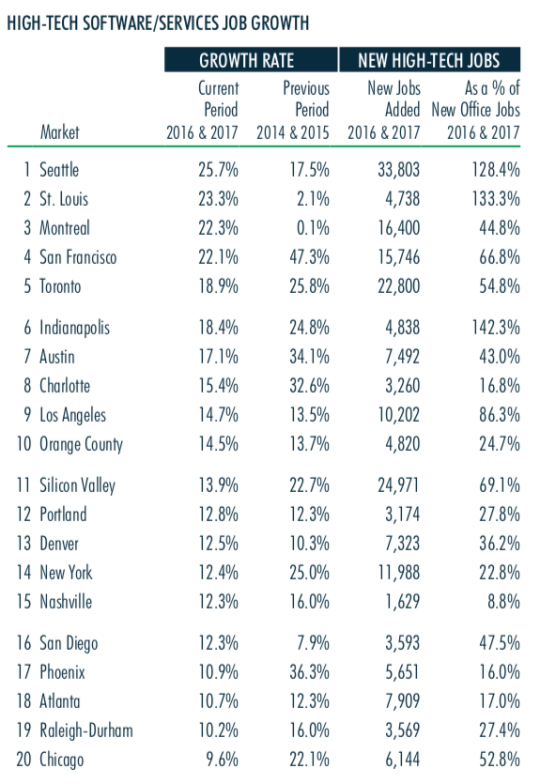
    CBRE recently published this report looking at the impact of the “high-tech software/services industry” on the North American office market. 

    Here are a few highlights:

    – Since 2010, tech has created ~1.1 million jobs in the US at an annual growth rate that is 3x the national average.

    – Seattle currently has the fastest tech job growth in North America. This is the first time in 7 years that San Francisco hasn’t been at the top of their list.

    – Silicon Valley, Toronto, New York, and Los Angeles all added more than 10,000 tech jobs from 2016 to 2017.

    – The biggest “momentum markets”, relying on 2016 and 2017 data, are Montreal, St. Louis, and Seattle.

    – Over the past two years (Q2-2016 to Q2-2018), Atlanta, Los Angeles, Orange County, Seattle, and Portland have all seen double-digit rent growth.

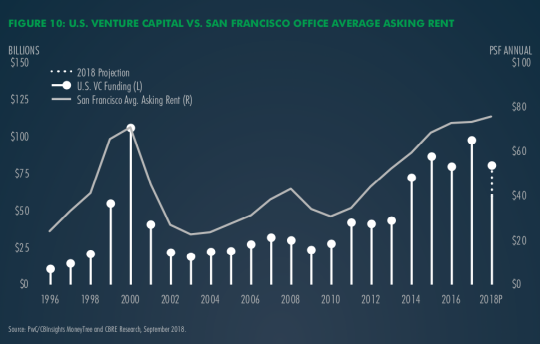
    One figure that also stood out for me was this one here showing the relationship between US venture capital investment and the average asking rent for office space in San Francisco.

    If you’d like to download the full report, click here. You’ll need to sign up for an account with CBRE, but it’s free to do that.

  • New Squarespace HQ

    I am a big fan of the company Squarespace. They have a great and beautiful product. I use them for globizen.com.

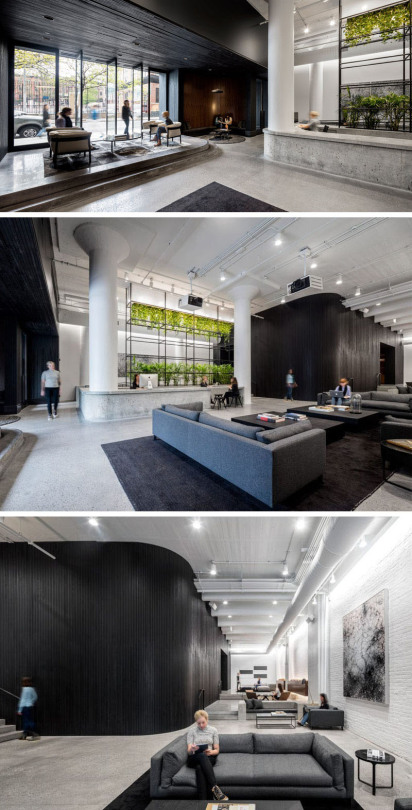
    Recently they moved into a new office in Lower Manhattan (98,000 sf), which was a consolidation of 4 distributed offices. The interiors were designed by New York-based A+I.

    Not surprisingly, it’s a beautiful space:

    image

    (Photography by Magda Biernat via Contemporist)

    But two other things stood out for me. 

    One: The amount of informal working/meeting spaces. I really had to look for the conventional office seating.

    Two: The ground floor presence and the lobby which doubles as a possible event space.

    For consumer-facing companies, I am really attracted to having a street presence and having spaces that can be programmed. It’s a way to engage and plug in to what’s happening beyond the office. Here’s a related example.

    I’m not sure if their narrative is the same as mine, but regardless: cool space.