Daily insights for city builders, delivered every morning at 6 AM ET. I’m Brandon Donnelly — a Toronto-based real estate developer and founder of Globizen. I’ve been writing here since 2013.

Tag: NIMBY

  • A mismatch of expectations

    Seth Godin’s blog post this morning, called “I hate this restaurant,” is really excellent. I would encourage you all to read it. In it, he talks about a mismatch of expectations. More specifically, he gives the example of somebody going to a restaurant and not liking what’s on offer, and therefore being upset. It’s not that the food was bad or that the restaurant has failed, it’s just that the person didn’t get what they were expecting. There’s a mismatch. And this, of course, happens all over the place and not just in restaurants. In his view, this failure is caused by a few different factors that ultimately result in us — the people that are involved in everything from the arts to business — having to make a decision about the kind of operation we would like to run. Below is an excerpt of those things. For the full post, click here.

    This failure comes from a few contributing factors, all amplified by our culture:

    First, you can’t know if you’re going to like an experience until you experience it. All you know is your understanding of what was on offer. And because there are so many choices and there’s so much noise, we rarely take the time to actually read the label, or we get carried away by the coming attractions, or we just don’t care enough to pay attention until we’re already involved.

    [And marketers are complicit, because in the face of too much noise, they hype what’s on offer and overpromise…]

    Second, because many people are afraid. They’re afraid of the new and even more than that, afraid of change. Most people in our culture would like to be entertained not transformed, lectured at instead of learning.

    Third, the double-edged sword of giving everyone a microphone means that we’ve amplified the voices of dissent at the same time we’ve given people a chance to speak up about their desires. This means that mass culture is far more divisive than it ever was before, and it also means that bubbles of interest are more likely to be served.

    And so the fork in the road:

    You can either turn your operation into a cross between McDonald’s and Disney, selling the regular kind, pandering to the middle, putting everything in exactly the category they hoped for and challenging no expectations…

    Or you can do the incredibly hard work of transgressing genres, challenging expectations and seeking out the few people who want to experience something that matters, instead of something that’s merely safe.

  • The America we need

    The New York Times is running an opinion series right now called, The America We Need. It is all about how the US might emerge from this crisis “with a fair, resilient society.” This piece by Carol Galante covers many of the topics that we discuss on this blog. Carol is a former city planner and nonprofit housing developer. She is now the faculty director of the Terner Center for Housing Innovation at UC, Berkeley. Here are a couple of excerpts from her article that I think will resonate with many of you:

    There are two things we know: The U.S. economy will recover. And the recovery will start in and be strongest in the same cities that were thriving before the pandemic. Economies in places like Seattle, San Francisco, New York and Boston are driven by the innovation, technology and biotech sectors, which are proving to be remarkably resilient to the impacts of Covid-19.

    We have an obligation to ignore the short-term reactionary impulse to blame density for the spread of the coronavirus and instead use this opportunity to rethink the policies that impede the construction of new housing, at more price levels, in the places where housing is most needed.

    In my subsequent career as a nonprofit housing developer working in prosperous coastal California communities, I spent far too many nights in City Council meetings working to get apartment buildings for lower-income older people and families approved. Underlying the “density” battle was almost always a battle over who has access to the opportunities of a place and who doesn’t, cloaked in arguments about neighborhood character and traffic impacts.

  • How Japan increased its housing supply

    River Davis’ recent article in the Wall Street Journal about Tokyo’s generally flat home prices had me, again, wondering about demographics. I mean, aren’t their demographics working in reverse? They have an aging population, low immigration, and a low birthrate. But Tokyo, which represents about 11% of Japan’s total population, is still growing. And their home price index looks like this compared to San Francisco and New York:

    Davis’ argument, which of course has been made by others before, is that deregulation has allowed housing supply to actually keep up with demand. Land use policies were relaxed to allow taller and denser buildings to be built and some degree of decision making (I’m not sure how much) was moved to the central government in order to counteract the NIMBY problem that invariably attaches itself to local politics.

    The result is housing numbers that look and compare like this:

    In Tokyo last year, housing starts came in around 145,000, according to Japan’s land ministry. This figure is on par with the total number of new housing units authorized last year in New York, Los Angeles, Boston and Houston combined, based on the U.S. Census Bureau data. The same feat was achieved in 2017.

    If we are to normalize against New York, it looks like this:

    And the belief seems to be that it is working:

    “A reason why housing prices in Japan are not rising as fast as in New York, for example, is the large number of housing starts,” says Masahiro Kobayashi, a director general at the Japan Housing Finance Agency, a state-run entity which supports the housing market by purchasing home loans.

    One sentence that really stood out for me in the article is this one here: “Private consultants were given permission to issue building permits to speed up construction.” If any of you have tried to pull a building permit for a large project in Toronto, you’ll know that it can take a very long time (understatement). Maybe it is the same in your city. Should we be looking at this?

    Charts: WSJ

  • The real reason people oppose new development

    image

    A good friend of mine just sent me this fascinating research paper called: Opposition to Development or Opposition to Developers? Survey Evidence from Los Angeles County on Attitudes towards New Housing. It is a study out of UCLA that was published earlier this year by Paavo Monkkonen and Michael Manville.

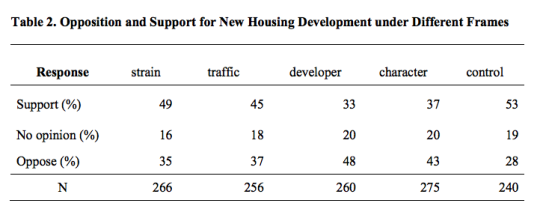
    For the paper, they conducted a survey-framing experiment with over 1,300 people in Los Angeles County to test how strongly they felt about a number of common anti-housing sentiments; arguments such as traffic congestion, neighborhood character, and strain on local services. 

    However, they also introduced another argument: large developer profits. And interestingly enough, they discovered that respondents were 20 percentage points more likely to oppose a new hypothetical housing development when the survey was framed around the developer making a lot of money.

    Here is a table from the paper showing the various frames, as well as the percentage of people who supported, had no opinion, and who opposed. Note that under the “developer” frame, the opposition number is 48%.

    image

    So their “takeaway for practice” is as follows: “Housing opposition is often framed as a form of risk aversion. Our findings, however, suggest that at least some opposition to housing might be motivated not by residents’ fears of their own losses, but resentment of others’ gains.”

    Photo by Cameron Stow on Unsplash

  • Supply-side toolkit for greater housing affordability

    image

    McKinsey Global Institute just published a “supply-side toolkit” for cities struggling with housing affordability. This seems to be every successful city.

    The article includes a long list of potential tools. Some of them you may agree with. And others you may disagree with. But I am sure that many of them will be familiar to you. One of the tools in the toolkit is accessory dwelling units.

    Of course, the overarching theme is that housing supply has not and is not keeping pace with housing demand:

    California, for instance, added 544,000 households but only 467,000 net housing units from 2009 to 2014. Its cumulative housing shortfall has expanded to two million units.

    Another one of the tools in the toolkit is “overcoming NIMBYism.” Here is an excerpt:

    People who come to a city to work need to be able to find an affordable place to live there. But the voices of existing homeowners who want to preserve the status quo often drown out those of newcomers, young adults, low-income service workers, and renters who need more housing. After a 2009 audit found that neighborhood councils were not representative of the city’s broader population, Seattle replaced these bodies with a central Community Involvement Commission that includes mayoral and council appointees chosen to represent a broader set of stakeholders.

    I am intrigued by Seattle’s move to create a central body and a new approach to public engagement – one that moves away from local district-councils. However, it appears that this Community Involvement Commission is still very much in its infancy.

    If any of you are familiar with the Seattle market, I would be curious to hear your thoughts on it in the comment section below. I am, however, going to spend some time reading up on it.

    For the full toolkit, click here.

    Photo by Sarah Brink on Unsplash

  • Frontier city

    Opposition to new development is nothing new in this city. In fact, it’s the norm in almost all cities, regardless of how big or small the project might be.

    But the battle happening right now in Toronto with respect to the proposed 8 storey condominium project at 321 Davenport Road is certainly taking things to the next level. All over 16 units.

    Some of the most recognized names in this city have their hat in the ring and virtually every media outlet has covered the topic. See here, here, here, and here, for a small taste.

    Just this evening I saw that Shawn Micallef (yes camp) had sent a copy of his recent book to Margaret Atwood (no camp) in the hopes that she would read it and better appreciate why it behooves our neighborhoods to move past this “village mentality.”

    If you haven’t yet read it, it’s called Frontier City: Toronto on the Verge of Greatness. I’ve just moved it to the top of my reading pile. I hope more folks do the same.

  • Solutions to NIMBYism

    Earlier today Richard Florida published a piece in CityLab called: Anatomy of a NIMBY. The article cites a recent paper by Paavo Monkkonen (of UCLA) that focuses on the relationship between NIMBYism and housing affordability – a much talked about subject these days.

    More specifically, the paper identifies “four different strains of NIMBYism” and then offers up some possible solutions, which include things like a more inclusive process and better data. I’ve publicly supported these kinds of approaches on this blog many times before.

    But in addition to the above, I wanted to point out two other ideas from the paper and Florida’s article.

    The first is about shifting land use decisions up to the regional level, and maybe even the state level. This one is particularly timely given that there’s a lot of discussion in Toronto right now about shifting land use decisions in the exact opposite direction – from province (OMB) to city.

    The second is a suggestion from Yale professor David Schleicher that he refers to as “tax increment local transfers.” Essentially, the idea is to somehow allow current residents to participate in the future tax revenues generated from new development in their neighborhood.

    There’s lots of interesting reading buried in the above links.

  • Positivity at a public meeting

    I’ve been reading the blog 5 Kids 1 Condo for, I think, about a year now. It’s written by Adrian Crook who is a single dad of 5 kids, living in a 2 bedroom condo in downtown Vancouver. And his blog is about just that.

    A few days ago he posted a video of himself speaking at a public meeting in support of a new purpose-built rental building at 18th and Commercial Drive in Vancouver. The proposal includes 110 secured market rental units; 37% of which will be 2 or 3 bedroom apartments. (More information on the project, here.)

    It’s rare to see people come out in support of a project at a public meeting. Usually people only show up when they’re grouchy and upset. So today I’d like to share his speech (click here if you can’t see the video below).

    [youtube https://www.youtube.com/watch?v=q-ENWu__HdM?rel=0&w=560&h=315]

    I’m curious to know what was shouted right at the beginning after he said that he was in favor of the proposal. I listened a few times but couldn’t figure it out. 

    In any event, Adrian’s speech touches on a number of important points that transcend this specific development proposal and that are relevant to many of the topics that we discuss here on this blog.

  • Why pessimism sounds so smart

    Tom Gardner and Morgan Housel (The Motley Fool) recently published a LinkedIn article called, Why Does Pessimism Sound So Smart? (Especially When Things Are So Good.)

    Here is the gist of it:

    If you say the world has been getting better you may get away with being called naïve and insensitive. If you say the world is going to go on getting better, you are considered embarrassingly mad. If, on the other hand, you say catastrophe is imminent, you may expect a McArthur genius award or even the Nobel Peace Prize.

    Part of the reason for this is that we, as humans, respond more strongly to losses:

    There’s clearly more at stake with pessimism. Daniel Kahneman won the Nobel Prize for showing that people respond more strongly to loss than gain. It’s an evolutionary shield: “Organisms that treat threats as more urgent than opportunities have a better chance to survive and reproduce,” Kahneman once wrote.

    The behavioural economic theory being referred to above is called Prospect Theory. I wrote about this back in the fall of 2013 and made the argument that Prospect Theory might explain why NIMBYISM is so common in city building. 

    Change to our communities is perceived as risky. And in the face of these uncertain situations, we tend to place more emphasis on the potential losses (traffic, congestion, shadowing, and so on) rather than the potential gains (increased vibrancy, improved streetscape, creation of more housing, and so on). It’s human nature.

    Having said all this, I show up here every day and try to make this blog a positive place on the internet. Sure, I make suggestions about things I think we should do, but I generally focus on them as opportunities. Hopefully that comes through, because I’m a big fan of optimism.

  • NO TOWER on Commercial Drive

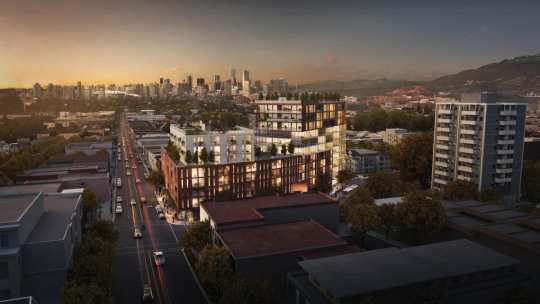
    For the past week or so I’ve been seeing the proposed Kettle Boffo Project in Vancouver make the rounds online. Here’s a rendering of the project, which is located at Commercial Drive and Venables Street:

    image

    The reason it has been making the rounds is that a community group called NO TOWER (written in all caps) has come out in fierce opposition of the 5 to 12-storey building. They have over 3,500 signatures.

    As an outsider looking in, this is surprising. The scale of the project seems appropriate. The height roughly matches the existing building shown above to the right. It may even be lower. And the project will provide somewhere around 30 social housing units, as well as additional space for the Kettle Friendship Society non-profit, who are currently on the site. (Note: An application to the city hasn’t yet been made.)

    What this has me thinking about is the push and pull between bottom-up and top-down planning. 

    When architect Bjarke Ingels talks about his Dryline project in New York, he likes to refer to it as the love child of Robert Moses (top-down planning) and Jane Jacobs (bottom-up planning). In the case of this project, it’s because it’s a large infrastructure project that they are trying to root into the local neighborhoods. Makes sense.

    But this same thinking could also apply to overall city building. Local communities rightly have their own wants. But at the same time, cities need to be thinking about the overall. The challenge is finding that right balance.

    I would be curious to hear your thoughts on the Kettle Boffo Project in the comment section below – especially if you’re from Vancouver.