Daily insights for city builders, delivered every morning at 6 AM ET. I’m Brandon Donnelly — a Toronto-based real estate developer and founder of Globizen. I’ve been writing here since 2013.

Tag: new york

  • Prime property appreciation around the world

    Every year for the last decade, Knight Frank has published something called The Wealth Report. I’ve written about it before, but it’s basically a look at “prime property” and global wealth.

    As part of the report, they have something called the PIRI 100. It’s their “Prime International Residential Index”, which looks at luxury residential property prices around the world. They generally define “prime property” as being the top 5% of each market according to value.

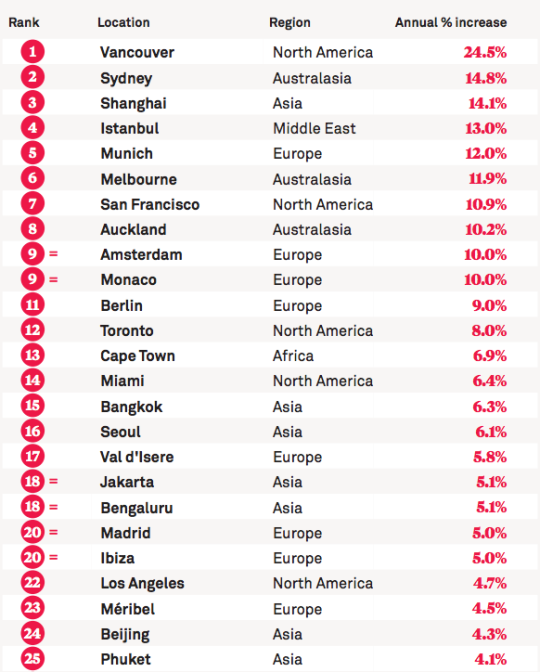
    This year, the top 25 locations in their PIRI 100 are as follows (for the most part, the data is up to December 2015):

    image

    Here in Canada, we like to talk about the insanity of the Vancouver and Toronto real estate markets. This list helps to put that into perspective. Even by global standards, Vancouver is at the top of the pack by quite a significant margin. 

    It’s worth noting that since this is a “prime property” index, it’s pretty safe to assume that the buyer profiles for these sorts of properties would have a significant international bias. So in a way, this list is really about global capital flows.

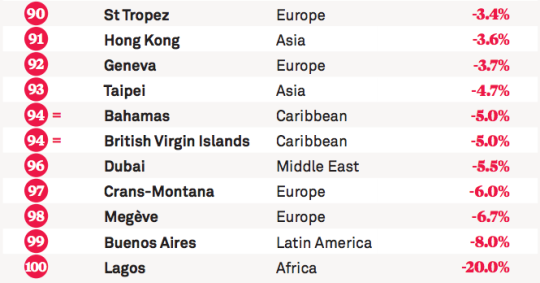
    Here are the bottom 10 locations on this year’s list:

    image

    If you’d like to see the full list, click here.

  • De Rotterdam…

    image

    “Manhattanism is the one urbanistic ideology that has fed, from its conception, on the splendors and miseries of the metropolitan condition – hyper-density – without once losing faith in it as the basis for a desirable modern culture. Manhattan’s architecture is a paradigm for the exploitation of congestion.” 

    Rem Koolhaas, Delirious New York, 1978

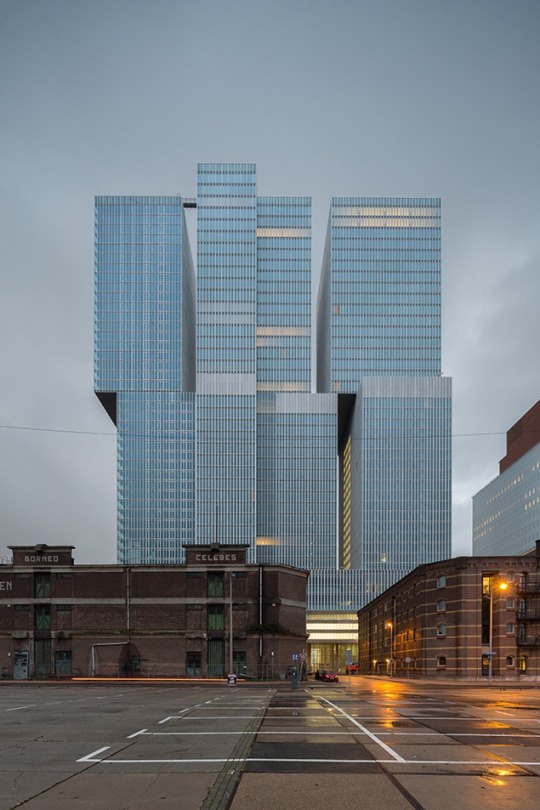
    Image: De Rotterdam by photographer Ossip Van Duivenbode via The Architectural Review

  • Happy 100th Birthday, Jane Jacobs

    “We came to Toronto,” she says, “because it’s a place where you can work, it’s a place where you can live well, it’s a place where there is hope.” –Jane Jacobs (1971)

    It was my birthday this week (May 2nd). But it was also the birthday of someone far more noteworthy. This past May 4th marks what would have been Jane Jacob’s 100th birthday. (She passed in Toronto in 2006.)

    In commemoration of this, Toronto Life published a photographic essay, along with a short piece by Joe Berridge. Joe is a partner at the urban design and planning firm Urban Strategies. He’s also a great storyteller.

    Here’s an excerpt:

    Jane didn’t do nice—Toronto’s default emotional setting. She was cantankerous and argumentative: once you got on the wrong side of her, that was that. About 20 years ago, when I was working as an urban planner, we were on a panel together at Boston College. I was making some remarks about city planning she clearly thought rubbish—and she just interrupted me. “Joe, Joe, Joe,” she said (her squawky Scranton, Pennsylvania, accent made it sound like “jaw, jaw, jaw”). “You’re tacking nansense.” The audience agreed. After I spoke, an incomprehensible social science professor took the stage. Jane wasn’t fond of academics—she didn’t think they knew much—but to make matters worse, he kept addressing her as Professor Jacobs. “Staap calling me prafessa,” she barked. “I barely graduated high school.” He and I both slunk offstage in shame, clutching our notes.

    Jacobs was certainly a force to be reckoned with. Without a doubt, she left her mark on this city, as well as others, like New York. And I believe that she is part of the reason why – almost 50 years after she first moved to Toronto – we remain a city where you can work, live well, and where there is hope. I like that simple characterization.

    If you’d like to read/see the full piece by Toronto Life, click here.

  • America needs a new map

    image

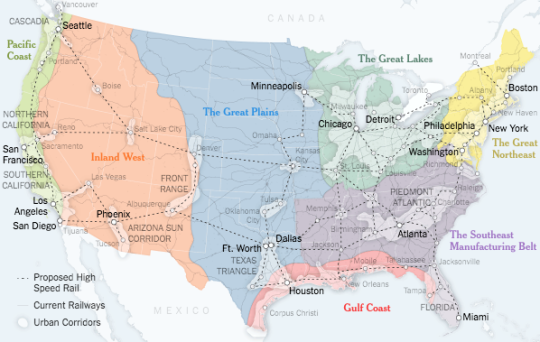
    Parag Khanna recently published an article in the New York Times calling for a new map for America

    Here’s why:

    “The problem is that while the economic reality goes one way, the 50-state model means that federal and state resources are concentrated in a state capital — often a small, isolated city itself — and allocated with little sense of the larger whole. Not only does this keep back our largest cities, but smaller American cities are increasingly cut off from the national agenda, destined to become low-cost immigrant and retirement colonies, or simply to be abandoned.”

    This is something that I’ve been writing about for awhile on this blog. As we continue to transition to an urban-based information economy, it strikes me that, here in North America, we’re going to need to refocus our governance structures around cities. We’re going to need to place our metropolitan regions at the fore if we want to continue competing with rising powers like China – which, by the way, seem to be adopting a megacity model.

    Here’s another snippet from the article:

    “While Detroit’s population has fallen below a million, the Detroit-Windsor region is the largest United States-Canada cross-border area, with nearly six million people (and one of the largest border populations in the world).

    Detroit’s destiny seems almost obvious if we are brave enough to build it: a midpoint of the Chicago-Toronto corridor in an emerging North American Union.”

    I’ve argued for this before and I continue to believe that it makes a lot of sense.

    Image: New York Times

  • The Social Life of Small Urban Spaces

    “It is difficult to design a space that will not attract people. What is remarkable is how often this has been accomplished.” -William Whyte

    In 1980, the sociologist and urbanist William Whyte published a revolutionary book called The Social Life of Small Urban Spaces

    The ambition was to discover why some urban plazas are successful and why many others fail. And to do that, he went out and studied urban plazas throughout New York using video and simple observation, such as head counting.

    His work has been hugely influential for architects, designers, and other urbanists. But if you think about how often we fail at creating urban spaces that actually attract people, I think it’s worthwhile revising what Whyte discovered way back in the 70s and 80s.

    Some of the principles – such as providing places to sit – are dead simple and intuitive. But again, a lot of urban spaces suck. So we’re clearly not doing it.

    The other thing I feel we often forget is that it’s not just the space itself that matters, it’s also the urban fabric around it. The Seagram Building in New York plays a central role in Whyte’s work as an example of a successful urban plaza. 

    But we can’t forget that Mies van der Rohe’s simple gesture of setting the tower back from the street is strengthened by the remaining urban fabric and the activity along Park Avenue. The plaza acts as a kind of release.

    Alongside the book, Whyte also published a 60 minute video. If you’ve never seen it, I highly recommend you watch it when you get a chance. Click here if you can’t see the video below.

    [youtube https://www.youtube.com/watch?v=MjxXTsHgc8g&w=420&h=315]

    To close out this post, I thought it would be fun if everyone shared their favorite public urban space in the comment section. It can be in your city or it could just be a place you’ve visited.

    To kick things off, I’m going to go with with a space that’s close to home: Berczy Park. It has lots of places to sit, including movable chairs. There’s a great water feature. And it’s well connected to the rest of the area and surrounding streets. I often sit there during lunch or when I just want to think.

    It’s also in the midst of a revitalization and I’m excited to see that come together.

  • A real estate dynasty without heirs

    Throughout history, real estate has been a tremendous source of wealth for a lot of people. Many family dynasties were created by accumulating property, holding it, and then riding the valuation wave.

    Here in Toronto, there was the Reichmann family. At one point they had created the largest real estate company in the world (Olympia & York). But I’m not sure exactly how much of that wealth remains today following the company’s bankruptcy in the early 90s. That was a tough time in Toronto real estate.

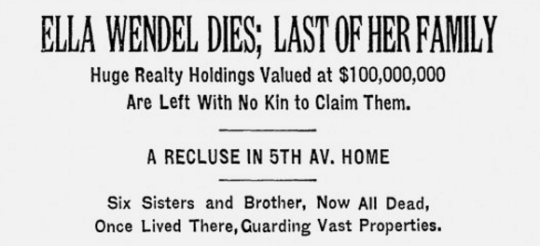
    In line with this, the NY Times recently published a fascinating account of the Wendel family in New York. In terms of how they conducted themselves, they were the polar opposite of some of today’s real estate families (i.e. Trump), but they certainly built an empire.

    Here are two snippets from the NY Times:

    In the early 20th century, the Wendels were perhaps the most powerful landlords in New York City, a dynasty with more than 150 properties in Manhattan worth over $1 billion in today’s dollars. The Wendels were the delight of the local papers, for, rich as they were, the family — six sisters and a brother, all unmarried — lived together in a shuttered mansion without electricity on the northwest corner of Fifth Avenue and 39th Street, and dressed in grim Victorian garb that had gone out of style half a century earlier. Tour buses regularly pulled up in front of “the House of Mystery.”

    Alongside their austere lives, they also practiced a strict and disciplined approach to investing: 

    Never mortgage a property; never sell anything; never pay for repairs; and never forget that Broadway moves uptown at a rate of 10 blocks a decade.

    In fact, they were so draconian in their approach, that the sisters were supposedly prohibited from marrying. Unions were not allowed because that, according to the NY Times, “would disperse the accumulated property and put it under other names than Wendel.”

    But in the end, this meant that the last Wendel – Ella, who died in 1931 – died alone and with no one to pass along the empire to. So instead it was distributed to various charities and the inevitable “cousins” that come out of the woodwork when a rich person passes.

    I guess the moral of the story here is the old saying that you have to “give to receive.” From the sounds of it, the Wendel family didn’t like to do that.

    Image from March 15, 1931 obituary

  • Population growth across North American cities

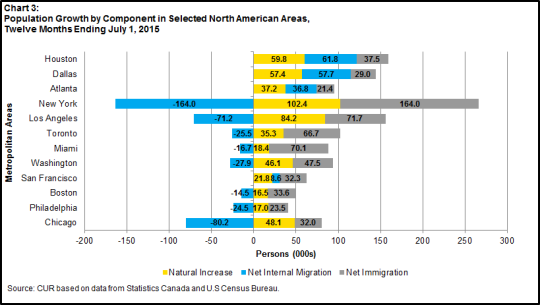
    The Centre for Urban Research and Land Development at Ryerson University recently published the following chart on their blog:

    It’s a look at population growth across a few North American cities, broken down according to natural increases, net internal migration from other parts of the respective country, and net immigration from outside of the respective country.

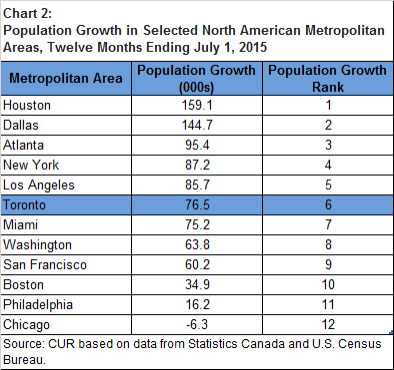
    When you sum up the pluses and minuses shown above, you get to population growth numbers that look like this:

    Houston, Dallas, and Atlanta are monsters in terms of population growth. They’re obviously smaller than New York and Los Angeles, and so on a percentage basis they are really adding a lot of people. Much of this has to do with the ease in which housing can be added in those cities and their relative affordability.

    Toronto is competitive with New York and Los Angeles in terms of an absolute number, but again our base is smaller so on a percentage basis we are growing faster. The big story with Toronto is our dependence on immigration to grow.

    The one city on this list that might surprise some of you is Chicago. Toronto and Chicago share many similarities and are often compared. But when you look at how the Chicago metropolitan area is shedding people, you see that, at least in this regard, it’s in structural decline.

  • BARF is fighting for more housing in San Francisco

    A new YIMBY activist group is starting to gain meaningful traction in San Francisco. They were recently featured in the New York Times and they have managed to secure the financial backing of people like Jeremy Stoppelman – co-founder and CEO of Yelp. 

    (All excerpts in this post were taken from the NY Times.)

    image

    The group is called SF BARF, which stands for SF Bay Area Renters’ Federation. The group, however, supports new development of all kinds. So I think the name is more driven by the fact that the founder, Sonja Trauss, wanted the acronym to be BARF. It speaks to their shit disturbing approach:

    “Her group consists of a 500-person mailing list and a few dozen hard-core members — most of them young professionals who work in the technology industry — who speak out at government meetings and protest against the protesters who fight new development. While only two years old, Ms. Trauss’s Renters’ Federation has blazed onto the political scene with youth and bombast and by employing guerrilla tactics that others are too polite to try. In January, for instance, she hired a lawyer to go around suing suburbs for not building enough.”

    The impetus for all of this, of course, is San Francisco’s lack of affordability and severe housing shortage. Housing supply is decades behind the city’s population and job growth. 

    Most people are directing the blame at the tech community for bidding up housing. But there’s clearly growing recognition that housing supply matters.

    As a real estate developer, my industry obviously benefits from fewer barriers to building. So let’s get that out there:

    “Ms. Trauss’s cause, more or less, is to make life easier for real estate developers by rolling back zoning regulations and environmental rules. Her opponents are a generally older group of progressives who worry that an influx of corporate techies is turning a city that nurtured the Beat Generation into a gilded resort for the rich.”

    But let’s also be clear that I don’t believe we should be developing roughshod over our cities. New development should respond to what’s already there and give back. 

    At the same time, housing supply matters a great deal. A big part of the reason that cities like San Francisco, New York and Vancouver are so expensive is that they’re naturally supply-constrained markets. Geographically, they are either peninsulas or islands.

    When you overlay tight land use restrictions, fierce community opposition and/or foreign investment on top of this geography, it should come as no surprise to anyone that demand is outstripping supply. 

    New supply won’t solve every problem, but I do agree that it is an important part of the solution.

  • 2 new ways to think about economic inequality

    We talk a lot about economic
    inequality these days. We worry, among other things, that our successful cities
    are becoming playgrounds for the rich and that housing is becoming increasingly
    unaffordable for the middle class.

    Without negating the
    importance of things such as attainable housing, I’d like to offer up two,
    potentially new, perspectives on economic inequality.

    The first is an
    essay by venture capitalist Paul Graham
    . In it, he rationally unpacks, as he always does, the phenomenon of economic inequality. One of his key points is the distinction between rent seeking degenerate economic inequality and the economic inequality caused by rapid value creation (i.e. Two Stanford students decide to create a new search engine called Google).

    “If the rich people in a society got that way by taking wealth from the poor, then you have the degenerate case of economic inequality where the cause of poverty is the same as the cause of wealth. But instances of inequality don’t have to be instances of the degenerate case. If one woodworker makes 5 chairs and another makes none, the second woodworker will have less money, but not because anyone took anything from him.”

    Of course, Paul Graham is thinking about this from the perspective of a venture capitalist that funds startups and helps entrepreneurs get rich. But what about the impacts to people who live in a city where the rich are far richer than the poor?

    That brings me to the second perspective.

    A recent study, published in The Journal of the American Medical Association and written about in the New York Times, has discovered a surprising relationship between income and life expectancy across the United States from 2001 to 2014.

    What they found was that cities with high economic inequality – such as New York and San Francisco – actually have lower inequality when it comes to life expectancy. 

    Here is a chart from the New York Times:
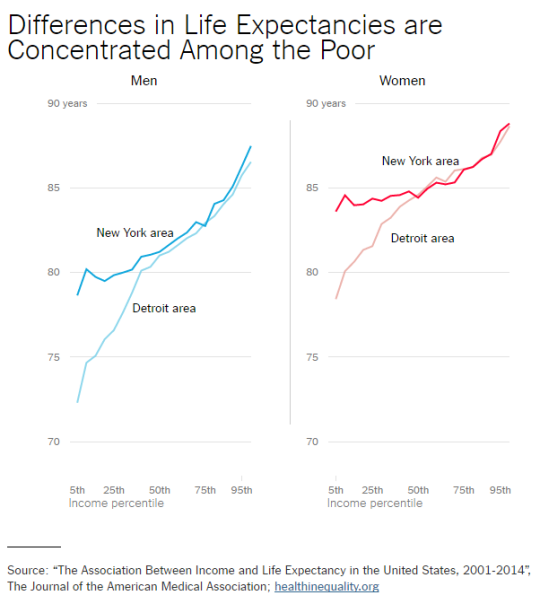
    And here is a chart from healthinequality.org:
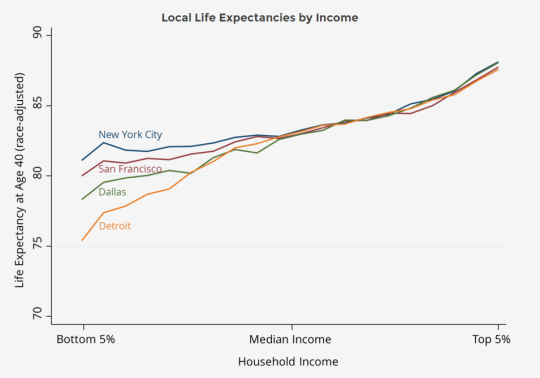
    If you’re rich, it doesn’t matter where you live. The life expectancy of a rich person in New York is roughly the same as a rich person in Detroit. (Though, as to be expected, women generally live longer than men.)

    However, as income levels fall, so does life expectancy. But it falls more in a city like Detroit than it does in New York. In fact, rich cities such as New York and San Francisco are almost model cities in this regard. Why is that?

    The biggest predictor appears to be health behaviors, such as smoking and obesity:

    “The research seems to suggest that living in proximity to the preferences — and tax base — of wealthy neighbors may help improve well-being. New York is not just a city of rich and poor, but also one of walkable sidewalks, a trans-fat ban and one of the most aggressive anti-tobacco agendas of any place in the United States.”

    So there you have it. Two, potentially new, ways to think about economic inequality.

  • WeWork launches first co-living space in New York

    I’ve written about co-living spaces before – here and probably elsewhere on this blog.

    Well this morning, WeWork (the co-working startup currently valued at a cool $16 billion) unveiled its inaugural co-living space on New York’s Wall Street. It’s called WeLive and Vanity Fair describes it as “Soho House meets Airbnb meets a tricked-out Restoration Hardware storeroom, but for the Slack Set.” 

    Got it?

    Ultimately, this location at 110 Wall Street will have 600 fully furnished WeLive apartments, but they’re coming online in tranches. This first release includes 200 units. Here’s a bit of information on pricing from Fast Company:

    “There are 200 units available—ranging from $1,375 per person in shared apartments to $2,000 for an individual studio—all with the option of either a month-by-month or yearly lease (a $125 monthly fee covers amenities). The apartments are about 450 square feet on average, with the largest units topping out at 1,000 square feet (one-bedroom apartments in the area, by comparison, range in prices from about $2,850 for 451 square feet to $3,500 for 700 square feet). Each apartment comes fully furnished, minimally decorated, and set up with cable and Internet at move-in.”

    But this is not just about price. The WeLive concept is about creating a strong sense of community within the building. Every floor, for instance, has some sort of common area to foster interaction – a space for yoga classes, a laundry room with a big pool table, and so on.

    I am interested in seeing how this concept pans out because I’ve had discussions before with people in the industry about how condos/apartments might be programmed to feel a bit more like hotels. Years ago, I even spoke to a major European company about trying to pioneer a model like this.

    Because there’s something very social about being in a hotel – something that I really like. You can walk down to the lobby bar by yourself and you never know who you might meet. That’s not really the case in many multi-family buildings.

    Now, part of that might have to do with the fact that people tend to be more open when they travel. But maybe WeLive can help create that kind of social interaction within the apartment building. I think that would be a positive thing.