Daily insights for city builders, delivered every morning at 6 AM ET. I’m Brandon Donnelly — a Toronto-based real estate developer and founder of Globizen. I’ve been writing here since 2013.

Tag: new york

  • Where the world’s billionaires live

    The Martin Prosperity Institute here in Toronto recently published an interesting report called The Geography of the Global Super-Rich.

    What they did was use the Forbes 2015 Billionaire List to chart billionaires and billionaire wealth by location and by industry. They also looked at the wealth gap in each location and whether the wealth was self-made or inherited.

    A correlation analysis was also done to see what key variables – such as population, density, economic output, global city standing, VC investment, and so on – were positively correlated with a greater concentration of super rich people.

    There are 1,826 billionaires across the world according to Forbes. The researchers were able to match 99% of them to a specific metro area / primary residence.

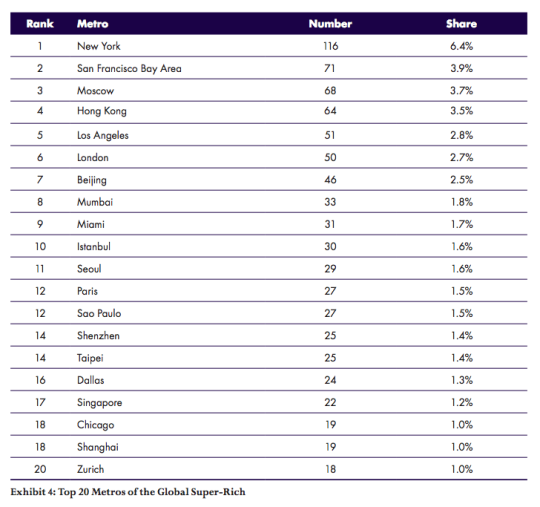
    Here are the top 20 metro areas in terms of the number of billionaires:

    image

    Look at Miami at #9. 

    I suspect that this may surprise some of you. But Miami has grown into a significant global city. As one of my friends from Miami likes to tell me: “The best thing about Miami is that it’s a Latin American city that’s so close to the United States.”

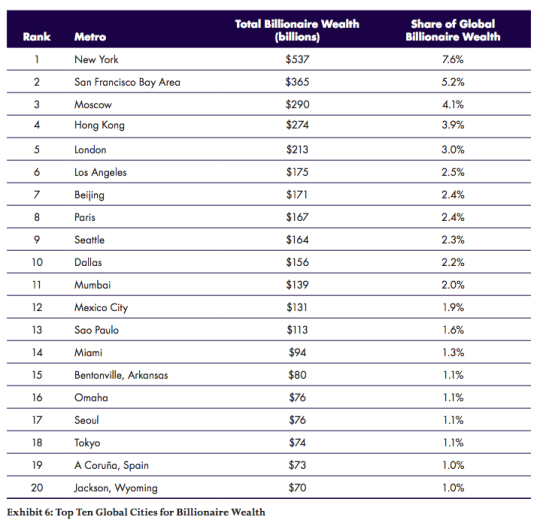
    Here are the top 20 metro areas in terms of total billionaire wealth: 

    image

    A bunch of changes on this list because of extremely wealthly people and families in places like Bentonville (Arkansas) and Omaha.

    One of the conclusions of the report is that the size of the city generally matters:

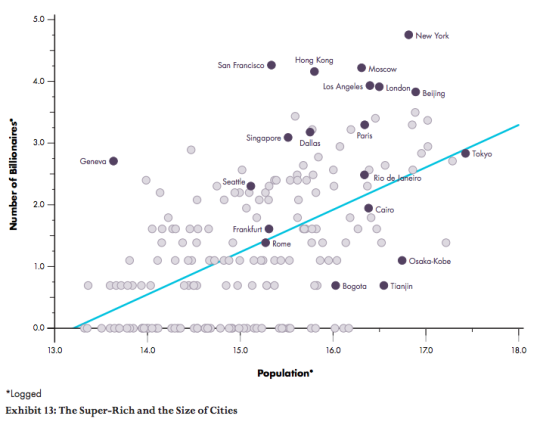
    “The geography of the super-rich is a function of larger cities. Both the number of billionaires and their net worth are positively associated with the population of global cities, with correlations of 0.56 for the number of billionaires and 0.44 to their net worth.”

    Here is a chart comparing population to the number of billionaires:

    image

    Cities such as New York, Moscow, and Hong kong, which sit far above the blue line, have more billionaires than their population size would predict.

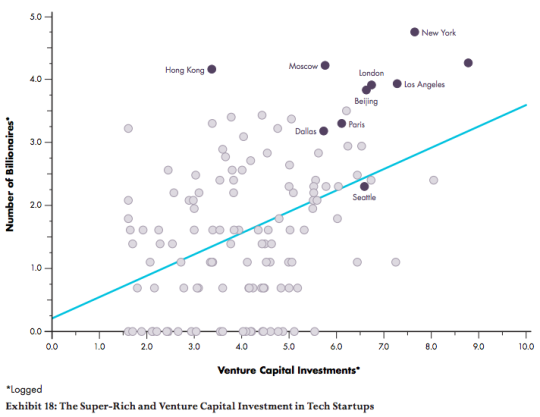
    Here is a similar chart comparing venture capital investment to the number of billionaires:

    image

    Once again, there is a positive association.

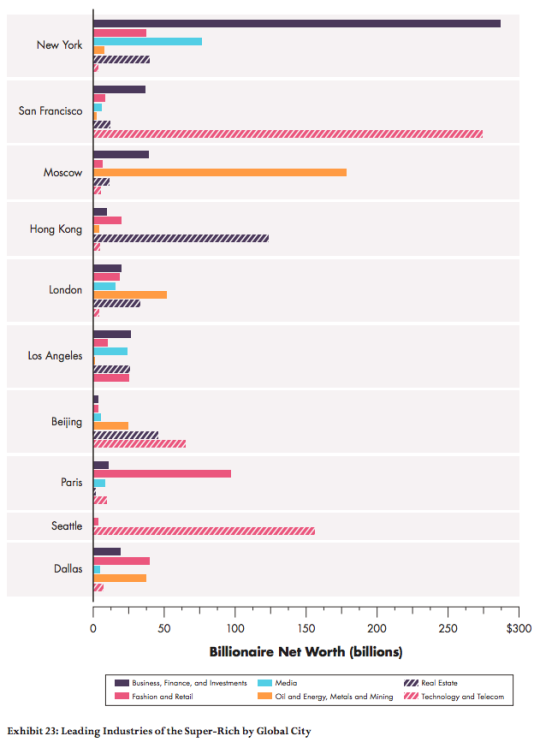
    Finally, here are a two charts that show which industries have produced the most billionaires:

    imageimage

    If you’re interested in this study, you can download the full report here. All of the charts were sourced from the report.

  • What I’m doing next

    image

    A number of you have asked if I’m moving to New York. I can see why that was inferred from some of my posts, but that was actually not my intention. I am not moving to New York. (Sorry New York friends. I’ll visit soon.)

    Toronto is home base. I hope it’s clear how much I love this city. Sure, I’m a big fan of New York and Miami and Vancouver and Berlin and Tokyo and Jackson (to name some of the places I have on my phone’s weather app), but I made a deliberate choice to station myself here.

    Because unlike some of the other industries I write about on this blog, city building is hyper local. What I do involves the built environment. And that doesn’t generally happen via a laptop on a beach in Bali (at least not for extended periods of time).

    It happens by being on the ground, interfacing with local communities, meeting face-to-face with the city, and poring over drawings with smart people who know far more about their respective disciplines than I ever will. It is a collaborative and local effort. It’s about getting into the details.

    And so to be successful in this business, I think it helps to find a home and take long bets. I’m not saying that I will never work on projects in other cities (I have and I would), but I am saying that I’m not moving to New York right now and that home remains Toronto.

    On that note, here’s what I have to tell you. Later this year I’ll be joining Slate Asset Management as VP of Development.

    A bit about Slate:

    Slate is one of the most active acquirers, owners, and managers of real estate in Canada right now. Founded in 2005 by two brothers (Blair and Brady), Slate has over $3 billion of assets under management across over 16 million square feet and over 130 properties.

    All of this is done through four main investment vehicles: 

    1) The first is Slate Advisors. It acts on behalf of and alongside private institutional investors — such as Greystone.

    2) The second is Slate Office REIT (TSE:SOT.UN). It is a pure play Canadian office REIT focused on downtown and suburban properties all across the country.

    3) The third is Slate Retail REIT (TSX:SRT.U). It is a pure play REIT entirely focused on grocery-anchored U.S. retail properties. (Remember how many times I’ve written on this blog about how grocery has one of the lowest online shopping penetrations?)

    4) And the fourth: Slate is also starting a grocery-anchored retail platform in Germany. It is similar to #3, except that it’s in Germany.

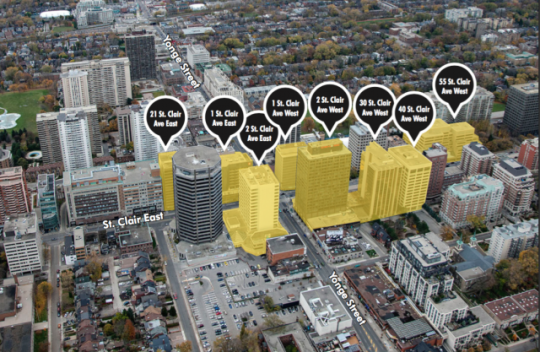
    Most recently, Slate has been in the news because of the position it has taken at Yonge + St Clair in midtown Toronto — a perfect example of “finding a home and taking long bets.” Slate, in partnership with Greystone, owns all 4 corners of the intersection and about 60% of the properties along the St. Clair corridor.

    Here’s a diagram of those Slate buildings:
    image

    In case you didn’t put two and two together, the 8-storey mural I wrote about two weeks ago is going up (right now) on the side of a Slate building (1 St Clair Avenue West — shown above). The British street artist known as Phlegm is doing it.

    Up until today, the focus of Slate has largely been on acquiring undervalued / overlooked real estate and creating value through re-leasing and overall repositioning. That will certainly continue. But given what I do, I am sure you can posit what’s also next.

    I’m genuinely excited to be joining such a talented group of real estate professionals. As I mentioned last week, I wasn’t in the market for anything new. I was heads down working on cool projects. But life happens. And Slate quickly demonstrated to me that the incredible success they have seen to date is precisely because of how progressive, nimble, and entrepreneurial they are.

    On that note, I have “one more thing” to share today.

    In parallel to all of this, and with the support of Slate, I am also starting a boutique city building company called Globizen. The name is derived from Global + Citizen.

    The objective is to build a company that embodies everything I write about on this blog. I want it to be lifestyle and design-driven. I want it to leverage technology to improve the way that cities and the building industry operate. And I want it to function as a vertically integrated real state + design firm, focused on sustainable urban infill development. Think of it as city building by and for the responsible global citizen.

    It’s still early days, but the thinking is that this new platform could compliment the larger Slate platform in some way. It’s too early to say how exactly, but everyone is open to having those discussions. And that’s what matters at this stage.

    I am going to end with a quote. It’s by Partner and Co-Founder, Blair Welch:

    “On all of our deals we have had people say ‘can’t’ to us. They say ‘Can’t be done, can’t do that, can’t raise money, etcetera.’ At Slate, we don’t do ‘can’t’ well.”

    I like that a lot. So here’s to finding a home, taking long bets, and not saying can’t. Onward my friends. 

  • Rinse and repeat

    image

    Venture capitalist Matt Turck has a post up on his blog that is packed full of information about the New York City tech ecosystem. (He has also written similar posts about Berlin and Paris.)

    His overall thesis is that New York – as a startup/tech hub – is only now starting to catch up to the hype of 4 or 5 years ago. He now refers to NYC as the de facto Number 2 after the Bay Area.

    If you’re interested in all of this, you can go read his full post. But I would like to pull out 2 points. The first is about the “rinse and repeat” cycle that happens over time that allows cities to become substantive startup hubs:

    As any student of emerging tech ecosystems knows, the key dynamic to success is the “rinse and repeat” cycle. You need several waves of successful tech companies to go through the whole cycle of founding, financing, scaling and significant exit.   Post-exit, the hope is that successful founders, employees and investors then contribute back both money and expertise to the next generation of tech startups, a few of which eventually become highly successful themselves and then provide money and expertise to the following generation.

    The trouble is, each successive cycle takes years, because the average successful startup takes 5 to 10 years to get to a large exit.

    One key reason the Silicon Valley has become such a powerful network is that this “rinse and repeat” cycle has been happening there for decades, at least since the 1940s and 1950s (Hewlett Packard), with a real acceleration in the 1970s and 1980s (Apple IPO, founding of Kleiner Perkins, etc).

    I’ve written about this idea before, but didn’t refer to it as “rinse and repeat.” I’m thinking about adopting that terminology going forward.

    The second is a list of New York-based startups. Matt uses it as an example of how entrepreneurial activity in New York is operating across a broad cross-section of different industries. That’s an important characteristic to identify.

    However, I also thought you might find it valuable to see what startups are out there, particularly if you happen to work in one of the below verticals/horizontals. I certainly went right to the real estate line.

    Fintech: Betterment, IEX, Fundera, Bond, Orchard, Bread
    Health: Oscar, Flatiron Health, ZocDoc, Hometeam, Recombine, Celmatix, BioDigital, ZipDrug
    Education: General Assembly, Schoology, Knewton, Skillshare, Flatiron School, Codecademy
    Real estate: WeWork, HighTower, VTS, Compass, Common, Reonomy
    Enterprise SaaS: InVision, NewsCred, Sprinklr, Namely, JustWorks, Greenhouse, Percolate, Mark43, Movable Ink
    Commerce infrastructure: Bluecore, Custora, Welcome Commerce
    Marketplaces: Kickstarter, Vroom, 1stdibs
    On Demand: Handy, Via, Managed by Q, Hello Alfred
    Food: Blue Apron, Plated, Maple
    IoT/Hardware: littleBits, Canary, Peloton, Shapeways, SOLS, Estimote, Dash, GoTenna, Raden, Ringly, Augury, Drone Racing League
    AR/VR/3D: Sketchfab, Floored

    I was happy to see my friends at Floored in the above list. They are under AR/VR/3D, but they service the real estate industry.

  • The most fascinatingly boring city in the world

    The Guardian Cities UK is currently focusing on all things Canada for a special week-long series. The first post is up and it’s about why Toronto is “the most fascinatingly boring city in the world.” The piece is by Stephen Marche.

    I don’t agree with everything in the essay – or maybe I just despise being called boring, steady, and predictable – but there are a number of great gems that I would like to reblog today. Here are the 5 that stood out for me.

    1. Chicago vs. Toronto:

    “What Chicago was to the 20th century, Toronto will be to the 21st. Chicago was the great city of industry; Toronto will be the great city of post-industry. Chicago is grit, top-quality butchers, glorious modernist buildings and government blight; Toronto is clean jobs and artisanal ice-creameries, identical condos, excellent public schools and free healthcare for all. Chicago is a decaying factory where Americans used to make stuff. Toronto is a new bank where the tellers can speak two dozen languages.”

    2. London vs. New York vs. Toronto Bankers:

    “In London and New York, the worst stereotype of a banker is somebody who enjoys cocaine, Claret and vast megalomaniac schemes. In Toronto, a banker handles teachers’ pension portfolios and spends weekends at the cottage.”

    3. Montreal vs. Toronto:

    “I was 19 when he said that, and I knew even then that for the rest of my life, Canada’s future would be built on money and immigrants. I wasn’t wrong. Most Canadian business headquarters had already taken the five-hour drive west. After 95, the rest followed. Montreal decided to become a French-Canadian city. Toronto decided to become a global city.”

    4. The last time Toronto built a white elephant subway line:

    “On any given morning on the Sheppard subway line in the north of the city, you can sit down in perfect peace and order, although you will find little evidence of good government. As the latest addition to Toronto’s fraying infrastructure, the Sheppard subway is largely untroubled by urban bustle. The stations possess the discreet majesty of abandoned cathedrals, designed for vastly more people than currently use them, like ruins that have never been inhabited. Meanwhile, in the overcrowded downtown lines, passengers are stacked up the stairs. The streetcars along a single main street, Spadina, carry more people on a daily basis than the whole of the Sheppard line, whose expenses run to roughly $10 a passenger, according to one estimate. A critic has suggested that sending cabs for everybody would be cheaper.”

    5. On Mayor Tory:

    “The current mayor, John Tory, is not an idiot, although he is hardly a figure of the “new Toronto”. He represents, more than any other conceivable human being, the antique white anglo-saxon protestant (Wasp) elite of Toronto, his father being one of the most important lawyers in the city’s history. The old Wasps had their virtues, it has to be said – it wasn’t all inedible cucumber sandwiches and not crying at funerals.”

  • Off to New York

    I’m packing and getting ready to leave for New York right now. I’ll be there for both Canada Day and Independence Day. My out of office message has been activated.

    I have a lot going on at the moment (which I’ll soon be able to share on this blog) and so I’m looking forward to getting out of the city and disconnecting a little. (I’ll, of course, still be blogging.) I’m generally not very good at down time. I like to keep busy and I like to work a lot. 

    But every now and then my body tells me that I should do otherwise. I also notice that I start getting decision fatigue. I am sure many of you probably feel this way as well. So I said no to a lot of things this week and I have very few things planned for New York. I’m content with that.

    A big city is probably not what comes to mind when many of you think of down time. But one of my favorite things to do is just wander around a city, look at buildings, and absorb it all. In some ways that feels like a luxury because most of the time I’m too busy rushing around. 

    But who knows, maybe I’ll end up on a beach somewhere. That’s the sort of thing that can happen when you don’t have much in the calendar. Either way, I’m off to New York for some rest and relaxation. Talk tomorrow.

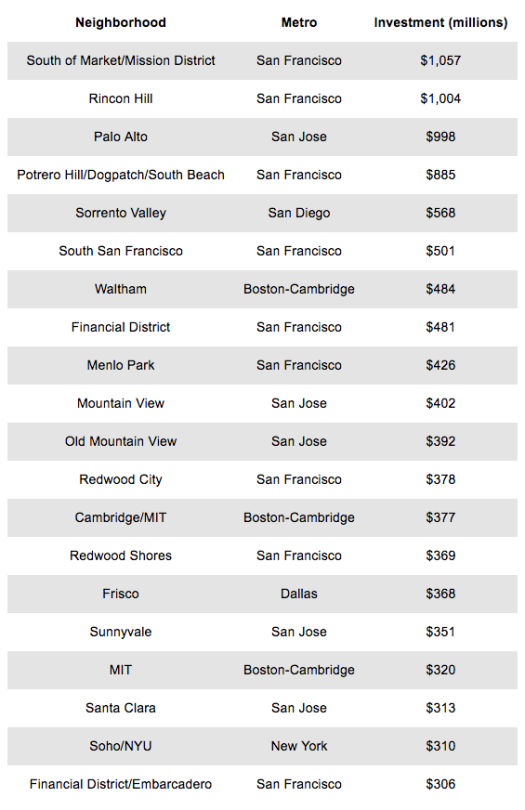
  • The top 20 US neighborhoods for venture capital investment

    There’s a lot of talk about how venture capital investment has shifted from the suburbs to cities and how it is also concentrated in certain metro areas. But a new report from the Martin Prosperity Institute has dug even deeper to look at the top 20 neighborhoods (zip codes) in the US for venture capital investment.

    Here’s a summary of what they found:

    “The top 20 neighborhoods or zip codes for venture investment include nine in San Francisco, five in San Jose, three in Boston-Cambridge (one in suburban Waltham and two in Cambridge close to MIT) and one each in San Diego (close to the University of California, San Diego), Dallas, and New York (close to New York University).”

    And here’s the full top 20 list:

    image

    Initially I looked at this list and thought that neighborhoods such as Menlo Park and Redwood City shouldn’t be labeled as San Francisco, since they are outside of the county. But technically they still fall within the San Francisco Metropolitan Area

    It’s amazing how San Francisco dominates this list.

  • Fluted glass curtain wall

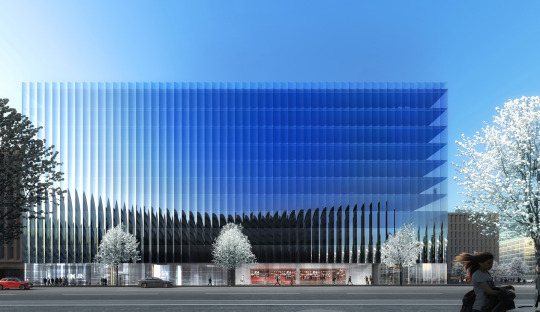
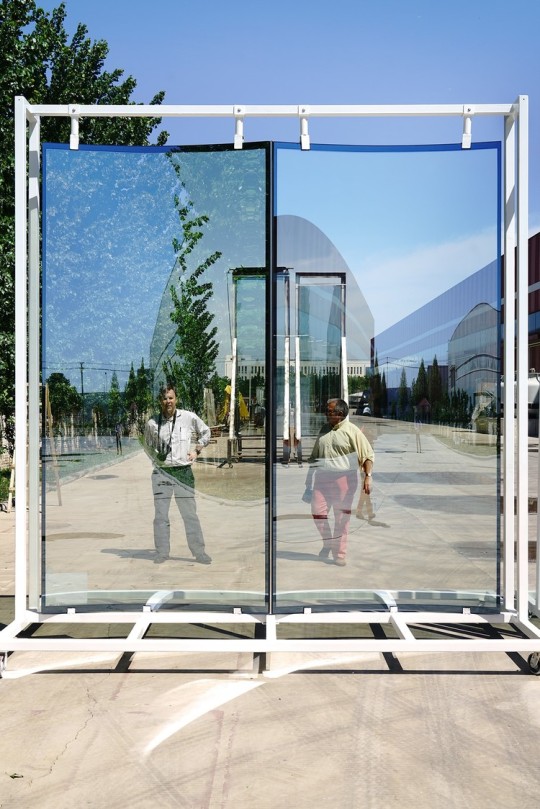
    New York architecture firm REX is working on a new office building in Washington DC that will incorporate a beautiful fluted glass facade. Here’s a rendering of what it is intended to look like:

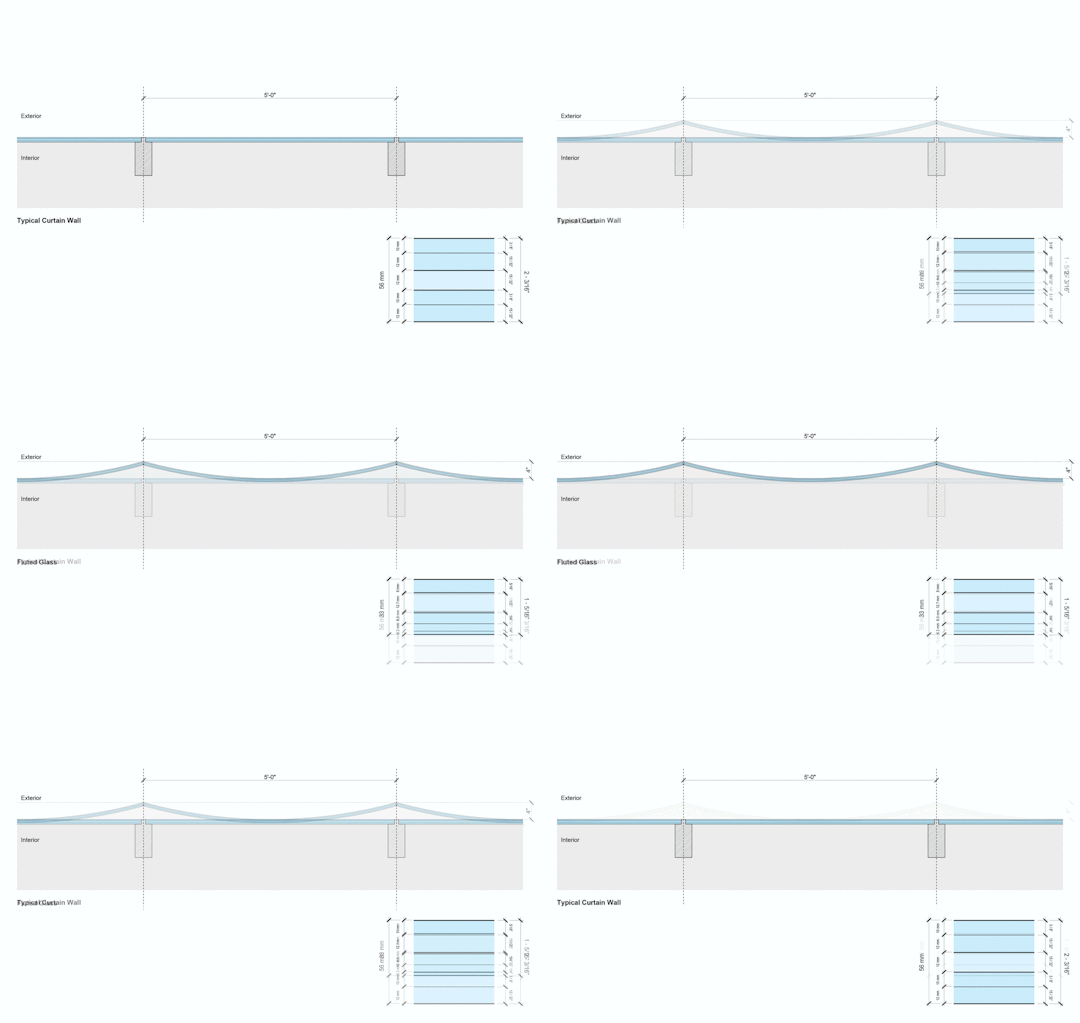
    Here’s what that looks like in plan (it’s a GIF that should show typical curtain wall vs. proposed fluted glass):

    Here’s a photo of the 1:1 mockup:

    And here’s a description from the architect:

    The façade’s approximately nine hundred identical, insulated-glass panels—3.2 m tall by 1.5 m wide (11’-6” tall by 5’-0” wide)—are subtly curved to a 2.9 m (9’-6”) radius through a heat roller tempering process. The curve yields structural efficiency, which meets wind load requirements and enables a thinner monolithic outer lite than normal, providing greater transparency. 

    Because of the curve’s inherent rigidity in compression, only the top and bottom edges of the panels are supported from the floor slabs, while the mullionless vertical edges are flush-glazed for a minimalist aesthetic that improves sight lines, while gaining usable floor area.

    They are working in collaboration with Front Inc., which if you haven’t heard of, you should check out. They are a design/engineering consultancy that specializes in facades and building envelopes. They work with many of the big name starchitects. The developer of the project is Tishman Speyer.

    It’s worth noting that part of the impetus for the fluted glass facade was to try and innovate within the confines of DC’s draconian zoning – which mandates that no building can be taller than 130 feet. Because of this, developers and architects are usually forced to build out to the allowable area, leaving little room for architectural variation. 

    But in this case, the fluted glass removed the need for thick mullions and also allowed them to extend out beyond the lot area by 4 inches every 5 feet (the curves are considered “architectural features”). So this move has created both architectural variation and more rentable area.

    It doesn’t appear that the building will have any operable windows, but other than that, I think it promises to be quite beautiful. What do you think?

    All images from REX.

  • The Storefront Index

    The folks over at City Observatory have recently developed something called The Storefront Index

    It is a mapping of “clustered” consumer-facing storefront businesses across the 51 largest cities in the United States and within a 3-mile radius of their CBD. (Their definition of cluster is that the business is located within 100m of another business.)

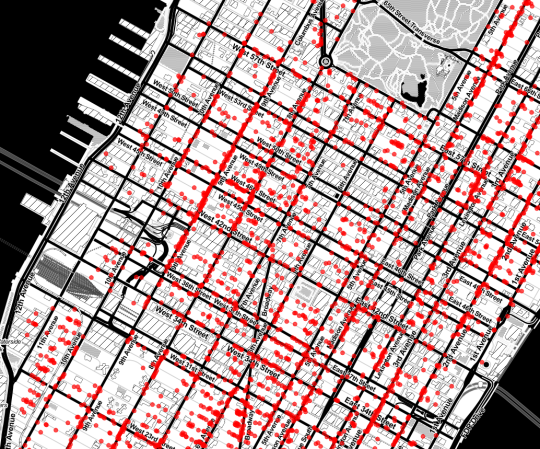
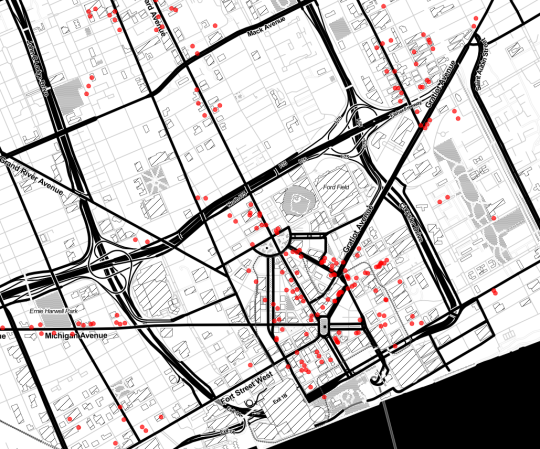
    At the top of this list is New York (no surprise here) with 9,905 storefronts and at the bottom of this list is Detroit (probably no surprise here either) with 411 storefronts. On average, they found that the “typical” city has about 900 storefronts within this 3-mile radius.

    Here’s a screenshot of New York:

    image

    And here’s a screenshot of Detroit:

    image

    They should be at the same scale.

    If you’d like to read their Storefront Index Report, you can do that here. And if you’d like to explore their interactive maps, you can do that here. City Observatory has made all of this available as a free tool for city builders – which is really great to see. (You can even download their shapefiles if you’re into that sort of thing.)

  • Empire and ego

    This morning I stumbled upon an old New York Times article from August 7, 1983 called: The Empire and Ego of Donald Trump.

    Here’s an excerpt you might find interesting:

    The essence of entrepreneurial capitalism, real estate is a business with a tradition of high-rolling megalomania, of master builders striving to erect monuments to their visions. It is also typically dynastic, with businesses being transmitted from fathers to sons and grandsons, and carried on by siblings. In New York, the names of Tishman, Lefrak, Rudin, Fisher, Zeckendorf come to mind.

    And now there is Trump, a name that has in the last few years become an internationally recognized symbol of New York City as mecca for the world’s super rich.

    “Not many sons have been able to escape their fathers,” said Donald Trump, the president of the Trump Organization, by way of interpreting his accomplishments. Three of them, built since 1976, stand out amidst the crowded midtown landscape: the 68- story Trump Tower, with its six-story Atrium housing some of the world’s most elegant stores; the 1,400- room Grand Hyatt Hotel, and Trump Plaza, a $125 million cooperative apartment. And more is on the way.

    “At 37, no one has done more than I in the last seven years,” Mr. Trump asserted.

    As I read this, 3 things came to mind.

    1) One could argue that, as real estate development institutionalizes, the megalomanic and dynastic nature of the business is being somewhat muted.

    2) I hope we are well beyond the point where a “dynasty” has to be transmitted only through men. We are, right?

    3) Trump sounded the same at 37.

  • Enemies of the High Line

    Despite not being the first example of infrastructural adaptive reuse, the High Line in New York has certainly kickstarted an urban trend. Cities all around the world now want their own “version of the High Line.”

    Philly is working on a new “rail park.” I toured the space last summer and it’s very similar to the High Line in terms of existing infrastructure. Rome and Toronto are both working on “under” spaces, which are beneath an old viaduct and elevated expressway, respectively. And the list goes on.

    But I think it’s worth remembering just how contentious the High Line was before it was built. For some people it was just an eyesore and a public safety hazard. Here’s a excerpt from a New York Times article dated 2002:

    “This is a terrific win for us,” said Michael Lefkowitz, a lawyer for Edison Properties, one of 19 businesses that own land beneath the High Line.

    Janel Patterson, a spokeswoman for the city’s Economic Development Corporation, said an agreement to share the $11 million cost of dismantling the High Line was being circulated among the property owners and the rail bed’s owner, CSX, of Richmond, Va. “It’s about eliminating a public safety hazard,” Ms. Patterson said, “but it’s also about enabling the city to move forward and better develop the area.”

    It’s also worth mentioning that former Mayor Giuliani supposedly favored demolition of the High Line. Former Mayor Bloomberg, however, did not:

    …Mr. Bloomberg said: "Today, on the West Side of Manhattan, we have an opportunity to create a great new public promenade on top of an out-of-use elevated rail viaduct called the High Line. This would provide much-needed green space for residents and visitors, and it would attract new businesses and residents, strengthening our economy. We know it can work … . I look forward to working with Friends of the High Line and other interested parties to develop a feasible reuse scenario.”

    The challenge with these sorts of things – that is, new ideas – is that we live in a world of proof and precedents. We want to see that it has been successfully done before, because, otherwise, we might be wrong. So now that New York has shown what is possible, it has cleared the way for other cities.

    Rethinking old infrastructure is a sound urban strategy. But we also shouldn’t forget that it’s less valuable to be right about something that every other city already believes to be true. The real value is created when you’re right about something that most other cities don’t yet believe.