Daily insights for city builders, delivered every morning at 6 AM ET. I’m Brandon Donnelly — a Toronto-based real estate developer and founder of Globizen. I’ve been writing here since 2013.

Tag: new york

  • Airbnb’s 5 point plan

    New York State Governor Andrew Cuomo recently signed a bill that will levy heavy fines (up to $7,500) on Airbnb hosts who do not abide by local housing regulations.

    Hours after, Airbnb filed a federal lawsuit claiming “irreparable harm.”

    However, they also proposed a 5 point plan that they hope will make home-sharing work in New York City and then serve as a framework for new legislation.

    Here are Airbnb’s 5 points (summarized by me):

    1. One host, one home: Just like it sounds, this would limit people to renting a single home within the five boroughs.
    2. Require registration: State would require short-term rental hosts to register. Airbnb would be authorized to register people on behalf of the state.
    3. Make home-sharing work for all: Landlords would be able to set specific rules for short-term rentals in their buildings and then secure a portion of the revenue for maintenance and so on. (I would imagine that the same could be done by condo corporations.)
    4. Good neighbor rules: Platforms would be required to have dedicated 24/7 hotlines should any neighbor complaints arise as a result of home-sharing.
    5. Taxes to support affordable housing: Airbnb would collect and remit additional taxes on behalf of hosts, which could then be used for things such as affordable housing.

    It’s interesting to think about Airbnb’s evolution. It started out as air mattress rentals on the floor and nobody thought it would ever work as a business. Now it’s a huge business and governments everywhere are trying to figure out an appropriate response. Hopefully a suitable middle ground will be found.

    How do you feel about Airbnb’s proposed 5 point plan? With this framework, would you be comfortable with Airbnb in your building? I know that many of you are also hosts (some of you do it for a living), so I would be curious to hear your thoughts.

  • The Shinola Hotel, Detroit

    Hotels play such an interesting role within cities. They are public-facing in a way that many other uses are not and they invite a mixing of different people – everyone from transients to locals. It is therefore no surprise that they can serve a variety of different roles. They can be cultural hubs. But they can also be places in which to misbehave.

    When the Drake Hotel opened up on the west side of downtown Toronto in 2004, I remember it feeling far out. It was on the edge of that which was interesting at the time. But it quickly anchored West Queen West with its cultural and nightlife offerings. And today, we could be about to see the exact same story repeat itself in the east end with the new Broadview Hotel.

    It’s for these reasons that I was both excited and curious to learn that Bedrock (real estate company) and Shinola are in the midst of launching a new boutique hotel concept in Detroit. It is called The Shinola Hotel. It will be located at 1400 Woodward Avenue. And it will be all about the city of Detroit. They expect it to open sometime in the fall of 2018.

    What I am about to say may be an availability bias talking, but there seems to be a push by many companies into the hotel space. In 2015, Equinox Fitness announced that it would be opening its first hotel in 2018 at Hudson Yards in New York. And just last month furniture retailer West Elm announced that it would be opening a first set of hotels in both Savannah and Detroit. (Go Detroit!)

    West Elm sells furniture. Equinox operates gyms. And Shinola makes and sells watches, bikes, and leather goods. But all of them are now in the hotel space. What other new hotel brands have I missed?

    Image: Shinola

  • The tech ecosystem in Toronto (and New York)

    Tech Toronto recently published a new study called, How Technology Is Changing Toronto Employment

    They estimate that there are over 400,000 tech jobs in Toronto, out of a total of 2.7 million people employed. That number includes tech people working for non-tech companies, and tech and non-tech people working for tech companies. So tech jobs are thought to represent about 15% of the city’s employment.

    Within this 400,000 or so jobs, an estimated 93,000 people are self-employed (23% of tech jobs). And the belief is that there are around 2,500 to 4,100 active “startups.”

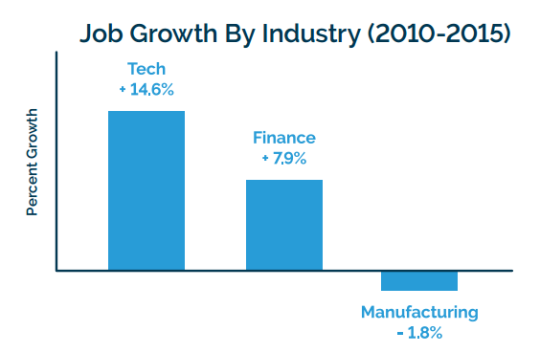
    Zooming out, it is also one of the fastest growing industries in the city:

    image

    To try and put this into perspective, a similar report for New York – published in 2014 – reported 291,000 tech jobs out of 4.27 million people employed. I was a bit surprised by these numbers, but the Toronto report seems to have been modeled after the New York one. So presumably they use similar methodologies.

    Of course, there’s the big question of quality over quantity. There’s a certainly a difference, in terms of impact to the economy, between a back office tech job and fast growing startup that will eventually reach the coveted $1 billion valuation number and create thousands of new jobs.

    Obviously every city is hoping for the latter.

  • Architecture bike tour

    I am in New York right now and I spent the day riding around on a Citi Bike looking at architecture. Atop two wheels is such a fast way to get around.

    The first stop was the new transportation hub at the World Trade Center. Here’s a photo of the Oculus:

    The main station house (above) is absolutely breathtaking, but the exterior (in particular the entrances) felt a bit unresolved to me.

    Here’s a photo of 56 Leonard by Herzog & de Meuron:

    People call it the Jenga tower.

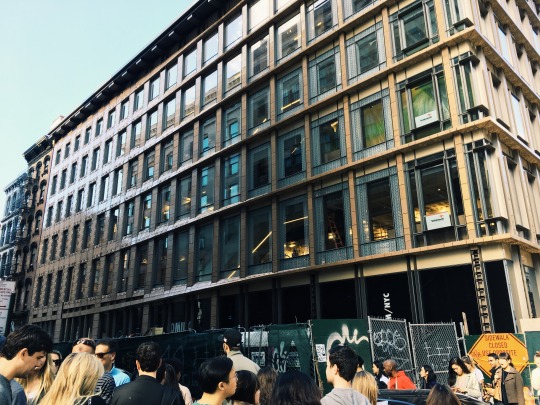
    And here’s a photo of a building on Broadway in Soho:

    Look at how the overhangs fold down and adjust the window dimensions so that it matches the building to the left. Bigger windows towards Broadway. Smaller windows as you move inward. I thought this was really neat.

    And now back to New York City. See you tomorrow.

  • The rise of paradiplomacy

    In the words of Mike Bloomberg, then mayor of New York: “We’re the level of government closest to the majority of the world’s people. We’re directly responsible for their well-being and their futures. So while nations talk, but too often drag their heels, cities act”. Whereas diplomacy is carried out for the state, paradiplomacy is executed for the population.

    Rodrigo Tavares has an interesting article up at the World Economic Forum talking about the rise of foreign policy and international relations at the local level. The argument is that as cities rise (and they are certainly rising) paradiplomacy is inevitable.

    He admits that the diplomatic networks tend to be stronger for regions who have “flirted with sovereignty.” Regions such as Quebec, Catalonia, and Scotland are given as examples. However, this shift is by no means exclusive to them. Lots of examples in his article.

    It is also manifesting itself very differently compared to at the national level. And that’s part of the advantage. One example is London & Partners, which is an arm of the City of London that sells consulting services to other cities and nations who want to replicate its successes. Do nations do this?

    I have argued before on this blog that our governance structures do not accurately reflect today’s urban reality. Rodrigo’s article is a reminder that we continue to underestimate the role of cities in the global economy.

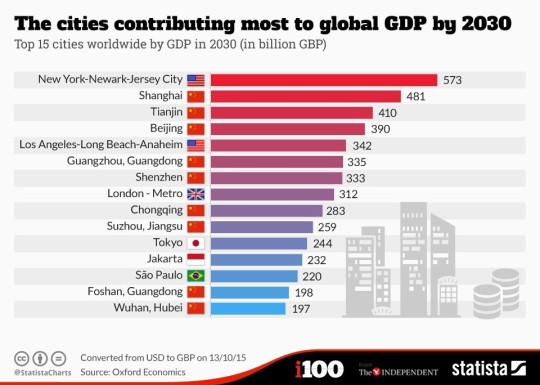
    I’ll end with this chart from his article:

    image

  • Vancouver-Seattle

    The New York Times has an interesting article up talking about how Vancouver and Seattle are trying to more closely align themselves and create a unified tech corridor. 

    BC premier Christy Clark and Washington governor Jay Inslee recently signed an agreement to that effect, which included more research collaboration between the University of British Columbia and the University of Washington.

    Seattle wants this because its companies need talent (read: foreign workers) and Vancouver’s borders are more open. Vancouver wants this because its tech industry is relatively small (go Hootsuite!) and it could benefit greatly from being more proximal to Seattle.

    On a side note, Seattle is an interesting case study. In terms of venture capital dollars invested, it is below top tier cities such as San Francisco, New York, Boston, and so on. But in terms of the companies it has birthed (Microsoft, Amazon, Zillow, Expedia…) it is certainly a heavy hitter.

    One of the key factors will be physical connectivity. There’s talk of high speed rail and/or a dedicated lane for autonomous vehicles. However it’s done, I think bringing this trip to < 1 hour would be the ideal scenario. There’s a psychological barrier beyond that.

    If any of you live/work in either of these cities today, I would be curious to hear your thoughts.

  • The lure of super-places

    image

    If you’re a very talented person, you have two choices: you either move to New York or you move to Silicon Valley. This is the message that Peter Thiel delivered to a conference being held in Chicago earlier this month. Not surprisingly, it pissed a few people off.

    Peter responded by saying that he was simply illustrating the “extreme version” of a metaphor about the impacts of globalization and technology. And while it certainly doesn’t sound very nice if you’re sitting in Chicago, or the countless other fantastic cities between the coasts, I can appreciate what Peter is getting at.

    Saskia Sassen is known for coining the term global city. These are cities which play an important role in the functioning of the global economy. But what has happened, she acknowledges, is an even further concentration of activity within a select few “super-places.”

    Here is an excerpt from a Financial Times article by Simon Kuper (2014) talking about Amsterdam’s position in the world:

    “…a new, higher category of cities may now be emerging: global capitals. Amsterdam has risen but New York, London and Hong Kong have risen faster. The Dutch elite is moving to Amsterdam; but many ambitious Dutch people no longer want to join the Dutch elite. They want to join the global elite. That often requires moving to a global capital.”

    Anecdotally, I can say that almost everyone I know who has left Toronto for an opportunity has moved to New York, Silicon Valley, London, and so on. They have moved up the rank of global cities/capitals.

    So while Peter may not have chosen the right way to deliver this message, I do believe it is a message worth delivering.

  • Mapping the creative soul of US cities

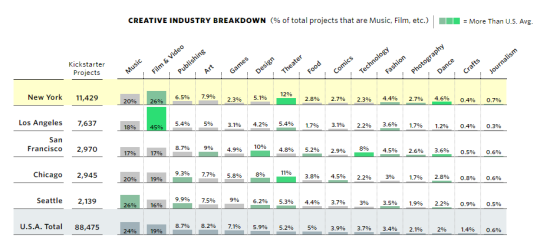
    Polygraph (visually-driven essays) has a great piece called, The Entire History of Kickstarter Projects, Broken Down by City. What they did was look at 88,475 Kickstarter projects to map the various creative communities across the US.

    Here’s a snapshot (you may need to zoom in):

    image

    In general, Kickstarter in the US sees a high concentration of music projects (24%) and film & video projects (19%). But where it gets interesting is to see which cities over-represent in certain categories.

    New York = film & video, theater, and dance

    Los Angeles = film & video (not surprisingly 45% of all projects)

    San Francisco = design and tech

    Chicago = theater

    Detroit = music

    Nashville = music (76% of all projects!)

    They also measured the size of each project (number of backers) and created these neat bubble diagrams:

    image

    Above is New York. Red is music. Orange is film. And yellow is theater.

    I also like their explanation for why they did this project:

    Pretty much all existing attempts to map creative communities use census and jobs data. But creative efforts are often side-hustles. They’re garage/basement/cottage industries that will not appear in a census.

    It’s true. This data should be a much better capture of each city’s creative soul.

  • $10,600 per square foot

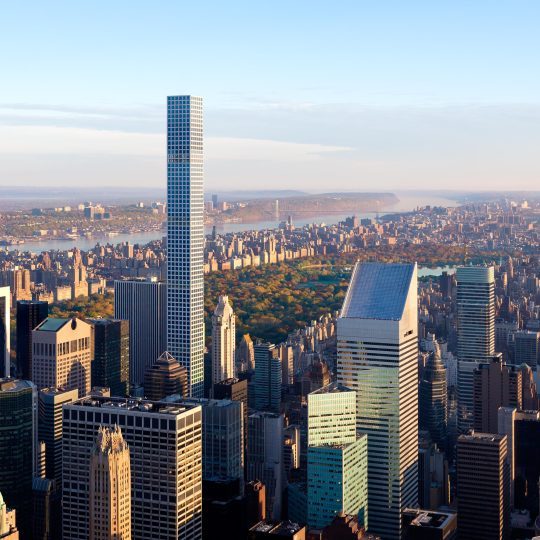
    It was just announced that the full floor 8,255 square foot penthouse in the Rafael Viñoly-designed 432 Park Avenue (New York) has closed at a sale price of USD$87.7 million. That works out to be just over $10,600 per square foot.

    It was purchased by Fawaz Al Hokair and is currently the most expensive sale in the building. However, the most expensive sale, ever, in New York remains the penthouse of One57, according to Curbed. It was purchased for $100.5 million.

    Architecturally though, I much prefer 432 Park Avenue. I love its simplicity.

    Each floor plate is 812 square meters. But because of the building’s height (424 meters / 1,395 feet) it appears a lot smaller. The ratio of building width to building height is about 1:15.

    Because of this “slenderness ratio” the building is split up into 7 distinct volumes with a void between each. These voids – which are completely empty save for the building’s core – reduce wind loading and help with the building’s overall structural stability. (I’m sure it’s fine.)

    The structural system is the exposed concrete grid. This leaves the interior of the floors completely column-free. Every window within this grid is exactly 10 square meters. 

    Here’s a good interior example of that:

    On a none architectural note, the building also features a private restaurant. I am curious how a private restaurant can operate sustainably in a building with 100 and some apartments owned by many people who probably don’t spend all (or much?) of their time in New York. Perhaps it’s partially carried by the ~$2.10 per square foot monthly maintenance fee.

    Occupancy is available immediately if you happen to be in the market.

    Images: 432 Park Avenue

  • Knowledge is more important than space

    I don’t always agree with economist Edward Glaeser, but I really enjoyed the talk that he gave at the Vancouver Urban Forum back in 2012 (at least part 2 of it). I came across it on Twitter today and, since it only has about 300 views, I figured that some of you also haven’t seen it.

    The argument he makes is that knowledge and education are the bedrock of cities. And since we continue to cluster in cities, despite all of our technological advances, knowledge is clearly more important than space. One of the ways he defines cities is by their lack of space and the closeness of the people.

    Of course, this isn’t anything new. If you’ve read his book Triumph of the City, you’ve heard all of this before. But that didn’t stop me from enjoying his talk. It’s a great overview of declining transportation costs, locational advantages, agglomeration economies, the importance of urban density, the impact of small and large firms in a city, and so on.

    I also really liked this idea that knowledge is worth more than space. So if you have 20 minutes and you want to get geared up about cities, have a watch.

    Click here if you can’t see the video below.

    [youtube https://www.youtube.com/watch?v=zg7aITkTNe8?rel=0&w=560&h=315]