Daily insights for city builders, delivered every morning at 6 AM ET. I’m Brandon Donnelly — a Toronto-based real estate developer and founder of Globizen. I’ve been writing here since 2013.

Tag: new york times

  • The politics of flooding

    Do you believe that human action has caused and is causing negative outcomes with respect to the environment?

    The New York Times published a feature piece this week on the flooding of the US east coast. 

    Associated with the article is a fantastic infographic that shows all of the NOAA (National Oceanic and Atmospheric Administration) tide gauges up and down the eastern seaboard. It then zooms in to a few locations and shows mean sea level rise (in inches) since 1950 and the number of days of “nuisance flooding.”

    Here’s a sample screenshot:

    If you don’t feel like reading the full article, at least check out the infographic. The increase in nuisance flooding for some cities – such as Wilmington, N.C. (shown above) and Annapolis, MD – is astounding.

    What’s frustrating about the whole climate change debate is that it remains not only a debate, but an ideological debate. Here’s a quote from the article that stood out for me:

    “I’m a Republican, but I also realize, by any objective analysis, the sea level is rising,” said Jason Buelterman, the mayor of tiny Tybee Island, one of the first Georgia communities to adopt a detailed climate plan.

    In other words: I’m not supposed to think this way, but I do.

    Politics.

  • The rise of tech outposts

    What happens when wages and real estate prices become too high in a city? Companies start growing in lower cost locations. We’ve all seen this before. 

    Fred Wilson recently blogged about this “spillover effect”, citing a New York Times article talking about the growth of tech offices in Phoenix. As someone who sits on the board of many technology companies, he was noticing a thematic trend:

    “A big theme of board meetings I’ve been in over the past year is the crazy high cost of talent in the big tech centers (SF, NYC, LA, Boston, Seattle) and the need to grow headcount in lower cost locations.”

    We talk a lot about housing prices on this blog, and so I think it’s useful to see how this, along with high wages, also impacts companies. The two are interrelated.

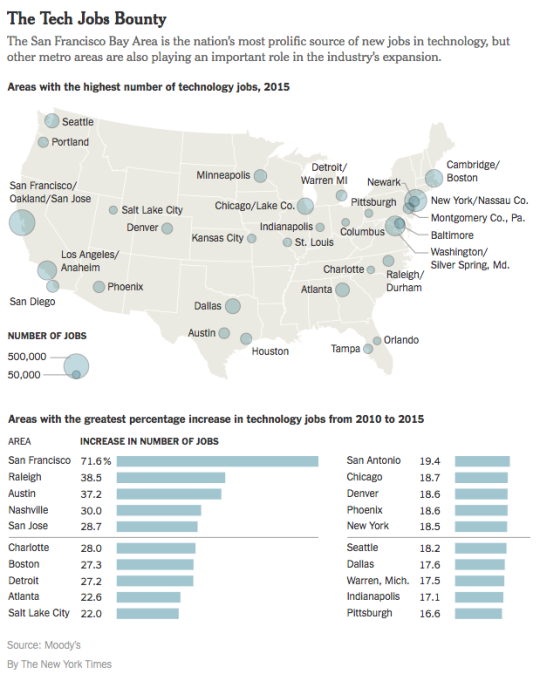
    Below is a chart from the NY Times article showing the US cities with the highest number of technology jobs and the most growth from 2010 to 2015. 

    San Francisco is in a league of its own. But overall, the growth is in tech and many cities are adding lots of technology jobs. Look at Detroit and Boston right beside each other (Detroit obviously has a smaller starting base). And look at how Miami is nowhere to be found.

    Of course, one interesting question is whether these new outposts – such as Phoenix – can truly come into their own and carve out a niche:

    “We don’t want to be San Francisco’s back office — we need more creators here,” said Scott Salkin, a founder and the chief executive of Allbound, which is based in Phoenix, makes sales software and has offices down the hall from Gainsight’s.

    Even with the high cost of living, it’s hard to supplant the coastal hegemony. That’s where people go to chase riches. As comedian Daniel Tosh likes to say, “the middle of the country is for people who gave up on their dreams.”

    Though for some, living in a place like Denver or Salt Lake City and snowboarding every weekend is a better outcome than living in a studio apartment and commuting an hour to work.

  • Design, technology, and culture

    Every now and then I’ll come across a website, a product, or something that immediately resonates with me. Usually that means I’ll immediately subscribe to it, buy it, follow it, or do whatever the action is supposed to be. It doesn’t happen all that often – though I think it should be a goal of companies and organizations to delight – but that’s exactly what happened to me this morning when I stumbled upon Subtraction.com.

    Subtraction is a blog about design, technology and culture (all things I love) and it’s written by Khoi Vinh. Khoi is Principal Designer at Adobe. Prior to this, he was Design Director of The New York Times and co-founder of the design studio Behavior, LLC. Fast Company also named him one of the 50 most influential designers in America. But enough of all that. His blog is great.

    Whenever I write about blogging, I tend to get questions about other blogs I might recommend. So today I’m recommending Subtraction.com. I’ve also added it to my working reading list, which I don’t think many of you are aware of because you probably just read this blog in your inbox. But it exists and I’m happy to add to it if you have interesting suggestions. (Please leave a comment below.)

    P.S. Because of Subtraction, I now have the movie High-Rise on my watch list. Have any of you seen it? Because I don’t have cable or Netflix, I tend to be painfully out of the loop on these sorts of things. It’s based on a book by J.G. Ballard and it’s the story of a 1970s suburban London apartment building that starts to socially degrade. How could I not want to watch that?

  • Enemies of the High Line

    Despite not being the first example of infrastructural adaptive reuse, the High Line in New York has certainly kickstarted an urban trend. Cities all around the world now want their own “version of the High Line.”

    Philly is working on a new “rail park.” I toured the space last summer and it’s very similar to the High Line in terms of existing infrastructure. Rome and Toronto are both working on “under” spaces, which are beneath an old viaduct and elevated expressway, respectively. And the list goes on.

    But I think it’s worth remembering just how contentious the High Line was before it was built. For some people it was just an eyesore and a public safety hazard. Here’s a excerpt from a New York Times article dated 2002:

    “This is a terrific win for us,” said Michael Lefkowitz, a lawyer for Edison Properties, one of 19 businesses that own land beneath the High Line.

    Janel Patterson, a spokeswoman for the city’s Economic Development Corporation, said an agreement to share the $11 million cost of dismantling the High Line was being circulated among the property owners and the rail bed’s owner, CSX, of Richmond, Va. “It’s about eliminating a public safety hazard,” Ms. Patterson said, “but it’s also about enabling the city to move forward and better develop the area.”

    It’s also worth mentioning that former Mayor Giuliani supposedly favored demolition of the High Line. Former Mayor Bloomberg, however, did not:

    …Mr. Bloomberg said: "Today, on the West Side of Manhattan, we have an opportunity to create a great new public promenade on top of an out-of-use elevated rail viaduct called the High Line. This would provide much-needed green space for residents and visitors, and it would attract new businesses and residents, strengthening our economy. We know it can work … . I look forward to working with Friends of the High Line and other interested parties to develop a feasible reuse scenario.”

    The challenge with these sorts of things – that is, new ideas – is that we live in a world of proof and precedents. We want to see that it has been successfully done before, because, otherwise, we might be wrong. So now that New York has shown what is possible, it has cleared the way for other cities.

    Rethinking old infrastructure is a sound urban strategy. But we also shouldn’t forget that it’s less valuable to be right about something that every other city already believes to be true. The real value is created when you’re right about something that most other cities don’t yet believe.

  • America needs a new map

    image

    Parag Khanna recently published an article in the New York Times calling for a new map for America

    Here’s why:

    “The problem is that while the economic reality goes one way, the 50-state model means that federal and state resources are concentrated in a state capital — often a small, isolated city itself — and allocated with little sense of the larger whole. Not only does this keep back our largest cities, but smaller American cities are increasingly cut off from the national agenda, destined to become low-cost immigrant and retirement colonies, or simply to be abandoned.”

    This is something that I’ve been writing about for awhile on this blog. As we continue to transition to an urban-based information economy, it strikes me that, here in North America, we’re going to need to refocus our governance structures around cities. We’re going to need to place our metropolitan regions at the fore if we want to continue competing with rising powers like China – which, by the way, seem to be adopting a megacity model.

    Here’s another snippet from the article:

    “While Detroit’s population has fallen below a million, the Detroit-Windsor region is the largest United States-Canada cross-border area, with nearly six million people (and one of the largest border populations in the world).

    Detroit’s destiny seems almost obvious if we are brave enough to build it: a midpoint of the Chicago-Toronto corridor in an emerging North American Union.”

    I’ve argued for this before and I continue to believe that it makes a lot of sense.

    Image: New York Times

  • 2 new ways to think about economic inequality

    We talk a lot about economic
    inequality these days. We worry, among other things, that our successful cities
    are becoming playgrounds for the rich and that housing is becoming increasingly
    unaffordable for the middle class.

    Without negating the
    importance of things such as attainable housing, I’d like to offer up two,
    potentially new, perspectives on economic inequality.

    The first is an
    essay by venture capitalist Paul Graham
    . In it, he rationally unpacks, as he always does, the phenomenon of economic inequality. One of his key points is the distinction between rent seeking degenerate economic inequality and the economic inequality caused by rapid value creation (i.e. Two Stanford students decide to create a new search engine called Google).

    “If the rich people in a society got that way by taking wealth from the poor, then you have the degenerate case of economic inequality where the cause of poverty is the same as the cause of wealth. But instances of inequality don’t have to be instances of the degenerate case. If one woodworker makes 5 chairs and another makes none, the second woodworker will have less money, but not because anyone took anything from him.”

    Of course, Paul Graham is thinking about this from the perspective of a venture capitalist that funds startups and helps entrepreneurs get rich. But what about the impacts to people who live in a city where the rich are far richer than the poor?

    That brings me to the second perspective.

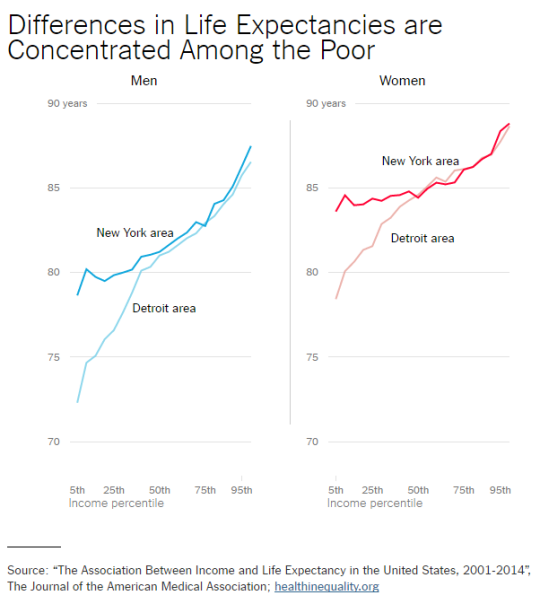
    A recent study, published in The Journal of the American Medical Association and written about in the New York Times, has discovered a surprising relationship between income and life expectancy across the United States from 2001 to 2014.

    What they found was that cities with high economic inequality – such as New York and San Francisco – actually have lower inequality when it comes to life expectancy. 

    Here is a chart from the New York Times:
    And here is a chart from healthinequality.org:
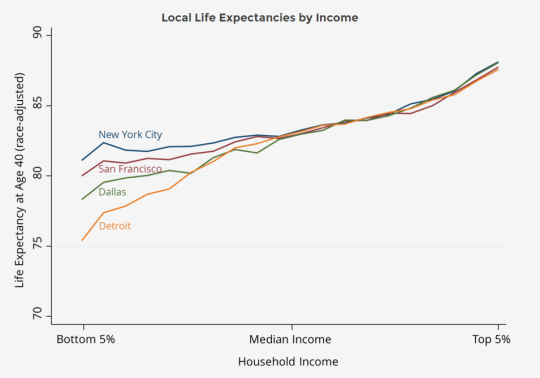
    If you’re rich, it doesn’t matter where you live. The life expectancy of a rich person in New York is roughly the same as a rich person in Detroit. (Though, as to be expected, women generally live longer than men.)

    However, as income levels fall, so does life expectancy. But it falls more in a city like Detroit than it does in New York. In fact, rich cities such as New York and San Francisco are almost model cities in this regard. Why is that?

    The biggest predictor appears to be health behaviors, such as smoking and obesity:

    “The research seems to suggest that living in proximity to the preferences — and tax base — of wealthy neighbors may help improve well-being. New York is not just a city of rich and poor, but also one of walkable sidewalks, a trans-fat ban and one of the most aggressive anti-tobacco agendas of any place in the United States.”

    So there you have it. Two, potentially new, ways to think about economic inequality.

  • Why creativity requires freedom

    Brazil colors by bruno Gueroult on 500px.com

    https://500px.com/embed.js

    In a knowledge and innovation economy, new ideas matter a great deal. But it seems to be a lot easier for existing companies to come up with sustaining, incremental innovations, than it is for them to come up with new, disruptive innovations. 

    New can be hard.

    That’s why I was interested in a recent New York Times article by Wharton professor Adam Grant called, How to Raise a Creative Child. Step One: Back Off.

    The article starts by arguing that many “child prodigies” rarely become adult creators who go on to the change the world:

    The gifted learn to play magnificent Mozart melodies, but rarely compose their own original scores. They focus their energy on consuming existing scientific knowledge, not producing new insights. They conform to codified rules, rather than inventing their own. Research suggests that the most creative children are the least likely to become the teacher’s pet, and in response, many learn to keep their original ideas to themselves. In the language of the critic William Deresiewicz, they become the excellent sheep.

    To become creators Adam argues that children need to be given the freedom and independence to develop their own sense of self:

    When psychologists compared America’s most creative architects with a group of highly skilled but unoriginal peers, there was something unique about the parents of the creative architects: “Emphasis was placed on the development of one’s own ethical code.”

    Yes, parents encouraged their children to pursue excellence and success — but they also encouraged them to find “joy in work.” Their children had freedom to sort out their own values and discover their own interests. And that set them up to flourish as creative adults.

    I firmly believe in this approach. But of course, this doesn’t just apply to children; though that is certainly an important takeaway. I also think that if you want the best work out of people in the workplace, you also need to: back off.

    Creativity needs freedom.

  • Cities aren’t the only places struggling with housing affordability

    We already know that many successful cities are struggling with housing affordability. But what you may not know is that a similar phenomenon is happening in many ski towns. Supply is constrained and demand is high.

    Here is an excerpt from a recent New York Times article:

    Local officials and housing experts say it is a symptom of widening economic inequality, one that is especially sharply felt in tiny resort towns hemmed in by beautiful but undevelopable public land. While the wealthiest can afford $5 million ski homes and $120-a-day lift tickets, others work two jobs and sleep in shifts to get by.

    “It’s so much worse today than it’s ever been,” said Sara Flitner, the mayor of Jackson, Wyo., where the median single-family home price rose 24 percent last year to $1.2 million, according to the Jackson Hole Report.

    It’s for reasons like this that some ski towns have strict criteria around who is an eligible resident. For example, Banff, Alberta does this to ensure, “that housing remains available for those whose primary objective is to live and work in the community.”

    In small landlocked ski towns – where it’s difficult or almost impossible to increase supply – there are only so many options. 

  • Being grateful

    Lately I’ve been reading about and interested in the idea that the more grateful you are, the happier you can actually become. It’s similar to the idea that positivity can lead to better outcomes in your life. Believe something and you make it true.

    It turns out that some people could have genetic tendencies towards more positivity and gratefulness. But there’s no reason why you couldn’t train yourself to be more like that.

    I’ve thought about adding to my daily discipline and introducing a bit of gratefulness here on Architect This City. But it’s hard to do that without regularly sounding braggadocious.

    In any event, I’ve also thought about how this same idea could apply to cities. I mean, when was the last time you were grateful and appreciative of the city you call home? Sometimes, or maybe most of the time, it’s easier to just complain about what we don’t like.

    But if being grateful about your own life can make you happier, I think being grateful about your own city could do the same. I did a bit of that in this post a few months ago. But I try and do it far more often than that. I’m a big fan of my city.

  • New York’s 8-figure apartments

    Whenever you’re starting to feel like real estate prices in your city are getting out of hand, just turn your attention to New York. It’ll make you feel better.

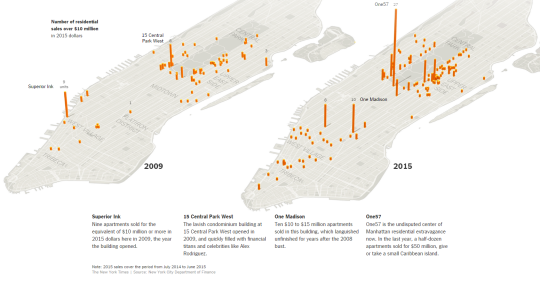
    The New York Times published an interactive overview of the Manhattan real estate market today. It was spurred on by the fact that the average residential sale price in Manhattan just hit $1.7 million (a new record) and that there’s a growing number of 8-figure apartments being bought up.

    Last year half a dozen apartments sold for more than $50 million in the One57 tower at 157 West 57th Street. (The New York Times calls this building the “undisputed center of Manhattan residential extravagance.”)

    Here’s one of their diagrams showing the number of residential sales over $10 million in 2009 and then in 2015:

    image

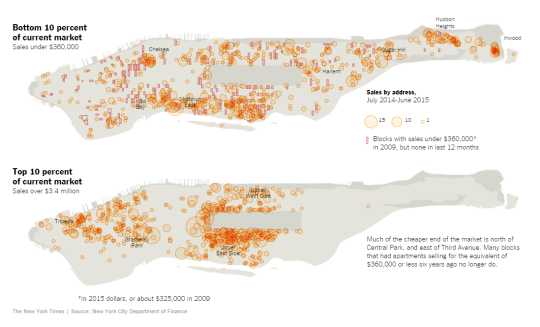
    And here’s another one of their diagrams showing the bottom and top 10% of the current market:

    image

    It’s interesting to see the clustering in certain areas and also the lack of clustering at the high end around the top of Central Park.