Daily insights for city builders, delivered every morning at 6 AM ET. I’m Brandon Donnelly — a Toronto-based real estate developer and founder of Globizen. I’ve been writing here since 2013.
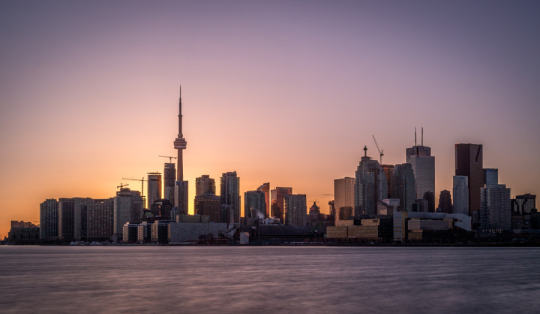
If you’re a regular reader of Architect This City, you’ll know that I generally like to include at least one photo with every post. Sometimes I run out of time and I don’t always do that, but that is at least the intent.
You might have also noticed that my go-to for stock photography is 500px. That is the case for a few reasons.
I find the photos to be of higher quality than any other service. I can easily “embed” them into my posts while giving appropriate credit to the author and linking back to 500px. The company was founded by a good friend of mine and snowboarding compadre. And the company is made in Toronto.
I’ve written about the Tenderloin neighborhood in San Francisco before. It’s an infamous neighborhood in the center of the city that has for decades resisted gentrification (which was the topic of my post).
But as the technology sector continues to urbanize, many fear that it’s only a matter of time before it does eventually gentrify. A new nickname has even emerged for the neighborhood: the Twitterloin.
However, a local nonprofit called the Wildflowers Institute is trying to ensure that gentrification doesn’t erase the cultural assets currently housed in the neighborhood. Through a project called “Hidden Gems”, the group is literally knocking on doors to find active artists within the community (many of whom live in single rooms) and then supporting them through fellowship programs and other investments.
What’s fascinating about their approach is that they are actively seeking out the informal activities taking place within the community – activities that would otherwise be hidden and then potentially lost. Once discovered, they then do a number of mapping exercises to keep track of this data.
As somebody who believes city building will become a lot more data driven in the future, I think this is a really interesting initiative. And as gentrification pressures continue to increase in San Francisco, I’m sure this information will help guide the discussions. You can’t account for something you don’t know exists.
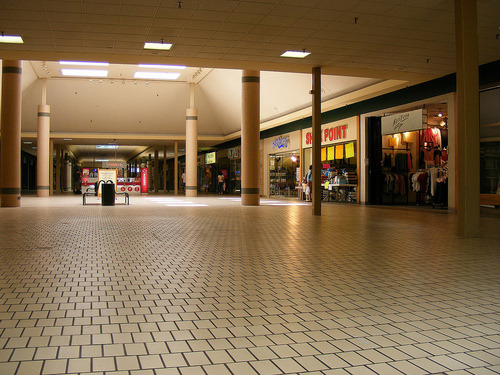
A lot of shopping malls are dying. You’ve probably heard this before. But how bad is it and what exactly is happening?
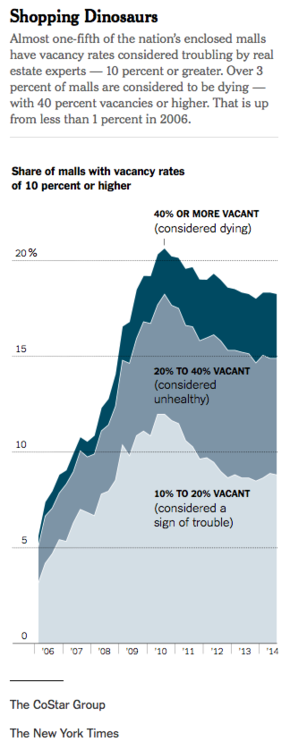
Well, a new report by CoStar (heard through the New York Times) found that nearly 20% of the 1,200 malls in the US are presently in trouble. “Trouble” is defined as a mall with a vacancy rate of 10% or more.
But what’s perhaps most disconcerting about this number is that, as recently as 2006, only about 5% of the malls in America would have been pegged as being “in trouble.” Here’s a chart from the New York Times (I’d love to see this same graph with a longer time horizon):
But not all malls are dying. The general sentiment seems to be that the high-end A malls are and will continue to thrive, and that it’s only the B and C malls that are dying:
Tom Simmons, who oversees the mid-Atlantic shopping center division of Kimco, another real estate giant, is more blunt. “There are B and C malls in tertiary markets that are dinosaurs and will likely die,” he said, but “A malls are doing well.” (NY Times)
So why is this happening? Some think it’s because the US is over-retailed. And some think it’s because of rising income inequality – which would explain why the high-end malls continue to thrive. But the experts seem to agree that it’s not the result of more people shopping online:
One factor many shoppers blame for the decline of malls — online shopping — is having only a small effect, experts say. Less than 10 percent of retail sales take place online, and those sales tend to hit big-box stores harder, rather than the fashion chains and other specialty retailers in enclosed malls. (NY Times)
I wrote a post 2 months ago where where I argued that big box stores will be the most impacted by online shopping (which is why so many of them now sell groceries). But I don’t believe that they are the only retailers that will be affected. Quite the opposite: Every retailer is or eventually will be impacted by the internet.
This threat is real.
Millennials have no hesitations about buying things online and, in many cases, they would prefer to do so. It has already been well documented that we (I’m a Millennial) don’t like driving as much as previous generations. So what makes you think we’d enjoy the process of driving to a mall?
But the other factor at play, I think, is that malls are no longer the “public space” of young people. Their position as a kind of cultural institution is waning. At the same time, more and more people are craving uniqueness. They like independent shops, not malls that all look and feel the same. And as these young people become old people, we might find that even the A malls start becoming impacted.
I don’t believe, for a second, that retail nodes within cities will ever disappear. But I think our attention would be better spent figuring out what the mall of the 21st century will be, as opposed to hiring PR firms to try and spin doctor our way out of this dead mall phenomenon.
We’ve taught generations of architects to speak out as artists, but we haven’t taught them how to listen.
This is a line from a recent New York Times op-ed that has been making the rounds online today called: How to Rebuild Architecture.
The premise of the article is that architects have marginalized themselves by being pompous elitists who increasingly serve only the rich and don’t respond to public opinion about architecture.
For too long, our profession has flatly dismissed the general public’s take on our work, even as we talk about making that work more relevant with worthy ideas like sustainability, smart growth and “resilience planning.”
The author’s recommendation is that architects need to get better at listening to their clients and listening to the public.
Reconnecting architecture with its users — rediscovering the radical middle, where we meet, listen and truly collaborate with the public, speak a common language and still advance the art of architecture — is long overdue. It’s also one of the great design challenges of our time.
What’s interesting about this viewpoint is that it’s precisely the sort of thing that entrepreneurs and business people are trained to do today. The mantra is that you should never build your product or service in isolation. Get out of the building. Talk to customers. Get feedback. Adjust. And iterate.
But architects don’t like to do this. Why is that?
The answer, at least partially, comes down to taste. As the author correctly pointed out, the kinds of buildings that architects like are often not the same ones that the general public likes.
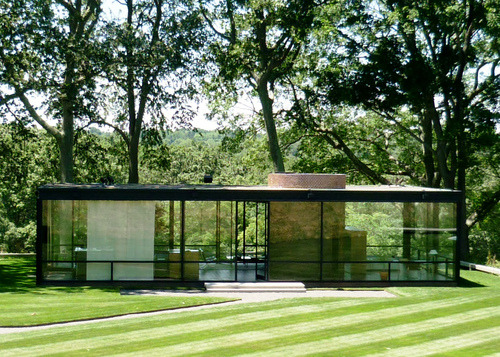
I don’t have any hard data to support this claim, but I suspect that most people out there – particularly those with money – would prefer their home to look like something that Robert Stern designed as opposed to a glass box designed by Philip Johnson.
And yet the latter is what architects and architecture students make pilgrimages to. I certainly did when I was in architecture school.
In fact, I think you’d have a difficult time getting into any architecture school right now with a portfolio of work as traditional as the work of Robert Stern. It’s simply not part of the architectural discourse at this stage.
So to many architects, it can be difficult – even painful – to listen to what the public wants. Architects are not trained in terms of market size and profit maximization. It’s about passion. It’s a labor of love. And when you’ve already fallen in love, it can be hard to change your mind.
Right now, I’m sitting on the sun deck at my friend’s cottage and looking out at the Georgian Bay. So this is going to be a short post. The New York Times just published a stunning photo series of hidden rooftop pools and gardens in New York. All of the photos were taken from a helicopter. If you’re as fascinated by cities as I am, I think you’ll really like them.
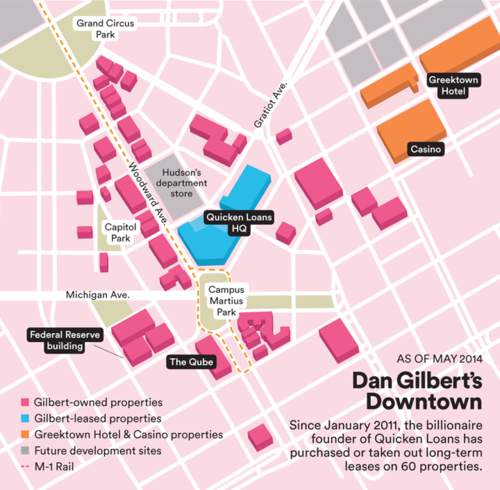
The New York Times published an interesting and popular article last Friday called The Post-Post-Apocalyptic Detroit. It of course talks all about the efforts of billionaire Dan Gilbert, but it also talks about the initiatives of many small and local entrepreneurs who are doing their part to help revive the city – while at the same time making a profit.
One thing that I found interesting about the article is the extent to which the private sector has taken over the responsibilities of the public sector. With only 35,000 of the city’s 88,000 streetlights actually working, the city simply doesn’t have the money to pay its bills. When I visited the city last fall, I was told that the city couldn’t even afford batteries for its parking meters.
So the private sector has stepped up.
In downtown, Dan Gilbert pays for his own security force to patrol the area 24 hours a day both on the ground and through 300 surveillance cameras. And in the Jefferson East corridor, John Stroh III – of the Stroh Brewery Company – is paying for 3,500 hours of private security in order to help transform the area into a walkable retail strip.
It’s a model that relies on the funding and vision of rich people to catalyze change. And it strikes me as a quintessentially American way of going about it. In Canada, I’m not so sure it would be approached in quite the same way, which I think is both good and bad. I think in Canada there would be more government involvement.
If the rich people are there and willing to step up (like they are right now in Detroit), then I would assume the capital would be deployed more efficiently and that change would happen more quickly. But if the rich people aren’t willing to step up, then nothing happens and the place declines.
That might be an oversimplification, but I think there are differences.
To end, I’m going to leave you with this Bloomberg video about Steve Case’s (former AOL founder) “Rise of the Rest” road trip to Detroit. If you can’t see the video below, click here.
One of the things that many city planners, transportation experts, and municipalities are trying to figure out is how to successfully shift people away from driving towards alternative modes of transportation, such as biking and transit. Now, this is no easy task. There are a myriad of factors that influence a person’s decision to drive or not drive–or if they should even own a car in the first place. Though, land use and density are, in my opinion, probably the biggest.
But of all the solutions thrown around, mobile apps are typically not within the playbook. However a recent New York Times article is making the argument that it should be, because car-sharing services and apps like Uber seem to be indeed having an affect on people’s decision to own a car. And that’s because in some cities it’s actually cheaper to use Uber every day (than to own a car) and because taxi use has been shown to correlate with other (non-driving) forms of mobility.
Paradoxically, some experts say, the increased use of ride-sharing services could also spawn renewed interest in and funding for public transportation, because people generally use taxis in conjunction with many other forms of transportation.
In other words, if Uber and its ride-sharing competitors succeed, it wouldn’t be a stretch to see many small and midsize cities become transportation nirvanas on the order of Manhattan — places where forgoing car ownership isn’t just an outré lifestyle choice, but the preferred way to live.
And to be honest, I don’t think this is all that far stretched. More and more I find myself wondering why I even own a car. It’s not appreciating sitting downstairs in my garage and, given the frequency in which I use it, I would definitely be better off financially if I simply used an app like Uber or Hailo more often. About the only thing those apps aren’t great for are trips to Home Depot and snowboard trips to the mountain.
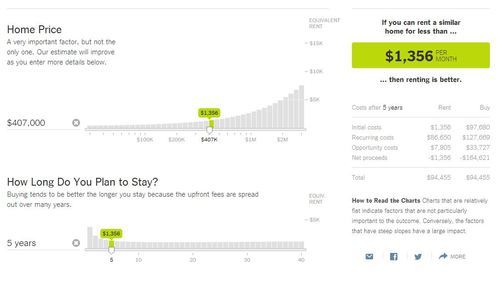
The decision to buy or rent your home can be a big one–it’s both personal and financial. If you buy, you tie up capital that could be put to use elsewhere. But if you rent, you don’t get to participate in any of the upside should home prices appreciate.
To help with this decision, the New York Times recently put together an online calculator. It takes into account the opportunity cost of your capital, inflation rates, the expected home price growth rate, and a myriad of other factors. It’s the most detailed of these types of calculators I’ve ever seen.
If you’re thinking about this decision, you may want to take a look. Although, keep in mind that it’s a US model and in the US you can deduct the mortgage interest on your principal residence. You can’t do that in Canada.
I’ve talked a lot about laneway housing here on Architect This City. I’m a big supporter and I wish that Toronto would get on board and formally allow them. It’s been done and it is being done in cities around the world. Just this morning, a friend of mine sent me this NY Times article talking about how Portland has embraced the “granny flat”, which is one of the many names used for this type of housing.
Eli Spevak, a local alternative-housing developer who is among those who lobbied for A.D.U.-friendly policies, said, “The city changed two rules, and all of a sudden it went from 30 a year being built to 200 last year” — an impressive figure, considering the total number of applications approved for single-family houses in 2013 was 800.
This is a hugely impressive figure that shows that these homes are not really a niche product. Laneway homes have become a meaningful chunk of the new home market in Portland. Given that they’re a relatively affordable and sustainable option, I’m not surprised. But I am surprised that more cities aren’t following suit.
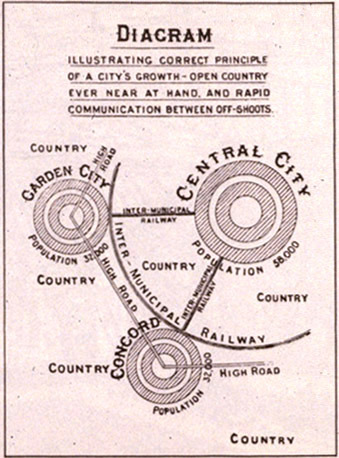
In the book, the authors argue that the solution to our suburban problems is to return to a “tragically interrupted, 150-year-old tradition” known within urban planning and architectural circles as the Garden City movement. Here’s how Arieff describes it:
The garden suburb is — because it still exists in many places — a planned, self-contained village located usually outside a major city. Ideally, it features a variety of housing types, though by variety, we’re talking single-family homes and a few low-rise multifamily buildings.
In contrast to the suburbs we’ve come to be most familiar with, these featured homes are situated in a comfortably dense, highly walkable environment designed around a public center or square.
But in addition to being more dense and walkable, the big difference for me is that the garden city (to use the original terminology) was initially intended to be self sufficient economically–rather than just serve as a bedroom community for the central city.
It was all incredibly rational. As one garden city reached its population and employment projections, the next garden city node would be created and connected to the network via road and rail. And by using land relatively intensely, it meant that more of the countryside could be preserved as undeveloped land.
But while I would agree that the suburbs aren’t going to go away (I’ve said this before) and that we should be making them more dense and walkable, the book (well, the article) got me wondering to what extent the Garden City model applies from an economic standpoint. Should we be trying to create poly-centric cities with tidy little self-sufficient pockets of employment? Or should everything primarily feed a central city?
The irony of the decentralized information economy is that it appears to be encouraging centralization across and within cities. But even before the rise of the internet and other technologies, there have always been real economic benefits to firms clustering in cities. Known as agglomeration economies, it’s one of the reasons cities even exist in the first place.
Certainly, there’s a lot we can learn from the way we used to build and plan our cities and towns (they were designed around people as opposed to cars). But something doesn’t sit right with me in terms of the way the Garden City movement thinks about cities, economically. It seems idealistic.