Daily insights for city builders, delivered every morning at 6 AM ET. I’m Brandon Donnelly — a Toronto-based real estate developer and founder of Globizen. I’ve been writing here since 2013.

Tag: new york times

  • Average age of a first-time mother

    image

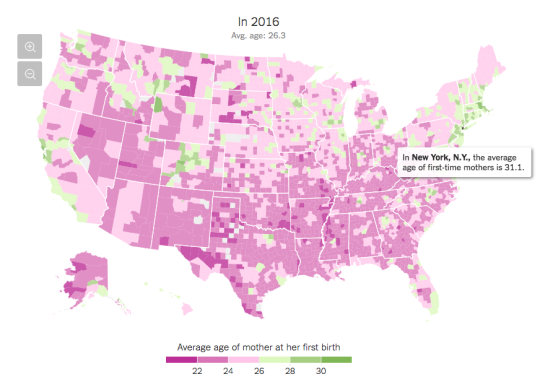
    According to a recent study in the New York Times, the average age of a first-time mother in Manhattan is 31.1 years old. In San Francisco County, the number is nearly 32. And in the US as a whole, it was 26.3 in 2016.

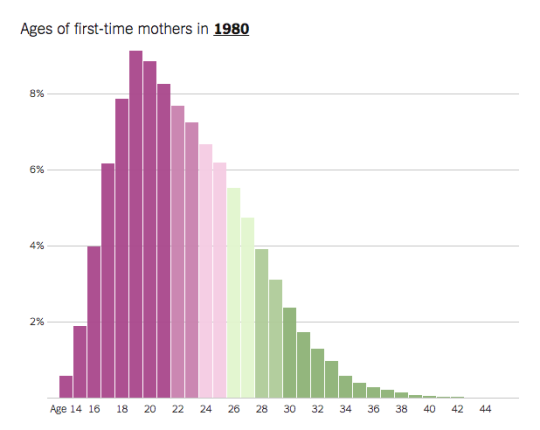
    This is what the national distribution looked like in 1980:
    image

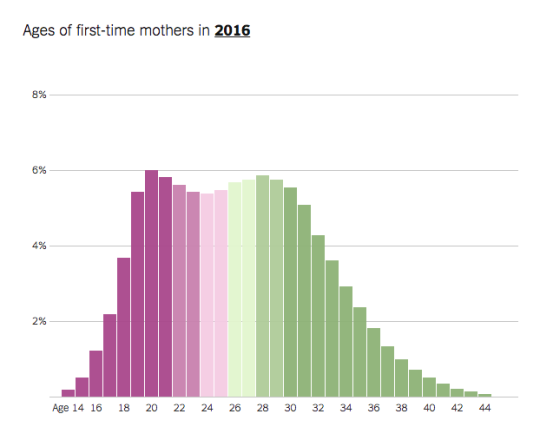
    And this is what it looked like in 2016:
    image

    Perhaps not surprisingly, the biggest factor influencing the age of a first-time mother is education. Becoming educated and building a career takes time. First-time mothers tend to be older in big cities (particularly on the coasts) compared to rural areas.

    The concern that researchers have with all of this is that it is symptomatic of growing inequality. Scrolling over the NY Times’ map, it would appear that there’s nearly a 10 year gap between the coasts and many parts of the country.

    On the one hand you have people who are finishing high school and having kids fairly soon after. And on the other hand, you have people going to college, establishing their career, and waiting, in some cases a decade, to have kids.

    This is significant because it can create a virtuous circle (excerpt from article):

    “A college degree is increasingly essential to earning a middle-class wage, and older parents have more years to earn money to invest in violin lessons, math tutoring and college savings accounts — all of which can set children on very different paths.”

    Unequal childhoods can lead to unequal outcomes.

    Images: New York Times

  • The Trump family real estate empire

    He is tall, lean and blond, with dazzling white teeth, and he looks ever so much like Robert Redford. He rides around town in a chauffeured silver Cadillac with his initials, DJT, on the plates. He dates slinky fashion models, belongs to the most elegant clubs and, at only 30 years of age, estimates that he is worth “more than $200 million.” 

    Judy Klemesrud, New York Times, 1976

    Last week the New York Times published a special investigation looking at the Trump family’s real estate empire and the suspect tax schemes that they allegedly employed over the years to preserve, grow, and pass it down. 

    According to the Times, all of which has been rebuked by a lawyer for the president, Donald Trump received at least $413 million in today’s dollars from the family empire. 

    I just finished reading the investigation in its entirety. It’s a long one. But if you’re interested, you can do the same here. If you’d prefer the Coles Notes version (Cliff Notes for you Americans), have a scroll through the headlines in this article instead.

  • The rise of proptech

    A friend of mine flipped me this New York Times article today talking about the rapidly growing interest in proptech and about Opendoor – a topic and a company that I have written about many times before on the blog.

    Here’s a snippet about proptech:

    The hauls are part of a race by investors to pour money into technology for real estate, or what Silicon Valley now calls proptech. Having watched tech start-ups upend old-line industries like taxis and hotels, venture capitalists are casting about for the next area to be infused with software and data. Many have homed in on real estate as a big opportunity because parts of the industry — like pricing, mortgages and building management — have been slow to adopt software that could make business more efficient.

    On the Opendoor front, which is the largest/most valuable company in the proptech category, they have now raised over $1 billion. By the end of this year they plan to be in 22 cities across the United States.

    Interestingly enough, they have started experimenting with other business models, beyond just buying and flipping homes. They now circumvent agents and sell some homes directly to customers.

    But Eric Wu, the CEO of Opendoor, believes that you can’t automate proper advice and so that will remain. The role of agents is simply about to shift from “administration” to that of “advisory”.

    I have been arguing for years that the home buying and selling process is ripe for change. And what we are seeing today is really the start of that.

    According to the NY Times, real estate tech startups raised $3.4 billion in funding last year. Some firms, such as Fifth Wall Ventures, are entirely dedicated to the space.

    This is money betting on change.

    Photo by Grant Lemons on Unsplash

  • Our social connectedness

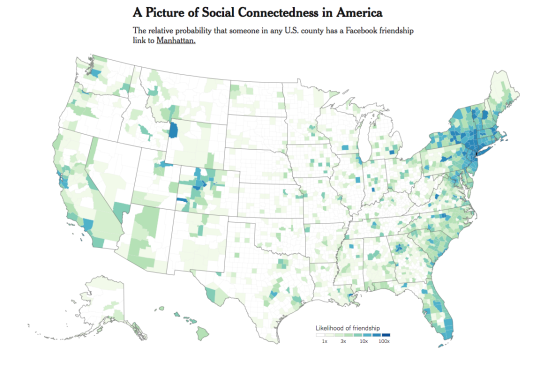
    Economists at Facebook, Harvard, Princeton and NYU recently analyzed anonymous Facebook data in order to study our social connectedness. The New York Times’ Upshot wrote about it here and it is a must read.

    There are a number of interesting takeaways from the study. One of them is that geography, distance, and political boundaries actually matter a great deal when it comes to our connectedness. 

    In other words, Americans are more like to be connected to someone nearby – within county or state boundaries – than they are to someone further away who may be infinitely more similar. This may seem somewhat intuitive.

    But at the same time, having a dispersed network also suggests certain things. Here’s the relationship that they discovered:

    These networks are important in part because of other patterns that are correlated with them. Counties with more dispersed networks — where a smaller share of Facebook friends are located nearby, or among the nearest 50 million people — are on average richer, more educated and have longer life expectancies. Places that are more closely connected to one another also have more migration, trade and patent citations between them.

    Counties that are more geographically isolated in the index are more likely to have lower labor force participation and economic mobility, and they have higher rates of teenage births. Some of the most economically distressed parts of the country appear to be the most disconnected: Among the 10 U.S. counties with the highest share of friends within 50 miles, six are in Kentucky.

    Again, it is worth checking out the full article. There’s also an interactive map to play around with.

  • Leading female architects

    Reed Kroloff has a noteworthy piece in the New York Times talking about how architecture is no longer just a ‘gentleman’s profession’. Though less than a third of AIA (American Institute of Architects) members are females, “offices led or owned by women are creating an ever-wider range of public buildings that address architecture and urbanism in new and invigorating ways”, says Kroloff.

    I am thrilled, but not surprised, to see Jeanne Gang of Studio Gang on the list (pictured above). Her firm is the design architect behind our One Delisle proposal. And I was also happy to see Magui Peredo of Estudio Macias Peredo on the list. She is based in Guadalajara and, if you aren’t familiar with her work, I recommend you check it out. I love the materiality of it.

    Image: New York Times

  • Public access at Martin’s Beach

    I just learned about the ongoing legal dispute on Martin’s Beach (south of San Francisco) through this New York Times article

    To briefly sum it up, tech billionaire Vinod Khosla bought a 53-acre beachside village known as Martin’s Beach in 2008. On the land is about 47 beach houses, a shop that sold ice cream at one point in its life, and a road that provides the only access to the beach. The road is private, but over the years and before Khosla purchased the property, it provided both parking for and access to the beach. 

    After acquiring the property, the county told Khosla that he had 2 options with respect to the road:

    (1) Keep it open (there’s a gate that controls access). And charge no more than $2 a car for parking, which was the rate charged in 1972.

    (2) Apply for a Coastal Development Permit to change how the access works.

    Khosla opted to do neither and in turn the residents of Martin’s Beach sued him. He’s been in a legal battle ever since. But according to the New York Times, he has about $3 billion sitting in his war chest. For him it is both a matter of principle and a matter of protecting property rights.

    Not surprisingly, tech billionaire fighting to keep people off a public beach makes for a sensational headline in the media. The NY Times argued that every generation has some sort of rich Californian fighting to privatize the waterfront. Khosla is this generation’s “beach villain”.

    But beneath the headlines lies a fascinating legal debate that you can read more about through a blog post that Khosla published earlier this year. For you property lawyers out there, I would be curious to hear your thoughts in the comment section below.

  • Apple and the humanities

    image

    This morning I came across two news item that are interesting in their own right, but also have a noteworthy relationship.

    $AAPL now has a market cap that exceeds $1 trillion. And not surprisingly, everyone, from the New York Times to Bloomberg (photo essay), is talking about it.

    But the one thing that continues to stand out for me about this story is what Steve Jobs said back in 2011 when he unveiled iPad 2.

    He said that fundamental to Apple’s DNA is its ability to marry technology with the liberal arts and the humanities. Its secret sauce is not technology alone.

    Now let’s move on to the second piece of news that caught my attention.

    As of 2017, less than 5% of college and university students in the US were studying one of the big four humanities majors – a sharp cliff-like drop from 2011 according to this data.

    That’s almost certainly because business degrees and STEM degrees are thought to be more valuable and in demand in the labor market. And I’m sure they are right out of school.

    But perhaps we shouldn’t forget Apple’s trillion dollar lesson. And I think this goes for both the tech space and the real estate industry, as well as others.

  • Toward penthouse amenities and smaller units

    image

    The NY Times reported this week that, as the ultra luxury real estate market in New York City continues to cool, developers appear to be making two kinds of product adjustments: (1) they are converting the penthouses and rooftops of their buildings from premium residential space into amenity spaces for the broader building and (2) they are shrinking unit sizes to help with overall sales and leasing velocity.

    According to the New York Times, condo prices on Billionaires’ Row in midtown are down 20-40% since the peak of the market in 2014 when this record was set. So developers are responding with more studios and 1 bedrooms, and amenity spaces – many of which now include high end restaurants also open to the public – that ensure no other building has something you don’t have.

    However, there are naturally some differences between condo and rental buildings. Since 2016, 35% of rentals projects in the city have had some sort of penthouse amenity, whereas the number is only 13% for condo buildings. This makes sense given that amenities are such a big driver of leasing. You definitely want your amenities ready for when your leasing office opens.

    What product changes, if any, are you seeing in your market right now?

    Photo by Aaron Burson on Unsplash

  • Where are all the kids?

    This evening, when I was reading the internet, I came across this New York Times article from 2017 talking about how San Francisco has the lowest percentage of children of any of the largest cities in the U.S. It’s around 13% of the population. (Supposedly it was the second lowest in 2015. Pittsburgh was first.)

    The article goes on to claim that the city has approximately the same number of dogs as it does children. That number is somewhere around 120,000. Not surprisingly, many blame the city’s prohibitive housing costs as the main culprit for the lack of kids. Families simply cannot afford to live in the city.

    This got me searching for more information. Richard Florida looked at similar data back in 2015, but it’s important to note that he looked at metro areas and not the city propers. So the data doesn’t speak to whether families were forced to move out from the urban core to the suburbs in search of more affordable housing or for more space.

    Nevertheless, he finds no statistical association between the share of children in a city and things like urban density, economic output per capita, or median home prices. He instead finds that the share of children is positively correlated with two main factors: immigration and with ethnicity – specifically people of Latin origin.

    Click here if you’d like to read the rest of Florida’s analysis. And if any of you have additional data on this topic, please do share it below. I think I’m going to continue digging into this question of kids and cities.

    Image: Photo by William Bout on Unsplash

  • Assortative mating at elite colleges

    When demographers talk about how educated a city or place is, they often refer to the percentage of the population with a 4-year college degree. This may seem crude, but so far it has been found to be one of the best predictors of higher income levels and overall urban prosperity.

    When you add in the fact that people tend to marry people that are similar to themselves – often called assortative mating – you get a driver for income inequality. People with high incomes are marrying other people with high incomes.

    In this recent New York Times article they dive into the sorting that can happen even within colleges, including elite colleges. 

    According to data from the Equality of Opportunity Project, if you were born between 1980 and 1984, went to Princeton, and came from a family with a household income in the top 20%, you had a 56% chance of being married by the time you hit 32-34 years old.

    However, if you came from a family with a household income in the bottom 20%, you only had a 34% of being married by the time you hit the same age bracket. One possible explanation is that if you’re from a lower income family, you simply aren’t privy to the same “clubs”, where people mate, even though you still got into Princeton.

    To reinforce this point even further, the above data suggests that only about 1.3% of Princeton students that come from a poor family will ultimately end up a rich adult. About 72% of Princeton students come from a household in the top 20 percent.

    When I look at the numbers for Penn, my alma mater, the marriage spread isn’t quite as dramatic. The marriage rates are 55% and 48%, respectively, for the top and bottom 20%. Maybe that makes it more egalitarian. Or maybe not.