Daily insights for city builders, delivered every morning at 6 AM ET. I’m Brandon Donnelly — a Toronto-based real estate developer and founder of Globizen. I’ve been writing here since 2013.
This recent NY Times article about crowd estimates for Hong Kong’s annual pro-democracy protest is a good follow-up to my post about the number of people who, allegedly, showed up to last month’s NBA Championship parade here in Toronto.
For years, Hong Kong has been seeing divergent estimates for its annual protest. Organizers typically overstate. And the police typically understate. This year, organizers claimed 550,000 people in attendance, whereas the police claimed only 190,000.
The difference this year is that a local tech company has started using AI software (loaded up onto iPads) to help supplement the standard practice manual counts. This year they concluded — perhaps more definitively — that 265,000 people protested in the streets of Hong Kong.
We are in West Virginia now, where the only kind of housing that we have come across is — not surprisingly — low-density, detached, and single-family.
Indeed, approximately 75% of the residential land across the entire US is estimated to be zoned for detached single-family homes. Using data from UrbanFootprint, the NY Times recently published a series of city maps outlining the percentage of land dedicated exclusively to this housing type.
In some cases, such as on residential corner lots in Portland, duplexes are allowed. But generally speaking, the pink corresponds to detached single-family housing. About 15% of residential land in New York City is zoned for this, compared to about 94% of the land in San Jose.
Interestingly enough, none of the residential land in Manhattan is zoned to accommodate detached single-family housing.
In 1937, New York created taxi medallions as a way of dealing with the sheer volume of unlicensed cabs in the city. About 12,000 were initially sold. They cost $10. And you needed one, fastened to your car, in order to operate a taxi service.
In 2002, the price of a medallion had risen to about $200,000, though its value had been fairly stable since about 1995. Below is a graph from a recent NY Times investigation on taxi medallions. At their peak, in and around 2014, they were worth over $1 million.
The common narrative is that ride sharing services simply killed the value of medallions. They disrupted the taxi business. While it is certainly true that mobile apps have forever changed the way we navigate our cities, the above investigation by the NY Times has revealed something potentially more impactful:
The medallion bubble burst in late 2014. Uber and Lyft may have hastened the crisis, but virtually all of the hundreds of industry veterans interviewed for this article, including many lenders, said inflated prices and risky lending practices would have caused a collapse even if ride-hailing had never been invented.
At the market’s height, medallion buyers were typically earning about $5,000 a month and paying about $4,500 to their loans, according to an analysis by The Times of city data and loan documents. Many owners could make their payments only by refinancing when medallion values increased, which was unsustainable, some loan officers said.
So at the same time that Uber was being vilified in the media for destroying the taxi business, the industry itself was working to manipulate medallion prices and shill unaffordable debt onto new immigrants. An interesting read from the NY Times.
There’s a lot of money at work right now trying to reinvent the way that homes are bought and sold. Perhaps the most popular trend is “instant buying” or algorithmic home buying. I have been writing about this for years, mostly because of Opendoor. But now there are lots of companies competing in this space. With this model, home sellers get the benefit of an almost immediate sale, though usually it’s at a slightly lower price.
Redfin, on the other hand, is returning to something that it first tried out back in 2006: a buy now button on its online listings. It failed back then. But maybe it was simply too early. The feature allows unrepresented buyers — that is, buyers without an agent — to make online offers. Naturally, it’s far from a single click process. But when accepted, the seller ends up paying about half the amount of commission.
According to the New York Times, the company started testing the feature in late March in the Boston area. Of the 120 homes listed on Redfin with a “start an offer” button, 5 ended up being purchased via an online bid. That’s more than I would have expected. But Redfin positions these offers as being the stronger option because they save sellers money. There’s also an option to tour the home on your own.
Given this initial response, the company is now working to roll out this feature nationally, market by market. Is this the future of home buying?
Hudson Yards officially opened today on the west side of Manhattan. More specifically, the eastern half of Hudson Yards opened. There’s a second phase to come on the western yards. And the highly anticipated observation deck at 30 Hudson Yards — the highest outdoor observation deck in the Western Hemisphere — is also not quite ready. It is expected to open in early 2020.
Considered the largest mixed-use private real estate project in American history by square footage, Hudson Yards has been in the works for many decades and was previously part of New York’s (failed) bid for the 2012 Olympic Games. Dan Doctoroff, who is now the CEO of Sidewalk Labs, led the bid under the Bloomberg administration.
So today is a bit of a big deal.
To commemorate the opening, the architecture critic for the New York Times, Michael Kimmelman, published this searing, but highly visual, piece about the project. I think it is fairly safe to assume that he isn’t a huge fan (he doesn’t seem to love developers either).
Purportedly inspired by ancient Indian stepwells (it’s about as much like them as Skull Mountain at Six Flags Great Adventure is like Chichen Itza) the object — I hesitate to call this a sculpture — is a 150-foot-high, $200 million, latticed, waste-basket-shaped stairway to nowhere, sheathed in a gaudy, copper-cladded steel.
It preens along the critical axis between the High Line and the newish No. 7 subway station at Hudson Yards, hoping to drum up Instagram views and foot traffic for the mall, casting egregious shadows over what passes for public open space, ruinously manspreading beside the Shed, the most novel work of architecture on site, and the only building the private developers didn’t build.
If any of you have formulated your own opinions about Hudson Yards, I would love to hear from you in the comments below. I’m looking forward to exploring the neighborhood in person sometime soon. If you’re interested in learning more about the project, Curbed also just published, The ultimate guide to Hudson Yards.
Every year since 1984, the National Association of Home Builders (in the United States) has commissioned a home with the goal of showcasing new trends and technologies in the industry. At the same time, it also serves as a kind of dream home. This is what one should aspire to achieve. The initiative is called the New American Home (TNAH).
The first home was built in Houston by Village Builders. The architect was Booth/Hansen & Associates and the home was about 1,500 square feet. It cost $80,000. Last year the home was in Montverde, Florida and was about 10,690 square feet (6,676 square feet of air-conditioned space). Not surprisingly, these homes have grown over the decades.
According to a recent New York Times opinion piece by Allison Arieff — called, The New ‘Dream Home’ Should be a Condo — the square footage of this New American Home has been steadily rising:
This is, of course, reflective of what has been happening in the market as a whole. According to Arieff, the average size of a new U.S. home today is about 1,000 square feet larger than it was in 1973. The average space per human has increased from 507 to about 971 square feet. As our wealth has grown we have naturally become more consumptive.
But as Arieff asks in her article:
What if the next New American Home was a condo? And what if there was a new American dream, not of auto-dependent suburbia, but walkable urbanism?
She then contrasts last year’s 10,000 square foot “Tuscan style” New American Home against this 6 unit urban infill condo project in Los Angeles, where the average home is about 1,800 square feet and the building in its entirety is around 11,000 square feet.
Today the Partnership for New York City took out a full-page ad in the New York Times with an open letter to Amazon chief executive Jeff Bezos, asking him to reconsider the decision to pull out of NYC. The letter was signed by a long list of prominent leaders in the city. Here is a copy (a PDF version can also be found, here):
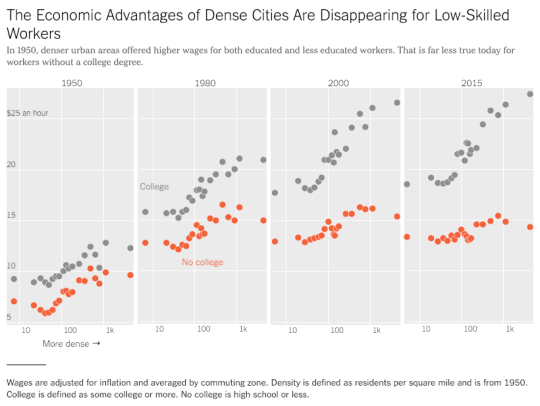
The New York Times has a recent article up talking about the disappearing “urban advantage” for low-skilled workers. It is based on the work of MIT economist David Autor.
Here is a chart from the article plotting wages against population density from 1950 to 2015:
The clear takeaway is that dense urban centers remain a place where wealth is created – but you probably need a college degree.
The economic advantages of dense cities for those without one appears to be disappearing. The labor market has diverged.
Interestingly enough, David’s research also suggests that college graduates may be starting to abstain from the suburbs – even when they have kids.
And that’s because the returns to being in the city are so great.
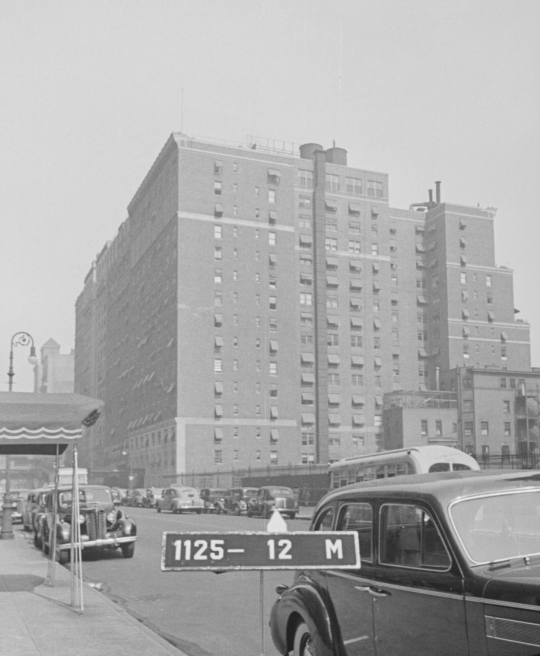
Starting in the late 1930s, New York City began hiring photographers to document each and every building in the city. It did this to improve the accuracy of its tax assessments, and so every photo was taken with a sign board indicating the building’s block and lot number. The photos looked like this (taken from here):
The initiative produced over 700,000 black and white photos, all of which have been recently digitized according to the New York Times. The Times also recently published this interactive piece where they go back to these archival photos to see how the city has and hasn’t changed.
In the late 1930s and early 1940s, documenting a city and its buildings was clearly a manual endeavor. Today we have Google Street View (launched in 2007), which has now photographed much of the world. Many countries, including all of North America, are reported as having “mostly full coverage.”
But already autonomous vehicles (and their supporting services) are starting to scan and map our cities in new ways. So it will be interesting to see what ends up getting built on top of this data. I am certain it will empower much more than just better tax assessments.
Happy New Year, friends. Thanks for reading over the last year.
Eduardo Porter recently published this piece in the New York Times on the “relentless economic decline” of small-town rural America. We often talk about rising income inequality, but the greater concern is the alarming rate of joblessness in many of these communities. Earning less than others is not as bad as earning nothing.
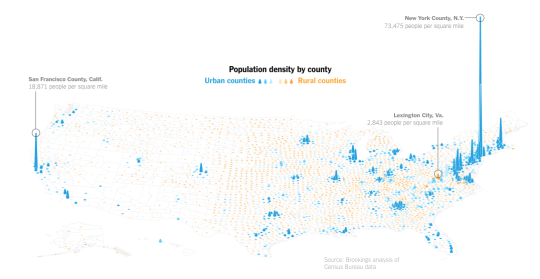
I think the below map from the article, depicting population density by county, starts to show how uneven the economic landscape is across the US. Porter puts it this way: “This is the inescapable reality of agglomeration, one of the most powerful forces shaping the American economy over the last three decades.”
But, of course, we don’t really have a solution to this problem. Some are suggesting employment subsidies, such as the earned-income tax credit. While others are suggesting that we need to make it easier to build in the large blue spikes shown above. That way we’ll be able to more affordably accommodate the people who will ultimately need to move from rural to urban.
While this latter suggestion may seem grim for small-town America, it is perhaps a reminder of what cities really are at their core: Cities are labor markets. They are the places where people come to get a job and make money.