
I posted this chart on Twitter last night. It’s from the WSJ showing new weekly confirmed COVID-19 cases in Florida, New York, and the U.S. as a whole. Now, the first thing I will say is that I relinquished my hopes of becoming an amateur epidemiologist back in April. I have no idea how this is all going to play out. But as an urbanist, it is interesting to note that back in April, many believed that New York City’s urban density was a real problem and the almost singular cause of its high number of cases (despite many other big and dense cities around the world doing much better). There was also a belief (or hope) that warmer temperatures might have a positive impact on transmission rates. That’s maybe why Florida was doing relatively better. But things have flipped. Cases in Florida are up and California just surpassed NY for the US state with the most number of cases. So who knows what will happen next. But what I do know is that wearing a mask isn’t a big deal (I have mine with me all the time) and that big urban centers will be just fine. City Observatory recently published apartment search data suggesting that dense cities have actually been getting more, rather than less, attention in the wake of COVID. That doesn’t surprise me.
Tag: new york city
-
Don’t touch that door handle
Door handles are a funny thing these days. They are one of if not our most common point of contact with the built environment, and yet in the best of times they go largely unnoticed. And in today’s world they have flipped to become a source of anxiety. Do I really need to touch this door handle or can I maybe use my foot or elbow? Some have responded by wearing gloves. But sometimes door handles offer up clues — such as a worn finish — as to where they are most commonly touched. But then one is faced with yet another difficult dilemma: do you handle the pristine part or remain committed to the worn out part since everybody else is probably thinking what you’re thinking and searching for the unadulterated section of the handle? Who knew that opening a simple door could elicit such complexity.

But we shouldn’t be too critical of the mighty door handle. Edwin Heathcote recently published this short history of door handles and it’s a good reminder of the design intent that has gone into them over the years and how they also came to embody our broader views about architecture. One of my favorites, of course, is the original Bauhaus door handle designed by Walter Gropius and Adolf Meyer c. 1922. (Pictured above, it’s currently housed on the fifth floor of the MoMA in New York.) Its lever starts out square and machine-like, but then transforms into a cylinder, exactly where you’re supposed to grip it with your hand. It is ultra minimal, but it tells you exactly what to do. It also helps us with our dilemma. Worn or not worn, the cylinder is obviously where it should be handled.
Image: MoMA
-
What’s in a street name?
In Toronto we have a street named Avenue Road. If you’re learning about this for the first time, you might be wondering: “Well, is it an avenue or is it a road?” Then again, does that sort of distinction even matter? Does it imply certain characteristics? When I think of an avenue, I think of a broad and straight tree-lined street. And indeed, Avenue Road is connected to a street called University Avenue, which is pretty straight, broad, and has trees lining it. It’s a ceremonial kind of street that leads you toward the Ontario Legislative Building. It fits my definition. And so maybe Avenue Road is really saying, “Yeah, I know I’m not an avenue in the traditional sense, but I eventually connect into one and so I have decided to use both names.”
It could also be the case that we haven’t always been that meticulous when naming our roads. Or perhaps we simply changed the way we designed and thought about our streets as we sprawled outward, and along with that came some name changes. In the oldest parts of Toronto, the main streets tend to be exactly that — streets. And our secondary streets are often named as avenues. This is the opposite of a place like Manhattan, where avenues are the broad north-south streets that take you downtown and uptown, and streets are the smaller east-west roads that take you across the narrower part of the island. Here there is a very clear logic. Avenues are big. Streets are small.
Looking at this road name map of London by Giuseppe Sollazzo (click here if you can’t see it above), it’s obvious that London’s street network is pretty much the opposite of New York’s rational street grid. But you can see what appears to be a clear graduation from streets (in the center) to roads and then to some sort of melange that seems to include a bunch more avenues. They may just be street names, but they to speak to a whole host of things, including the evolution of our cities, changing attitudes toward city planning, and naturally the adoption of new kinds of mobility. They also make for nerdy maps.
-
New York City is budgeting $30.8 billion in property tax collections
According to the WSJ, New York City is budgeting to collect $30.8 billion in property taxes for fiscal year 2021. These tax bills will go out on June 1 and payments will start becoming due on July 1, which is the start of the city’s fiscal year. Here’s how the collections break down across houses, apartments, and commercial properties:

Overall — and despite the fact that values have softened in the wake of COVID-19 — this year’s property tax budget represents a 5.7% increase over FY2020. The reason for this is that each year the city completes its annual assessments on January 5. And so according to the city’s January numbers, everything is just fine.
Supposedly this January 5 date is usually non-negotiable. A lawyer is quoted in the Journal article saying that under normal circumstances, if your house were to burn down on January 6, you would still have to pay all of your taxes for the upcoming fiscal year.
Time will tell if this time is different. But it is interesting, though not surprising, to note just how significant property taxes are to New York City’s overall tax collections. They represent a little more half of all taxes collected.
-
Long live the megacity
Azeem Azhar’s recent newsletter, titled “Don’t call time on the megacity: cities will learn and adapt,” is a reminder of the tensions that cities face. There are forces of attraction. And there are also forces of repulsion.
Cities all around the world continue to create wealth and lift people out of poverty. But they also repulse people through traffic congestion, housing supply shortages, and overcrowding (which is distinct from density). Generally though, the forces of attraction have tended to outweigh the forces of repulsion, which is why the world continues to urbanize.
As Azeem points out, the first city believed to have reached 1 million inhabitants was Rome. It happened some 2,000 years ago. In the 1930s, New York then became the first city to reach 10 million inhabitants. And today, the 10 largest urban agglomerations in the world look something like this:

Outside of Japan, all of these city regions are expected to add many more people by 2030. Missing from this chart, however, are cities such as Lagos, Nigeria. Between 2018 and 2050, the UN estimates that 35% of the growth in the world’s urban population will come from just three countries: India (+416 million), China (+255 million), and Nigeria (+189 million).
Long live the megacity.
-
New Yorkers are actually pretty healthy
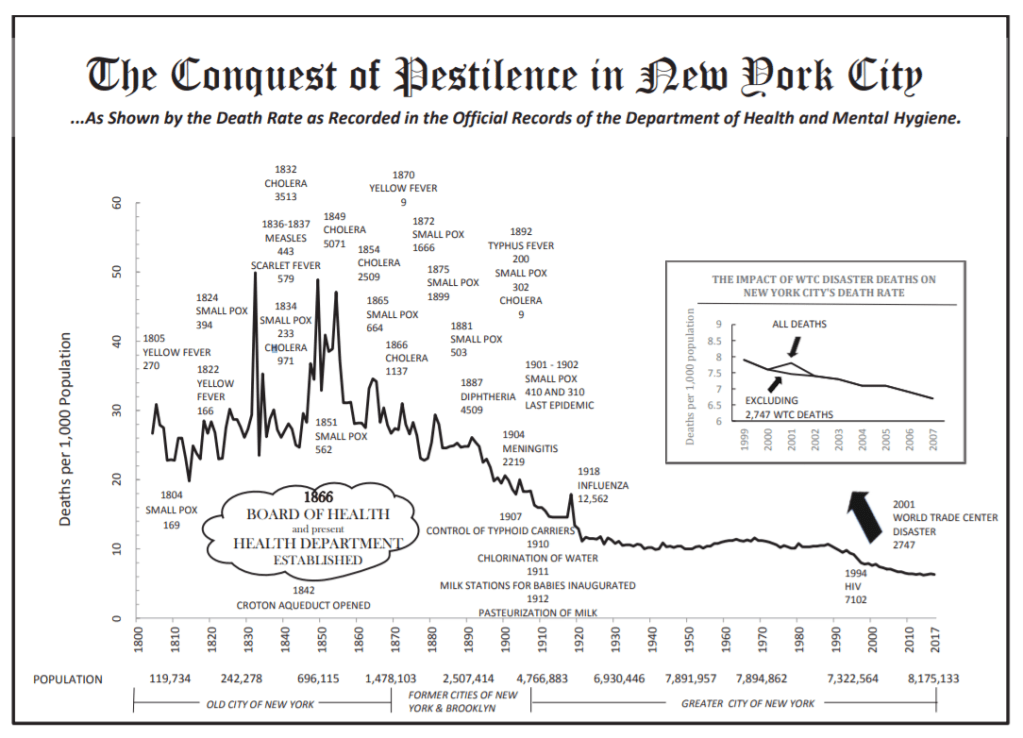
Nicole Gelinas’ recent piece in CityLab is a good reminder that — despite all of the debates around COVID-19 and urban density — New York City is actually a really healthy place to live. Part of this obviously has to do with the city’s investments in public health. But the biggest factor, Nicole argues, is the city’s transit network. Six million people move around New York City each day without a car. That translates into a meaningfully lower traffic fatality rate. New York State’s rate is about 4.8 per 100,000, whereas Florida’s is 14.7 deaths per 100,000. Taking transit (and having an urban morphology that supports taking transit) also brings along with it other benefits, such as increased walking. And I have to believe that is an important factor. The obesity rate in New York City is thought to be about 22%, compared to a shocking 42% for the country. All of this rolls up into a life expectancy of about 81.2 years for New Yorkers, as of 2017. This is compared to 78.6 years for the US as a whole.
For more on the health of New Yorkers, check out this 2017 Summary of Vital Statistics. (It’s the source of the above chart.)
-
What’s next for cities? Probably more of the same.

I am surprised, although maybe I shouldn’t be, by how quickly many seem to be allegedly turning their back on cities. According to the New York Times, cities were “losing their allure” well before this pandemic, and this might just be the tipping point. The underlying argument: Density is bad. We should probably all move somewhere bucolic, where the cost of housing is less and work isn’t so stressful. Zoom only when necessary.
But as the chief economist for Indeed, Jed Kolko, rightly points out in the article, how people behave (and think) during a global pandemic is probably not a great indicator for how they will want to live their lives when this is all over. It’s also not clear that urban density is really the contributor of spread. Hyper-dense cities such as Seoul and Hong Kong have been performing relatively well. (Joe Cortright has some thoughts on this.)
Once we get to the other side, we will see the data and we will get a better understanding of this current situation. And then in hindsight, we will find ways to rationalize the outcomes to ourselves. In the interim, I’m not about to bet against cities. Here’s how Paul Romer, professor at New York University, put it in this recent interview in City Journal:
“I think the underlying economic reality is that there is tremendous economic value in interacting with people and sharing ideas. There’s still a lot to be gained from interaction in close physical proximity because such interaction is a large part of how we establish trust. So I think that, for the rest of my life, cities are going to continue to be where the action is.”
-
$27 million worth of condos in New York
This week it was reported that a South American family has bought and closed on ~$27 million worth of residential condos at Waterline Square in Manhattan. Apparently they went into contract (after the online showings) and closed on the same day, which I suppose you can do when it’s an all-cash deal like this was. The agent, Maria Velazquez, didn’t disclose who the family was, but apparently they’re from Peru and they wanted a safe place to park their money during this pandemic. Uncertain times usually create buying opportunities, and it sounds like the family did get a bit of a bulk discount here. But it’s also interesting to see where capital is flowing right now and what is perceived as a safe haven. Residential real estate in one of the world’s preeminent global cities probably won’t come as a surprise to any of you.
-
Leveraging mobile phone data during a pandemic
Smartphone user data is hugely valuable at a time like this. Which is why governments all over the world from Israel to South Korea are using aggregated telecom data to try and track how their citizens are moving during this pandemic.
Some are calling this a violation of digital rights. I don’t know enough to comment on that specifically, but I do know that the value to society as a whole is clear. It strikes me that if we knew (1) who was infected (you know this by doing widespread testing), (2) where people have been, and (3) where people are today, we would be in a much better position to contain the spread.
To that end, Singapore’s Ministry of Health has been publicizing a surprising amount of information regarding its cases. And that data has been in turn made into interactive maps. You can see who is infected, where they live and work, which hospital they were admitted to, and so on. Is this an overshare? Or is this price of collective health and security?
The New York Times has similarly gone and visualized the movement of people and the virus using data from major telecoms, Baidu, and other sources; though in this case it is more of a retrospective view of what went wrong as opposed to a proactive management tool. The argument they make is that Wuhan’s lockdown was too little, too late.

According to the NY Times, 175,000 people left Wuhan on January 1st alone. Throughout the month of January, outbound travel from Wuhan accelerated as many started to fear a lockdown. About 7 million people left in January. Where they travelled to can be found here. Would it be too draconian to use this kind of mobile phone data to see who is obeying a lockdown and who is not?
Images: New York Times
-
How superstar cities can continue to scale
Aaron Renn’s latest article in the Manhattan Institute is about how America’s top cities can “grow to new heights.” Usually when we talk about urban problems, it is because of failures. But in this case, it is about problems of success (though I suppose you could argue these are still failures).
Cities such as New York and San Francisco have, in his view, stopped thinking like growth cities and that is leading to high home prices and overburdened infrastructure. But we all know that these problems are not unique to only “superstar cities.”
Not surprisingly, Aaron argues that we need to stop implementing land use policies that only exacerbate our housing supply problems. Things like rent control and inclusionary zoning. And in some cases, it may be time for states to start intervening in local planning decisions.
For the full article, click here.