Daily insights for city builders, delivered every morning at 6 AM ET. I’m Brandon Donnelly — a Toronto-based real estate developer and founder of Globizen. I’ve been writing here since 2013.

Tag: Montréal

  • Sonder — intimate neighborhoods, consistent quality

    Airbnb has been a game changer. I know many people who have made Airbnb their full-time career or who “stay for free” when they travel because they Airbnb their home. Airbnb likes to focus on the “community” rather than on the business possibilities, but regardless, it unlocked space in a new way.

    Here’s another take on decentralized vacation rentals: Montreal-based Sonder. Similar to Airbnb, you submit your property to their platform. But unlike Airbnb, they take care of everything from reservations and guest communication to operations and housekeeping. It’s a completely hands-off approach for owners.

    The value proposition to guests is that they get a more consistent experience, but with all the “local color” of a traditional vacation rental. And for owners, they get to maximize revenue without having to be as hands-on as with an Airbnb. (Presumably Sonder’s take is greater.) In many ways, it’s like a decentralized hotel chain. Same supply source as Airbnb, but they are now unifying the customer experience.

    It’s fascinating to watch this software/internet layer developing on top of real estate. It’s giving me all sorts of ideas.

  • Forest

    I just backed the following project on Kickstarter:

    https://www.kickstarter.com/projects/991195979/n-o-r-t-h-simple-timeless-and-refined-watches/widget/card.html?v=2

    It is a new watch line from two Montreal designers. The brand is called Forest Time Co. There’s so much creative talent in that city.

    I was immediately drawn to the focus on minimalism and on high quality materials. That’s a philosophy I can get behind. I plan to go for the black band with copper case.

    I know nothing about watch movements, but it’s a “Japanese Miyota.” I assume that’s pretty basic.

    I love finding interesting projects on Kickstarter. There’s something about backing a team and their new creation. We should all aspire to make and create more.

    At the time of writing this post, they’re about $1,000 shy of their funding goal of $24,000. I hope they reach it by this Sunday. I’m sure they will.

  • BARED: David Wex, Urban Capital Property Group

    image

    David Wex started his career working for one of the big Seven Sister law firms in Toronto. But right from the outset, it was clear that he wasn’t in it for the long run.

    In fact, only a few days after he started, David had the clever idea of turning his desk around so that it faced the window, instead of the hall. That way, he could avoid eye contact with partners as they walked by his office, and reduce his chances of being assigned a file.

    Of course he couldn’t avoid being tracked down all the time. But whenever someone would try to assign him work, he would simply say: “I’m sorry, but I’m really busy working on something right now.” His nickname quickly became “One File Wex” and it was clear that he was headed towards the departure lounge and not a corner office.

    But already, David had his mind set on doing something related to cities. So while still working as a lawyer he decided to complete his Graduate Record Examination (GRE) in preparation for going to planning school. Ultimately, he decided not to go back to school, but instead leave the firm and just figure things out. He left in 1992.

    After leaving, he did in his words, “nothing” for a few years. He lived off his savings, spent some time working with a bunch of guys cleaning up the Don River, and tried to figure out a way to put together a development project.

    Eventually he met a friend of the Goodman family and this led to an introduction to the Dundee Corporation.

    It was the early 90’s and nothing was happening by way of development in Toronto. The real estate industry was in a deep recession. Ask anyone who was “active” during this time. It was a painful time to be in the business. But the Goodmans told David that he if could find a suitable site to develop, they would invest. Lesson: Developers are constantly leveraging other people’s money.

    So David went out and found a site on a sleepy street named Camden in Toronto’s Fashion District. This is not the Camden Street of today, which has an Ace Hotel currently in the works. It was a dead zone. By this point we are in 1995 and few people believed that anyone would want to live on a downtown street like Camden.

    Given the perceived undesirability of the site and the continued lull in the market, David tied up 29 Camden for C$700,000 with a 2 year option. What this means is that he had 2 years to figure out if he actually wanted to close on it. He could put very little money down and get the project going before having to worry about carrying the land. It wasn’t until midway through sales that he actually went firm.

    It’s hard to imagine being able to do this in today’s competitive real estate market, but that was the market at the time.

    Of course, the flip side to all of this is that it also took him 2 years to sell about 20 condominium units (out of a total of 55), at an average price per square foot of $195. Today you could sell those units in 2 hours at $800 psf.

    Brad Lamb – who was just starting out at the time – was the broker on the project. And activity at the sales office was so scant that everyone would get excited even when a car would drive down Camden Street. That’s how dead it was in the Fashion District.

    Eventually Dundee got impatient. Sales were slow. A lot of money had been spent on marketing. And the partners didn’t believe that “the bump and grind of Queen Street” (original marketing pitch) was the right way to position the product. David was also in the midst of rebranding his company from Red Rocket (named after our transit commission) to Scrappy Dog Real Estate Investments. By that point Dundee came in and said: “You’ve fucked up this project. You’re out.”

    David had felt like he had made it and become a developer with Camden Lofts. But just like that – before construction had even started – he was off the project.

    The deal that David struck with his partners was that he didn’t want any money out of the project (it didn’t end up making much money anyways). But he wanted to stay involved and be able to call Camden Lofts his project. And so to this day, Camden Lofts remains the first development project of his very successful real estate career.

    But Camden Lofts didn’t solidify David as a real estate developer. After the fumble, David took on the role of managing a loft conversion for what turned out to be some pretty dodgy landowners. The total management fee was a princely $5,000, but David wanted to complete his own project from beginning to end. And so he did just that with Century Lofts at 365 Dundas Street East. He also spent a great deal of time learning Illustrator, Photoshop, and other design tools so that he could do all of the marketing himself. This is an experience that would later manifest itself in his company’s business model.

    After tuning his craft for a couple of years, David met his current business partner, Mark Reeve. Mark was a corporate real estate developer and planner, and they talked about doing something together. So they did, and the result was Urban Capital Property Group. Mark was also able to planning consult on the side and that helped fund their fledgling business as they worked on breaking into the development game.

    The first project to come out of this relationship was The Sylvia, which was also on Camden Street (#50). However, you won’t find this project on their website because it was done in partnership with developer Intracorp. The relationship ended up not being a productive one and both David and Mark vowed never again to be involved in a project that they weren’t actively managing themselves. That vow continues to this day.

    The first project that Urban Capital did on their own was the 66-unit Charlotte Lofts. It’s the first project they completed from A to Z. They sourced the site, secured the financing, worked on the design, marketed it, and constructed it. It was a success.

    The partners did well but the learning curve remained so steep that neither felt that they had really “made it” with this project. Indeed, my interviews have uncovered that this is a common experience amongst new developers. It can take a few projects before they really hit their stride and, in some cases, even make any money.

    But who ever remembers the stumbles?

    Today, Urban Capital has completed over 4,000 urban condominiums and has another 2,500 in the works. They have developed over $2 billion worth of real estate to become one of Canada’s most influential urban infill developers.

    Unlike other Toronto-based condo developers, they have branched out beyond Toronto: east to Montreal, Ottawa and Halifax; and west to Winnipeg and Saskatoon, with other cities on the horizon. Their mission is to act as an urban regenerator by bringing high design urban living to new markets across the country.

    They have come a long way since the days of Scrappy Dog Real Estate Investments. Clearly David is the furthest thing from “One File Wex.”

    You can follow Urban Capital on Twitter and on Facebook.

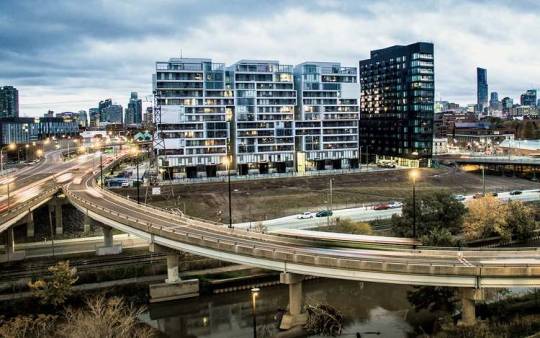
    Image: River City 2, Toronto

    ———————————————————

    This is the first post in my new blog series called BARED (Becoming A Real Estate Developer). More posts to come in the following weeks. Subscribe to stay in the loop.

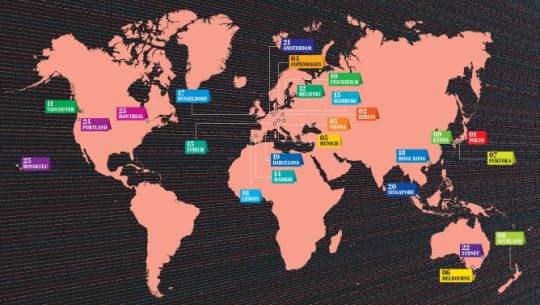
  • Monocle’s Top 25 Liveable Cities — 2016 Edition

    Monocle’s annual survey of the top 25 most liveable cities in the world was just released. It’s now in its 10th year. I found it in my inbox this morning and it was a good reminder that it was about time I renewed my subscription. I’ve been a regular reader of Monocle since 2007, but I let my membership lapse last year.

    Of course, any sort of list like this is going to be subjective. It all depends on the methodology you use. Still, their annual survey is an interesting way to see what each city is up to and where the tides are going. This year Monocle put extra weighting on each city’s nightlife. If you’re not a subscriber, here’s a short video you can watch. It will give you a rundown of all the cities. (I was happy to see Montréal creep onto the list. Incredible city.)

    This focus on the night is something that I’ve been writing about a lot both on this blog and elsewhere. It’s an idea that’s picking up momentum around the world as an economic development strategy. But for whatever reason, uptake seems to be slower here in North America.

    I like how architect Anna Dietzsch puts it in this video. She says that Rio may have the beaches, but Sao Paulo (where she’s based) has the night. That’s exactly how cities should be thinking about this opportunity. It used to be that cities thrived almost entirely because of location, waterways, transport, and other natural features (example: Buffalo). But increasingly, it’s becoming about things like nightlife.

    Vancouver may have the mountains, but Toronto has…

    Image: Monocle

  • The most fascinatingly boring city in the world

    The Guardian Cities UK is currently focusing on all things Canada for a special week-long series. The first post is up and it’s about why Toronto is “the most fascinatingly boring city in the world.” The piece is by Stephen Marche.

    I don’t agree with everything in the essay – or maybe I just despise being called boring, steady, and predictable – but there are a number of great gems that I would like to reblog today. Here are the 5 that stood out for me.

    1. Chicago vs. Toronto:

    “What Chicago was to the 20th century, Toronto will be to the 21st. Chicago was the great city of industry; Toronto will be the great city of post-industry. Chicago is grit, top-quality butchers, glorious modernist buildings and government blight; Toronto is clean jobs and artisanal ice-creameries, identical condos, excellent public schools and free healthcare for all. Chicago is a decaying factory where Americans used to make stuff. Toronto is a new bank where the tellers can speak two dozen languages.”

    2. London vs. New York vs. Toronto Bankers:

    “In London and New York, the worst stereotype of a banker is somebody who enjoys cocaine, Claret and vast megalomaniac schemes. In Toronto, a banker handles teachers’ pension portfolios and spends weekends at the cottage.”

    3. Montreal vs. Toronto:

    “I was 19 when he said that, and I knew even then that for the rest of my life, Canada’s future would be built on money and immigrants. I wasn’t wrong. Most Canadian business headquarters had already taken the five-hour drive west. After 95, the rest followed. Montreal decided to become a French-Canadian city. Toronto decided to become a global city.”

    4. The last time Toronto built a white elephant subway line:

    “On any given morning on the Sheppard subway line in the north of the city, you can sit down in perfect peace and order, although you will find little evidence of good government. As the latest addition to Toronto’s fraying infrastructure, the Sheppard subway is largely untroubled by urban bustle. The stations possess the discreet majesty of abandoned cathedrals, designed for vastly more people than currently use them, like ruins that have never been inhabited. Meanwhile, in the overcrowded downtown lines, passengers are stacked up the stairs. The streetcars along a single main street, Spadina, carry more people on a daily basis than the whole of the Sheppard line, whose expenses run to roughly $10 a passenger, according to one estimate. A critic has suggested that sending cabs for everybody would be cheaper.”

    5. On Mayor Tory:

    “The current mayor, John Tory, is not an idiot, although he is hardly a figure of the “new Toronto”. He represents, more than any other conceivable human being, the antique white anglo-saxon protestant (Wasp) elite of Toronto, his father being one of the most important lawyers in the city’s history. The old Wasps had their virtues, it has to be said – it wasn’t all inedible cucumber sandwiches and not crying at funerals.”

  • Our urban history in 50 buildings

    At the time of writing this post, it’s still 2015 – at least here in Toronto. But by the time you (subscribers) get this post in your inbox, it will be 2016. So happy new year! I am thrilled about getting this year started and I hope you feel the same way.

    To kick things off, I thought I would share a great interactive post from Guardian Cities called, A history of cities in 50 buildings. It’s a look at our urban history through 50 important and pivotal buildings. Buildings such as Southdale Center, which was the first fully enclosed, climate-controlled shopping mall, and Chicago’s Home Insurance Building, which was a building that really set the stage for the modern skyscraper that we know today.

    Not all of these buildings have left a positive legacy on our cities. I am sure that some of you would argue that the creation of the suburban shopping mall, with its corresponding “sea of parking”, was not a step forward for cities, but a step backwards. The architect behind Southdale Center, Victor Gruen, has even gone on record saying that he refuses “to pay alimony for those bastard developments.” He hated the shopping mall.

    But like them or not, these buildings are part of our urban history, and I think it’s not only interesting but important to understand their impacts. If you want to see which important buildings were missed, at least according to Guardian readers, click here. I have to say that I was happy to see both Montréal and Toronto represented in the original list, as well as a few other buildings that I’ve written about here.

    On that note, happy new year to you all, again, and many thanks for reading Architect This City. If you have any suggestions for content you would like to see on this blog in 2016, please leave it in the comment section below. This may be my personal blog, but my goal is to make it valuable for all of you. Hopefully I achieve that sometimes.

  • The Olympics are dead. Or are they?

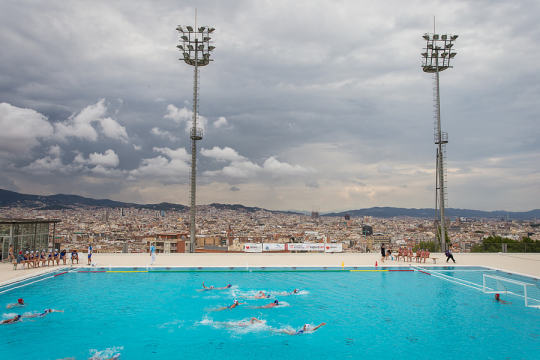
    Olympic Pool – Barcelona, Spain by Tom Weightman on 500px.com

    https://500px.com/embed.js

    Early this morning Professor Robert Wright – who is a regular reader and commenter on this blog – sent me an article from The Guardian called, ‘The Olympics are dead’: Does anyone want to be a host city any more? And that got me thinking.

    With Toronto having just hosted the Pan Am Games (the Parapan Am Games are still going on), there’s a lot of talk and debate happening in this city right now about whether or not we should make a go at hosting the 2024 Summer Games. The deadline for cities to express their interest is September 15th, 2015.

    The supporters (of which I would include myself) say it’s a great opportunity for civic (re)branding and urban renewal. It creates real deadlines to get things done. But the naysayers argue it’s a fiscal disaster waiting to happen. See 1976 Summer Olympics in Montreal.

    But in my view there are ways to host the Olympics and there are ways not to host the Olympics. Montreal (1976) is an example of what not to do. And Los Angeles (1984) and Barcelona (1992) are some of the best examples of what to do.

    The key is to think of the Olympics not as the end, but more as the beginning. In Olympic talk, they refer to this as legacy. Here’s what Los Angeles managed to accomplish as a result of the 1984 Summer Games (via Gizmodo):

    In 1979, the L.A. organizing committee had made a deal. If the games saw any profits, LA84 would give 60 percent back to the U.S. Olympic Committee and keep 40 percent for Southern California. At the end of the games, the total expenditures came in at a respectable $546 million, but even more impressive was the profit: A surplus of $232.5 million, meaning $93 million would stay in the region. This was huge. The only other games at the time which could claim to be financially successful at all were the other L.A. Olympics: The ones held in the city in 1932.

    The profits were used to create an endowment called the LA84 Foundation, which funds youth sporting events, resources, and facilities throughout the area. With smart management, the endowment has grown over the years, and over $214 million has helped an estimated three million children and 1,100 organizations in Southern California. Recently, the LA84 Foundation helped raise money to pay coaches and buy equipment at LAUSD high schools after budget cuts decimated their programs.

    The rest of the above article is definitely worth a read. It’s a great example of fiscal prudence.

    So what I am suggesting is not that we run blindly into hosting the Summer Games. But that we instead open our minds to the opportunities. Let’s great creative. If we could catalyze further city building, turn a profit, and leave meaningful legacies for this region (like what LA did), then why wouldn’t we want to have a go at it?

  • What food is your city famous for?

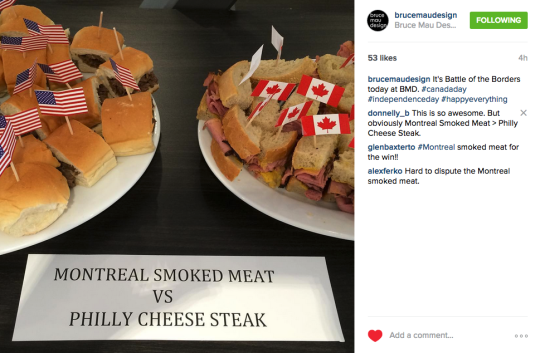
    Yesterday I came across the above Instagram post by Bruce Mau Design, which pitted the Philadelphia Cheese Steak sandwich against the Montreal Smoked Meat sandwich in a “battle of borders.” It was to celebrate both Canada Day and American Independence Day.

    I thought this was an awesome idea, so I tweeted out the photo. Then Daniel Kay Hertz – who is a Senior Fellow at City Observatory and from Chicago – asked me: “Is there a Toronto equivalent?

    And that got me thinking. 

    Montreal has smoked meat, bagels, and poutine. Philly has the cheese steak. Chicago has deep dish pizza. Quebec City has maple sugar and tourtiere (a kind of meat pie). New Orleans has po’boy sandwiches. Boston has clam chowder. Austin has tacos. Seattle has crab. And the list goes on.

    But what is the quintessentially Toronto dish? Asian fusion food? Peameal bacon sandwiches from the St. Lawrence Market? I really don’t know. So I think we should decide on one right now. Think of it as an exercise in city branding.

    Leave your suggestion in the comments below and we’ll have a vote.

  • Toronto is at the center of an emerging megalopolis

    https://500px.com/embed.js

    With the recent talk around downtown Cleveland’s resurgence, I am reminded that for those of us living near the Great Lakes, we are living in one of the most important urban agglomerations in the world: The Great Lakes Megalopolis.

    In 1962, French geographer Jean Gottmann wrote a seminal book called, Megalopolis: The Urbanized Northeastern Seaboard of the United States. And in it, he described the remarkable clustering of cities in the northeast, running from Boston in the north to Washington D.C. in the south. He called this the Northeast Megalopolis.

    The term megalopolis simply refers to a clustering or chain of generally adjacent metropolitan areas.

    Then in the 1960s and 1970s, architect and planner Constantinos Doxiadis started writing about the emergence of what he called the Great Lakes Megalopolis. In his mind, a contiguous urban region was forming that stretched all the way from Chicago in the west to Quebec City in the north east. And at its economic center was the city of Detroit.

    More recently, Richard Florida, as well as others, have been referring to these urban clusters as mega-regions. And in the case of the Great Lakes, Florida broke the area down into two distinct regions: Chi-Pitts in the west and Tor-Buff-Chester in the east. (I think you can guess how the names were derived.)

    According to his research, these two mega-regions have a combined population of almost 60 million people and an economic output equivalent to almost $3 trillion. That places it in line with the Northeast Megalopolis. But according to the Brookings Institution, the output coming from the Great Lakes could be closer to $4.5 trillion.

    Whatever the case may be and whatever you want to call it, the Great Lakes Megalopolis is unquestionably an economic and cultural powerhouse. But this has me wondering whether or not we’re doing enough to unleash its full potential.

    When I attended Joe Berridge’s talk last week on Toronto as a global city, I asked him how he thought we should be organizing our cities and regions. Do city-states make sense? Should we be rethinking the relationship between provinces/states and cities?

    His response was that we should be creating agencies and entities with regional authority (as opposed to fighting to make any constitutional changes). For example, the Toronto region should not have an array of competing transit agencies (as it does today). It should have one regional transit authority that blankets the region. People, ideas, and capital don’t follow borders.

    So with that in mind, what opportunities are there for us to unite the metropolitan areas within the Great Lakes Megalopolis?

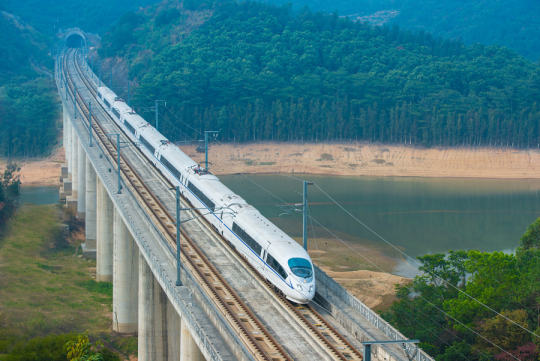
    The first idea that comes to my mind is a high speed rail network that seamlessly connects to each city’s local transit network. Imagine a Great Lakes bullet train that could zip you across the region. It would completely reorganize the spatial landscape.

    Here’s an excerpt from a recent report by the Independent Transport Commission called, Ambitions & Opportunities – Understanding the Spatial Effects of High Speed Rail:

    There has been a global shift of economic power and influence from nation states to cities and city-regions. Today’s successful cities collaborate across existing boundaries to form polycentric metropolitan regions. As a result cities function in a much less self-contained manner than they did fifty years ago. Longterm trends in the pattern of urban settlement reflect the interplay between opportunities for dispersal afforded by greater mobility, and economic and social forces promoting concentration.

    But what else could we be doing to empower the Great Lakes Megalopolis? 

    I would love to hear your thoughts in the comment section below. I think there’s a strong case to be made for thinking at the scale of the megalopolis and not just at the scale of our own backyard.

  • 7 ideas and lessons for global cities

    Today I had the pleasure of attending a really great talk by Joe Berridge (partner at the planning firm Urban Strategies) that was all about how Toronto can best maintain its position as a globally competitive city. 

    He went through 7 ideas/lessons. Though they were specifically aimed at Toronto, most of them could be applied to any city that’s concerned about its position on the global stage. They are:

    1. Invest in infrastructure, such as transit, airports, and so on. Sustainable funding and proper governance are critical. Transit planning in Toronto has become far too political and it’s crippling our city.
    2. Embrace Uber and get them using our Presto card so that it becomes a legitimate part of the city’s public transit network. Every city in the world is battling with Uber. Toronto has the opportunity to take a leadership position.
    3. Build a new convention centre and invest more in tourism and economic development. Berridge’s suggestion was something big at Ontario Place/Exhibition Place.
    4. Build new Universities to fuel the knowledge economy. See New York’s Cornell Tech campus as an example.
    5. Invest in infrastructure and institutions that turn research and development into businesses. Platforms like MaRS.
    6. Start thinking big. This was specifically geared towards Toronto, as his argument was that we do a lot of the small things right, but we’re missing out on the really big opportunities.
    7. Create Suburban Enterprise Zones to help drive employment outside of the core and along new transit corridors.

    Alongside these ideas and lessons, there was a fascinating sub-argument. And that is that Toronto is really an accidental global city. In other words, we didn’t set out to become a top 10 global city and one of the fastest growing cities in the developed world.

    But by getting a lot of things right – such as a high quality of life – and through a bit of luck – such as Montreal shooting itself in the foot – we somehow became one. But we absolutely shouldn’t take that for granted. There’s lots of work to be done.