Daily insights for city builders, delivered every morning at 6 AM ET. I’m Brandon Donnelly — a Toronto-based real estate developer and founder of Globizen. I’ve been writing here since 2013.

Tag: Montréal

  • The missing middle will come, eventually

    Yesterday Lloyd Alter of Treehugger wrote a great rebuttal to my post about homes for families. His argument was that I missed a whole world of building typologies between single family homes and apartments. (Something that architect and urban planner Daniel Parolek calls “The Missing Middle”.)

    Now he’s absolutely right. I didn’t mention it – other than provide an option in the survey for townhomes. And he’s right that it’s a tremendous opportunity for cities looking to increase housing supply and improve affordability.

    But the reason I didn’t mention it in my survey is because, here in Toronto, we’re not very good at that middle scale.

    I previously wrote a post talking about Toronto’s 3 stages of intensification. It went from high-rise to mid-rise, and then to low-rise intensification. And my argument was that we’re still in and figuring out the mid-rise scale. (There are challenges at this scale, but that deserves a separate post.)

    Eventually though, I think we will get to low-rise intensification. And that will cover off many of the building typologies that Lloyd is talking about: duplexes, triplexes, fourplexes, and, my personal favorite, laneway houses.

    This, of course, isn’t the case in every city. Many cities, such as Montreal, have a strong history of neighborhood-scaled apartments. Lloyd points that out in his article. But that’s not the case here in Toronto.

    In fact, Toronto’s Official Plan explicitly designates these low-rise “Neighborhoods” as areas that are stable and should not see much intensification. And it was a great selling point for the Places to Grow Act: intensification here, but not there.

    But I think this will change. Not because I’m a real estate developer and I think it should change, but because our current arrangement is causing a dramatic erosion of affordability at the low-rise/ground-related housing scale.

    If it were up to me, and it most certainly is not, I would start with laneway housing. It’s a great way to intensify low-rise neighbourhoods without altering the character of the streets.

    If you live in a single family neighborhood, I would especially love to hear your thoughts in the comment section below. It will be interesting to see how this all plays out. 

  • 4 design strategies for your cold-climate waterfront

    Photograph Sugar Beach in Toronto by christophmarten on 500px

    Sugar Beach in Toronto by christophmarten on 500px

    Since we’ve been discussing waterfronts lately, I thought I would share this post from ArchDaily talking about 4 ways that cold-climate cities can make the most of their waterfronts.

    They are:

    1. Plan for winter sun
    2. Create plazas that block wind
    3. Break up outdoor spaces with comfort stations (not sure why they just have to be stations)
    4. Design for active winter programming

    These, of course, aren’t new design strategies. Cities have been built around their climates since, probably, the beginning of cities. It wasn’t until more recently that we started basically ignoring local climates and focusing more on what mechanical systems can do to make us feel comfortable.

    But I think that was a mistake. I don’t think that mechanical systems are bad though. I just think that there’s a lot that we can do first – without mechanical systems – to address local climates.

    If you’ve ever sat on a patio during a swing season (i.e. right now) where the wind was blocked and you were in the direct sun, you already know that there’s a lot that can be done without relying on active systems.

    But the other thing I like about this post is that it acknowledges the fact that winter waterfronts require just as much, if not more, design attention than a warm-climate waterfront.

    Saying that we’ll (insert cold-climate city name here) never be Miami or Barcelona or Sydney is just giving up.

  • Waterfront Cities of the World comes to Toronto

    image

    This morning I was interviewed for a Montreal-produced TV show called Ports D’Attache. The English version of the show is called “Waterfront Cities of the World” and it airs on Discovery. 

    Here’s a list of all the cities they’ve visited in the first 4 seasons and here are all the shows from the first 2 seasons in English (which you can watch online for free).

    Rather than a travel show, it’s a look at the “spirit and soul” of each waterfront city through the lens of “local personalities.” There’s definitely a lot of fodder for city geeks and so I thought you all might find the series interesting.

    Toronto was the last stop of season 5. The other cities from this season include Philadelphia, Budapest, Rome, Taipei and Kuala Lumpur, to name only a few of them. 

    I’m glad that they decided to come to Toronto and I’m delighted that they invited me to be on the show. The team was great and, if you haven’t already noticed, I love supporting this city.

    The show will first be released in French (with my comments dubbed over), but an English version will follow. Once that version is released, I’ll circulate a link.

  • The most segregated cities in North America

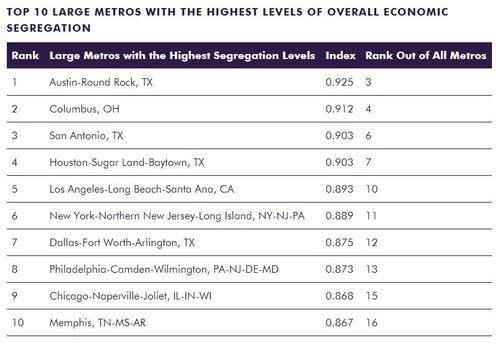
    The Martin Prosperity Institute here in Toronto just released a new research study called Segregated City: The Geography of Economic Segregation in America’s Metros

    The report looks at the physical sorting and separation of advantaged and disadvantaged groups within cities. And it did so across 70,000+ Census tracts in the US and in terms of 3 different dimensions: income, education, and occupation.

    Here are the most segregated “large metros” in the US:

    image

    Table Source: MPI

    And here are some of their broader findings – taken verbatim from page 9 of the study (click here for the full report):

    Economic segregation is positively associated with population size and density. It is also positively correlated to two other sets of factors that follow from metro size and density: how people commute to work and the breakdown of liberal versus conservative voters.

    Economic segregation tends to be more intensive in high-tech, knowledge-based metros. It is positively correlated with high-tech industry, the creative class share of the workforce, and the share of college grads. In addition, it is associated with two key indicators of diversity, the share of the population that is gay or foreign-born, which tend to coincide with larger, denser and more knowledge-based metros.

    Economic segregation is connected to the overall affluence of metros, with positive correlations to average metro wages, income, and economic output per capita.

    Race factors in as well. Economic segregation is positively associated with the share of population that is black, Latino, or Asian, and negatively associated with the share that is white.

    Economic segregation is associated with income inequality and even more so than with wage inequality. Its effects appear to compound those of economic inequality and may well be more socially and economically deleterious than inequality alone.

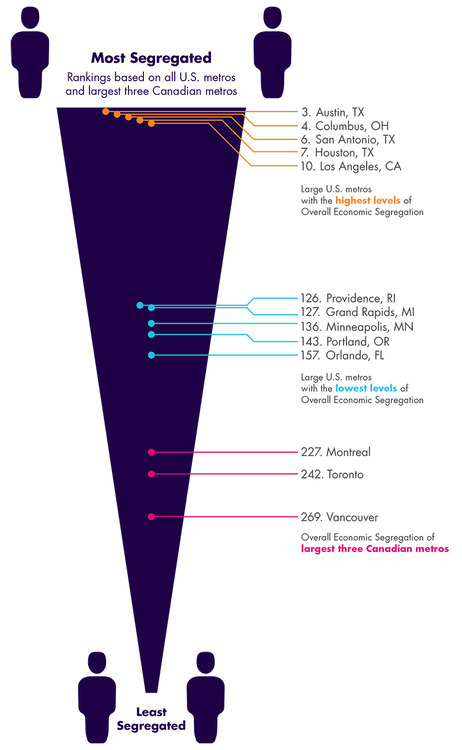
    The research team also looked at how Canada’s 3 largest metros – Toronto, Montreal, and Vancouver – compare to those in the US in terms of segregation. 

    The finding was that Canadian cities are overall less segregated than US cities, but that it should still be considered an area of concern. The most segregated of Canada’s 3 largest metros was found to be Montreal.

    image

    Image Source: MPI

    My view is that our economy is going through a profound shift right now. We’re transitioning from the industrial age to the information age. And in its wake, we’re seeing a number of disruptions, one of which appears to be rising inequality and segregation. 

    That’s not to say that I think this transition is a bad thing (I don’t think it is), but I do think we should be carefully considering and designing our future.

  • Why Canada needs a true urban agenda

    It should start from the premise that the fundamental underpinning of the Canadian economy to have prosperity is dependent on the success of the cities, because 80 per cent of Canadians live in cities.
    -Toronto mayor John Tory

    This week the leaders of Canada’s 22 largest municipalities are gathering in Toronto to figure out how to put urban issues on our national agenda. This is a topic I’ve touched upon many times before on Architect This City, but I continue to believe that it’s one of our most pressing issues.

    We know that the vast majority of Canadians live in cities (see above quote) and we know that the vast majority of our economic output is concentrated in cities. In fact, roughly half of Canada’s GDP is produced in our 6 biggest cities alone – Toronto, Montreal, Vancouver, Calgary, Edmonton, and Ottawa-Gatineau.

    But despite this concentration of wealth and economic activity, our governance structures do not reflect this reality. They’re outdated. They were built for a Canada that has passed. And so in my view, there’s a significant amount of untapped potential lying dormant in our cities if only we could get around to properly empowering them. There’s a “stimulus package” waiting to be unleashed.

    In anticipation of this week’s leadership meeting, the Globe and Mail published an article called, Canada’s big city mayors ready to push urban agenda. And in it they included a number of interviews with Canadian mayors. It’s fairly long, but definitely worth a read. Here are a few relevant sound bites…

    Vancouver mayor Gregor Robertson

    We have an archaic system. Cities aren’t recognized in our constitution. It’s unbelievable. But Big City Mayors have set aside those important gaps because the needs are now so urgent on housing and transit, we can’t afford to spend a couple years debating structural change. For the time being, the focus is just on ensuring there’s more federal capital provided for transit and other urban infrastructure.

    Calgary mayor Naheed Nenshi (on municipal funding sources)

    I would prefer to levy myself, so that I’m ultimately accountable to my citizens and, if they don’t like it, they can get rid of me. Allowing others to levy the tools takes away predictability and stability, as well. That said, we’re starving here, and any improvement to the system that leads to those predictable, stable cash flows is a good thing.

    Winnipeg mayor Brian Bowman (on the most pressing issue facing Canadian cities)

    I’d say without question infrastructure and new funding models to modernize the ways that cities fund themselves. That’s something I’ve started discussions on already with some of my counterparts, Mayor [Naheed] Nenshi in Calgary, Mayor [Don] Iveson in Edmonton as well as Gregor Robertson in Vancouver. We’ve talked about a number of topics including the missing and murdered indigenous women and girls issue, public transit and rapid transit development. But the one consistent theme is that the way cities are funded is outdated.

    Toronto mayor John Tory

    I start from this premise: Are people paying enough taxes? In many cases, you could argue, not only are they paying enough taxes, they can’t afford to pay any more. We should be looking at the total amounts paid to all three levels of government and how that is being allocated. Do we believe that, in the case of Toronto, the federal and provincial governments are making adequate investments in transit, given the amount of money they take out of this area in taxation? I would say the answer is: not yet. [But] they have been doing better.

    Montreal mayor Denis Coderre

    We are negotiating a new pact between the province and Montreal, and it’s all about municipal autonomy. We need tools so we’re not always waiting in the hallway at the end of legislative sessions looking for amendments to make the city work better. Since 85 per cent of immigration in Quebec is going to Montreal, we need more control over tools of integration, like job creation and housing. Montreal needs financial leverage…

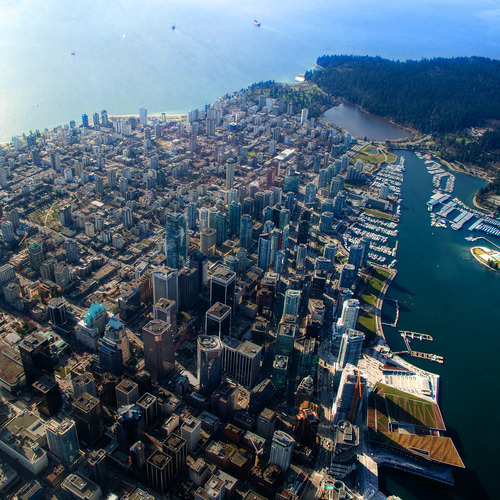
    Image: Vancouver via Flickr

  • Fun Friday: How Montreal makes winter awesome

    //player.vimeo.com/video/113321361

    It’s wintertime in Canada and that means people complaining about the cold and/or the fact that in our climate there are certain things that simply can’t (or shouldn’t) be done when it comes to city building.

    But I don’t buy that.

    A great counter example is Igloofest in Montreal. Unless you’re into electronic music (OK, fine, young people call it EDM today), you probably haven’t heard of it. But it’s basically an outdoor dance party on Montreal’s waterfront in the middle of the winter.

    The opening night is tonight and the overnight low is expected to hit -27 degrees celsius. Take a look at the video at the top of this post though (click here if you can’t see it). That’s how many people are going to crowd outside in the cold and dance their hearts out this evening.

    And so whether you’ve got harsh winters or summers, there are always creative ways to make it work for you. You just have to own it.

    If anyone would like to take a trip to Montreal this winter, I promise to stand by my words and dance outside in the cold. Have a great weekend everyone.

  • Life below zero and underground

    image

    A few years ago, I was touring a friend from the US around Toronto’s Financial District and the first thing he said to me was: “You have no retail.” And that’s certainly what it might look like at first glance.

    But there’s actually lots of retail. It’s just all underground in an over 30 kilometer long network of walkways called the PATH.

    Initially conceived of as the antidote to Canadian winters, “underground cities” are a kind of uniquely Canadian form of urbanism. Toronto and Montreal have the largest ones in the world and they continue to grow. As new towers are built, new connections are added.

    But the downside to all of this is that it pulls street life down underground. And it can conceal a lot of the urban vibrancy that is actually take place. So maybe we need to come up with design solutions to better connect these subterranean cities back to street level and also not forget about the street.

    I’m thinking about this today because of a CBC documentary I watched this morning called Life Below Zero. It basically argues that – unlike other cold climate cities and countries – the vast majority of Canadians actually hate winter. And underground cities are our way of trying to ignore it.

    Well, I don’t hate winter. In fact, I love it because it signals snowboarding season for me. But I may be in the minority. What’s your position on winter?

    Image: Flickr

  • How Toronto became cool

    image

    After yesterday’s post about Toronto, I had a friend ask me on Facebook what it is exactly that I think happened to make this city so much cooler. Was it because of one iconic building like Toronto’s new City Hall? Was it because of our recent condo boom? Or was it something else? What changed exactly?

    My response was that it’s a generational thing. Let me explain.

    Toronto used to have the reputation of being a boring and staid city, and that’s because it was a boring and staid city. In the immediate post-war years, Toronto was overwhelmingly Protestant and the immigration policies at the time were specifically designed to exclude anyone who wasn’t white and from Western Europe or America. If you were Asian, Southern or Eastern Europe (especially Jewish), then you were at the bottom of the entry list.

    Here’s how Prime Minister Mackenzie King felt in 1947:

    Prime Minister Mackenzie King reflected the national mood when he observed that “the people of Canada do not wish to make a fundamental alteration in the character of their population through mass immigration.” Discrimination and ethnic selectivity in immigration would remain. “Canada is perfectly within her rights in selecting the persons whom we regard as desirable future citizens. It is not a ‘fundamental human right’ of any alien to enter Canada. It is a privilege. It is a matter of domestic policy.”

    In the 1950s and 1960s, Canada started to slowly open up, but only because it needed to. It was in need of labour to fuel its robust post-war economy. Reluctantly, Canada began to look for workers in places like Italy. Initially, Canada had hoped to attract more northern and Germanic-like Italians, but with the European economy picking up, it was the southern Italians who came in the greatest number. In the 1950s, Canada’s Italian population jumped from around 150,000 to 450,000.

    But this influx of espresso drinking Catholics was hard for Toronto to adapt to at first. They were so alien compared to Toronto’s population at the time. They wanted to do weird things like eat outside on patios, and that just wasn’t the way we did things here in Protestant and conservative Toronto. We ate inside. That’s where food belonged.

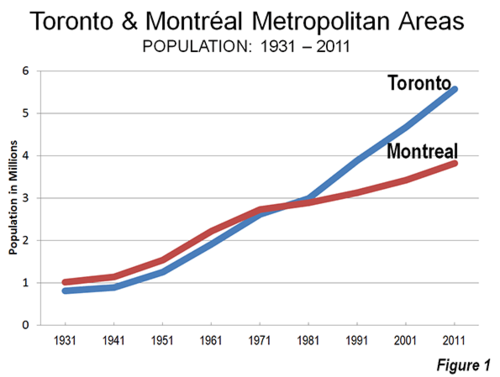
    In the 1970s, multiculturalism finally became a federal mandate and Toronto’s population took off, quickly surpassing that of Montreal. In the end, we were left with the most multicultural city on the planet.

    image

    My best friend’s father – who’s also in the real estate development business – once told me that when he first moved to Toronto in the 1970s the real estate business was virtually run by two groups of people: Italians and Jews. In other words, the people building our city were the people that we were once afraid to let come here in the first place.

    But in their quest for wealth and a better life (I have so much respect for people who are able to build something from nothing), these new Canadians also reshaped Toronto both physically (through building) and socially (by doing crazy things like eat outside on patios). They were not only building new lives for themselves, they were also rebuilding Toronto. They helped us grow up and not be so stuffy. And I absolutely believe that we’re a better city because of it.

    However, I think the true impact of their efforts is happening right now through the next generation – their children. Millennials and Generation Xs (at least the younger ones) don’t remember when Italians were considered aliens. They remember growing up with martini bars on College Street (which is the original Little Italy for those of you unfamiliar with Toronto). They know a different and cooler version of this city.

    But most importantly, those subsequent generations are now old enough (and have a lot more generational wealth behind them) to reshape this city even further. And with much deeper roots here, they have the passion to do just that. When I went to graduate school in the US, my parents were afraid I would never come back. That’s what they told me. But the more I traveled and the more I lived outside of Toronto, the more I wanted to come back.

    Just like those early wave of pioneering aliens who got us to dine al fresco and taught us that if we shop on Sundays we’re not going to go straight to hell, I feel like I too want to shape this city. I want to make it even better. No city is perfect, but if there’s something you don’t like about Toronto, then here’s my advice to you: Go change it. I can tell you it’s possible, because new immigrants with no money managed to do it.

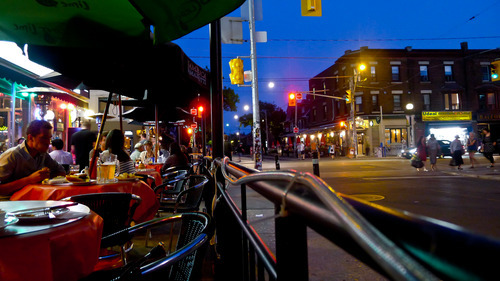
    The first person who can tell me (in the comments below) which restaurant the patio shown above belongs to will get a free Architect This City t-shirt. If you’re from Toronto, this should be an easy one.

    Note: Most of the stats for this post were taken from this great research paper.

    Top Image: Wikipedia

  • Les escaliers de Montréal

    Montreal is one of my favorite places on the planet. In fact, if I have one regret in life it’s that I didn’t do my undergrad at McGill University. Living in Montreal as a poor student would have been the best. Though I shouldn’t complain because I did spend quite a bit of time there when I was a poor student.

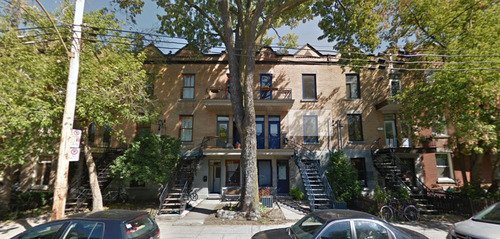
    If you’ve ever been to Montreal, the image at the top of this post will look familiar. The urban landscape of Montreal–at least in the residential areas–is filled with exterior staircases. They’re all over the place. And this always strikes everybody as a bit odd given that it’s a pretty cold and snowy place a lot of the time. Nonetheless, those staircases are quintessentially Montreal.

    Some people think it was done to minimize the amount of interior space that needed to be heated, but I’ve never really gotten a definitive answer. Either way, all those stairs are an interesting byproduct of Montreal’s commitment to one predominant building type: the multiplex. A multiplex is essentially a small apartment building containing a handful of units. They’re usually only around 3 storeys high. And they’re all over the Ville de Montréal.

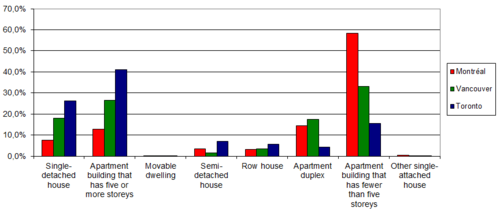
    To be honest though, I don’t think I’ve ever really explicitly thought about this defining Montreal quality. But then last night I stumbled upon an interesting blog post called “Les escaliers de Montréal vs towers of Toronto." (escaliers = stairs) In it the author talks about how Montreal is essentially this city of multiplexes (with stairs everywhere) and Toronto is this, more modern, city of towers surrounded by single family homes.

    And here’s the data to back it up:

    When it comes to single-detached houses and apartment buildings taller than 5 storeys, Toronto dominates. But when it comes to apartment buildings less 5 storeys, it’s all Montreal. And if you add in apartment duplexes, you’ve accounted for almost 75% of Montreal’s housing stock. Note: These figures are for the city proper and don’t include any amalgamated suburbs.

    The author’s explanation for this comes down to zoning and timing. Since Montreal is an older city, the belief is that Montreal was simply further along in its evolution when formal land-use planning came into effect and started to order the city. I generally agree with this hypothesis, but I think it’s also worth keeping in mind that, just because a Toronto house might be zoned as single family, doesn’t mean it’s actually begin used as such.

    A lot of the older houses in Toronto have been subdivided into what are effectively illegal multiplexes. Since this is all happening under the radar, nobody really knows what the actual stock of multiplexes might be. Nonetheless, there’s no denying that there are some real differences between the urban fabric of Montreal and Toronto. 

  • A Third Coast Megaregion

    The distance between Chicago and Quebec City is roughly 1,000 miles (or 1,609 km). There are 6 major cities and a population of over 25 million people. You have the 4th and 5th largest cities in North America (Chicago and Toronto); the largest city in Canada; the capital of Canada; 2 different languages; 2 different countries; and 5 different states/provinces.

    image

    Now imagine if all of these 6 cities—Chicago, Detroit, Toronto, Ottawa, Montreal and Quebec City—were effortlessly connected through a high speed rail network, allowing you to travel from one end to the other in just over 5 hours. How would that impact the movement of people, goods and services across the region? How would it change our economies if you could wake up in Detroit and, without any lead time, travel 1 hour and 15 minutes to Toronto for a meeting?