Daily insights for city builders, delivered every morning at 6 AM ET. I’m Brandon Donnelly — a Toronto-based real estate developer and founder of Globizen. I’ve been writing here since 2013.

Tag: manhattan

  • Invisible walls

    image

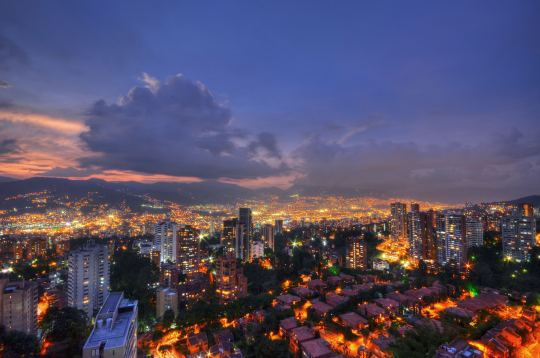
    This is an interesting working paper by a team of researchers at NYU’s Marron Institute of Urban Management. The paper examines the relationship between urban density and organized violence, first in Colombia and then within a sample of 200 global cities.

    The finding is that organized violence actually increases the population density of the surrounding areas within a city because it creates a kind of “invisible wall” – effectively a no-go zone.

    This makes perfect intuitive sense, but it’s not something I ever considered. Geography and other natural constraints typically drive density. Think about the island of Manhattan. But so too can invisible walls.

    For the full working paper, click here.

    Photo by Joel Duncan on Unsplash

  • Toward penthouse amenities and smaller units

    image

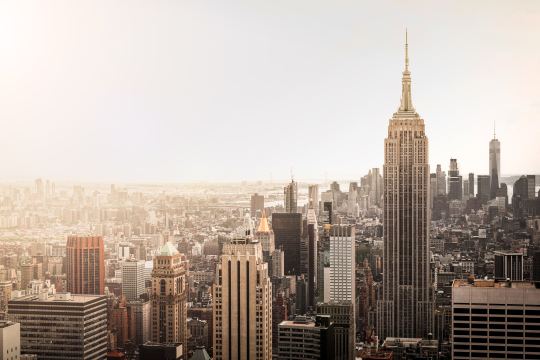
    The NY Times reported this week that, as the ultra luxury real estate market in New York City continues to cool, developers appear to be making two kinds of product adjustments: (1) they are converting the penthouses and rooftops of their buildings from premium residential space into amenity spaces for the broader building and (2) they are shrinking unit sizes to help with overall sales and leasing velocity.

    According to the New York Times, condo prices on Billionaires’ Row in midtown are down 20-40% since the peak of the market in 2014 when this record was set. So developers are responding with more studios and 1 bedrooms, and amenity spaces – many of which now include high end restaurants also open to the public – that ensure no other building has something you don’t have.

    However, there are naturally some differences between condo and rental buildings. Since 2016, 35% of rentals projects in the city have had some sort of penthouse amenity, whereas the number is only 13% for condo buildings. This makes sense given that amenities are such a big driver of leasing. You definitely want your amenities ready for when your leasing office opens.

    What product changes, if any, are you seeing in your market right now?

    Photo by Aaron Burson on Unsplash

  • Airbnb and affordable housing

    image

    Fred Wilson published a good post last weekend on the proposed bill that went to New York City Council this week regarding new reporting requirements for Airbnb and their hosts in NYC. You can read more about his position on his blog, but he is in favor of a comprehensive bill that would properly legitimize short-term rentals. He is also not opposed to city and state taxes on the service.

    What I wanted to focus on today were his comments around housing. This is already sounding like a broken record, but Fred draws attention to the severe supply-demand imbalance that is occurring in the boroughs of Brooklyn, Queens, and the Bronx, precisely because many/most young people were priced out of Manhattan long ago and want to live in these places.

    But I particularly like his comments around what makes for good policy and what makes for good politics. I agree with his view that it is often a case of the latter over the former. I think a lot of the excitement around Airbnb is a red herring. For me, it’s akin to the fixation on foreign buyers and their impact on the local housing market in places like Toronto and Vancouver.

    Yes, they are factors. But the data suggests they are marginal ones. As Fred points out, they are almost certainly not the root cause of the problem. The reality is that we need a lot more housing – both market-rate housing and subsidized housing. The challenge is that nobody wants to pay for the latter and so we’ve instead decided to focus on things that sound like they’re going to help.

    Photo by Jon Tyson on Unsplash

  • How New York City became boring

    image

    On the cover of the July 2018 issue of Harper’s Magazine is a picture of New York City – with Rafael Viñoly’s 432 Park Avenue as the focal point – and the title: Death of a Great American City. New York and the Urban Crisis of Affluence.

    The long-form article is by Kevin Baker and it is an account of how New York City has transformed itself over the past few decades from a place of culture and character (and of cockroaches and discarded crack vials) into a place for the ultra-wealthy to buy ultra-luxury real estate that may or may not sit empty for more often than it is occupied.

    “As New York enters the third decade of the twenty-first century, it is in imminent danger of becoming something it has never been before: unremarkable. It is approaching a state where it is no longer a significant cultural entity but the world’s largest gated community, with a few cupcake shops here and there. For the first time in its history, New York is, well, boring.”

    This narrative and/or phenomenon is of course not unique to New York City, though it is surely more pronounced when you are one of, if not the, preeminent global city. In fact, I was sent this article by a reader who was wondering about the possible parallels here in Toronto. Thank you Natasha.

    The desire, which is how Baker ends his article, is that New York City should be a city of “workers and eccentrics” as well as “visionaries and billionaires.” It should be a place for “street photographers” and “hedge fund operators.” That sounds like a pretty cool place to me.

    But we all know how challenging this has proven to be for cities.

    Photo by Dean Rose on Unsplash

  • Percentage of residential properties dedicated to single-family housing in US cities

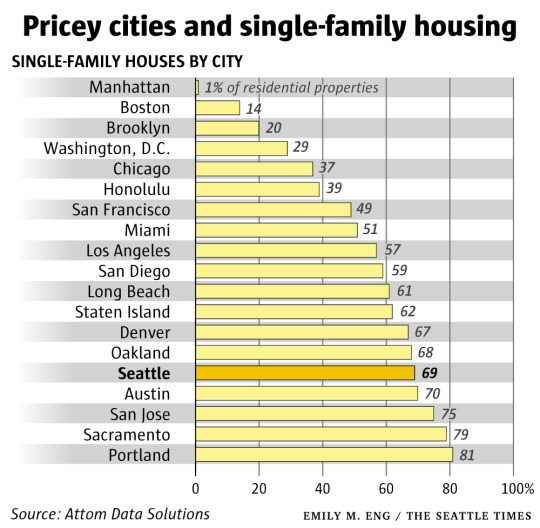
    The Seattle Times has an article up about “widespread single-family zoning” that will feel familiar to many here in Toronto who, I know, are having similar conversations about the amount of land dedicated to low-density housing.

    The article, by Mike Rosenberg, estimates that 49% of all developable land in Seattle is dedicated to single-family housing; that 8% is dedicated to multi-family housing; and that another 8% is dedicated to commercial and mixed-use buildings. The rest of the land is institutional, open space, vacant, and so on.

    Of all the residential lots in the city, the estimate is that 69% of them are occupied by single-family houses. This is compared to 1% in Manhattan. 

    I tried to reverse engineer the 69% based on the land use areas in the article, but the math didn’t quite add up. In any event, the argument here is, of course, that single-family homes are too expensive in Seattle and that the city needs more land available for multi-family housing.

    Housing supply is no doubt important, but looking at the above chart, having a low, or lower, percentage of residential land dedicated to single-family housing doesn’t seem to necessarily guarantee affordable housing.

  • What’s Manhattan worth?

    I like looking at real estate values over longer periods of time because it helps to put things into perspective. 

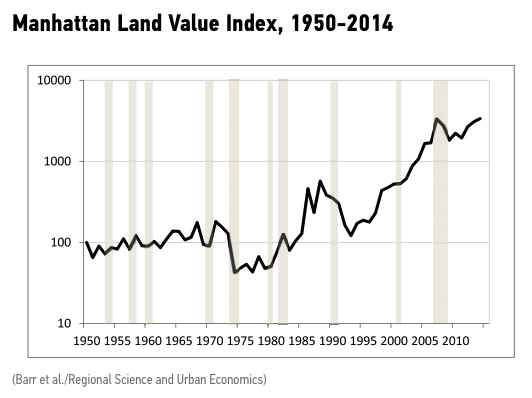
    Below is a land value index for Manhattan running from 1950 to 2014 that was recently created by economists out of Rutgers University.

    image

    The study was also cited in this recent article by Richard Florida.

    Here are some of the highlights from their study:

    We find three major cycles with land values reaching their nadir in 1977, just after the city’s fiscal crisis.

    Since 1993, land prices have risen much faster than population or employment, at an average annual rate of 15.8%.

    We estimate the entire amount of developable land on Manhattan in 2014 was worth approximately $1.74 trillion.

    We estimate the long run return to Manhattan land values [since the island was first inhabited by Dutch settlers in 1626] to be about 6.4%.

    What’s fascinating to me is the accelerated appreciation. The index starts at 100 in 1950, ends up slightly above that by 1993, and then simply takes off.

  • Manhattan apartment rents post biggest decline since 2011

    A friend of mine sent me this article earlier today with a sarcastic comment about the relationship between housing supply and rents.

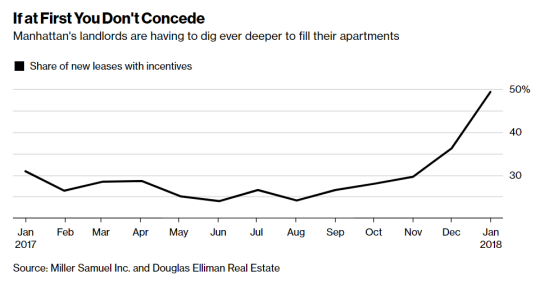
    The article talks about how rents in almost every Manhattan neighborhood have fallen compared to a year ago because of a flood of new apartment supply coming online. The median rent dropped 3.6% (year-over-year) which is the biggest decline since October 2011.

    image

    There has also been a spike in the number of leases with some sort of incentive attached to it (see above). As a landlord you typically want to use incentives, such as free rent, before resorting to lower face rents. Because lower rents mean a lower overall net operating income, which in turns depresses the value of your property.

    But sometimes you have no choice:

    “Landlords have finally realized, ‘OK, we have to adjust these prices because the concessions aren’t doing as much,’” said Hal Gavzie, who oversees leasing for Douglas Elliman. “Customers are looking past the concessions being offered and just looking for the best deals they can find.”

    A few weeks ago I wrote about a similar story playing out in Seattle. It’s almost as if excess housing supply is driving down rents.

  • An even longer view on home prices — this time in Amsterdam

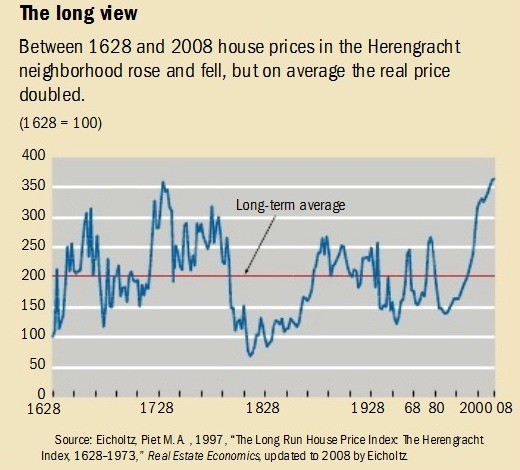
    In the comments of my recent post about Manhattan real estate prices during the Great Depression, a regular reader of this blog shared this terrific blog post (and corresponding research paper by Piet Eichholtz) about house prices along the Herengracht canal in Amsterdam from 1628 to 1973. Later it was updated to include up to 2008. It’s a long run house price index.

    Probably the first thing you’ll notice is that the index is highly volatile. Amsterdam enters its Golden Age, creates the world’s first stock exchange, and becomes the wealthiest city in the western world – house prices go way up. The tulip mania bubble pops – house prices go way down. It’s not until after World War II that prices sort of start to stabilize and increase, maybe, more consistently.

    In nominal dollars, the house price index increases 10x over the study period. But in real dollars most of that disappears. The biennial increase (that’s how the study was done) over the same period of time is just 0.5%. That translates into a doubling of house prices, which may seem quite good, except that remember it’s over a 380 year time period.

    image

    The Herengracht canal is a particularly good study because it was and has remained (or so I’m told) a desirable part of Amsterdam. This is an attempt to control for the variable that maybe some of the volatility could be explained by the area simply falling out of favor. (As a quick sidebar, the Herengracht was one of the first canals laid and dug out around the original city center of medieval Amsterdam during its Golden Age.)

    Generally, this finding is in line with one that economist Robert J. Shiller famously published a number of years ago where he argued that, when you correct for inflation, home prices actually look remarkably stable over long-run forecasts. In one study, he looked at 100 years of US home prices ending in 1990. Real home prices increased about 0.2% a year. What an outstanding hedge against inflation.

  • Manhattan real estate prices during the Great Depression

    image

    I was searching around trying to find data on long-term real estate prices and I came across a paper by Tom Nicholas and Anna Scherbina called, Real Estate Prices During the Roaring Twenties and the Great Depression.

    Here are some stats about Manhattan real estate (from the paper) that you all might find interesting:

    – In 1930, Manhattan housed 1.5% of the US population, but had approximately 4% of all US real estate wealth.

    – To construct their price indices the authors randomly collected 30 real estate transactions per month in Manhattan between 1920 and 1939. The mean price per square foot in 1929 was $6.91 (year of Black Tuesday). And the mean price per square foot in 1939 – 10 years later – was $2.29.

    – Buildings containing a store at grade tended to sell at higher prices. The authors speculate that this could be because a zoning change in 1916 made it difficult to open stores in “residential” areas.

    – Buildings with three, four and five storeys tended to sell at a discount. Six storeys or higher and the buildings generally had an elevator, which resulted in higher pricing.

    – Manhattan real estate prices reached their highest level in Q3-1929 before falling 67% by 1932. Prices remained more or less flat during the Great Depression.

    – If you bought a “typical property” in 1920, it would have retained only 56% of its value (in nominal dollars) by 1939. In fact, it took until 1960 for assessed property values in Manhattan to exceed their pre-Depression pricing.

    – An investment in the stock market index during this same time period, 1920-1939, would have outperformed real estate by a factor of 5.2x.

    Much of this probably seems hard to believe given the market today. Imagine waiting 40 years for the value of your property to come back.

    Photo by jesse orrico on Unsplash

  • How to revive the American Heartland

    “Every unemployed American is a failure of entrepreneurial imagination.” -Edward Glaeser

    At the end of September, economist Edward Glaeser returned to the Manhattan Institute to deliver the 2017 James Q. Wilson Lecture. If you’re a regular reader of this blog, you may remember that he was there in 2016 and delivered a presentation called “The End of Work.” 

    This year’s talk continues that theme, but focuses on joblessness and economic stagnation in the US Heartland. 

    The solutions he puts forward are based on a very simple economic model for growth that he refers to as “rules and schools.” Simply put: The rules of a place need to support business and entrepreneurship and the people need to be educated.

    One example he gives is of a woman in Detroit who was trying to start a food truck business but had to wait 18 months for a permit. There’s no reason that should happen. He blames the insider restaurant lobby for working to keep competition at bay. The rules are bad. We have similar problems here in Toronto with our food trucks. I think it’s wrong.

    He also pokes fun at the Bilbao effect. Yes, Frank Gehry created a beautiful piece of architecture. But did it lower the unemployment rate?

    The last thing I’ll mention are his comments regarding Amazon HQ2 because I like how he frames it. 

    Firstly, Amazon is going select a city that doesn’t need Amazon. It’s going to go where there’s already abundant human capital. 

    Secondly, “smokestack chasing” is not the right economic development strategy. The key questions should be: How will this benefit our human capital and how many new firms could it create?

    If you have an hour, check out Ed Glaeser’s talk. If you can’t see it below, click here.

    [youtube https://www.youtube.com/watch?v=e8LvHpRCUYk?rel=0&w=560&h=315]