Daily insights for city builders, delivered every morning at 6 AM ET. I’m Brandon Donnelly — a Toronto-based real estate developer and founder of Globizen. I’ve been writing here since 2013.

Tag: los angeles

  • North America’s second city?

    image

    Over the weekend Richard Florida sent out a tweetstorm that compared Toronto and New York City, and made the argument that Toronto’s “incredible diversity, density, and industry mix” is making the city feel a lot more like New York and London compared to any other North American city. 

    He even went so far as to say that, even though it may not be the bigger metro in terms of raw population, Toronto increasingly feels like North America’s second city after NYC. I’m obviously incredibly biased in this discussion, so I would be curious to get your thoughts in the comment section below.

    If you can’t see the embedded tweetstorm below, click here. Regardless, you’ll likely need to click through to see the entire thread.

    //platform.twitter.com/widgets.js

  • International and domestic migration in the US

    In response to President Trump’s proposed immigration bill, Brookings recently analyzed census data from earlier this year to demonstrate the importance of immigration for growth within much of the United States. 

    I’d like to share three tables from their analysis.

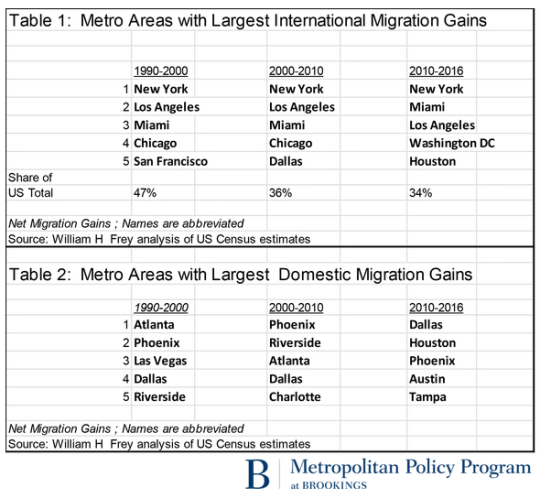
    The first two look at international migration grains and domestic migration gains over the last 3 decades (the last decade isn’t quite a decade).

    Here you can see that New York, Los Angeles, and Miami (all port cities) have dominated international migration to the US since 1990. But at the same time, international migration has become less geographically concentrated. From 1990-2000 the top 5 cities received almost half of all immigrants moving to the US. More recently, that number has dropped to 34%.

    Domestic migration is different in that it’s a zero sum game. When one US city gains, another US city loses. Here there is a very clear migration trend toward cities in the southwest – arguably because of weather, job growth, cheaper housing, and probably a bunch of other factors.

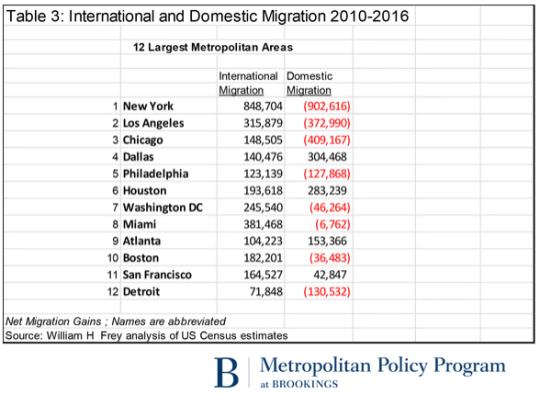
    If we look at actual international and domestic migration numbers over the last 6 years, the 12 largest metropolitan areas look like this:

    The key takeaways here are that 8 of these cities are losing people to domestic migration and only 7 of these cities have a positive net migration number – meaning their population is actually growing.

    What is clear is that the international migration column is a pretty important one if you believe that growth is valuable. 

    If you’re Dallas, Houston or Atlanta, maybe you care a little less about that column. But for most of the other cities, international migration is either the only way you’re growing (look at Miami go) or keeping your population losses in check (see Philadelphia).

  • Less is more

    The Wall Street Journal recently asked: Venice Beach Is a Hot Place to Live, So Why Is Its Housing Supply Shrinking? 

    According to Issi Romem, chief economist at BuildZoom, it’s because Venice Beach is the toughest place in America to build housing.

    Here are some numbers from the WSJ:

    “The Venice Beach population is shrinking even as the local economy has boomed. The neighborhood had about 27,000 residents in 2015, about 3,800 fewer than in 2000, according to U.S. Census data. At the same time, the ZIP Code has added 4,000 new jobs, according to Jed Kolko, chief economist at employment website Indeed.”

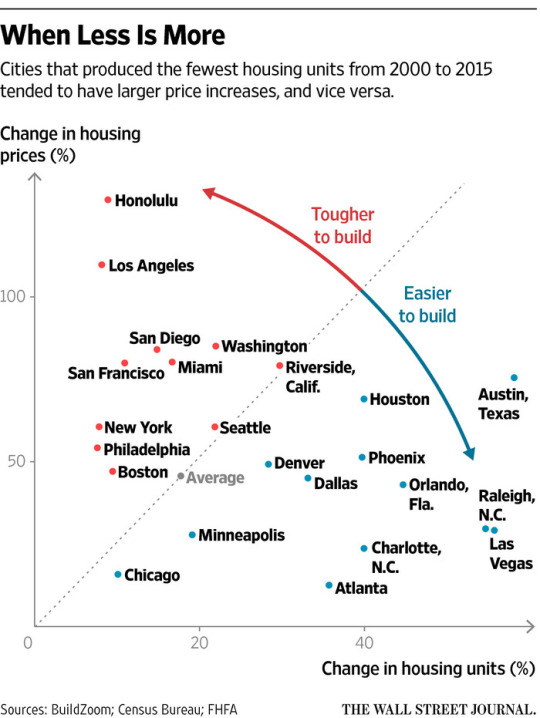
    And here is a chart that speaks to the relationship between housing prices and housing supply:

    Housing supply, alone, isn’t going to solve all of our problems. But it certainly matters. Also, what’s up with Chicago?

  • Neon rooftops of LA

    I am absolutely obsessed with the below video by Drew Ganyer called Neon Rooftops of LA. If you can’t see the embedded video, click here.

    [vimeo 158929583 w=640 h=360]

    The story is that Gayner was playing around with his new drone at a friend’s apartment next to “The Embassy” sign. This peaked his interest and so he went searching for more of these signs. This brought him to PublicArtInLA.com, which provides a comprehensive list of “buildings with historic neon signs” in the Los Angeles area.

    And so a movie was born.

    I’ll end with the below snippet from the opening paragraph of Public Art In LA. I don’t know about you, but I love these signs. I think they really do give rise to the magic of the night.

    “Sometimes, urban renewal can be as simple as the relighting of a neon sign on Wilshire, Hollywood or Sunset boulevard, lights that recover the past and point to an equally bright urban future. Remnants of a lost Los Angeles, city of the mind, remembered and yearned for, the neon lights of L.A.–celestial fires of another sort, green, gold, ruby red, electric blue–guide us down the Wilshire corridor, up through Hollywood and out along Sunset Boulevard west. If Paris is the City of Lights, L.A. is the City of Neon, possessed of a comparable (yet antithetical) beauty and capable as well, like all great cities, of giving rise in the magic of the night to hungers of body, mind and spirit.” (Kevin Starr, “Landscape Electric; A program that renews the city’s urban spirit by relighting Philip Marlowe’s neon L.A.” Los Angeles Times, July 4, 1999. 

  • What’s happening in Melbourne?

    image

    I’ve never been to Australia, so take everything I’m about to say in this post for what it’s worth. I also don’t know much about Sydney and Melbourne, other than the fact that I’ve studied the latter’s laneways and the tremendous impact they’ve had on revitalizing the CBD.

    However, recently I’ve had a few close friends visit these cities for the first time and, since then, I have started noticing a trend. All of them come back and tell me the same thing, that they prefer Melbourne to Sydney. They say: “Yeah, Sydney is nice and beautiful and all, but it’s not all that exciting. Melbourne feels way more dynamic. Oh, and have you seen their laneways? You would love them.” That’s what they tell me.

    So that’s what I have in my head when I read that Melbourne is now the fastest growing city in Australia; that it’s one of the most liveable cities in the world; and that by as early as 2031 it could take Sydney’s place as the biggest city in the country. Below is a chart from The Australian. If you can’t see it, click here.

    //platform.twitter.com/widgets.js

    Some argue that this is happening because housing is cheaper in Melbourne (median dwelling price of ~$700,000 versus ~$1 million). And some argue it’s because the jobs are there and the city has become a cultural and sporting destination. Whatever the case may be, net migration is estimated to be somewhere around 100,000 people per year.

    My own view – and I’ve made this argument before on the blog – is that we shouldn’t underestimate the importance of cool shit when it comes to cities. People vote with their feet more than ever today. And for a growing segment of the population, cities are a consumer good.

    Indeed, in 2001, Edward Glaeser, Jed Kolko, and Albert Saiz penned a research paper called the Consumer city, where they argued precisely that. The premise was that historically we have tended to think of cities as being centers of production, but we should also be thinking about them as places of consumption.

    Here’s an excerpt:

    “But we believe that too little attention has been paid to the role of cities as centers of consumption. In the next century, as human beings continue to get richer, quality of life will become increasingly critical in determining the attractiveness of particular areas. After all, choosing a pleasant place to live is among the most natural ways to spend one’s money.”

    This is why those coffee shops and cool laneways matter. Some cities have unfair natural advantages. Los Angeles has weather. Vancouver has mountains. Montreal has poutine. But for the rest of us, the amenities typically form part of the built environment. They are a product of our choices.

  • How I built this

    My friend Dan just introduced me to a terrific podcast called, How I Built This. It’s all about “innovators, entrepreneurs, and idealists, and the stories behind the movements they built.” As soon as he told me about it I immediately pulled out my phone and hit subscribe.

    You will recognize many of the brands and entrepreneurs featured on this podcast. The companies span everything from Whole Foods and the Corcoran Group (real estate) to Kate Spade and Instagram.

    I’m not that up on podcasts. I think it’s because I don’t really drive that often and I don’t have much of a commute. Podcasts are great when you’re sitting in traffic, which is something people here in LA obviously do a lot of.

    But I’m going to make time to listen to this one. I have so much respect for anyone who has built something from nothing. Building and creating is what moves us forward.

  • The most Instagrammed wall in Los Angeles

    So it turns out that what may be missing from your city is just a bright candy pink wall.

    I was walking along a stretch of Melrose Avenue today that didn’t seem to have all that much going on. But then I came across a bright pink building with a subtle Paul Smith emblem near the top corner. I like Paul Smith and so I decided to pop in.

    But as I turned the corner, I was greeted by throngs of millennials all posing for photos along the building’s west face (read: lots of afternoon sun). Here’s a snap of what that looked like:

    Once inside, I was quickly told that the pink wall is the most Instagrammed location in all of Los Angeles. I’m not sure that’s factually true, but I’m going to say it’s up there. A quick review of #pinkwall seems to suggest that.

    What I find interesting is the simplicity of it all. It’s a pink wall. And people love it. If you believe that we are now living in an attention economy, then perhaps you ought to find or create your own version of a candy pink wall.

  • One of the most expensive neighborhoods in LA

    image

    Oftentimes when I visit a city I like to ask myself: Which neighborhood would I want to live in if I were to move here?

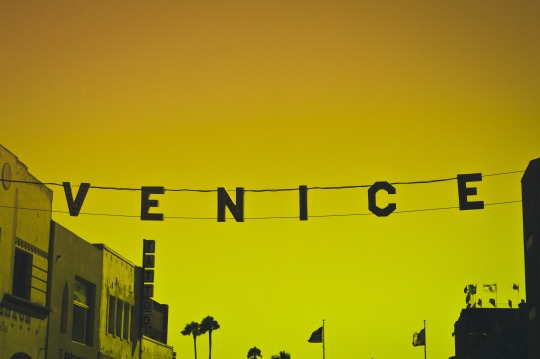
    Today I spent much of the afternoon hanging around Venice. After we got there, I told my friend that if I moved to LA, I would probably want to live there. I told him that, relative to the rest of the city, I liked the compressed scale of the neighborhood. There are many pedestrian-only lanes and streets beyond the boardwalk. And I told him that I thought it was interesting how the neighborhood seems to combine both bohemians and yuppies (though many people seem to hate the yuppy part).

    But I’m obviously not alone in my thinking. My friend quickly informed me that Venice is one of the most expensive neighborhoods in LA and that it’s been adding essentially no new housing supply. Here’s an excerpt from an LA Weekly article published at the beginning of this year:

    Anti-development activists like to argue that development fuels gentrification, that the construction of new, high-end apartment buildings makes the whole neighborhood more expensive.

    But the case of Venice is a counterpoint. For the last 50 years, Venice has successfully fought developers to a stalemate. The housing supply stayed constant, while demand grew. As a result, the value of property in Venice has soared.

    In 1996, according to data provided by Zillow, the average home value in Venice was $251,000 — more expensive than Silver Lake and Encino but cheaper than Westwood, Studio City, Mid-Wilshire and Los Feliz. Today, Venice’s average home value is nearly $1.6 million, more expensive than all of those neighborhoods — more expensive, in fact, than its historically tony neighbor to the north, the city of Santa Monica, which, according to Alvarez’s research, added more than 10,000 dwelling units between 1960 and 2010.

    Perhaps I should give this some more thought.

  • Hey Los Angeles

    Los Angeles is a city that I have been indoctrinated to dislike. It sprawls and it’s car-oriented. But every time I visit I think to myself: This place is awesome.

    I’m going to be in LA and Palm Springs this weekend catching up with a good friend, looking at architecture, taking photos, and escaping spring allergy season. 

    I don’t know the city very well, so if any of you have recommendations for things I need to see or do, I would love to hear from you in the comment section below.

    Also, if you’re in town and you think we should meet about design, real estate, startups, photography or something else, definitely drop me a line.

  • Where the cranes are

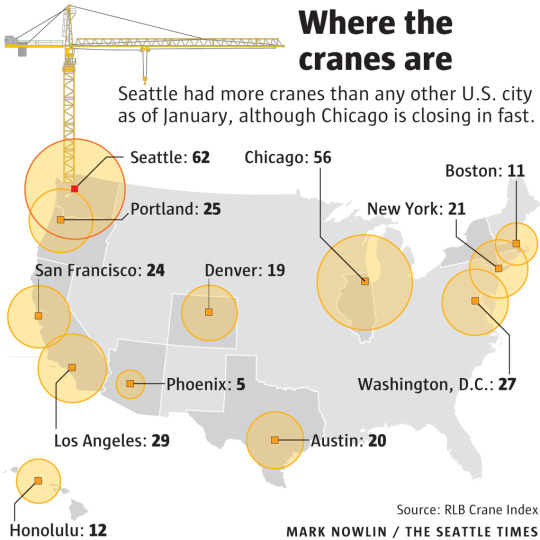
    Earlier this week the Seattle Times published the following graphic showing the US cities with the most (construction) cranes up in the air at the end of 2016:

    At the top of the list is Seattle with 62. And in second place is Chicago with 56. 

    You really need to see these numbers over time to get a better sense of activity. But supposedly, Seattle has been holding pretty steady. Also, these numbers only include cranes within each city proper. The suburbs don’t seem to be counted.

    To put these numbers into perspective, here’s a snippet from the article:

    “Seattle remains behind Toronto, which has 81 cranes, for the North American lead. In Australia, the Middle East, and elsewhere, there are cities where more than 100 cranes are at work.”

    I wonder which city has the global lead. Any guesses?