Daily insights for city builders, delivered every morning at 6 AM ET. I’m Brandon Donnelly — a Toronto-based real estate developer and founder of Globizen. I’ve been writing here since 2013.

Tag: los angeles

  • Less, rather than more, housing

    Earlier this year I wrote about the California housing bill (827) intended to dramatically increase housing supply around transit stations all across the state. Well that bill was rejected last month and the Los Angeles Times wrote this post post-mortem explaining why and how it went wrong. Their argument is that it came down to opposition from low-income residents who feared that an increase in housing supply would lead to greater displacement.

    On a related note, the Official Plan Amendment and Zoning By-law Amendment that would permit laneway suites in Toronto went to Community Council this week. They voted to defer the decision for a month. Only 3 of 13 councillors voted to pass the proposal, despite there being 185 letters of support and only 4 letters of opposition. For more information on what the hell happened, check out this Lanescape post.

  • Studio Gang’s first project in Los Angeles

    This past week Studio Gang unveiled its first project in Los Angeles, a curvaceous apartment (300 rental units) and hotel (149 rooms) tower in Chinatown.

    The developer is Paris-based Compagnie de Phalsbourg and the hotel component is expected to be operated by the European brand, MOB Hotel.

    Above is the only rendering I could find. If you would like to read a bit more about the project, check out Curbed LA.

    Image: Studio Gang

  • Top US metro areas for VC investment

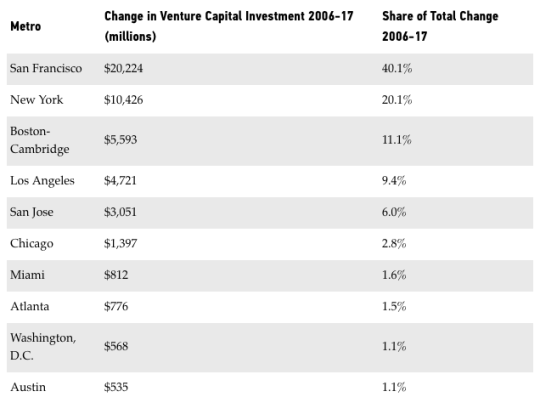
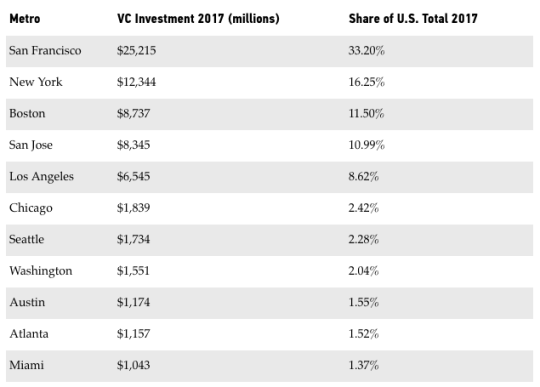
    Below is a list of the US metro areas that saw a billion dollars or more in venture capital investment last year (2017). It is taken from a recent CityLab article by Richard Florida where he talks about the “geographic inequality of high-tech venture capital.”

    image

    It’s worth noting that San Francisco – not San Jose (Silicon Valley) – is at the top of the list with nearly 1/3 of the US total last year. It’s also interesting to note that when you look at each metro’s share of the total change from 2006-2017 (the chart below), you get Los Angeles now punching above San Jose. 

    image

    Florida also gets into which economic and demographic variables seem to be associated with higher levels of venture capital investment. For the rest of the article, click here

  • The most popular building amenities (according to a small subset of people)

    Here are the results from my primitive multi-unit building amenities survey:

    Gym is number 1. No surprise there. 46% of respondents said it was in their top 3. 

    Rooftop outdoor space at number 2 was perhaps a bit surprising. But then again, who doesn’t love a good rooftop patio?

    As for concierge service, I tend to think this was driven by package delivery. That’s certainly the biggest value add for me.

    One standout near the top, for me at least, is co-working space. Andrew LeFleur made mention of this on Twitter and I think he’s right: The changing nature of work is making these spaces more valuable in multi-family dwellings.

    And now some color on the above results.

    436 amenity selections were made as part of this survey. 

    About half of the respondents were from the Greater Toronto Area, followed by Calgary, San Francisco, Ottawa, Boston, New York City, Denver, Los Angeles, Paris, Miami, and many other cities. Shoutout to whoever responded from Kuala Lumpur and Porto Alegre.

    In terms of “Other” amenities, there were suggestions for a band rehearsal space, a vending machine, a grassy area for sports, and programming the helps you meet your neighbors.

    In terms of this one last, it can be tricky for condo buildings. Developers only provide the space. It’s then up to management. But I’ve seen it done very well in rental buildings.

    Are you surprised by any of the results from this survey?

  • “I hate golf”

    I am a big fan of Malcolm Gladwell, and not just because he’s Canadian and went to the University of Toronto (my alma mater), although those facts certainly don’t hurt.

    I’m late to his podcast, Revisionist History, so in case some of you are as well, I would encourage you to check it out. Every episode reexamines something from the past and questions: Did we get it right the first time? It’s very Gladwell. It’s a must listen.

    The episodes span a secret research project setup by the Pentagon in downtown Saigon during the Vietnam War to why rich people are obsessed with the game of golf. Spoiler: He hates golf.

    The golf episode will be of particular interest to many of you because it deals with real estate. Malcolm wades into something known as California Proposition 13, which is a constitutional exemption that keeps property taxes artificially low.

    It is what has allowed these “vast, gorgeous, and private” golf courses to continue to exist in expensive cities like Los Angeles. Otherwise they would have long ago drowned under the property taxes following reassessment.

    This also leads to a philosophical debate about what constitutes a change in ownership, since many clubs are member owned and Proposition 13 requires that there not be a change in more than 50% of the ownership. 

    But I’ll stop there. Give it a listen. Malcolm is just excellent.

    Photo by Rémi Müller on Unsplash

  • Last-mile electric scooters — will they work?

    I’ve been hearing a lot about Bird recently. Perhaps it has something to do with the $15 million Series A round they raised last month (February 2018) and the $100 million Series B round they announced earlier today.

    A “Bird” is small electric scooters that look like this and can be rented from your phone for short haul trips. They are currently available in Santa Monica, Venice, UCLA, Westwood, and San Diego, and they are intended to be ridden in existing bike lanes.

    What may be particularly interesting to this blog audience is the fact that Bird is calling itself a “last-mile electric vehicle sharing company.” The pitch: 40% of car trips (in the US?) are less than 2 miles long. Let’s replace those using electric scooters.

    One of the first things that came to my mind is that this feels more accessible than cycling. Cycling to work can be a commitment. You have to think about your attire and the sweat factor, among other things.

    Would you agree?

  • Los Angeles Councilman says upzoning near transit is the worst idea he’s ever heard

    Earlier this month I wrote about California Senator Scott Wiener’s bill to increase housing supply and mandate greater land-use intensities adjacent to transit. Here is that post.

    Judging by the comments, many of you seemed to think this was a fairly sensible proposal. I know I certainly did. Senator Wiener called it a housing-first agenda, as opposed to a housing-last agenda.

    So I thought it would be interesting to share how some people have responded to the proposal. 

    Los Angeles City Councilman Paul Koretz called it both “devastating” and “the worst idea [he’s] ever heard.” He went on to tell the LA Times that, within 10 years, people should expect their neighborhoods to be transformed into Dubai. 

    His conclusion: “I don’t think people want to see significant rezoning around single-family neighborhoods whether they’re near transit or not.”

    I don’t agree with his first set of remarks, but I agree with his second one. And that, of course, is the challenge. If you own a single-family home down the street from transit, what great incentive do you have to support intensification?

    Paul is the messenger.

  • Where the young and educated are moving to in the US

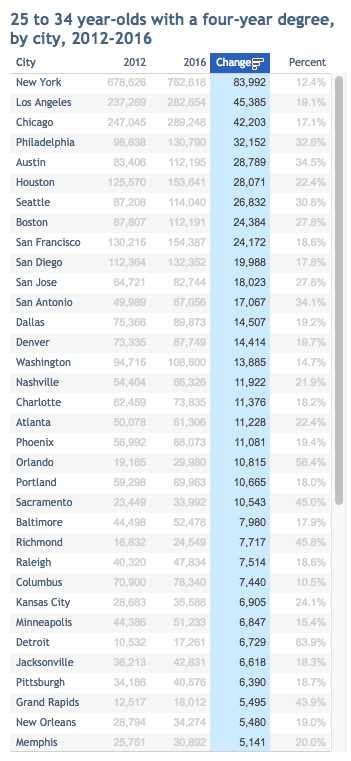
    City Observatory tracks something that they call “The Young and Restless.” It refers to the segment of the US population that is between 25-34 years old and has a bachelor’s degree or higher.

    We know that people in this age bracket tend to be relatively mobile and that the likelihood of moving decreases as people age. So it’s a potential leading indicator for the city regions of the future. It also adds a bit more nuance to the urban vs. suburban growth debate. 

    According to City Observatory, between 2012 and 2016 the number of 25 to 34 year olds with a 4-year degree living in one of the 53 largest largest cities in the US increased by 19%. This is compared to a 4% increase in the overall population in these cities.

    This increase in young well-educated adults is also happening 50% faster in the largest cities. So the young and educated still seem to be demanding city living, even if the world is arguably still suburbanizing.

    Below is a snapshot of City Observatory’s latest data. I’ve sorted the list by total change in population (2012 to 2016). Happy to see Philadelphia near the top. If you do it based on percentage, Detroit wins with a 64% increase.

    For the full list of cities, check out City Observatory.

  • Land use restrictions and upward mobility

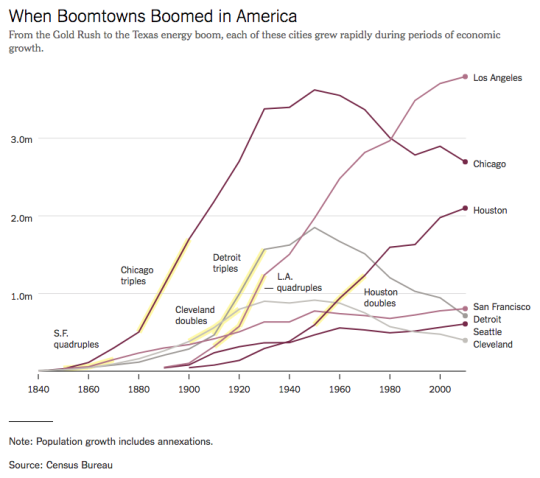
    Throughout US history, economic growth has typically spurred an “enormous reallocation of population.” Here is a graph from a recent New York Times article called: What Happened to the American Boomtown?

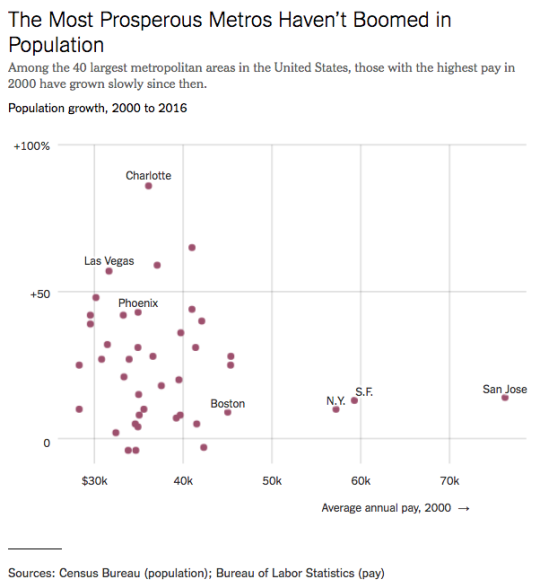
    The argument, here, is that restrictions on development have made it so that the most prosperous cities are actually the slowest growing cities in terms of population. Here is a chart, from the same article, comparing population growth to average annual pay:

    And here is an excerpt:

    But these productive places aren’t growing as fast now as economists believe they should — and as they would if they didn’t impose so many obstacles on new development. Since the 1970s, land use restrictions have multiplied in coastal metros, making it harder to build in, say, San Jose, Calif., than in Phoenix. And the politics of development have become tense, too. In the Boston suburbs, the Bay Area, Brooklyn and Washington, people who already live there have balked at new housing for people who don’t.

    We often talk about the impact of land use restrictions on supply and overall housing affordability. But here is an argument that it could also be impacting upward mobility.

  • Aerial photographs of LA and NY

    I like the built form aerial photography of Jeffrey Milstein. Here is one of Stuyvesant Town in New York City:

    It shows a symmetrical plan view that followed a particular dogma at the time.  But it’s also a view that few people or residents would ever see or appreciate.

    The above image is from his exhibition at the Bau-Xi Gallery here in Toronto (340 Dundas Street West). It runs until December 16, 2017.

    On January 25, 2018, the exhibition moves to the Benrubi Gallery in New York City (521 W. 26th Street). Check them out if you’re interested.